Do you follow the vehicle manufacturers recommended specs for air pressure?

The only reason the vehicle mfg spec is used is for solely out of liability. It saves a tire distributor lots of headache in potential lawsuits.

Don't forget, the vehicle manufacturer operates in the same legal environment. Comfort is no doubt considered in the final psi spec, but handling too, and there's no way, after Ford/Firestone, they would let the load and speed reserve (safety reserve) shrink too far in the name of comfort.
 
I hear what you're saying, Mike, however when you have two tires of the same size but different mfg's you can (and will) have vastly different performance outcomes even when running the same pressures and that is only because of how the mfg chooses to contruct their tire. This has nothing at all to do with the vehicle weight whatsoever.

(BTW; when I say "performance" I don't necessarily mean racing. I mean the entire picture, contact patch, chassis feedback, fuel mileage, hell, even braking is affected)
 
I hear what you're saying, Mike, however when you have two tires of the same size but different mfg's you can (and will) have vastly different performance outcomes even when running the same pressures and that is only because of how the mfg chooses to contruct their tire. This has nothing at all to do with the vehicle weight whatsoever.

Performance is one thing....tire pressure is something different.

Tire manufacturers may design their tire to not put the same foot-print on the as another manufacturer. If so the tire with the smaller foot-print will have a higher tire pressure setting.

This is PHYSICS...Although some people claim it...laws of physics CAN'T BE BROKEN.
 
Guys this is easy to resolve all you need is chalk and a parking lot. You should chalk a line on the tire and then drive forward to see what chalk is removed. You want the foot print to be uniform so add or remove presure to get the uniform chalk print. That is your tire pressure.

We do this all the time for road racing.
 
Guys this is easy to resolve all you need is chalk and a parking lot. You should chalk a line on the tire and then drive forward to see what chalk is removed. You want the foot print to be uniform so add or remove presure to get the uniform chalk print. That is your tire pressure.

We do this all the time for road racing.

Exactly what I'm saying....
 
If so the tire with the smaller foot-print will have a higher tire pressure setting.

This statement is just not true and it has very little to do with proving or disproving physics. There are other factors at play with how much tire is making contact and there is no absolute in the contact area provided between tire mfg's.
 
Just my 2 cents...I got my 255/75's and they were really loose on the freeway at 32psi. Like the sidewall was not super strong. Bumped it up to 40 and handling is way better (max is 55 btw). So the size of tire makes a difference and I would say with a taller sidewall a little extra air to get the same stock rigidity is nice.
 
Through the years of trying different pressures I've come to the conclusion 40 psi works the best.

Koz
 
This statement is just not true and it has very little to do with proving or disproving physics.

Sorry that statement is 100% true. For the same weight vehicle....the tire with the smaller footprint will have a higher tire pressure rating...

There are other factors at play with how much tire is making contact and there is no absolute in the contact area provided between tire mfg's.

The more air you put in the LESS tire footprint you have. Each manufacturer MAY design a tire to have an optimum footprint...but that footprint difference between tire manufacturers is extremely small (as long as you're comparing the same size tires). The difference in footprint between manufacturers will make at most 1lb difference in air pressure.
 
Guys this is easy to resolve all you need is chalk and a parking lot. You should chalk a line on the tire and then drive forward to see what chalk is removed. You want the foot print to be uniform so add or remove presure to get the uniform chalk print. That is your tire pressure

This is the best way to find the right pressure
 
Guys this is easy to resolve all you need is chalk and a parking lot. You should chalk a line on the tire and then drive forward to see what chalk is removed. You want the foot print to be uniform so add or remove presure to get the uniform chalk print. That is your tire pressure

This is the best way to find the right pressure

We did a similar test my college physics class. We measured the weight of a car by figuring out it's footprint (at each wheel). Then measured the tire pressure at each wheel.

Weight = PSI x Footprint.

We then took the weight we calculated from each wheel and added it up to get the total weight of the car. If you take your time measuring...this can be a very accurate way of measuring the weight of the vehicle.
 
I run 35psi all around, all seasons in the LTX M&S 2's.

Ran the same on my Toyota 4 x 4 pickup's two sets of first gen LTX M&S tires.

35 seems to be the optimum balance of grip, wear, comfort and longevity.
 
Sorry that statement is 100% true. For the same weight vehicle....the tire with the smaller footprint will have a higher tire pressure rating...

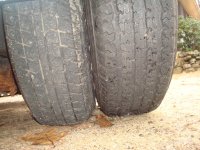
Both tires are 205/75-15 however the left one has weight on it and the other does not.

The tire on the left (a 40psi max tire) clearly shows that it not only appears to be more narrow, but the contact patch is smaller.

The tire on the right (a 50psi max tire) very clearly shows that it is wider and will provide a larger contact patch.

Same load range.

Two different mfg's, both tires belong to the same vehicle and all I had to do was walk out to my driveway.

With all due respect, if you want to see the respective contact patches of each tire with vehicle weight on them, you are going to have to come over and swap wheels. I have already put enough effort into this conversation.

I appreciate the banter but it is a known fact that different tire mfg's will have different contact patches even when using all the same criteria....size, vehicle weight, etc.....and it is only because of how they all assemble their tires.
 

Attachments

  • DSC03314.jpg
    DSC03314.jpg
    138.9 KB · Views: 130
The tire on the left (a 40psi max tire) clearly shows that it not only appears to be more narrow, but the contact patch is smaller.

The tire on the right (a 50psi max tire) very clearly shows that it is wider and will provide a larger contact patch.

UM....WRONG....

Width does NOT equal contact patch. Contact patch is the total area. In other words draw an area AROUND the tire it touches the ground. But on a tire that's not mounted...you have to be careful because there could very well be area's inside that are NOT touching.

Car Bibles : The Wheel and Tyre Bible Page 3 of 4
 
The max on my tires is 51. I inflated to 45 and my ride is very choppy and rough. I don't know how much of an improvement it will make to the gas consumption. I am going on a fairly long trip tomorrow (500+ miles one-way) and will monitor the gas consumption.

If it does make a difference I will get used to the choppy and bouncy ride, otherwise I may have to deflate the tires to 40 or less.
 
This thread is funny. Bro-scientists arguing with an engineer. I keep my LT BFGs inflated to 36psi cold on my 4R and have perfectly even wear. I keep my all season tires on the cruiser at 34psi, 2 above the door sill amount.
 
run whatever you need to so the tires show even wear.

i run 44 psi on LT tires and they wear even

on stock i even pumped them up a bit because i was getting sidewall wear at 32 psi on a P tire
 
UM....WRONG....

Width does NOT equal contact patch.
So, what you're suggesting is that a 195 has the same contact patch as, say, a 335?

Going on that notion, I suppose that's why we all see high-performance cars using econo-box sized tires since they offer the same amount of contact patch and therefore, grip.

As far as the tires pictured, the "skinny" 205 typically contacts the very center treads while the "wider" 205 contacts straight across.

Obviously the same amount of contact area. ;)

This thread is funny. Bro-scientists arguing with an engineer.

I kinda figured he was an engineer. Generally speaking, and no offense to Mike, but they have difficulty accepting what they see on paper and what is actuality. I see it nearly every day.
 
So, what you're suggesting is that a 195 has the same contact patch as, say, a 335?

I didn't say that....Did you read the article I posted.

Read the article..and read what I said....

width NOT equal to contact patch....

width AND depth = contact patch....

You're just applying width.

You're trying to rewrite the laws of physics. This is simple physics...and simple math.
 

Members online

No members online now.

Forum statistics

Threads
278,315
Messages
3,554,130
Members
248,016
Latest member
Advally Service

Trending content

Back
Top