Drum Brake Shoe Replacement

Anyone have an old set of pads or the box handy?

I'm looking for the cold & hot friction ratings for the OEM Toyota brake shoes.

By USA law, it must be printed somewhere on the shoe or the box.

Without the friction rating (which is the most important spec on a brake shoe), I can't compare the $157 Toyota OEM pads with any others.

Also, the dealer doesn't sell a repair/rebuild kit for the $102 wheel cylinders, where these look fine (see photo below) but I was just checking out whether I should rebuild them while I'm in there.

Do you know of a good aftermarket rebuild kit for the wheel cylinders?
 
Last edited:
Anyone have an old set of pads or the box handy?

I'm looking for the cold & hot friction ratings for the OEM Toyota brake shoes.

By USA law, it must be printed somewhere on the shoe or the box.

Without the friction rating (which is the most important spec on a brake shoe), I can't compare the $157 Toyota OEM pads with any others.

Also, the dealer doesn't sell a repair/rebuild kit for the $102 wheel cylinders, where these look fine (see photo below) but I was just checking out whether I should rebuild them while I'm in there.

Do you know of a good aftermarket rebuild kit for the wheel cylinders?

I utilized Advics WCT068. This manufacturer is the same as Aisin essentially. The castings had the "TEQ" symbol ground off. Very high quality.
 
I utilized Advics WCT068. This manufacturer is the same as Aisin essentially. The castings had the "TEQ" symbol ground off. Very high quality.

Thanks for that advice on a good cylinder brand as the local dealer's price is five times what I was quoted at local parts stores for the cylinders (about twenty bucks each for the cylinders and about 7 bucks each for the repair kits).

Searching around on this forum, I see most people don't even bother to replace the cylinders or repair them. I don't see any leaks, and other than the uneven wear, I see no anomolies that would indicate that the cylinders are worn, although they are two decades old.

One thing I definitely did wrong was I didn't back out the adjuster before removing the drum, so I scored the old shoes slightly.

For the shoes, I would love to go OEM but $157 is too much considering aftermarket shoes are around one tenth that price but I do see all the warnings that aftermarket shoes might not fit well, causing the brake adjustment mechanism to tighten the shoes too tightly against the drum and causing significant drum heating and vibration at highway speeds.

So what would be useful would be users' experience on either the aftermarket brands to avoid or the aftermarket brands to get.

One problem with going aftermarket is that we have to make sure that the friction coefficient meets or exceeds Toyota's original spec, which is printed on every shoe in the USA - but I called 3 dealers and none felt like opening a box to tell me what was printed on the shoe so I don't know if the OEM shoe is EE or FF (most likely) yet but I'll find out and report back if nobody here has a shoe handy to read the numbers off of.
 
Last edited:
Thanks for that advice on a good cylinder brand as the local dealer's price is five times what I was quoted at local parts stores for the cylinders (about twenty bucks each for the cylinders and about 7 bucks each for the repair kits).

Searching around on this forum, I see most people don't even bother to replace the cylinders or repair them. I don't see any leaks, and other than the uneven wear, I see no anomolies that would indicate that the cylinders are worn, although they are two decades old.

One thing I definitely did wrong was I didn't back out the adjuster before removing the drum, so I scored the old shoes slightly.

For the shoes, I would love to go OEM but $157 is too much considering aftermarket shoes are around one tenth that price but I do see all the warnings that aftermarket shoes might not fit well, causing the brake adjustment mechanism to tighten the shoes too tightly against the drum and causing significant drum heating and vibration at highway speeds.

So what would be useful would be users' experience on either the aftermarket brands to avoid or the aftermarket brands to get.

One problem with going aftermarket is that we have to make sure that the friction coefficient meets or exceeds Toyota's original spec, which is printed on every shoe in the USA - but I called 3 dealers and none felt like opening a box to tell me what was printed on the shoe so I don't know if the OEM shoe is EE or FF (most likely) yet but I'll find out and report back if nobody here has a shoe handy to read the numbers off of.

Buddy, you need to be ordering these parts from an online Toyota parts dealer like Conicelli or CamelBack. The OEM brake shoe kit should cost closer to $75. It's worth it to go OEM as much as possible (that's the general thinking around here anyway, and I usually agree). :nerd:
 
Buddy, you need to be ordering these parts from an online Toyota parts dealer like Conicelli or CamelBack. The OEM brake shoe kit should cost closer to $75. It's worth it to go OEM as much as possible (that's the general thinking around here anyway, and I usually agree).

I've ordered from Camelback before, but I didn't know about Conicelli also having good prices, so I'll check them out as I agree with anyone who says OEM is the way to go unless the price is prohibitive.

* Camelback $82.35 SHOE KIT, BRAKE, RR (0449535230)
* Conicelli $78.30 BRAKE SHOES - TOYOTA (04495-35230) Replaces: 04495-26050, 04495-26051, 04495-26061, 04495-35150, 04495-35151

If anyone has an old Toyota OEM shoe just sitting around, if they can take a picture or read off the markings, that would be very helpful because the markings tell us who made the friction material, what it's composed of, and what its SAE J886 Chase Test friction coefficients are for cold and various hot temperatures.

I snapped a picture of the Amazon shoes that said they were "OEM quality", where of the score of shoes available, only three showed the markings (and we don't know if those were pictures of the actual shoes).

All three of those were FF.
Does anyone have a shoe handy to see if the OEM shoes are FF?
 

Attachments

Last edited:
If anyone has an old Toyota OEM shoe just sitting around, if they can take a picture or read off the markings, that would be very helpful because the markings tell us who made the friction material, what it's composed of, and what its.
...
Does anyone have a shoe handy to see if the OEM shoes are FF?
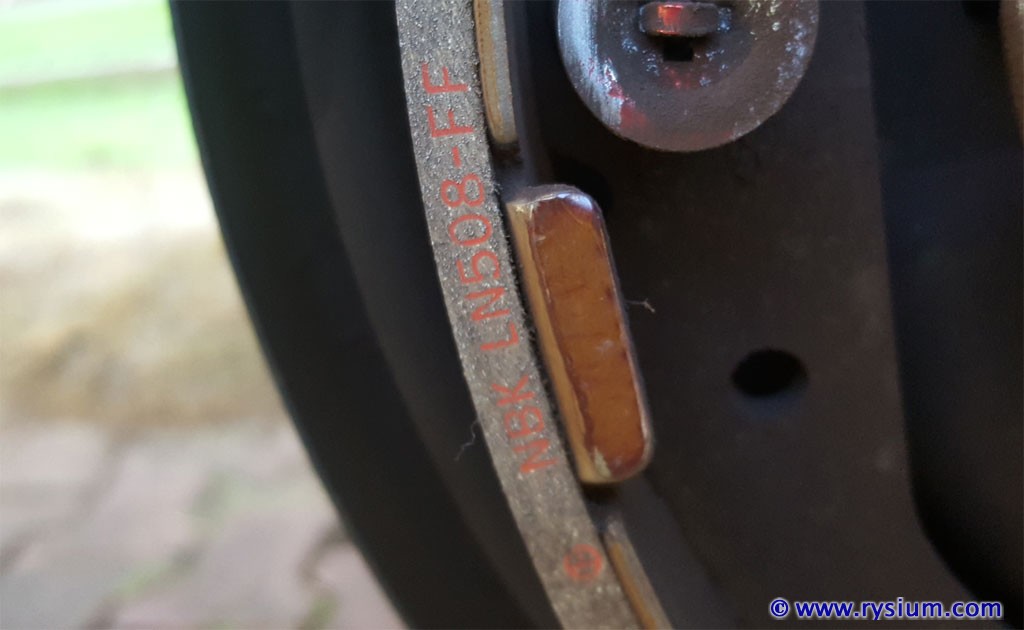
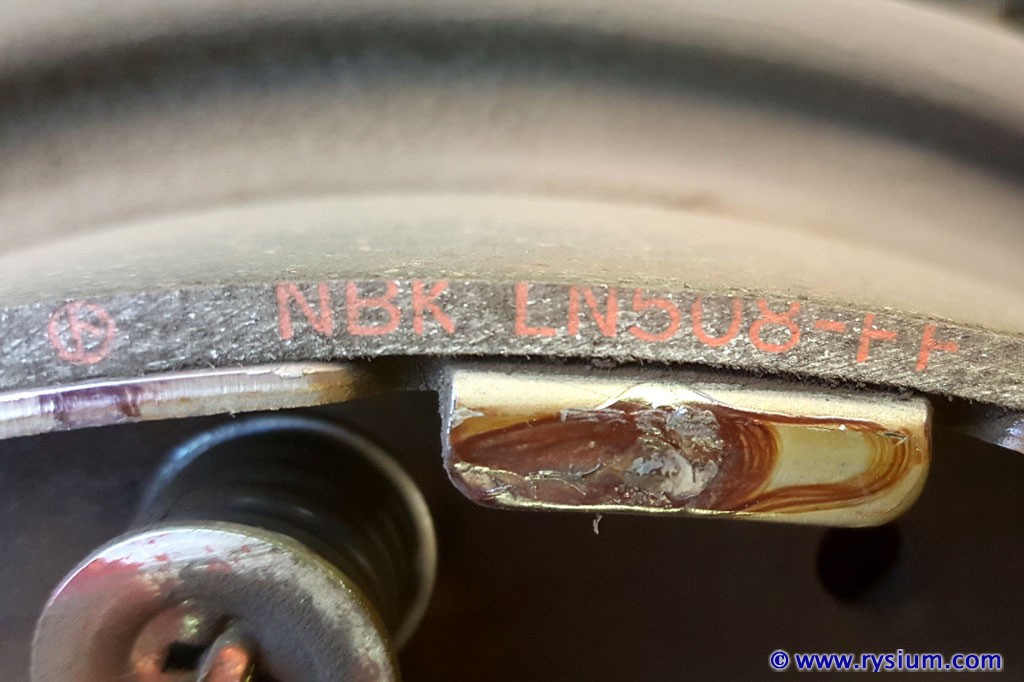
Here is the original shoe I have in my 1995 Tacoma that came with the truck. You can't get more OEM than that :dance:

rear-brakes-07.jpg


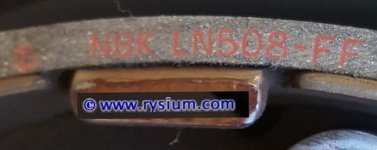
If you have a problem with reading markings from the image it is:
NBK LN508-FF. Definitely FF grade.

The other shoe (same wheel) has the same markings.

rear-brakes-08.jpg


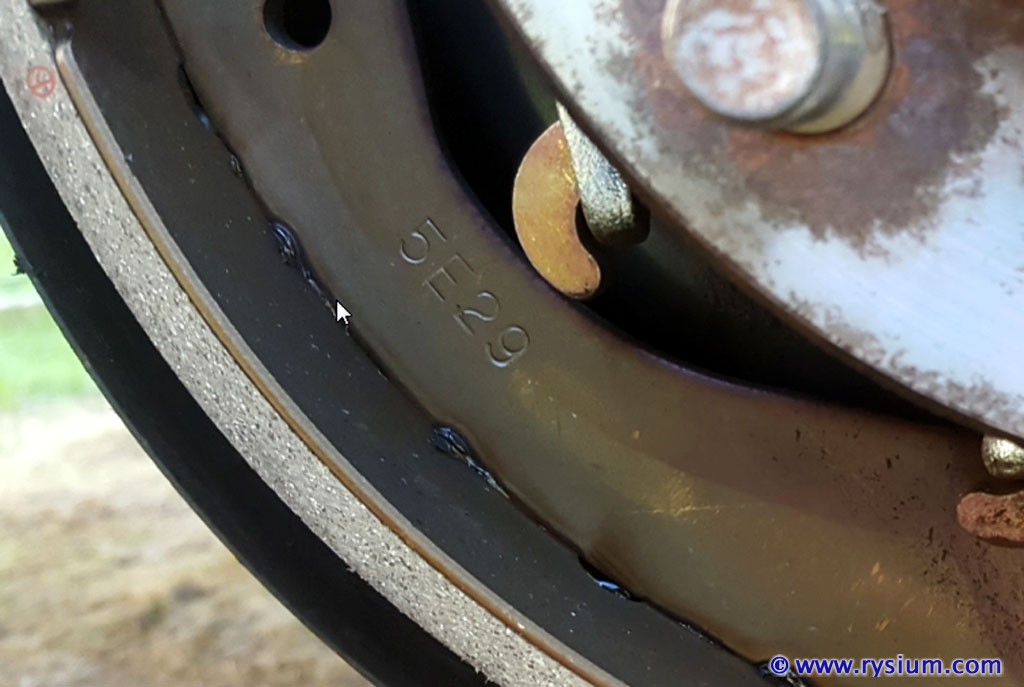
I also saw the marking 5E29 stamped on the metal - I don't know what it means

rear-brakes-09.jpg
 
Last edited:
...So what would be useful would be users' experience on either the aftermarket brands to avoid or the aftermarket brands to get...

FWIW, when I was getting the parts to fix the worn axle bearnings/destryoed brakes on the '01, the parts manager at the dealership where I was ordering gave me the prices for all of the rear brake stuff from Toyota, then told me that the service writers never sell any of it because of the pricing, so they exclusively use NAPA premium. Since I had a friend getting me the parts on her employee discount pricing, I went with the NAPA brakes but being a bit skeptical. I ended up using the shoes, hardware kit ( every spring is a separate item from toyota, there's no "kit" ) and wheel cylinders. I re-used the original drums, I just had them turned. The NAPA premium drums measured .060 over sized compared to the OE drums after I had the OEM drums turned.

I have to say that everything worked well. I only put about 2K on the Runner before I sold it but the brakes felt fine. Once I got them adjusted properly the E-brake worked perfectly and held the Runner on a slope w/ the trans in neutral.
 
Here is the original shoe I have in my 1995 Tacoma that came with the truck. You can't get more OEM than that
Thanks. I appreciate the effort and I'm sure others do too because that tells us three things about the friction material.

If you have a problem with reading markings from the image it is: NBK LN508-FF. Definitely FF grade.
The other shoe (same wheel) has the same markings.

Thanks for the level of detail on both shoes.

I have never seen a car have different grades on any wheel, at least for pads, (have you?) so, I would assume the fronts are FF also (based on that experience only though).


I also saw the marking 5E29 stamped on the metal - I don't know what it means
I don't know what that stamped number is, but the "NBK LN508 FF" was exactly what I was looking for, because it confirms the OE pads are made of material with FF friction coefficients.

From the Automotive Manufacturers Equipment Compliance Agency document previously posted, that exact number cross references to the OE manufacturer "Nisshinbo Automotive Manufacturing, Inc.", and an AMECA compliance registration number of "160426".

That same AMECA compliance number of 160426 cross references to the following 19 edge code markings for pads and shoes sold in the US over the past 3 years, so, if by some miracle, you run into those numbers on a pad or shoe, they're the exact same friction material.
  • NAC D9011 FF
  • NAC LN508 FF
  • NAC N2009 FF
  • NBK D9011 FF
  • NBK LN508 FF
  • NBK N2009 FF
  • NSA D9011 FF
  • NSA LN508 FF
  • NSA N2009 FF
  • NSC D9011 FF
  • NSC LN508 FF
  • NSC N2009 FF
  • SABC D9011 FF
  • SABC LN508 FF
  • SABC N2009 FF
  • SAC D9011 FF
  • SAC LN508 FF
  • SAC N2009 FF
  • SABC LN508 FF

I'm on the phone with AMECA right now trying to get further information about our shoes based on the information above.
 
Last edited:
FWIW, when I was getting the parts to fix the worn axle bearnings/destryoed brakes on the '01, the parts manager at the dealership where I was ordering gave me the prices for all of the rear brake stuff from Toyota, then told me that the service writers never sell any of it because of the pricing, so they exclusively use NAPA premium.

That's interesting as I got a somewhat similar comment from the local Toyota dealer when I asked for rear 6-inch speakers for a neighbor's Camry where the 20-Watt Panasonic speakers were, get this ... $150 each ... or $300 for a set, where you can go to Crutchfields and get a set of 150Watt RMS (or peak?) speakers for a tenth of that price.

So the dealer told me that nobody buys from them so they don't even bother stocking the parts. It's just a MSRP price lookup, they said, for insurance adjuster and mechanic parts-price estimation purposes, he said.

Since I had a friend getting me the parts on her employee discount pricing, I went with the NAPA brakes but being a bit skeptical. I ended up using the shoes, hardware kit ( every spring is a separate item from toyota, there's no "kit" ) and wheel cylinders. I re-used the original drums, I just had them turned. The NAPA premium drums measured .060 over sized compared to the OE drums after I had the OEM drums turned.

It's interesting that there was room to spare for your drums to be turned, because these I'm working on only have 2mm to spare from the maximum diameter of 297mm at 175K miles, so, I would think, if there were deep grooves, that they'd go deeper than those 2mm and that would fail the drum instantly.

I have to say that everything worked well. I only put about 2K on the Runner before I sold it but the brakes felt fine. Once I got them adjusted properly the E-brake worked perfectly and held the Runner on a slope w/ the trans in neutral.

I think that the only choices we realistically have (since the local dealer priced the shoes out of sight of reality), is to go with Camelback/Conicelli, or, find an aftermarket shoe that someone else has already said fits and works fine, that is at least an FF shoe.

Nobody wants to "experiment" with shoes NOT fitting, least of all me, so, while I certainly understand and appreciate the suggestion to get the $85 Conicelli shoes, it may be that aftermarket can be had that is just as good as long as they are FF and the fit is right.

Therefore any aftermarket recommendations of shoes outside of the Toyota channel that you know worked well, would be useful to everyone, as they can likely be had for half the price of even Conicelli (and one fifth the price of my local dealer).

Although just saying "NAPA" doesn't really help, I don't think, because NAPA must have a bunch that fit (maybe, maybe not ... there's no NAPA near me so I would likely use Autozone if they have good shoes that fit, or O'Reillys).
 
When I was stocking wear and tear parts for transfer my truck to Poland in 2016 I asked a question on TacomaWorld "what can go wrong with my truck". I got suggestions to buy a rear brake shoes and drums but I ignored it then. Then before my trip to USA last fall i was ready to buy them until I checked my rear brakes. 318k miles and still a lot of life in OEM brakes.

I'm writing this story to suggest that even with radicuosly high prices for OEM stuff it may be worth to go for OEM as it is just a "set and forget" deal.

I know my front brakes go faster so I stocked a set - OEM of course. As I wrote I like the "set and forget" deals.
 
I don't have any of the friction"coding" from the NAPA brake shoes, so I can't help you with that information although I applaud your in-depth investigation into the details of finding a truly comparable friction lining material.
Just to be clear on those brake drums, they weren't grooved at all, just saturated with gear oil so the point that I didn't think they would clean up with just a solvent, so a clean-up cut was taken and it worked out well for me. The stock drums were noticeably heavier in weight as well when compared to the best drums that NAPA had to offer. My personal opinion on places like vatozone and other discount auto parts stores is not a good one- those places sell 2nd and 3rd tier quality auto parts, not the kind of gamble I'm willing to take on something as serious as a brake system. If you have the luxury of being able to wait for mail order parts, then Rockauto is hard to beat for good quality, brand names parts at good prices.
 
318k miles and still a lot of life in OEM brakes.
This 4runner got 175K miles on the OE brakes so I'm not complaining about the miles as that's half the life of the vehicle. Your explanation is valid that even a very high Toyota OE price isn't that much per mile when the shoes give that many miles.

I'm writing this story to suggest that even with radicuosly high prices for OEM stuff it may be worth to go for OEM as it is just a "set and forget" deal.
I may still end up going OE as nobody is going to argue with something we know fits, and from the Timmy the Toolman video, it comes with the U clips and round hold-down cups (I think he called them "e clips").

But it would be nice to know what brand and model people went with, where just saying "Napa" or "Wagner" isn't really enough information to do anything useful with unless they only sell one brand to fit.

Saying "Wagner Z589" or Napa Altron ALT589 is enough information though where anyone can use them knowing they will fit, if someone else already used them and said they fit.

BTW, did anyone notice the "589" seems prominant in most of the part numbers from a variety of manufacturers?

I made a more zoomed in and straightened and full-pad thickness picture of the one that you previously posted included below. Let me know by PM if you don't want it here and I will delete it. I included the credit to you in the picture where it's just zoomed in, and straightened for easier reading for others.
 

Attachments

  • rear-brakes-07.jpg
    rear-brakes-07.jpg
    105.3 KB · Views: 1,005
Perfect timing on this video. I need to do mine as well.

Now, I wish I could bring my rig over to figure out why its covered in oil...I just replaced the valve cover gaskets but I guess I'll do them again.
 
My personal opinion on places like vatozone and other discount auto parts stores is not a good one- those places sell 2nd and 3rd tier quality auto parts, not the kind of gamble I'm willing to take on something as serious as a brake system. If you have the luxury of being able to wait for mail order parts, then Rockauto is hard to beat for good quality, brand names parts at good prices.

That advice is valuable, as I kind of hate going to local parts stores myself because I don't know enough to get good quality yet.

I do have plenty of time though and I saw Rock Auto prices which were rock bottom - but I assumed their quality was bad becaues the price was just too good (like $15 to $20 per set). Of course, if I knew exactly what model of brake shoe to get at Rock Auto, that would simplify things immensely.

I think at this point, I have only three requirements (which most people would also have too).
  1. It has to fit right (which we already know is why most people play safe with OE)
  2. It has to be FF friction (which is easy to find so that's not a problem)
  3. Price

It would be helpful to everyone if anyone has a shoe brand and model that works because that's the easiest way to buy things where we can shop around for a better price and still get a perfect fit.

I don't have any of the friction"coding" from the NAPA brake shoes, so I can't help you with that information

The nice thing about the DOT Edge Codes" (also called AMECA Edge Codes) is that they tell you three things outright and they make great search terms!

although I applaud your in-depth investigation into the details of finding a truly comparable friction lining material.

Thanks. I was hoping this number would be a "holy grail" where I could use it to better compare two brake shoes in my hands.

To get a better handle on how to interpret the numbers, I called the main number at AMECA.ORG in Maryland at 202-898-0145 and spoke to the engineer in charge of that "AMECA Edge Code Markings" cross reference.

It was a long discussion, the net of which is that this code isn't really for the consumer. The engineer said it's kind of like the so-called "serial number" on a tire, or on a package of baked beans, where if something goes wrong, the government has a way of tracking down whose fault it is. In addition, he said that the SAE J866 Chase Test is really a quality metric, and not a performance metric, even though friction is an outcome of the Chase Test.

The engineer did give me all sorts of personal insight into how to buy brake pads but overall, he said you can't extrapolate very much real-world decision-making data from the DOT Edge Code.

Of course, if you miraculously find two pads with the same DOT Edge Code, then there's a 100% chance that it's the same friction material.

Or, if you find any pads with any of the 19 DOT edge codes that cross reference to the same AMECA registration number 160426 then they too are exactly the same friction material.

That's because the AMECA registration number 160426 is for a specific 1-inch square piece of friction material that can be used on any brake pad or shoe.

But that's really as far as a consumer can go with the edge code, he said.

He knew about all three of the Michigan police studies of EE and FF brake pads, where those in-depth police cruiser tests also said it's hard to extrapolate real-world performance from just the EE or FF friction code they tested.

The AMECA engineer said that there are from 10 to 30 compounds in a brake friction material, where he opined that Toyota spends enormous energy with what he called the Tier 1 companies (e.g., Nisshinbo for Toyota) optimizing the compound for each vehicle; but the engineer said that the aftermarket suppliers (e.g, Centric, Wagner, Akebono, Axxis, etc.) centralize on about a half dozen to a few more than a half dozen formulas for all their offerings.

In summary, the AMECA Edge Code is only "slightly" useful to a consumer, as it tells the consumer the most information only if numbers match, but if they don't match, the only three things it tells the consumer are the manufacturer, the friction coefficient, and the registration number for the specific friction material.

BTW, I was tempted to call the Nisshinbo senior principle engineer himself (Tsuyoshi Kondo, +1-586-997-1000, [email protected]) who submitted the 1-inch squares for our particular friction material on October 31st 2017 for repeat testing, but I didn't have the nerve to call him for more information, especially after the AMECO engineer told me this information is mostly for law enforcement and government use, and not really intended for consumer use.

The one thing the AMECA engineer told me over and over again though, is that what we'd want for comparitive purposes, has been studied and studied by the "smartest guys on the planet", and nobody can agree because of conflicting interest.

So he symphathized with our needs.
 

Attachments

I watched Tim's video and did a rear drum refresh. I got new brake pads, installed them, adjusted them off the ground to just a light scraping with maybe 1 whole free spin. I can easily pull the lever to 7 clicks with a moderate amount of force. 8 clicks requires a bit more effort, and 9 clicks requires that you eat your wheaties before even thinking about attempting. As part of the refresh I replaced the central brake hose and made sure my drum cylinders were cleaned out. For the first time in a long time the rear brakes are working. However even at 9 clicks of e brake with the vehicle in neutral on a small decline I still roll forward. My bell cranks move freely and the adjustment bolt from what i can tell by just pulling the bell crank taught moves an almost imperceptible amount. When fully engaged the bolts look to be about 1/4" or so from the backing plate. I really just don't even know why the E brake refuses to work as intended. If I adjust the rear brakes anymore i will be at 4 or 5 clicks which is too much.

Thoughts?
 
I got new brake pads, installed them, adjusted them off the ground to just a light scraping with maybe 1 whole free spin. I can easily pull the lever to 7 clicks with a moderate amount of force. 8 clicks requires a bit more effort, and 9 clicks requires that you eat your wheaties before even thinking about attempting.

I don't know the answer to your question but since you just did it, can you let us know what brand and model brake shoe you used? It would be nice to know what works and what doesn't if it's not OE.

Also, after watching the video that started this thread, I came up with this right-hand-rule that I hope should work for everyone, which is to place your right hand in the hitchhiking position and point your thumb horizontally in the direction you want the shoes to go ... toward the rear for loosening the shoes away from the drum, or toward the front for tightening the shoes toward the drum.

Based on what I saw in the original Timmy the Toolman video, your four fingers of your right hand will always curl in the direction that the toothed adjuster needs to be spun.

The easiest way to install the rear brakes is to pre-assemble them and slide them over the axle.

That's a great idea which I will try when I do this job in an upcoming warm weather weekend.

For an example in practice, this thread has a video by chipsahoy which shows that pre-assembling procedure in real time.

To spare you most of the dubbed-in-and-out music, you can skip to time 592 seconds

https://youtu.be/TywVkpCDcCA?t=592
 

Attachments

Last edited:
I watched Tim's video and did a rear drum refresh. I got new brake pads, installed them, adjusted them off the ground to just a light scraping with maybe 1 whole free spin. I can easily pull the lever to 7 clicks with a moderate amount of force. 8 clicks requires a bit more effort, and 9 clicks requires that you eat your wheaties before even thinking about attempting. As part of the refresh I replaced the central brake hose and made sure my drum cylinders were cleaned out. For the first time in a long time the rear brakes are working. However even at 9 clicks of e brake with the vehicle in neutral on a small decline I still roll forward. My bell cranks move freely and the adjustment bolt from what i can tell by just pulling the bell crank taught moves an almost imperceptible amount. When fully engaged the bolts look to be about 1/4" or so from the backing plate. I really just don't even know why the E brake refuses to work as intended. If I adjust the rear brakes anymore i will be at 4 or 5 clicks which is too much.

Thoughts?

You might still need to adjust them a little tighter. Try pulling the lever hard a few more times and see if the tension begins to increase. It might also be that your brake adjustment is OK but the actual parking brake cable slack needs to be tightened up.
 
You might still need to adjust them a little tighter. Try pulling the lever hard a few more times and see if the tension begins to increase. It might also be that your brake adjustment is OK but the actual parking brake cable slack needs to be tightened up.
That sounds likely. I had to slightly tighten the cable itself (inside the cab) along with down at the wheels. Now it self-adjusts just fine and holds the truck well.

For the cable adjustment, don't overdo it. You just want to shorten the distance between moving the lever and it starting to move the cable at the backing plate. You can just feel it as you pull the lever up.

-Charlie
 

Members online

Forum statistics

Threads
278,310
Messages
3,554,077
Members
248,016
Latest member
Advally Service

Trending content

Back
Top