Drum Brake Shoe Replacement

You might still need to adjust them a little tighter. Try pulling the lever hard a few more times and see if the tension begins to increase. It might also be that your brake adjustment is OK but the actual parking brake cable slack needs to be tightened up.

I have been using the parking brake several times a day for about a week. With the handbrake down the cables are still quite taught. currently facing down hill in neutral with a slope of roughly 15 degrees or so and it takes 11 clicks to prevent moving and Hercules needs to be in charge of the E-brake. I do agree it may need some more adjusting but I was aiming for the magic 7 - 9 clicks.

I don't know the answer to your question but since you just did it, can you let us know what brand and model brake shoe you used? It would be nice to know what works and what doesn't if it's not OE.

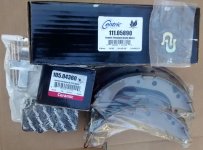
I bought the CENTRIC 11105890 from Rock auto.


Its annoying difficult trying to determine if one side needs to be adjusted more or less than the other.
 
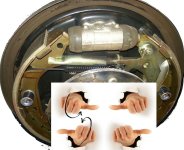
I came up with this right-hand-rule that I hope should work for everyone, which is to place your right hand in the hitchhiking position and point your thumb horizontally in the direction you want the shoes to go ...

Funny stuff...my first thought..."Flight School 101 during the preflight...left wing down, right thumb up...right wing down, left thumb up." Thanks for the smile!
 
Funny stuff...my first thought..."Flight School 101 during the preflight...left wing down, right thumb up...right wing down, left thumb up." Thanks for the smile!

It's just a fun rule, which I wouldn't take too seriously, because most of us know how to twist a bolt instinctively by now.

The original right-hand rule is an electromagnetic basic rule that all physicicists and electrical engineers know, but the RHR also works well when you're upside down as it works for bolts too (it's the same end result as "righty tighty lefty loosy").

If you want a normally threaded bolt to go in or out, you place your thumb in line with the bolt and in the direction that the bolt needs to go, and your right hand fingers will always curl in the direction that you need to spin a normally threaded bolt.

It's the same here, where you have to treat the adjuster as a bolt, where going "in" is going to the "rear" of the vehicle.

Facing the adjuster bolt from either the outside of the vehicle looking toward the lug bolts or from underneath looking toward the backing plate, you "hitch hike" with your thumb pointing toward the rear to adjust the shoes "inward", and you hitchhike toward the front to adjust the shoes outward.

  • Remove = hitchhike to the rear
  • Adjust = hitchhike to the front
 

Attachments

  • RRR.jpg
    RRR.jpg
    74.8 KB · Views: 1,040
Last edited:
How much force should it take to reach 7, 8, 9 or 10 clicks on the Ebrake? I feel like anyone below my strength level would not be able to get to 8 or 9 clicks.
 
The right hand rule works well especially when you're upside down as it works for bolts too (it's the same end result as "righty tighty lefty loosy").

The Right Hand Rule works when you face the front of the brake drum (from the outside looking inward) to tell you the direction to spin the toothed wheel to expand and contract the brake shoes.

We probably need to hone the right hand rule a bit because it works only if you're FACING the outside of the drum.
It's the opposite if you're looking at the drum from inside, under the frame, and from behind the drum.

I appreciate little tricks like this to remember things but remembering which way to turn star wheel adjuster is pretty darn easy. The way you're able to turn it is tightening. When you're trying to turn it and the adjuster plate is stopping you, that means you're turning it in the direction to loosen it.

So, say for instance you want to make adjustments to your brakes while the wheels and drums are still on. You take out the access plug on the back, get on the star wheel with whatever tool you've got and try turning it. if it turns, you're tightening. If you wanted to loosen the brakes, you get a screwdriver in there, push the adjusting plate out of the way while you turn the star wheel in the opposite direction. Pretty easy and you don't have to remember which way your thumb is pointing. Feel me?
 
Another thing I'm wondering about is how much easier is this supposed "Pre-Assembled" technique over the old school way of just getting the shoes on individually and then stretching the return spring into place. I do have to admit the return spring is a little bit of a hassle but that's mostly due to the tool I've been using. I bought an OTC brake kit and the return spring tool is a little flimsy so it's bent from me using it and it's not working very well anymore. I called OTC and they are sending me out a replacement that hopefully works a lot better.
 
I bought the CENTRIC 11105890 from Rock auto.

Nobody wants to get the wrong size shoes, least of all me, so I appreciate that reference to an actual model number that I can sink my teeth into to replace the OE #160426 NBK LN508 FF Nisshinbo shoes.

I called Centric at 626-961-5775 today and asked for technical support, who confirmed what you said in that the "OEM Quality" equivalent Centric shoes and pads are:
  • Rear shoes, Centric Part Number 11105890, ceramic
  • Front pads, Centric Part Number 10504360, ceramic
Based on a descrepancy shown below, I spoke to three progressively more senior Centric technical support people, all of whom knew all about the Michigan police cruiser studies, SAE J866 Chase Test, and SAE J2784 compliance, and the AMECA Edge Codes (aka DOT Edge Codes).

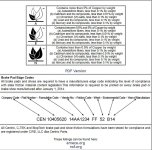
Centric kindly gave me the DOT Edge Codes after calling the warehouse who read them off the shoes & pads:
  • CENTRIC 11105890 shoes = 111AA9101FF30N17 which means 111AA formula, 9101 factory, FF friction, 30th week of 2017, N type material (low copper)
  • CENTRIC 10504360 pads = 15AA2256FE48A17 which means 15AA formula, 2256 factory, FE friction, 48th week of 2017, A type material (high copper)
While both our front and rear "OEM Quality" replacements are termed as "ceramic", their composition is very different where our "N type" rear shoe is described here but it's mainly that the 1-inch by 1-inch by 1/4 inch burnished square supplied to AMECA for materials compliance contains less than 0.5% copper by weight - while our "A type" front pads are mainly more than 5% copper by weight.

Looking the numbers up in the December 8th, 2017 AMECA cross reference, the Centric rear shoes have a registered material of #161379 which matches these two AMECA Edge Codes:
  • CEN 111AA9101 FF
  • CEN 112AA9101 FF
In that AMECA document, the front shoes match to #161583 but there is a huge discrepancy in friction codes:
  • CEN 15AA2256 GF (this is not EF which is what is printed on the pad and is most likely an AMECA mistake)
  • CEN 15AA8241 GF
There must be a mistake which they'll iron out between themselves - but it appears to be a mistake on AMECA's side since Centric told me they never made a GF friction material, and AMECA asked me to send them the details since the difference is noticable.

  • AMECA +1-202-898-0145
  • CENTRIC +1-626-961-5775
While I had them on the line, I asked CENTRIC what "OEM Quality" means, and the engineer told me "mostly marketing". I asked if there was a spec of clay in the pad if they could call it ceramic, and he agreed. Likewise with semi-metallic. There are no legal rules for what they call anything, other than the federal and steate government requirements for maximum asbestos, copper, cadmium, etc. levels.

He told me a lot of other stuff also, such as the fact they don't sell to Rock Auto nor to Amazon, so if you get Centric parts there, it's through a reseller of some sort.

The technical engineer did tell me that Centric puts all brake shoes on a dyno and tests them thoroughly to assure they meet OEM Quality, but it's not like a manufacturer gives them a spec. They just know how brake shoes and pads should work.

I don't plan on putting any shoes or pads that others here haven't already found to be working, but I might put these Centric pads on, if I can figure out if the OE Toyota pads are also FE pads (and not FF pads).

Does anyone know if there's a thread that lists all the specific brand and model of pads and shoes that people found to work well on the 4Runner, including pictures of the OE pad DOT Edge Codes?

 

Attachments

  • leaf_codes.jpg
    leaf_codes.jpg
    120.4 KB · Views: 1,478
Last edited:
Nobody wants to get the wrong size shoes, least of all me, so I appreciate that reference to an actual model number that I can sink my teeth into to replace the OE #160426 NBK LN508 FF Nisshinbo shoes.....

(Reduced quote for cleanliness)

I must say I did not expect that degree of detail when speaking about brake pads. I often wondered how they determine ceramic vs semi-metallic and so forth. The marketing BS really hurts us the consumers more than anything. I dont even know what Toyota OEM brake pads feel like in this vehicle. It would be nice to know if the pads I bought have a lower than factory friction rating or if I really do need to make adjustments to the star wheel and or cables. I purchased these specific pads because they were listed in the premium section of rockautos list. I wanted high quality stopping power that would last longer than the junk I have to buy on the island that wears out in a few months. Please continue with your research.
 
Last edited:
Nobody wants to get the wrong size shoes, least of all me, so I appreciate that reference to an actual model number that I can sink my teeth into to replace the OE #160426 NBK LN508 FF Nisshinbo shoes.

You are sure putting a ton of work into this brake shoe research. You could save all the research and time posting all this info and just buy OEM pads. We now know how long these pads can last and one replacement might be good for the rest of the life of your rig. I bought another 3rd Gen recently and have a leaking rear axle seal. I bought OEM brake shoes from Camelback Toyota for $82 and called it a day. You can't go wrong with OEM.

Maybe you just like researching things like this so I guess go for it if this is what floats your boat. But, if you're just want a quality set of brake shoes, your search can be over today by buying an OEM.
 
I must say I did not expect that degree of detail when speaking about brake pads.

It's actually not much detail - it's merely reading the writing on the pads.

Most people would just pay three to ten times as much for OE pads, just so they don't have to think about it, or take any risk.

And that's OK if that's what they want to do. I'm not saying that's wrong.
It's certainly easy. But it's three to ten times more expensive to go OE.

I often wondered how they determine ceramic vs semi-metallic and so forth.
I've had this conversation with every pad manufacturer since I started replacing my own pads. One teaspoon of clay dust, and they can defend the term ceramic.

I learned this from the marketing guys themselves, because they all complain about the competition for saying exactly what each marketing team does.

The marketing BS really hurts us the consumers more than anything.

In the end, nobody can help us pick a brake friction material because it's like trying to pick a girlfriend. We all have the same basic criteria, where we all have a mother, who is the OE standard to compare to.

But every girl is different in each ride, where some of us care more about dusting, others more about noise, others who tow may care more about fade, others may care more about pedal force for any given deceleration, others may care more about panic stop distances.

Even if one guy says he loves pad A, he may drive differently than you do, so maybe pad B is better, for you.

You really have to choose pads blind, and then test them out.

This is why people pay from three to ten times more for the risk free safety of buying the OE pads and shoes. In other words, you can't go wrong with OE and if you would rather not burn calories thinking.

I don't yet know what the friction coefficients are for the OE front brake pads are - so I'm trying to dig that up.

One interesting fact is that I called three dealers who didn't even know what I was talking about, and yet, every brake company I called knew EVERYTHING I was talking about - so really, the Toyota parts guys are completely clueless as they don't even understand that which they sell (and they don't need to).
 
But, if you're just want a quality set of brake shoes, your search can be over today by buying an OEM.
If the goal was to get it over with, it would be easy to just drop off the vehicle at the dealer and pick it up when they're done with it.
You are sure putting a ton of work into this brake shoe research.
All I'm doing is extremely basic stuff that everyone should already know.
I'm just reading the writing on the pads. It's simple stuff.

The multiple calls today were because AMECA was wrong, and I was the first person to notice it, so it took a while to establish that error with Centric & AMECA.
You could save all the research and time posting all this info and just buy OEM pads.
The original goal was to get better than OE pads, and to get them at 1/3rd to 1/10th the price of the OE pads.

It's easy to get equivalent pads at 1/3rd to 1/10th the price - but it may not be as easy to get better pads, because we have no way of knowing what's better yet since we don't know what the OE pads are for the fronts.
Maybe you just like researching things like this so I guess go for it if this is what floats your boat.
I like being able to read a pad just by looking at it.
And I like learning about brake pads and their marketing methods.

I don't like being influenced by BS.
And I don't like paying 3 times to 10 times the price for the same result.

I also learned something about Centric's sales channel as they told me they don't have a direct relationship with Rock Auto, but they know where Rock Auto gets their shoes from and they're OK with that.

Centric does haver a direct relationship with AutoAnything, and TireRack, and Comet, so they recommend them, in addition to Rock Auto.

Centric does not have any relationship with Amazon, they told me, so they don't recommend we buy from Amazon.
 
Last edited:
If the goal was to get it over with, it would be easy to just drop off the vehicle at the dealer and pick it up when they're done with it.

All I'm doing is extremely basic stuff that everyone should already know.
I'm just reading the writing on the pads. It's simple stuff.

The multiple calls today were because AMECA was wrong, and I was the first person to notice it, so it took a while to establish that error with Centric & AMECA.

The original goal was to get better than OE pads, and to get them at 1/3rd to 1/10th the price of the OE pads.

It's easy to get equivalent pads at 1/3rd to 1/10th the price - but it may not be as easy to get better pads, because we have no way of knowing what's better yet since we don't know what the OE pads are for the fronts.

I like being able to read a pad just by looking at it.
And I like learning about brake pads and their marketing methods.

I don't like being influenced by BS.
And I don't like paying 3 times to 10 times the price for the same result.

I also learned something about Centric's sales channel as they told me they don't have a direct relationship with Rock Auto, but they know where Rock Auto gets their shoes from and they're OK with that.

Centric does haver a direct relationship with AutoAnything, and TireRack, and Comet, so they recommend them, in addition to Rock Auto.

Centric does not have any relationship with Amazon, they told me, so they don't recommend we buy from Amazon.

Ok Dude. Continue with your quest. I have to say your posts are reminiscent of someone who's changed his screen name a few times now and been banned at least twice. @Foo and [MENTION=166771]verbutani[/MENTION] were your former screen names and I guess you've moved on to this current one.

I know you mean well but unfortunately you will beat a subject to death and then have a hard time when people bring this to your attention. You did this with the sway bar end link bushings, next it was crush washer dimensions and now it's brake shoes.

I highly doubt you're going to find brake shoes superior to OEM and at a fraction of the cost but research and research away to your heart's content. People who I respect on this forum have told me OEM brake pads and shoes are the way to go and I took their word for it. If you want to spend your time researching and making multiple phone calls to save a few bucks, go right ahead. Personally, I'd rather be riding my bicycle, going on a hike, wrenching on trucks, or whatever else that I find appealing. If you like researching and calling companies about brake shoes, then I say go for it. Happy Trails.
 
Ok Dude. Continue with your quest. I have to say your posts are reminiscent of someone who's changed his screen name a few times now and been banned at least twice. @Foo and [MENTION=166771]verbutani[/MENTION] were your former screen names and I guess you've moved on to this current one.

I know you mean well but unfortunately you will beat a subject to death and then have a hard time when people bring this to your attention. You did this with the sway bar end link bushings, next it was crush washer dimensions and now it's brake shoes.

I highly doubt you're going to find brake shoes superior to OEM and at a fraction of the cost but research and research away to your heart's content. People who I respect on this forum have told me OEM brake pads and shoes are the way to go and I took their word for it. If you want to spend your time researching and making multiple phone calls to save a few bucks, go right ahead. Personally, I'd rather be riding my bicycle, going on a hike, wrenching on trucks, or whatever else that I find appealing. If you like researching and calling companies about brake shoes, then I say go for it. Happy Trails.

I think you're right. Same style as "Mom" as well.
 
I think you're right. Same style as "Mom" as well.

And the thing is, he seems to gravitate towards the threads I start for some reason. Anyway, I can tell the guy means well but he can beat a subject to death like no other. I know from experience with the previous subjects he's latched onto that this brake shoe research can go on for a long time and people will tire of it. Ultimately, somebody will call him out on it (this time it's me), he'll get defensive and then the conversation goes downhill from there.

I can appreciate somebody going into detail about something, like my buddy [MENTION=148218]JZiggy[/MENTION] did with an explanation of why the brake shoes wear the way they do. But, spending a huge amount of time on the quest to find an aftermarket brake pad equal or better than OEM and then formulating these crazy long posts seems like a serious waste of time. Even with all the research, the only way he'll know if these "Holy Grail" pads are just as good or better than OEM is he'll have to drive them for 200k miles because that's about how long the OEM pads can last from what I've seen.

Anyway, enough said on this. Time to do some wrenching on my new rig.
 
Do you think there will ever be a time where Toyota will stop supplying the brake pads? At what point do they just "force" people to buy a newer vehicle?
 
Do you think there will ever be a time where Toyota will stop supplying the brake pads? At what point do they just "force" people to buy a newer vehicle?
In the US, I think car manufacturers are required to have parts available for 10 years from the date the vehicle was sold. We are already well out of that period. Toyota will keep supplying parts as long as it makes economic sense for them. Luckily, there are a lot of older 4Runners on the road consuming parts... :)

As for the brake shoe discussion... I don't see any reason to change from OEM for the rear brakes. A much better discussion would be finding (possibly) better pads for the front to match with OEM discs...

-Charlie
 
As per what Charlie was driving home, there are many Hiluxs and the like that still are in use and use the same parts as our 4runners so the demand should be there for them for some time to come. For my mother's old 2008 Camry though Toyota used many model specific parts, used only on that period of Camry, so who knows how long those parts will be in production for that generation plus the cost for the part was high.

If all I could find to repair my 4runner were Dorman parts, I might would have to burn mine on the side of the road.
 
A much better discussion would be finding (possibly) better pads for the front to match with OEM discs...

The only related datum I can tell you about the fronts is that I had called Toyota at 800-331-4331 who put me in contact with a helpful dealer who read off the edge code for our front pads, which were "AK PA533 EE A17". That cross references to Akebono E cold and E hot friction material of Type A (high copper) content of registered formulation #170537 (which 4 other Akebono edge codes used also).

That dealer volunteered that Toyota only sources from two manufacturers for all their brake shoes and pads, which we found out independently are Nisshinbo (for our rear) and Akebono (for our fronts).

Anyway, enough said on this. Time to do some wrenching on my new rig.

I am an electrical engineer where just being able to understand the simple markings on a brake pad or shoe isn't something I'd consider even the slightest bit "too detailed", but apparently people are objecting to the detail I'm providing on how to interpret the markings on any brake pad or shoe sold in the USA today.

So I will politely and summarily drop the subject in this thread and I'll not post any further to this thread as I had never intended understanding of Toyota OE brake friction information to be bothersome to anyone.
 

Attachments

  • brake010.jpg
    brake010.jpg
    68.2 KB · Views: 740
Last edited:

Members online

No members online now.

Forum statistics

Threads
278,309
Messages
3,554,075
Members
248,016
Latest member
Advally Service

Trending content

Back
Top