E-Locker and Differential Breather install, Trail Edition

Well then enlighten us on how the air gets back in.

Not to interject into the conversation, but when I unscrewed the stock breather there was definitely a vacuum that had been built up in the axle housing. The truck had been sitting a few days, and was dead cold. When driving, the gear oil/air in the differential heats up, and the expanding gasses are released through the stock one way valve. After being parked and the gasses cool, they contract and create a vacuum in the differential, as no air comes through the one way valve. This is the same vacuum that could draw water into the housing and ruin the rear end. The whole reason this mod came across. Maybe this helps, if not, oh well. Where's [MENTION=66316]1engineer[/MENTION] when you need him...
 
Last edited:
OEM E-Locker breather height

The transmission, transfer case and front axle are all mounted in the engine bay on the passenger side firewall, remotely. Plenty high to not worry about water intrusion. The rear axle breather is on the axle, and the e-locker is about 10" above that. Much lower than the other 3 breathers on the vehicle.

Hi Max,

All good info. Except that the E-Locker breather is about the same height as the axle, maybe an inch lower. You can see the grey tube leading from the locker in my photos. You can see the electrical bundle with the locker tube heading inside it. From there it follows the wire bundle, comes out near the connector plug and goes over the frame to the breather, which tops out just below the frame cross bar. I think the cross bar is out of focus bright reflection on black that's visible in the foreground of the first photo and the E-locker breather is below that. That was shot nearly level looking forward.
 
Hi Max,

All good info. Except that the E-Locker breather is about the same height as the axle, maybe an inch lower. You can see the grey tube leading from the locker in my photos. You can see the electrical bundle with the locker tube heading inside it. From there it follows the wire bundle, comes out near the connector plug and goes over the frame to the breather, which tops out just below the frame cross bar. I think the cross bar is out of focus bright reflection on black that's visible in the foreground of the first photo and the E-locker breather is below that. That was shot nearly level looking forward.

Thoroughly (and rightfully) corrected :doh:

That's what I get for writing that from my desk, and not looking at that breather myself! Ha!
 
Not to interject into the conversation, but when I unscrewed the stock breather there was definitely a vacuum that had been built up in the axle housing. The truck had been sitting a few days, and was dead cold. When driving, the gear oil/air in the differential heats up, and the expanding gasses are released through the stock one way valve. After being parked and the gasses cool, they contract and create a vacuum in the differential, as no air comes through the one way valve. This is the same vacuum that could draw water into the housing and ruin the rear end. The whole reason this mod came across. Maybe this helps, if not, oh well. Where's [MENTION=66316]1engineer[/MENTION] when you need him...

Playing basketball in my Thursday night game...
My opinion on this? It's probably not a necessary mod but it won't hurt anything if done correctly. If I am in deep water for any length of time I change my fluids. Cheap insurance.
 
Playing basketball in my Thursday night game...
My opinion on this? It's probably not a necessary mod but it won't hurt anything if done correctly. If I am in deep water for any length of time I change my fluids. Cheap insurance.

He has spoken...
 
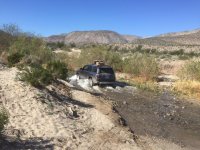
Deep Creek Crossing

This is what I needed my breather relocation for. I got it done just in time for this trip. There's another crossing just beyond this that is usually high enough to submerge your rear bumper and leave a water mark half way up your doors. Not this time though. The creek was dryer in places and the flow had changed this year. Still, I'm sure the axle got soaked in this crossing.

Anza Borrego Desert State Park, San Diego County, 25 miles from the Salton Sea in California ~20 miles from the Mexican border.
 

Attachments

  • IMG_2894.jpg
    IMG_2894.jpg
    138.2 KB · Views: 1,614
Has anyone every actually found water in the axle? My question is basically this: Toyota axles have used the same system for 50+ years and have not opted to locate the breather up higher. And this includes all the Asian trucks and SUVs that spend a lot of time in the water. I've done breathers on half a dozen toyotas over the years. I'm questioning whether it is necessary or not.

Also just for future folks - bellows type breathers are a good alternative to filters or caps. They will eventually wear out, but they maintain a closed system and it really doesn't make any difference where you mount them. No need to run hose all over the place or drill holes. Just tuck up along the frame rail somewhere protected.
images
 
Has anyone every actually found water in the axle? My question is basically this: Toyota axles have used the same system for 50+ years and have not opted to locate the breather up higher. And this includes all the Asian trucks and SUVs that spend a lot of time in the water. I've done breathers on half a dozen toyotas over the years. I'm questioning whether it is necessary or not.

Here was my logic behind completing this simple upgrade. I read a number of articles from as far back as 25 years about 4wheelers extending the differential breathers for all of the same reasons that we talk about on here, namely water intrusion. The articles (and forum posts) were across a number of platforms, in a number of different environments. I don't think that this modification would have lasted this long if it wasn't for good measure.

The other thing that I considered was if water intrusion wasn't an issue at all, then why would Toyota route the transmission, transfer case and front axle breathers to the firewall versus an 'on the unit' piece? I guess flip side would be why would Toyota knowingly design the rear axle breather as they have, knowing that it would lead to failure (unlikely). It's a back and forth argument.

Ultimately for me, it was the thought of being over protected that got me to do it. Same as most of the mod's that we add on to these vehicles, not because something will happen, but if it happens. Plus I took it as a good chance to get to know the underside of the truck a little bit more, and to get some more wrench time on it. That's just me though!
 
Has anyone every actually found water in the axle? My question is basically this: Toyota axles have used the same system for 50+ years and have not opted to locate the breather up higher. And this includes all the Asian trucks and SUVs that spend a lot of time in the water. I've done breathers on half a dozen toyotas over the years. I'm questioning whether it is necessary or not.

The diff is hot, you are not going to find water just sitting in it. It will leave behind all the dirt and deposits that were in the water.

Manufacturers just do what is practical. They put the air intake at the top of the engine bay, and call that good enough. A few people need a snorkel and have to add that themselves. They do the same with the breathers.

Most owners manuals will tell you to change the diff oil anytime you drive in water up to the hubs. Ever wonder why they say that?
 
Guys , just throwing this out there , I would not use the factory end one way valve , been working with Toyota axles for a long time and have seen them plug on even pavement queens , the oil mist/ vapors gets around the little rubber valve and dust and dirt stick to it and the little spring and after so much gets on them it renders them useless and they plug ,

I have always put a cheap ole see through gas filter on the end and extended the hose up and never had an issue and keeps dust out when axle sucks in air .

I have seen the factory ones suck both open and closed
Not really an issue if it sticks open and its elevated above any water crossings , the problem is when it sticks closed first thing that leaks is the pinion seal.
 
Guys , just throwing this out there , I would not use the factory end one way valve , been working with Toyota axles for a long time and have seen them plug on even pavement queens , the oil mist/ vapors gets around the little rubber valve and dust and dirt stick to it and the little spring and after so much gets on them it renders them useless and they plug ,

I have always put a cheap ole see through gas filter on the end and extended the hose up and never had an issue and keeps dust out when axle sucks in air .

I have seen the factory ones suck both open and closed
Not really an issue if it sticks open and its elevated above any water crossings , the problem is when it sticks closed first thing that leaks is the pinion seal.

Good points! I've had my oem valve on for a year but it should be time to throw a regular cone shaped filter on the fuel line for piece of mind. Thanks for the reminder.
 
The transmission, transfer case and front axle are all mounted in the engine bay on the passenger side firewall, remotely. Plenty high to not worry about water intrusion. The rear axle breather is on the axle, and the e-locker is about 10" above that. Much lower than the other 3 breathers on the vehicle.

Do you have pics of where they are mounted? I looked and did not see them, but I may have overlooked them. Thanks!
 
Which ones specifically are you looking for?

The front diff, transfer case, and transmission breathers. I can't seem to locate them on the firewall. I swear this 4Runner is making me feel like such a noob. I've wheeled fords and dodges for years and felt like I had a good knowledge base for those vehicles, but this Toyota has me scratching my head sometimes. Thanks again.
 
No air is drawn through the axle seals.

From ARB: Many drivetrain assemblies are fitted with a breather from the factory. These factory breathers can be a one-way valve mounted directly to the housing or remotely on a short tube. The shortfall with the factory breathers is that driving through water crossings creates a vacuum caused by the drivetrain assembly being cooled rapidly by the water. This vacuum will tightly close the valve shut causing air to be instantly drawn into the assembly through the seals. Many times the seals are still submerged below water, leading to the water being drawn into the drivetrain. This will contaminate the oil and possibly damage drivetrain components or your Air Locker.
 
The front diff, transfer case, and transmission breathers. I can't seem to locate them on the firewall. I swear this 4Runner is making me feel like such a noob. I've wheeled fords and dodges for years and felt like I had a good knowledge base for those vehicles, but this Toyota has me scratching my head sometimes. Thanks again.

The front diff breather(s) (one on a Limited, two on everything else) are on the driver's side inner fender near the fusebox and oil fill hole. The transmission and transfer case breathers (two for everyone) are behind the engine at the top of the transmission bell housing. You can't really see those two but you can find them by feel.
 
From ARB: Many drivetrain assemblies are fitted with a breather from the factory. These factory breathers can be a one-way valve mounted directly to the housing or remotely on a short tube. The shortfall with the factory breathers is that driving through water crossings creates a vacuum caused by the drivetrain assembly being cooled rapidly by the water. This vacuum will tightly close the valve shut causing air to be instantly drawn into the assembly through the seals. Many times the seals are still submerged below water, leading to the water being drawn into the drivetrain. This will contaminate the oil and possibly damage drivetrain components or your Air Locker.

Thats from ARB , Not Toyota ! they're telling you that to cover themselves because their systems are known to leak and pressurize the housing. I'm very familiar with ARB and there shortfalls. In regards to the factory breather without the ARB it is completely safe and absolutely unnecessary to modify and air is not drawn through the axle seals in a stock type application period . Like many have said the factory style breather has been a Toyota trademark for 50+ years and Toyota has the best reputation because it works perfect!
That's why we buy toyota in the first place.
 
The front diff breather(s) (one on a Limited, two on everything else) are on the driver's side inner fender near the fusebox and oil fill hole. The transmission and transfer case breathers (two for everyone) are behind the engine at the top of the transmission bell housing. You can't really see those two but you can find them by feel.

Thanks for the info!
 
Thats from ARB , Not Toyota ! they're telling you that to cover themselves because their systems are known to leak and pressurize the housing. I'm very familiar with ARB and there shortfalls. In regards to the factory breather without the ARB it is completely safe and absolutely unnecessary to modify and air is not drawn through the axle seals in a stock type application period . Like many have said the factory style breather has been a Toyota trademark for 50+ years and Toyota has the best reputation because it works perfect!
That's why we buy toyota in the first place.

Really, then you must have never seen one after water crossings where water has gone past the pinion or axle seals. By design, seals are made to keep oil in, not keep anything out.

:doh:


Then, why do we mod?

:pop2:

YMMV
 

Members online

Forum statistics

Threads
278,316
Messages
3,554,120
Members
248,016
Latest member
Advally Service

Trending content

Back
Top