ECGS DIY Gear Swap

Mutant138

Banned
Idk if I necessarily want to do all this work myself... Not that I'm over my head but more that I hate wrenching lol. I suppose this is what I asked for by getting into 4x4s from drifting and telling myself it would be less expensive.

Anyone do the fully assembled method with the core charges diy? Watched some vids online and it seems I could bang it out at home no issues.

Do’s? Don’ts? Regrets?

Is this more expensive then just getting the gears and paying the labor? Trying to compare labor costs to the core charge option and diy.

I haven’t dove into it personally but is it super complicated to take apart the existing diffs and install gears yourself? Seems like there will be a ton of technical issues and job specific tools. Would the cost of the tools be cheaper then both options?
 

Attachments

  • 9E328157-0FB0-4320-AAAB-E3E6E24940A8.jpg
    9E328157-0FB0-4320-AAAB-E3E6E24940A8.jpg
    87.9 KB · Views: 1,735
Last edited:
Register to hide this ad
You will get the core charge back when you send your different in. So going with ECGS will be cheaper. Many people have gone this route.

Labor for gears is pricey. I had a shop do my rear locker and 4.56 gears and ran me about 4k.


As for tools if you get the cores I think its basic hand tools with a torque wrench.

Sent from my SM-N986U using Tapatalk
 
Last edited:
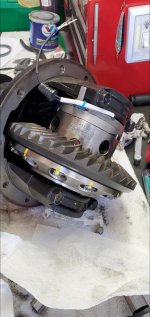
I installed a rear locker, so I did have do deal with the ring gear shims and backlash, but not the pinion.

It was not difficult. I do suspect the pinion work will be more effort than the ring gear work.

Only tool I recall buying for the job was a dial indicator.

If (and when) I regear, I will do it myself, but that's because I want to. The more practical way would be the pre-built swap.
 

Attachments

  • Screenshot_20200912-085822_Gallery.jpg
    Screenshot_20200912-085822_Gallery.jpg
    144 KB · Views: 1,628
  • Screenshot_20200912-085755_Gallery.jpg
    Screenshot_20200912-085755_Gallery.jpg
    141.4 KB · Views: 1,673
Last edited:
You will get the core charge back when you send your different in. So going with ECGS will be cheaper. Many people have gone this route.

Labor for gears is pricey. I had a shop do my rear locker and 4.56 gears and ran me about 4k.


As for tools if you get the cores I think its basic hand tools with a torque wrench.

Sent from my SM-N986U using Tapatalk

I meant tools to assemble the diffs myself just buying the gears.
 
All my experience is with 8" Toys and that is installing Lockers and gearing......but If I was to do the 4Runner I would get the built pumpkins and do the swap.....and if you do limited slip OR a locker, get the spacer and new bearings for sure. No crush sleeve in a locked unit or you will regret it.
 
I did ECGS assembled diffs with 4.56 gears and ARB locker back in 2014. Highly recommend. Not too many places with experience with the 8.2 and so many problems with the ARB lockers due to (IMHO) poor installation (or counterfeit parts). 200k miles later and not a single issue with my diffs.
 
I opted to have a local shop who specializes in ARB’s do my gears and lockers, gears are generally one of those things that takes specialized knowledge to set correctly, doubly so for air locker installs.

I place value in having a local shop to go back to for ongoing maintenance and any potential issues that may arise.. at least for specialized things like transmissions, transfer cases, and gears.

I tried to do a mail-order built 3rd member swap on my 80-series Crusier and it ended up being a nightmare. The thirds couldn’t fit without internal grinding of the axle housing (which isn’t uncommon in general, but not sure if it is on 5th gens specifically). But the diffs they sent also had knockoff Chinese built 3rd housings that didn’t mate up perfectly to the axle, and on top of that they used an fj60 spec rear locker instead of an 80 spec, which they claim is “strong enough” but it wasn’t what I ordered (2 pinion vs 4 pinion design). This was from an outfit on the west coast that has an arguably excellent reputation, on par with ECG.

Long story short, after a lot of bs I got them to accept the return, but I was out return shipping and a restocking fee. if you do mail-order be extremely specific on your expectations, and know that other things could arise that require extra work, as well as eventual maintenance. It’ll be good to have a local shop on call for future service.

If all goes well they should just bolt right in. The front is harder to access than the rear, so plan your time accordingly.

I’ve heard only good things with ECG so I’m
not dissuading anyone from them. The fact they more or less originated the needle bearing bushing swap for the front diff is a testament to their commitment to Toyota’s, so you should be good. I just wanted to express my thoughts on the value of having it done locally.

For what it’s worth, I paid under 6k for 4.88’s and dual air lockers installed, with solid spacers (no crush sleeve) and including a gear oil change and diagnostic at 500 miles to assess break-in.

Hope that helps.
 
No locker upfront??

Idk what I’m doing yet tbh. I’m on the fence with going all out or just leaving it as is for now. Part of me says just spend the money getting the electrical prepped for mods, upgrade the fogs, full set of maxtrax, portable power supply with solar, better camping gear, better comm/ems sat shit, bla bla bla bla bla

I just wanted to price out the base swap and try to get a feel for it.

Suppose if I go through with this I would just dish out and be twin locked. I will say I have yet to encounter a situation where rear locked and atrac couldn’t hang... but I imagine that’s because I don’t have the bumpers to put myself on those lines.
 
Last edited:
FWIW - I'm not sure how many other members have setup the diff gearing themselves, so I'll give you my take on it. - It's very do-able yourself if you have the right tools, a very good clean workspace, and a shit ton of patience.

The following is a lot of stuff that's pretty hard to describe, but easier to demonstrate. My life is simply too busy right now to do a full tutorial video on how to do this.

The front is a lot harder than the rear. The pinion depth is by far the most difficult part of setting up any differential gear set. The pinion depth is 90% of the work to get a proper gear pattern. The ring gear is set to mesh at a specific distance relative to the pinion, so if the pinion is set correctly, the ring gear depth is just a matter of getting spacing correct.

Doing this DIY style usually means that you don't have the proper measuring tools for pinion depth. So you'll be doing by essentially the "guess and check" method. And that takes a lot more time than doing it with advanced measuring tools. Advanced tools allow you to simply measure the stock pinion (it has a depth measurement written on the end), new pinion will also have depth measurement that was measured by the manufacturer during the manufacturing process. This is a measurement to the surface of the end of the gear head. You cannot add or subtract the shims based on the two different measurements. The measurement is from the center of the carrier bearing (side bearings) center point to the head of the pinion. But it's offset laterally, so you can't just measure it directly. There are tools that do this, I just don't own one. Toyota almost certainly does it with sophisticated laser interference measurements. They don't guess. And they only assemble once for a perfect pattern every time. If I ever do a front setup again - I'll figure out how to either buy or build my own very high precision measuring setup. The guess and check method is pretty easy on a rear diff. It's not on the front. I'll try to explain why;

When setting up a diff, you're trying to match a gear pattern in 3 dimensions. The pinion moves in one axis - let's call it "in and out". The ring gear is then adjustable in another perpendicular axis we'll call "left and right". The backlash is essentially just the small space between the gears. They can't be setup completely pushed together. They need a little space. It's measured by the distance between contact of the teeth in one direction, and then again in the other direction. That's called backlash, but it really just means a way to measure how much extra space there is between them.

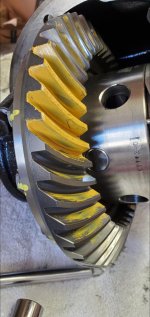
On a typical Toyota rear diff - the ring gear adjustment left and right is done with big adjuster rings that you move with a specialty wrench. So you can set the pinion depth to start with, then adjust the ring gear left or right to get the correct backlash. Then you check the paint pattern and see if the pinion needs to go in or out more. You take a guess at how far, and check again. Every time you have to adjust the pinion depth - you have to remove the ring gear and carrier assembly, then remove the pinion and remove the pinion bearings.

It's difficult to remove the pinion bearings without damaging them. This is why you really need a set of "setup bearings". I make my own. What that means is that you take a good used set of bearings and you take a die grinder and sand the inside so that they are a slip fit over the pinion shaft. That way you don't have to go press the bearings on and off each time. You can simply slip fit them. Final assembly you'll then use the real bearings that will require a press together fit. *so this is a one of the costs that you're probably not accounting for. If you're buying full rebuild kits with all new bearings - then you use your old bearings. If you're not replacing the bearings (honestly - even in the rear diff there's no need to unless you're probably 150k miles plus. Toyota uses very good quality stuff and they basically don't wear out - but still, you'll want a second set for setup bearings if at all possible. They make life so much easier. - the ones that IMO are kind of a must-have for an easy assembly is the main pinon bearing on the rear diff and both pinion bearings on the front diff.

What makes the front clamshell a huge PITA is that the backlash or ring gear left/right adjustment is also a guess and check situation and the shims you use go outside of the bearing races on the clamshell housing. So you set the pinion depth with the shim stack you think is correct. Then you have to put shims in the housing on both sides to guess what backlash will be and to do so you have to remove the bearing races on both side, add or remove shims on both sides, re-hammer in the bearing races, then put the carrier in and clamp the clamshell sides together and measure for backlash. If the backlash isn't correct - you can't take a paint pattern to see if the pinion depth is correct.

You have to adjust backlash by separating the clamshell and adding or removing shims. So each adjustment requires separating the clamshell, pressing out both bearing races in each half of the clamshell, trying new shim sets, then pressing back in the races. then re-assembling, checking backlash, then if you get it right - you can test the pinion depth via paint pattern. To adjust the pinion depth once you see the pattern, you then get to do the entire thing all over again (and yeah - you have to adjust the backlash shims again with every new pinion depth change). So it takes for fawking ever unless you guess pretty close on the first one. Or you have the correct measuring tools. If you add to this process having to use a press to press on and off the pinion bearing every time - it'll really take forever. Having a set of setup bearings makes this go a whole lot easier.

When I did mine - I bought a spare front complete diff so I could set it up before I got started with the rest. It was much easier and less stressful to do that way. I didn't start the rest until I had the front diff ready to go. I also bought a spare rear diff as well.

The rear is pretty quick and easy. I think I could do a complete rear diff gear swap in about 2 hours once the diff is out. The removal and install takes me something like 5 hours IIRC. If I had a vehicle lift, I'd cut that in half.
On older Toyota setups without the clamshell front - I'd say DIY without much hesitation. I could probably swap gearing in my FJ40 in an afternoon. The newer setups are just a lot more time consuming.

I ended up short on time and was trail guiding a moab event, so I went to a local shop to setup my rear diff - it went poorly. They botched it in a few ways, then promptly closed the shop a week later. FML. They had a good reputation among the jeep crews, had been around for 20 years, etc. They didn't get the pinion crush sleeve fully crushed and I could tell from day 1 that something was wrong. Pattern was WAY off. And preload was also not even close. So I had to pull the diff back out and re-build it anyway. Complete waste of time and money on that. I replaced all the bearings too when I did it because I didn't trust their work after seeing what kind of shit job they did. It was a shop called Orion in SLC, UT. They did some really fawking shitty stuff - like filled the pinion splines where the flange goes on with RTV. WTF?? They used red loctite on some of the diff housing nuts, but not all of them??? Just all around terrible job. So I basically just threw away the money on that one.

The point here - if you do have a local shop do the setup be very careful who you let touch your diffs. Sadly this skill is getting less and less common. It's really not that hard. But, it's done so infrequently that most shops don't have anyone who's good at it. Hate to say it - but 4wheel parts probably does more than almost anyone around here. At a minimum make them keep track of all the specs for you so you know they've checked them and you can verify if you need to - pinion preload, combined preload, and backlash, plus a picture of the final paint pattern.

In retrospect for mine - I think the ECGS swap is probably a good solution for most people. It's still going to take a full day to get them swapped in. But you get diff setup by pros who do a ton of them. And the cost is probably the same or less than what a local shop would charge to do the setup. Even if you have a local shop swap the diffs out - I'd still go for an ECGS or similar setup unless you know for absolute certain that your local shop is really good.

Hope that sorta helps explain some of the pitfalls of doing it yourself. Yes, you absolutely can DIY this if you have:
a hydraulic shop press

A GOOD QUALITY bearing separator. This is important. - cheap ones are soft metal and will not work. You will ruin parts if you try to use a cheap one. This is teh one I have. Amazon.com: ABN Bearing Puller with 1/2in to 4-5/8in Jaw – Splitter Tool for Wheel Hub, Gear Pinion, Bearing Separator: Automotive I also have a cheap HF one - it's trash. The metalurgy is very weak on the cheap HF one and it would just deform and ruin the bearing if you tried to use it for this. You need a good one. This ABN one is totally different. It's very hard high quality steel. And works great. You need to use it in combination with your shop press to remove the pinion bearings without damaging them.

a decent set of bearing race press discs
a dial indicator on a magnetic base,
spare bearings for setup bearings (could probably buy some really cheap ones and keep the originals for final assembly)
torque wrenches - one full size, and one inch lb for bearing preload,
A long breaker bar for crushing the sleeve - it takes a lot of force,
A bench vice is really handy to have also,
some ability to fabricate tools to use for doing paint pattern test on the clamshell - it's not easy
ability to make a tool or a spanner wrench for the side bearing preload on the rear diff.
A clean bench top to work on
All the tools and space to remove and install your diffs in the vehicle - this means you'll also need to be able to clean the rear diff mounting face and bleed the rear brakes.

Also - boiling the ring gear as per the FSM really does work just right.

I think that covers most of it.

Hope that helps a bit. Good luck.

 
Last edited:
I would limited -slip the front.......I have seen too many front diffs break with lockers, it isn't very stout and LS is plenty for all but crazy stuff few people do in a 5th Gen.
 
I would limited -slip the front.......I have seen too many front diffs break with lockers, it isn't very stout and LS is plenty for all but crazy stuff few people do in a 5th Gen.

FWIW - I would say the opposite and not put a LS in the front. The reason is that in 2wd mode, your spinning one side of the front carrier only. The LS, depending on model - will run down the road in a constant state of friction in the cluches or wear on the hypoid gears. It's not a good front diff disconnect design for limited slips in 2hi. And Atrac or MTS/Crawl is as good or better than any limited slip I've ever used already.

I do think that a trutrac type limited slip would work really well combined with the traction control systems. They would compliment each other really nicely when in use. But - the 2wd operation would be a deal breaker for me.

In a Limited model - sure. A limited slip might work nicely.

This video shows pretty well just how good the ATRAC is on a base model SR5. It's kinda why I think a front limited slip isn't really doing anything beneficial compared to what it already has and the next step is probably best to be a full locker.

<iframe width="1009" height="568" src="https://www.youtube.com/embed/6ARYqd9lQRo" frameborder="0" allow="accelerometer; autoplay; encrypted-media; gyroscope; picture-in-picture" allowfullscreen></iframe>
 
Last edited:
Holy hell I was not expecting that in depth of a response and I’m humbled you would take the time to provide it. [MENTION=118321]Jetboy[/MENTION]

I’m gonna give it a solid read through when I have less beer in my belly tomorrow.
 
Holy hell I was not expecting that in depth of a response and I’m humbled you would take the time to provide it. [MENTION=118321]Jetboy[/MENTION]

I’m gonna give it a solid read through when I have less beer in my belly tomorrow.

I had a headache reading it. To sum it up, it seems painful to try it without the precise measuring tools as its a lot of trial and error haha
 
I, myself would NOT put anything in the front either........just saying if you are dead set on doing something, I wouldn't lock it. I agree with Jetboy that ATRAC is all you need in the front. I really like the worm-gear style Tru-Trac over any clutch style LSD.
 
FWIW - I'm not sure how many other members have setup the diff gearing themselves, so I'll give you my take on it. - It's very do-able yourself if you have the right tools, a very good clean workspace, and a shit ton of patience.

The following is a lot of stuff that's pretty hard to describe, but easier to demonstrate. My life is simply too busy right now to do a full tutorial video on how to do this.

The front is a lot harder than the rear. The pinion depth is by far the most difficult part of setting up any differential gear set. The pinion depth is 90% of the work to get a proper gear pattern. The ring gear is set to mesh at a specific distance relative to the pinion, so if the pinion is set correctly, the ring gear depth is just a matter of getting spacing correct.

Doing this DIY style usually means that you don't have the proper measuring tools for pinion depth. So you'll be doing by essentially the "guess and check" method. And that takes a lot more time than doing it with advanced measuring tools. Advanced tools allow you to simply measure the stock pinion (it has a depth measurement written on the end), new pinion will also have depth measurement that was measured by the manufacturer during the manufacturing process. This is a measurement to the surface of the end of the gear head. You cannot add or subtract the shims based on the two different measurements. The measurement is from the center of the carrier bearing (side bearings) center point to the head of the pinion. But it's offset laterally, so you can't just measure it directly. There are tools that do this, I just don't own one. Toyota almost certainly does it with sophisticated laser interference measurements. They don't guess. And they only assemble once for a perfect pattern every time. If I ever do a front setup again - I'll figure out how to either buy or build my own very high precision measuring setup. The guess and check method is pretty easy on a rear diff. It's not on the front. I'll try to explain why;

When setting up a diff, you're trying to match a gear pattern in 3 dimensions. The pinion moves in one axis - let's call it "in and out". The ring gear is then adjustable in another perpendicular axis we'll call "left and right". The backlash is essentially just the small space between the gears. They can't be setup completely pushed together. They need a little space. It's measured by the distance between contact of the teeth in one direction, and then again in the other direction. That's called backlash, but it really just means a way to measure how much extra space there is between them.

On a typical Toyota rear diff - the ring gear adjustment left and right is done with big adjuster rings that you move with a specialty wrench. So you can set the pinion depth to start with, then adjust the ring gear left or right to get the correct backlash. Then you check the paint pattern and see if the pinion needs to go in or out more. You take a guess at how far, and check again. Every time you have to adjust the pinion depth - you have to remove the ring gear and carrier assembly, then remove the pinion and remove the pinion bearings.

It's difficult to remove the pinion bearings without damaging them. This is why you really need a set of "setup bearings". I make my own. What that means is that you take a good used set of bearings and you take a die grinder and sand the inside so that they are a slip fit over the pinion shaft. That way you don't have to go press the bearings on and off each time. You can simply slip fit them. Final assembly you'll then use the real bearings that will require a press together fit. *so this is a one of the costs that you're probably not accounting for. If you're buying full rebuild kits with all new bearings - then you use your old bearings. If you're not replacing the bearings (honestly - even in the rear diff there's no need to unless you're probably 150k miles plus. Toyota uses very good quality stuff and they basically don't wear out - but still, you'll want a second set for setup bearings if at all possible. They make life so much easier. - the ones that IMO are kind of a must-have for an easy assembly is the main pinon bearing on the rear diff and both pinion bearings on the front diff.

What makes the front clamshell a huge PITA is that the backlash or ring gear left/right adjustment is also a guess and check situation and the shims you use go outside of the bearing races on the clamshell housing. So you set the pinion depth with the shim stack you think is correct. Then you have to put shims in the housing on both sides to guess what backlash will be and to do so you have to remove the bearing races on both side, add or remove shims on both sides, re-hammer in the bearing races, then put the carrier in and clamp the clamshell sides together and measure for backlash. If the backlash isn't correct - you can't take a paint pattern to see if the pinion depth is correct.

You have to adjust backlash by separating the clamshell and adding or removing shims. So each adjustment requires separating the clamshell, pressing out both bearing races in each half of the clamshell, trying new shim sets, then pressing back in the races. then re-assembling, checking backlash, then if you get it right - you can test the pinion depth via paint pattern. To adjust the pinion depth once you see the pattern, you then get to do the entire thing all over again (and yeah - you have to adjust the backlash shims again with every new pinion depth change). So it takes for fawking ever unless you guess pretty close on the first one. Or you have the correct measuring tools. If you add to this process having to use a press to press on and off the pinion bearing every time - it'll really take forever. Having a set of setup bearings makes this go a whole lot easier.

When I did mine - I bought a spare front complete diff so I could set it up before I got started with the rest. It was much easier and less stressful to do that way. I didn't start the rest until I had the front diff ready to go. I also bought a spare rear diff as well.

The rear is pretty quick and easy. I think I could do a complete rear diff gear swap in about 2 hours once the diff is out. The removal and install takes me something like 5 hours IIRC. If I had a vehicle lift, I'd cut that in half.
On older Toyota setups without the clamshell front - I'd say DIY without much hesitation. I could probably swap gearing in my FJ40 in an afternoon. The newer setups are just a lot more time consuming.

I ended up short on time and was trail guiding a moab event, so I went to a local shop to setup my rear diff - it went poorly. They botched it in a few ways, then promptly closed the shop a week later. FML. They had a good reputation among the jeep crews, had been around for 20 years, etc. They didn't get the pinion crush sleeve fully crushed and I could tell from day 1 that something was wrong. Pattern was WAY off. And preload was also not even close. So I had to pull the diff back out and re-build it anyway. Complete waste of time and money on that. I replaced all the bearings too when I did it because I didn't trust their work after seeing what kind of shit job they did. It was a shop called Orion in SLC, UT. They did some really fawking shitty stuff - like filled the pinion splines where the flange goes on with RTV. WTF?? They used red loctite on some of the diff housing nuts, but not all of them??? Just all around terrible job. So I basically just threw away the money on that one.

The point here - if you do have a local shop do the setup be very careful who you let touch your diffs. Sadly this skill is getting less and less common. It's really not that hard. But, it's done so infrequently that most shops don't have anyone who's good at it. Hate to say it - but 4wheel parts probably does more than almost anyone around here. At a minimum make them keep track of all the specs for you so you know they've checked them and you can verify if you need to - pinion preload, combined preload, and backlash, plus a picture of the final paint pattern.

In retrospect for mine - I think the ECGS swap is probably a good solution for most people. It's still going to take a full day to get them swapped in. But you get diff setup by pros who do a ton of them. And the cost is probably the same or less than what a local shop would charge to do the setup. Even if you have a local shop swap the diffs out - I'd still go for an ECGS or similar setup unless you know for absolute certain that your local shop is really good.

Hope that sorta helps explain some of the pitfalls of doing it yourself. Yes, you absolutely can DIY this if you have:
a hydraulic shop press

A GOOD QUALITY bearing separator. This is important. - cheap ones are soft metal and will not work. You will ruin parts if you try to use a cheap one. This is teh one I have. Amazon.com: ABN Bearing Puller with 1/2in to 4-5/8in Jaw – Splitter Tool for Wheel Hub, Gear Pinion, Bearing Separator: Automotive I also have a cheap HF one - it's trash. The metalurgy is very weak on the cheap HF one and it would just deform and ruin the bearing if you tried to use it for this. You need a good one. This ABN one is totally different. It's very hard high quality steel. And works great. You need to use it in combination with your shop press to remove the pinion bearings without damaging them.

a decent set of bearing race press discs
a dial indicator on a magnetic base,
spare bearings for setup bearings (could probably buy some really cheap ones and keep the originals for final assembly)
torque wrenches - one full size, and one inch lb for bearing preload,
A long breaker bar for crushing the sleeve - it takes a lot of force,
A bench vice is really handy to have also,
some ability to fabricate tools to use for doing paint pattern test on the clamshell - it's not easy
ability to make a tool or a spanner wrench for the side bearing preload on the rear diff.
A clean bench top to work on
All the tools and space to remove and install your diffs in the vehicle - this means you'll also need to be able to clean the rear diff mounting face and bleed the rear brakes.

Also - boiling the ring gear as per the FSM really does work just right.

I think that covers most of it.

Hope that helps a bit. Good luck.

Well I'm going to be honest this doesn't seem impossible by any means. But what it does sound like is a gigantic pain in my rectum.

If i decide to do this I'll just go for the complete units from ECGS and swap them in over a weekend. Take the financial hit as the cost of convenience and rest easy knowing it was professionally assembled.

Thanks for your time and input. Path ahead has been cleared. Cheers.
 
A regear is on my list within the next year and I am torn between paying someone to do it or doing it myself. I know I could probably figure out how to do it myself but sometimes it is just easier to pay someone to do it and work the time it would've taken me to make up the difference in cost.
 
Well I'm going to be honest this doesn't seem impossible by any means. But what it does sound like is a gigantic pain in my rectum.

I think this pretty much sums it up. It's totally do-able. You don't need special magic skills. It's just a huge PITA to setup and do only one set.
 

Members online

Forum statistics

Threads
278,311
Messages
3,554,082
Members
248,016
Latest member
Advally Service

Trending content

Back
Top