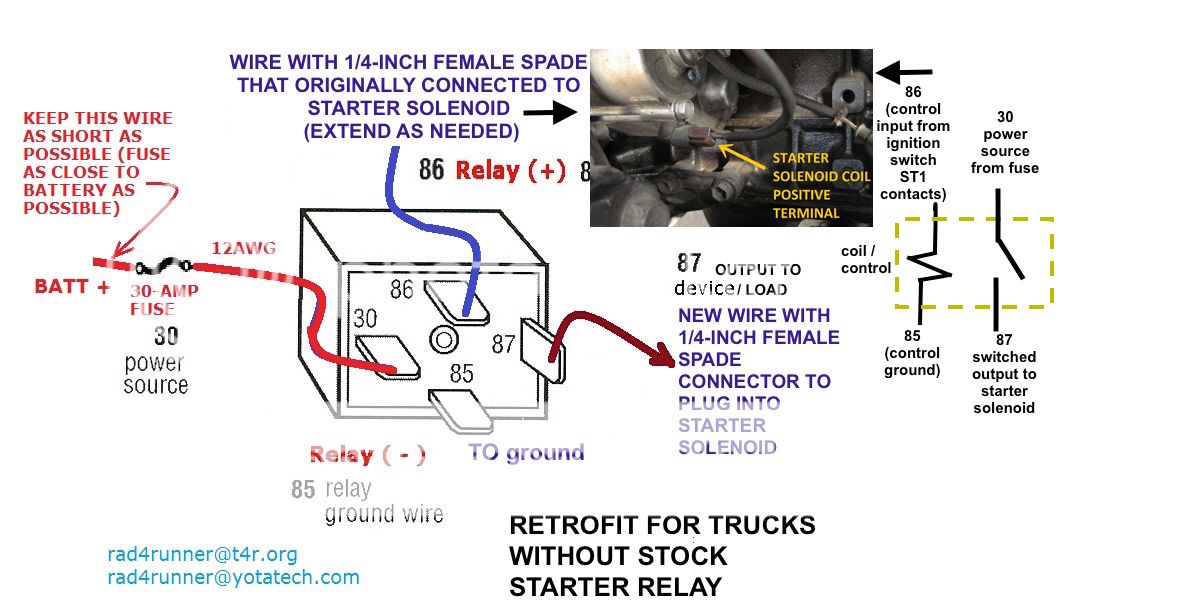
Final fix for intermittent no-crank on the 22re.

I really appreciate the awesome write up and detailed information.

What would make this even easier for idiots like me is a separate list saying something like
"Parts needed" and describing the approximate length of said wires needed and connectors. I'd recommend putting it as the first step.

Once again awesome Write up and please don't take offense to the ideas I had. I simply think it'd be easier for adhd freaks like to comprehend.

I'm still not sure about the ignition wire. Can I just run the ignition wire to the solenoid/relay from the starter and from near plenum gasket to solenoid/relay effectively putting the relay/solenoid in the middle of the two?

Should I get all stranded wire?

What lengths are needed approximately?

FYI for me it seems like the hotshot would have been easier if it was sold locally cause relay was 22 with tax and wires are gonna run about 12 plus connectors. But a fun learning experience.
 
Last edited:
I want to put it on the wheel well inside the engine compartment like kid v did. Do I simply run a wire from the relay and splice it into the ignition wire close to the starter or do I run the ignition wire to the relay and run it from the relay to the starter?

I'm terrible with electrical systems but can figure stuff out if I know where to look.

Thanks guys

The first one of you to make fun of my mad Paint skills is gonna get it in the neck.

relaywiring.png

Maybe this makes it easier, Proto? This assumes that you don't have a factory relay - the top is how it's wired now, there's a path from the battery to the ignition switch to the starter solenoid. That path allows the entire voltage needed to close the solenoid (which is basically a high power relay) to flow through the ignition switch, and it wears out the contacts in the ignition. The bottom is how it's going to look when you're done - you're going to cut the wire between the ignition switch and the starter solenoid (the smaller of the two wires on the starter, wire 2 in my high speed diagram there). You're going to terminate that wire instead on the trigger post of the new relay (86). You're going to run a new wire (the blue wires on the diagram, 3 and 4) from the starter to the primary input on the relay (30) and then from the primary output (87) to the solenoid wire plug on the starter.

I can't tell you exactly what lengths of wire you'll need, sorry, it depends on where you put the relay and how you route the wires, etc, and I don't have the truck I did this to anymore so I can't tell you exactly what lengths mine were :). Get three or four feet of the 8AWG and maybe a foot or two or 18AWG and you'll be set. I used basic stranded wire with fuel/oil resistant sheathing from the hardware store.
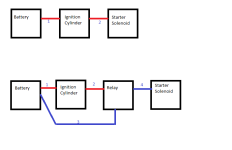
 

Attachments

  • relaywiring.png
    relaywiring.png
    11.2 KB · Views: 1,466
This is how I understand it

It seems to me that both wires can be simply spliced and terminated onto the 76 bronco relay/solenoid unless I'm missing something.

I understand that you chose to keep the original power cable from the starter to the battery intact in case you wanted to go OEM again. For me it seems like a simple splice of the ignition wire under the plenum would be sufficient.

Does that ignition wire terminate near the Plenum gasket? Or does it run directly from the ignition switch unterminated to the starter?

And if I choose I can splice into the power cable (between the starter and the battery) and terminate it to the relay/solenoid that I've added to the fender wall, rather than making new cables.

I'm posting too pathetic five-year-old like drawings of how I understand it to work please confirm and tell me if this makes sense.

KidV you ****ing rock!!! :first:


pic host


image hosting over 5mb


Obviously I did not draw stuff to scale and in the second picture I forgot to label the ignition wire as such but I think we all know what it represents.

I still feel like I'm missing something however. After splicing into the ignition wire does it not have to run to the starter at all?
Aye aye aye
 
Last edited:
...What would make this even easier for idiots like me is a separate list...

Hi Protomind,
Before you do anything, it would help, it would be safer, and it would be simpler and cheaper (You may not need to add a relay) if you told us what year-model truck you have.
(1) If 1985 4Runner, then you would need to add a relay.
(2) If 1986-1987 4Runner with stock starter relay, then you merely need to re-wire.
Either way, you would need a couple feet of 12AWG stranded wire, a 30-amp fuse and soldering/crimping supplies.

The following apply to 1984-1988 4Runner 22R-E's (Not sure about others)

NEED TO ADD A RELAY?:
Add_Starter_Relay_zpsqvdy66ip.jpg~original


FACTORY RELAY ALREADY EXISTS?
user101367_pic26329_1349500438_zps0ba521c9.jpg~original

Place fuse as close to battery as possible.

Where is the factory starter relay on the 22R-E?
Starter_Relay-1.jpg~original


Cheers!
 
Last edited:
It seems to me that both wires can be simply spliced and terminated onto the 76 bronco relay/solenoid unless I'm missing something.

I understand that you chose to keep the original power cable from the starter to the battery intact in case you wanted to go OEM again. For me it seems like a simple splice of the ignition wire under the plenum would be sufficient.

Does that ignition wire terminate near the Plenum gasket? Or does it run directly from the ignition switch unterminated to the starter?

And if I choose I can splice into the power cable (between the starter and the battery) and terminate it to the relay/solenoid that I've added to the fender wall, rather than making new cables.

I'm posting too pathetic five-year-old like drawings of how I understand it to work please confirm and tell me if this makes sense.

KidV you ****ing rock!!! :first:


pic host


image hosting over 5mb


Obviously I did not draw stuff to scale and in the second picture I forgot to label the ignition wire as such but I think we all know what it represents.

I still feel like I'm missing something however. After splicing into the ignition wire does it not have to run to the starter at all?
Aye aye aye

Nope, your second drawing has issues. The main 4ga power cable will always run from the battery straight to the starter, don't touch it. The factory setup has a thin little 18ga or so wire from the ignition to the starter solenoid - that's the one that pops out of the harness under the plenum, that's the one you're going to cut the connector off and terminate it on the trigger post of the new starter relay (as you noted, making it so you can easily swap back to factory is optional). Once you've done that, then turning the ignition will provide 12v to actuate the relay, but that won't help at all unless the relay is providing the missing power to the solenoid, so you're going to run 8ga from the battery to the relay, and another run of 8ga from the relay to the starter. Please note that there will be only one wire between the starter relay and the starter. The fourth post is the ground reference for the trigger wire/ignition wire - you shouldn't need a wire there, if you use the same relay I did and mount it to the inner fender it should ground itself to the fender.

All this assumes that your truck does not already have a factory starter relay - anything after '87 and some (most?) '86 trucks will have that factory relay already installed, in which case you want RADs fix, not mine.
 
Oh sorry
I didn't specify which truck I have. It a 2002 Chevy Silverado.


Just kidding it's an 87 4Runner 22RTE with no starter relay from the factory what so ever.
 
So....essentially the starter relay would now take the place of (supplement in conjunction with rather) the ignition being engaged. It uses the power from the 8awg from the battery and is triggered by the weak signal from the ignition wire and sends that directly to the spade terminal on the starter (where the ignition wire was originally connected) via the 8awg wire coming from the solenoid.

amiright?
 
Last edited:
1987 Without Starter Relay? So you must have automatic transmission


So....essentially the starter relay would now take the place of (supplement in conjunction with rather) the ignition being engaged. It uses the power from the 8awg from the battery and is triggered by the weak signal from the ignition wire and sends that directly to the spade terminal on the starter (where the ignition wire was originally connected) via the 8awg wire coming from the solenoid.
amiright?

The IGN switch now works only as controller, not carrying the high current to energize the solenoid. Solenoid function does not change. It still works same as in stock circuit; Closing contact to allow high current from thick batt cable to go to starter motor.

Words are confusing. Let's VISUALize:
Here's how new and ideal cranking system should work:
Cranking_zpsmytranly.png~original


You put IGN in START position.
IGN ST1 contacts close. Low current passes through it and energizes starter relay (that you are adding) coil. Coil energizes.
Relay contacts close, so you hear it click like this

Higher current (approx 12Amps) pass through relay contacts to solenoid coil via the spade terminal.
Solenoid plunger will move and close the solenoid contacts (makes heavy click)

The 8AWG wire from battery is screwed on to the post on solenoid, and connected to one side of contact.
When plunger closes the contact, very high cranking current will pass to the starter motor.

Basically the starter relay is like This (I could not think of a simpler analogy - LOL!):

gung-ho-sci-fi-master-blaser-left-side_zpsctnerb1d.jpeg~original


Master = Coil controls closing of contacts using low current.
Blaster = Contacts do heavy work of carrying current.
Solenoid does basically same thing BUT controls heavier current and a mechanical load (to engage starter gear and flywheel gear)
 
Last edited:
So....essentially the starter relay would now take the place of (supplement in conjunction with rather) the ignition being engaged. It uses the power from the 8awg from the battery and is triggered by the weak signal from the ignition wire and sends that directly to the spade terminal on the starter (where the ignition wire was originally connected) via the 8awg wire coming from the solenoid.

amiright?

You've got it.
 
Okay so I was about to do my. Edison of an idiots guide write up to this 'fix' after installing and starting my truck many time throughout the day but I ended up going to search for a vacuum leak and started her up and ran it for a while. Now I'm getting the intermittent no start again.

Full disclosure I followed the KidV bronco relay fix except I used what was on hand and added a 10 gauge from the relay to the starter as I didn't have an 8 gauge female spade connector.

So either I ****ed up by adding a 10 gauge and it's big enough to fix the issue of I'm having another issue altogether.

Tomorrow I'll upgrade that line to an 8 gauge but are there any other thoughts ?

note** I also didn't add a fuse from the battery and I'm not sure if this could be an issue
 
Did you wire it like your second drawing above? Then it is wrong. You do not remove the thick stock wire that went from battery screw terminal to starter solenoid screw terminal.
And you do not need a gauge 8 or gauge 10 wire for the solenoid spade connector (goes to the coil) It only has to carry 12Amps. 12AWG or whatever the stock gauge is enough. It is not the wire thickness that's the problem. The problem is where it is ran to in stock circuit.

Why don't you make a clear drawing of how you wired it so we can let you know if u did it right?

Better yet, post
(1) Picture of the relay you are using showing the terminals,
(2) Diagram of relay contacts if available,
(3) picture of your actual solenoid/starter assembly with actual terminals showing.

Then we will draw exactly where each wire goes from one terminal to the other.
 
Last edited:
Of course I didn't wire it like the second drawing!!!

I wired it exactly like KidV did in second picture. I also left the battery power connected.

I did understand yalls response regarding my second drawing :/ haha.

Looking at my relay

Upper left post (fat) 8awg from battery
Upper right post (fat) 10awg with spade connected to starter

Lower left post (skinny) igni think wire

I even cleaned up all the battery connection and made me shiny again and made sure the retrofitted relay was booted against bare metal.

Is it possible that my ignition switch and or starter contacts are worn down?

Any other ideas?

Pics will follow a little later.
 
That wiring sounds right, so lets back up. Do you know for sure that your battery and your solenoid contacts are good? Either of those things can also cause a click-no-start. I assumed you'd already checked them, but lets make sure.

Next question, do you have a multimeter?
 
The battery is brand new as of Friday. Gotta love Costco 42 month full replacement ha.

Not sure about starter solenoid. I have new contacts for it so I guess I pull it later today.

My theory was that of it didn't have a factory starter relay the it was flawed and I should add it. Didn't cost much at all and was super easy. If I have to donut again it'll take minutes haha.


Somewhere I have a multimeter, what should I check with it?

Radrunner, KidV you guys rock.
 
Last edited:
The battery is brand new as of Friday. Gotta love Costco 42 month full replacement ha.

Not sure about starter solenoid. I have new contacts for it so I guess I pull it later today.

My theory was that of it didn't have a factory starter relay the it was flawed and I should add it. Didn't cost much at all and was super easy. If I have to donut again it'll take minutes haha.


Somewhere I have a multimeter, what should I check with it?

Radrunner, KidV you guys rock.

Battery could be brand new and still be bad. If you were frequently starting the truck all day and not letting it run long enough to recharge the battery it could be run down too.
 
...... 76 bronco relay/solenoid ..

Battery could be brand new and still be bad. If you were frequently starting the truck all day and not letting it run long enough to recharge the battery it could be run down too.

Yes, could be weak battery
Could be bad Bronco solenoid (It really should be called relay in my book because it only switches electrical contacts, not actuate a mechanical function)
Could be bad starter solenoid contacts.
All of the above contribute to being able to close starter solenoid contacts all the way and make good contact.

To eliminate doubt about the Bronco solenoid, use this special setup to directly power starter solenoid coil from battery. If this consistently allows cranking, then the Bronco solenoid is defective.

Have your battery tested or measure battery voltage at battery post. You should have more than 12V with everything off. With headlights and AC on, it should drop a little bit but should still stay around 11V or higher (sorry, I don't remember what mine reads now). IF it does not drop at all, your connection may not be good/clean enough.
 

Members online

Forum statistics

Threads
278,316
Messages
3,554,120
Members
248,016
Latest member
Advally Service

Trending content

Back
Top