Gas Mileage

My last tank was 17.9mpg 95% city driving. My first tank on the highway was 23.9 - driving from Montana to Utah in a winter storm so I was going 55. At 80mph I'm right at 20mpg. In a mostly stock '15 TEP with stock size Wrangler ATS tires. I rarely have *cold* starts - I park in a garage and Utah doesn't get very cold in winter compared to northern states.

To an engine, especially one running synthetic fluid, an ambient temperature of 20 degrees F and a temperature of 50 degrees F makes little difference. Your engine still has to get up to operating temperature of around 185 degrees F and will adjust fuel/air mixture accordingly until it does so. While the temperature spread from 20-50 F is noticeable to us humans, it is negligible to an engine. Now, if we are talking -30 degrees F or 125 degrees F then yes, ambient temperature does come into play but not temperatures that you or I would call "cold" or "warm."
 
Hi Guys, I picked up my 10 limited 4x4 on saturday and my gas mileage has been between 14 and 15 mpg. This is with eco mode on! Can you guys give me some suggestions as to how I can increase the gas mileage? I use regular gas. Its been really cold out here in Buffalo, NY and I drive normal, not someone with a lead foot here! This is below what the epa specifications are!

I have a '10 LTD with similar miles. I get about 17 city and averaged 21.5 on a 800mile trip through VA, MD and the PA/OH turnpikes. 14-15 seems a bit low.

Have you calculated your MPGs manually? The computer can be off too (try resetting it - hold down the set button for ~5sec).

PS - there is no such thing as 'ECO Mode' its only a little light that turns on letting you know you are driving "optimally" (usually keeping the RPMS under a certain threshold - 3K?)
 
Last edited:
To an engine, especially one running synthetic fluid, an ambient temperature of 20 degrees F and a temperature of 50 degrees F makes little difference. Your engine still has to get up to operating temperature of around 185 degrees F and will adjust fuel/air mixture accordingly until it does so. While the temperature spread from 20-50 F is noticeable to us humans, it is negligible to an engine. Now, if we are talking -30 degrees F or 125 degrees F then yes, ambient temperature does come into play but not temperatures that you or I would call "cold" or "warm."

The day after I bought it in Montana it was -20*. Being from there I generally consider anything below -10* 'cold'. In comparison the typical 50* in my garage is quite a bit warmer.

And oil viscosity is not linear in relationship to temperature. It's a hyperbolic curve - I think - I haven't actually looked at a formula. The difference between 20 and 50* can be pretty significant in terms of internal friction.
graph_4_viscosity_comparison.jpg
 
The day after I bought it in Montana it was -20*. Being from there I generally consider anything below -10* 'cold'. In comparison the typical 50* in my garage is quite a bit warmer.

And oil viscosity is not linear in relationship to temperature. It's a hyperbolic curve - I think - I haven't actually looked at a formula. The difference between 20 and 50* can be pretty significant in terms of internal friction.
graph_4_viscosity_comparison.jpg

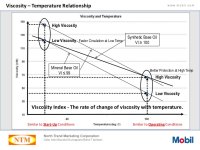
A synthetic, if superimposed on your graph, would be much flatter and change less over temperature. Viscosity INDEX is the keyword when looking at conventional versus synthetic fluids. Here is a link explaining them here http://www.machinerylubrication.com/Read/28956/lubricant-viscosity-index
Here is a simple graph showing a difference between conventional versus synthetic.
 

Attachments

  • ntm-mobil-lubricant-base-oil-groups-14-728.jpg
    ntm-mobil-lubricant-base-oil-groups-14-728.jpg
    95.4 KB · Views: 429
Last edited:
I Think it should look a lot more like this using a logarithmic y axis - your graph simply looks linear because the range is sufficiently narrow:

graph_3_viscosity_multigrade.jpg


The difference in viscosity for each unit of temperature change at lower temperatures can be significant. If it wasn't, you car wouldn't be noticeably harder to start when it was cold. You wouldn't get gear box whine or any of the other common observable symptoms at -20*Fthat you don't experience at 20*F.

Edit: After looking it up, I'm now confident that the theoretical and empirical models are logarithmic/exponential. The Mobil Oil chart is a simplification.
 
Last edited:
I Think it should look a lot more like this using a logarithmic y axis - your graph simply looks linear because the range is sufficiently narrow:

graph_3_viscosity_multigrade.jpg


The difference in viscosity for each unit of temperature change at lower temperatures can be significant. If it wasn't, you car wouldn't be noticeably harder to start when it was cold. You wouldn't get gear box whine or any of the other common observable symptoms at -20*Fthat you don't experience at 20*F.

Edit: After looking it up, I'm now confident that the theoretical and empirical models are logarithmic/exponential. The Mobile chart is a simplification.

What are you trying to say?
I never said linear in my original post.
If you have a high VI synthetic engine oil (don't know where you got gearbox lubrication whine) then the curve for that fluid would be much flatter than what your chart shows. I just posted a quick graph and link for simplification.

My point is an engine running synthetic oil won't take substantially more or less time (from say 20-50 degrees F) to warm up to operating temps and the ambient temperature will not effect the consumption of fuel appreciably until the temperatures approach extremes. Is this wrong? Please feel free to correct me.
 
What I'm saying is that cold starts and driving cold vehicles with thicker oil and lubricants throughout does significantly effect your gas consumption. It burns more gas to warm to operating temperature, requires more gas to overcome the additional friction throughout the drive train, and results in lower MPG. The difference between 20* and 50* starting vehicle temperature can be significant.

As for gear box whine. Find an manual transmission Toyota and give it a start at -30*F. Let off the clutch and listen. Spinning the input shaft alone in really cold thick oil will result in noise from the bearings. Even the new 4runners will make unpleasant noises from sources like the power steering pump at that temp.
 
Last edited:
Before lift and tires, my '14 TE was getting about 17 in town and 19.5 on the highway. I returned last week from a 3200 mile round trip from NM to ND and back. Combined mpg for the whole trip was 17.5, which I don't think is too bad considering my TE is lifted 2.5" and running BFG ATs. It was my wife, kids, tons of luggage, snow chains, and quite a bit of tools. It also snowed on the return trip and was fairly cold from the southern edge of ND to Santa Fe NM so a large chunk of the return was also ran in 4x4. Honestly, the biggest hit on mpg I observe on that trip is 1. letting it warm up in the mornings and 2. cold weather in general. On the cold weather, both my 4runners seem to suffer less when it comes to below zero weather compared to other vehicles that have made the same trip in the past.

Overall, I am ok with that kind of mpg.
 
Per Gas Cubby App:

7/28/14-1/8/15
average MPG 17.74

Slight dip after lift (12/12/14) and sliders 9/25/14).
 
Last edited:
You are correct sir. I imagine that like me TBrock tries not to run his empty.

That's exactly what I'm trying to accomplish.

However, I was thinking about that a few weeks ago. I'm guessing its an invisible reserve because even when going to empty while showing only 3 miles left on the tank .. I was only able to fill a max of 19.2 Gallons .. Thoughts?
 
its a safety measure so people don't run the system dry.

these ecu and etc systems have a fit when you run them dry especially the fuel pump and lines.

its like water hammer in copper lines if you ever seen/heard that.
 
its a safety measure so people don't run the system dry.

these ecu and etc systems have a fit when you run them dry especially the fuel pump and lines.

its like water hammer in copper lines if you ever seen/heard that.


A 3 Gallon Safety measure seems extensive. However, this is my first 4Runner, so maybe I am just in the dark about this. I understand the concept completely though.
 
A 3 Gallon Safety measure seems extensive. However, this is my first 4Runner, so maybe I am just in the dark about this. I understand the concept completely though.

3 gal = 36-60 miles depending on conditions.
 
3 gal = 36-60 miles depending on conditions.

3 gallon reserve still seems pretty excessive to me too, but i'm sure there are people who get into trouble without that much forewarning and it doesn't really bother me having it
 
That's exactly what I'm trying to accomplish.

However, I was thinking about that a few weeks ago. I'm guessing its an invisible reserve because even when going to empty while showing only 3 miles left on the tank .. I was only able to fill a max of 19.2 Gallons .. Thoughts?

Most of my miles are done driving 200 - 500 miles to or from an oil rig, so I tend to run it down until the light comes on to reduce the number of stops I have to make. On mine that is usually at the 20 gallon mark. I have very rarely managed to cram 21 gallons in there. And yes the miles remaining on my dash seems to be geared for that reserve (light) more than what I actually have left.

If it's any consolation the light would come on in my 2011 Tundra when I still had 6 gallons/100 miles left in the tank. 3 gallons of reserve seems more reasonable to me.
 
6 gallons is unacceptable. 3 is even excessive. To contrast those numbers, my Nissan Rogue doesnt seem to have much of a reserve buffer at all. Its a 15.6 gallon tank and Ive put 15.1 gallons of gas in it before. Its regularly 13.x-14.x when the light comes on
 
6 gallons is unacceptable. 3 is even excessive. To contrast those numbers, my Nissan Rogue doesnt seem to have much of a reserve buffer at all. Its a 15.6 gallon tank and Ive put 15.1 gallons of gas in it before. Its regularly 13.x-14.x when the light comes on


but 1-2 gal reserve on a vehicle that get between 26-33 mpg compared to a 4runner that gets between 12-19 mpg with 3 gals?

the reserves on vehicles is dependent on mpg they get, so each vehicle usually have different reserves from what I have seen.

also that 3 gal reserve probably helps when your on the trails. all that sloshing around helps to keep the fuel pump primed easier.
 
Most of my miles are done driving 200 - 500 miles to or from an oil rig, so I tend to run it down until the light comes on to reduce the number of stops I have to make. On mine that is usually at the 20 gallon mark. I have very rarely managed to cram 21 gallons in there. And yes the miles remaining on my dash seems to be geared for that reserve (light) more than what I actually have left.

If it's any consolation the light would come on in my 2011 Tundra when I still had 6 gallons/100 miles left in the tank. 3 gallons of reserve seems more reasonable to me.

I guess coming from a Sedan to "THE BEST VEHICLE EVER MADE" will need come with its differences. I'm used to vehicles that can go a bit longer on a gallon of gas (intern having a smaller reserve).

Either way .. :focus: .. I still think my 4Runner gets phenomenal gas millage and love seeing the smiles, I mean miles, rack up.
 

Members online

No members online now.

Forum statistics

Threads
278,312
Messages
3,554,089
Members
248,016
Latest member
Advally Service

Trending content

Back
Top