rigtec
New member
Hi forum (*A*) team!,
I Just finished a new project that came clear out of nowhere (completely unplanned) so I've become really excited about it's end result! Before I get started talking about this new "Mega-sub", I would like to take just a moment to share some things about subs in general or "Subwoofers 101". You know, I get the sense that a bunch of folks here have been considering adding a subwoofer to their 4Runner's existing audio system but are 'on the fence' about it because of a few obstacles: (#1) The lack of information e.g., don't quite know how to choose a sub or where to begin. (#2), space constraints, e.g., how much cargo space will this sub consume? And (3), Cost e.g., How much for the speaker, the amplifier, and the cost of installation... Sound familiar? Okay, well I'm not here to convince you to go that route at all but rather, to remove some of "The mystery"... that has prevented you from moving forward with a decision by discussing the subject w/you 'Openly'. If you love music, adding a little bass to any stock system will make it sound like a WHOLE different stereo system, and 100% better; particularly in conjunction with... The "Party mode" tweak! (non JBL) - Toyota 4Runner Forum - Largest 4Runner Forum; a very 'high-end' sounding audio system upgrade from the stock 'non-jbl' system, and the best part is that this upgrade... "IS FREE!" (2010-2013 4Runners)
Nowadays, you'll hear the term "Subs" or "Subwoofer" being used interchangeably with the words "woofer" or "bass speaker"; as if they're the same thing... They're not! This "Car audio" industry practice (marketing trick) has caused a lot of confusion... as it was intended to do; after all, the marketing agencies have but one objective which is to make you (and me) think that if you buy a speaker that's well packaged, has the words, "BLAST-O-MATIC 5000" on the box yielding a colorful cone w/ vulcanized skull and cross bones, with an iridescent surround, then it will become this 'High-end' infra-sonic low frequency wavefront reproducer. Okay, so what is a /sub.woof.ef/? As it's name implies, it hovers below the bass (hence the term... "*Sub*bass*"). It only operates in the low frequency pass band having a relatively narrow bandwidth and is designed to function in the audio spectrum range below the "musical" bass. A typical bass speaker may need to operate anywhere from the low midrange of 200hz (Hertz), down to around 80hz. So a subwoofer will be required to succeed in power handling, control and efficiency below this range, whereas the bass speaker is running out of it's resource and capacity to cope with the high stress imposed by the electrical and the mechanical demands at this level.
Because our ears are relatively 'insensitive' to audio soundwaves down this low e.g., 50hz and downward, our subwoofer must be able to produce these soundwaves at a much higher decibel level just to match the much louder bass, mids, and treble coming from the other speaker components! As a result, they must be able to handle a considerable amount of power; four to ten times that of the entire audio system. Ever go to a Rock or R&B concert to see those celebrity artists perform for 20,000 to 30,000 people? No matter how much power is used to generate music for the whole 'front of house' (F.O.H) p.a. system, (say... 50,000 watts?), the subs will be using at least that by themselves to create the extreme low-end experience. The reason is because of the way bass is reproduced. There's a lot of physics going on here and that involves the physical movement (displacing) of air... a whole lot of air! Subwoofers come in many different sizes typically 10 inch to 21 inches. Smaller designs are available but the less cone surface area they have, the less air will be displaced, and the low frequency extension and amplitude is limited by the amount of air moved.
A sub's cone/moving system must have a certain amount of safe travel "Fwd / Backwards" known as "x-max"; denotes it's linear travel in one direction (usually measured in millimeters) creating no more than 10% THD (total harmonic distortion). A 'true sub' must (arguably) have at least 12 to 15mm of x-max to be considered a true sub; 10 to 12mm for an 18". Most bass speakers don't have anywhere near 12mm of x-max because their low-end assignment doesn't require it; they can achieve 80 or 90hz w/o moving that far, given that they aren't fed too much power. Here's a question that I've heard from time to time. "Can a 10" sub go as low as an 18" sub?" The answer... Yes! (all things being equal) A ten inch sub may be able to go even lower than an eighteen incher! That's because a sub isn't limited only by the size of it's cone. It's also limited by the amount of air that it can move, and so what it may lack in "Cone surface area" (compared to an 18), it may more than make up for in it's ability to travel back and forth (x-max).
There are many other things that distinguish a true subwoofer from a bass (or midbass) driver but this subject is so vast that to discuss them all, there would be no time left to talk about... Bilsteins', Weather-tech, KDSS, Lockers, A-trac, vsc, sr5 'premium' pkg... "you get it!"
In the car audio genre, there are basically three different subwoofer types to choose from: vented box, sealed box, and band-pass. The "vented" design yields the highest efficiency out of the three, which translates into higher spl (sound pressure levels). Next, the band-pass enclosure will likely surpass in the lowest frequency output in 'cycles per second', otherwise known as "Hertz", BUT... will also yield the narrowest bandwidth (the "one note wonder"). And third, the "sealed" box; aka an "Infinite baffle" or "acoustic suspension". This is "without question", the most musical alignment of all. With each of these there is a distinct advantage in it's design... and a notable disadvantage inherent in it's particular alignment; I may go into this a little later but don't want to bore you with "low frequency soundwave reproduction / theory". Okay, here's what I did to my truck this week. Being very familiar with all three alignments described above, I've chosen the "Sealed" box design due to it's warmth, it's "Impact" and wider pass band in general.
I wanted to try something EXTREME! I was already using a four ten sealed box which I wouldn't consider extreme, but perhaps a little more than most people might be using due to space constraints. I was considering going with an eight ten sub to "Set it off" proper like. But that meant that I would likely have to have the box 'custom made'. I started looking for a box builder on an audio systems website where I spend a considerable amount of my leisure time. I got a couple of replies from builders but then I realized that 'shipping' would be a huge factor in the cost of building a custom box, plus... with low frequency drivers, they need to be precisely matched; same size, identical electrical/mechanical parameters, etc. Now this was getting expensive already because the JL audio drivers that I already have cost about $350 to 400 bucks each, as in... "APIECE"(!), and I would need 4 more. So that put an end to that idea in short order!
But then I had another idea. To increase "Surface area" (which is what it's all about), I didn't have to buy more 'Tens' to increase surface area. I could go with a much larger driver (like 15's) and use only four and eliminate the 4 ten sub all together... for now! I could get two standard dual fifteen inch sealed boxes "off the shelf"; eliminating the need for a custom box build and S&H, to keep costs down. And... now I could shop around for a lower priced driver... "jl audio driver prices are out of control", like buying a "lexus" when a Toyota will do just fine! I also remembered being extremely impressed when I learned of Alpine's new "R series" drivers. They will MORE THAN keep up w/ jl drivers. But unfortunately I didn't know about them back when I bought the 4 jl tens.
BTW: I'm gonna sell my four ten "JL Audio" sub (at a loss). Here's a link to the ad: http://www.toyota-4runner.org/sale-...-10w6-fs-$995-bergenfield-nj.html#post1749596
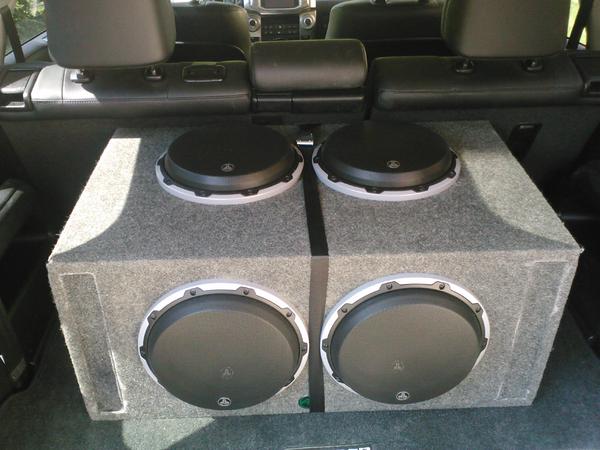
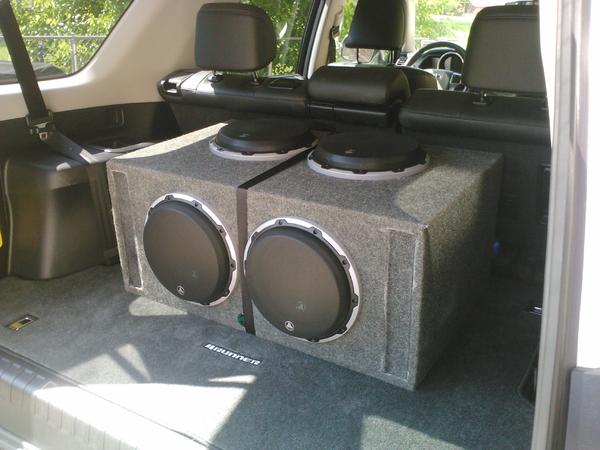
Here's a couple of photos of the 4 ten inch jl audio sub that I've been using for about a year now; some serious hardware, take a look:
Now, a look at the recent sub build project below; and this time I remembered to take pictures from the very start, even the unopened boxes!:whoo:
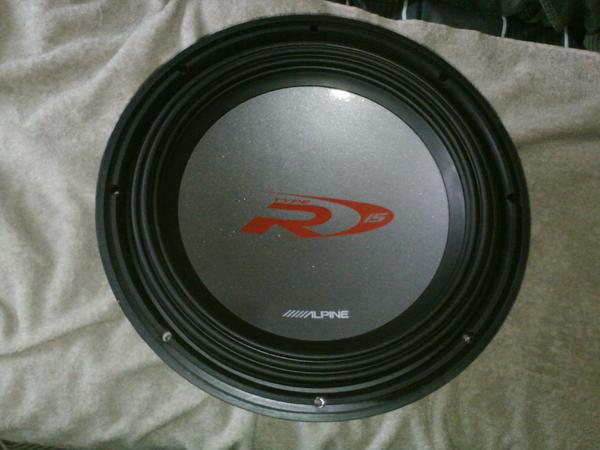
This is the Alpine "SWR-1522D", a 15 inch, 2 ohm, dual voice coil subwoofer.
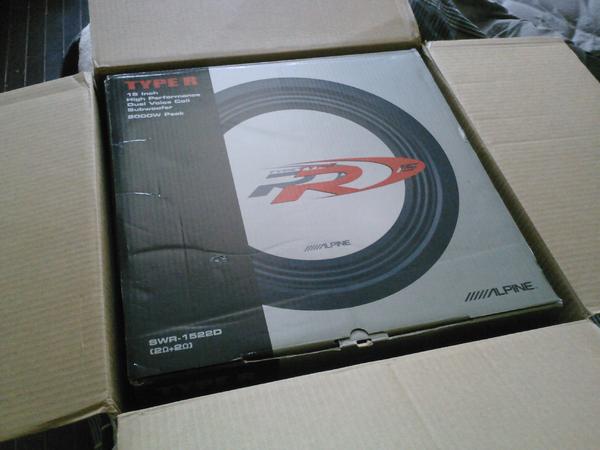
Alpine really knows how to crate their driver products; there were about three boxes inside of this box.
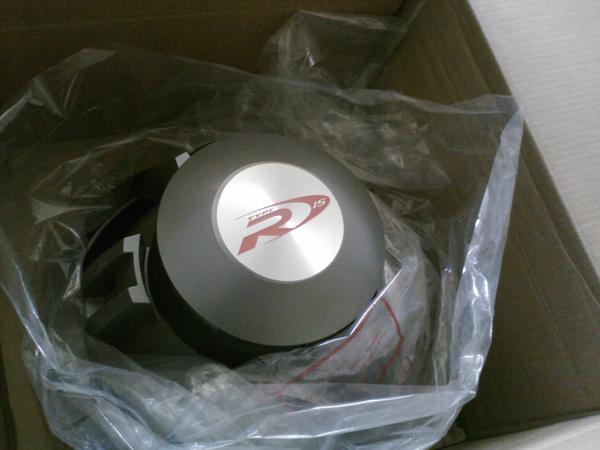
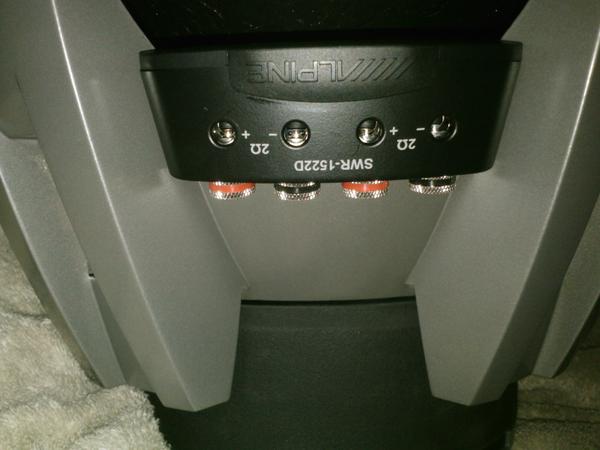
And now a little wiring. The way these "Dual 15" boxes are set-up, there's one terminal connection plate on either side of the box, (so you could feed the speakers separately if you chose to), but I'm gonna feed both drivers with one amp (per pair), so I'll have to drill a small hole through the partition wall between the subs.
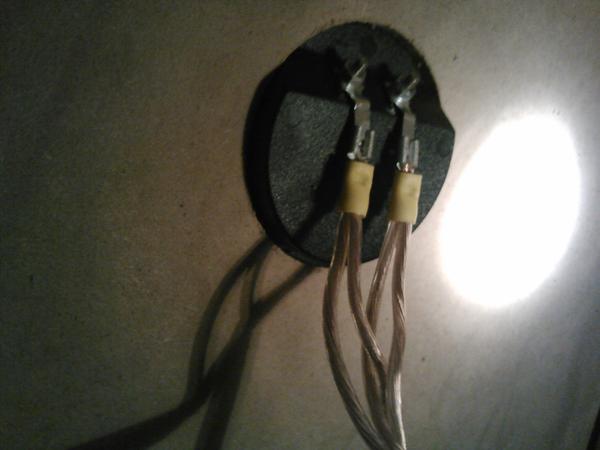
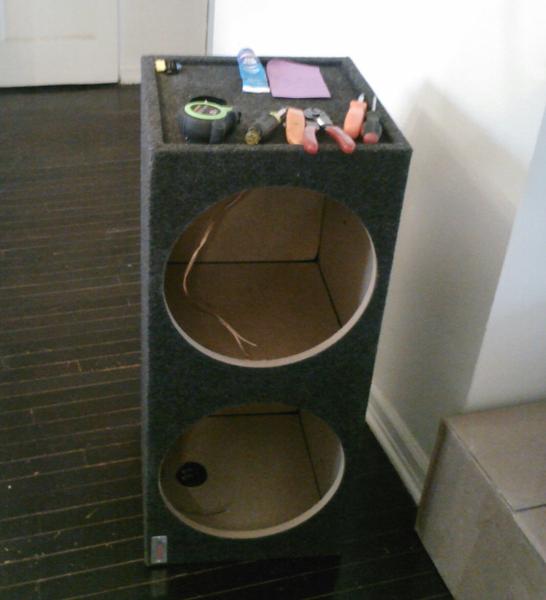
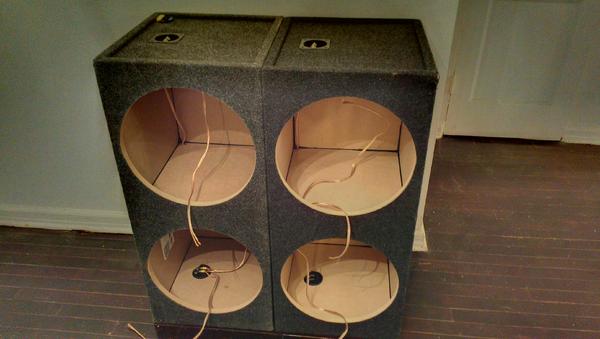
And now I'll need to use some rubber silicone caulking to seal up the area around the wiring portals to prevent any interacting between the drivers.
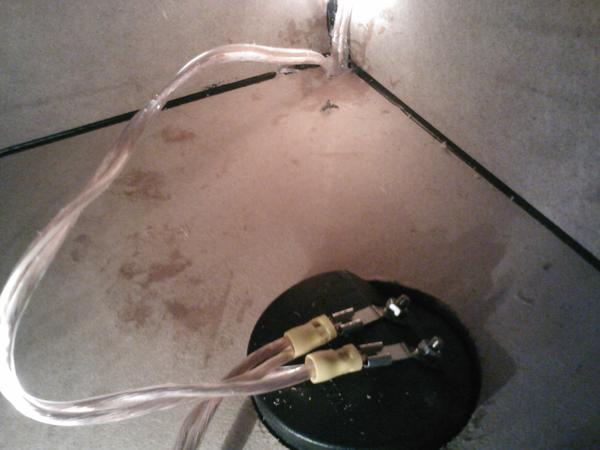
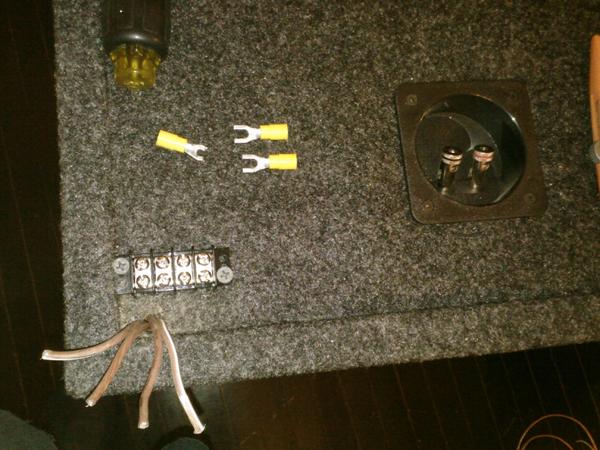
With these boxes I'm doing something a little different wrt the wiring. I'm providing a means of 'Disconnecting' the two drivers from each other, so that in the future should I decide to remove the other box (for whatever reason), I can still run both JL HD-750/1 mono-block amplifiers into one box, (one 15 each). These SWR-1522D 15's are powerful enough to handle 750 watts each w/o worries, so I won't lose any amplifier power just because I needed to remove one of the subs from the truck.
Take a look at the way this box is wired with a 'built-in' disconnect terminal strip:
And here's the wiring diagram to illustrate how it works:

NOTE: If I ever do reconnect the 'intermediate' cable between the two drivers, I cannot connect both of the amps to the 'Terminal connection plates' on either side of the box! I'll only be able to connect one to the main terminal connector near the term 'strip'.
Now for the 'stuffing'! Using polyester-fiber batting makes a BIG DIFFERENCE in the way a sealed low frequency cabinet performs. It'll absorb a lot of the mid frequency resonance (noise), which causes turbulence and 'phase anomalies' inside of the box. The end result... uncontrolled rumble which degrades the quality of the bass, so stuffing makes it sound tighter! Stuffing the box does something else for the sound. It creates a delay of the soundwaves within the box, causing the drivers to believe, and behave as if they're in a much larger box. And this causes the F3 (The lowest box frequency when it drops three decibels) to descend, lowering it's resonance and giving you a 'DEEPER' bass.
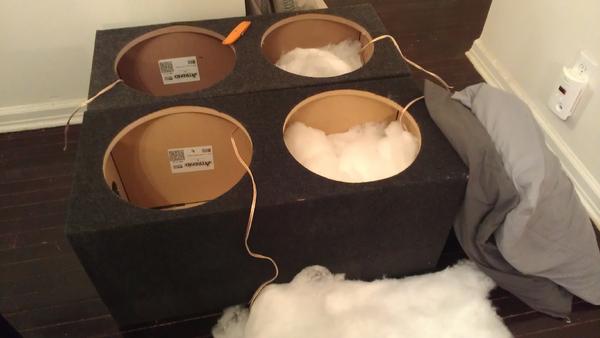

When stuffing your 'sealed' speaker boxes, try and use 1 to 1.5 pounds per cubic foot of internal box area. If you google "How much do I stuff my sealed speaker box?"... it'll give you many different formulas because it's not an exact science; very subjective. But if you read them all, you'll come up w/ an average of one to one an a half lbs per cubic ft, and I've tried a bunch of ratios and this one works! If you were to buy 'poly-ester fiber' (or "Acousta stuff") from an audio outlet retailer, they'd charge you about $50 dollars for a 5 lb bag. But, if you use those old worn out pillows you've been meaning to through out, it'll cost you NOTHING!
'Dual voice coil' drivers, what does that mean? Dual V.C. drivers are the greatest. They enable the user to decide what load the amp sees by giving you the option of doubling the impedance, or cutting it in half; 'For Example'... My new drivers are dual 2 ohm vc's. If I join them in series, the total system impedance will be 4 ohms. If I wire them in parallel, the total system impedance will drop to 1 ohm. So now I have a choice as to what the amplifier sees.
Take a look at this driver, with this jumper in place, it's voice coils are configured in series:

The total ohms resistance will be 4 ohms, but the total impedance will be cut in half because there are two 4 ohm drivers so the end total will be 2 ohms. This wiring configuration is considered a "series/parallel" wiring scheme.
Now here's a parallel vc wiring scheme using two jumpers:
Confused yet??? Don't be! Just picture two 12 volt car batteries joined together. When wired in parallel, your amperage capacity will double but voltage will remain the same. When the batteries are wired together in series, the voltage will double, giving a voltage output of 24 volts... make sense?
These drivers weigh almost 50lbs each (50 + 50= 100) plus the empty wooden box weighs 50 lbs, so that's 150 lbs which I will not be able to negotiate through the doorway alone. Nor can I heave it up into the truck without help. So I'll have to take the two boxes outside 'empty' then bring all four drivers out 'one-by-one'; that's gonna be fun "Here goes"!

I've taken the precaution of pre-drilling the speaker mounting holes in the house to avoid the risk of puncturing the drivers w/ the drill; not a good thing, ask me how I know : /
"Continued below"
I Just finished a new project that came clear out of nowhere (completely unplanned) so I've become really excited about it's end result! Before I get started talking about this new "Mega-sub", I would like to take just a moment to share some things about subs in general or "Subwoofers 101". You know, I get the sense that a bunch of folks here have been considering adding a subwoofer to their 4Runner's existing audio system but are 'on the fence' about it because of a few obstacles: (#1) The lack of information e.g., don't quite know how to choose a sub or where to begin. (#2), space constraints, e.g., how much cargo space will this sub consume? And (3), Cost e.g., How much for the speaker, the amplifier, and the cost of installation... Sound familiar? Okay, well I'm not here to convince you to go that route at all but rather, to remove some of "The mystery"... that has prevented you from moving forward with a decision by discussing the subject w/you 'Openly'. If you love music, adding a little bass to any stock system will make it sound like a WHOLE different stereo system, and 100% better; particularly in conjunction with... The "Party mode" tweak! (non JBL) - Toyota 4Runner Forum - Largest 4Runner Forum; a very 'high-end' sounding audio system upgrade from the stock 'non-jbl' system, and the best part is that this upgrade... "IS FREE!" (2010-2013 4Runners)
Nowadays, you'll hear the term "Subs" or "Subwoofer" being used interchangeably with the words "woofer" or "bass speaker"; as if they're the same thing... They're not! This "Car audio" industry practice (marketing trick) has caused a lot of confusion... as it was intended to do; after all, the marketing agencies have but one objective which is to make you (and me) think that if you buy a speaker that's well packaged, has the words, "BLAST-O-MATIC 5000" on the box yielding a colorful cone w/ vulcanized skull and cross bones, with an iridescent surround, then it will become this 'High-end' infra-sonic low frequency wavefront reproducer. Okay, so what is a /sub.woof.ef/? As it's name implies, it hovers below the bass (hence the term... "*Sub*bass*"). It only operates in the low frequency pass band having a relatively narrow bandwidth and is designed to function in the audio spectrum range below the "musical" bass. A typical bass speaker may need to operate anywhere from the low midrange of 200hz (Hertz), down to around 80hz. So a subwoofer will be required to succeed in power handling, control and efficiency below this range, whereas the bass speaker is running out of it's resource and capacity to cope with the high stress imposed by the electrical and the mechanical demands at this level.
Because our ears are relatively 'insensitive' to audio soundwaves down this low e.g., 50hz and downward, our subwoofer must be able to produce these soundwaves at a much higher decibel level just to match the much louder bass, mids, and treble coming from the other speaker components! As a result, they must be able to handle a considerable amount of power; four to ten times that of the entire audio system. Ever go to a Rock or R&B concert to see those celebrity artists perform for 20,000 to 30,000 people? No matter how much power is used to generate music for the whole 'front of house' (F.O.H) p.a. system, (say... 50,000 watts?), the subs will be using at least that by themselves to create the extreme low-end experience. The reason is because of the way bass is reproduced. There's a lot of physics going on here and that involves the physical movement (displacing) of air... a whole lot of air! Subwoofers come in many different sizes typically 10 inch to 21 inches. Smaller designs are available but the less cone surface area they have, the less air will be displaced, and the low frequency extension and amplitude is limited by the amount of air moved.
A sub's cone/moving system must have a certain amount of safe travel "Fwd / Backwards" known as "x-max"; denotes it's linear travel in one direction (usually measured in millimeters) creating no more than 10% THD (total harmonic distortion). A 'true sub' must (arguably) have at least 12 to 15mm of x-max to be considered a true sub; 10 to 12mm for an 18". Most bass speakers don't have anywhere near 12mm of x-max because their low-end assignment doesn't require it; they can achieve 80 or 90hz w/o moving that far, given that they aren't fed too much power. Here's a question that I've heard from time to time. "Can a 10" sub go as low as an 18" sub?" The answer... Yes! (all things being equal) A ten inch sub may be able to go even lower than an eighteen incher! That's because a sub isn't limited only by the size of it's cone. It's also limited by the amount of air that it can move, and so what it may lack in "Cone surface area" (compared to an 18), it may more than make up for in it's ability to travel back and forth (x-max).
There are many other things that distinguish a true subwoofer from a bass (or midbass) driver but this subject is so vast that to discuss them all, there would be no time left to talk about... Bilsteins', Weather-tech, KDSS, Lockers, A-trac, vsc, sr5 'premium' pkg... "you get it!"
In the car audio genre, there are basically three different subwoofer types to choose from: vented box, sealed box, and band-pass. The "vented" design yields the highest efficiency out of the three, which translates into higher spl (sound pressure levels). Next, the band-pass enclosure will likely surpass in the lowest frequency output in 'cycles per second', otherwise known as "Hertz", BUT... will also yield the narrowest bandwidth (the "one note wonder"). And third, the "sealed" box; aka an "Infinite baffle" or "acoustic suspension". This is "without question", the most musical alignment of all. With each of these there is a distinct advantage in it's design... and a notable disadvantage inherent in it's particular alignment; I may go into this a little later but don't want to bore you with "low frequency soundwave reproduction / theory". Okay, here's what I did to my truck this week. Being very familiar with all three alignments described above, I've chosen the "Sealed" box design due to it's warmth, it's "Impact" and wider pass band in general.
I wanted to try something EXTREME! I was already using a four ten sealed box which I wouldn't consider extreme, but perhaps a little more than most people might be using due to space constraints. I was considering going with an eight ten sub to "Set it off" proper like. But that meant that I would likely have to have the box 'custom made'. I started looking for a box builder on an audio systems website where I spend a considerable amount of my leisure time. I got a couple of replies from builders but then I realized that 'shipping' would be a huge factor in the cost of building a custom box, plus... with low frequency drivers, they need to be precisely matched; same size, identical electrical/mechanical parameters, etc. Now this was getting expensive already because the JL audio drivers that I already have cost about $350 to 400 bucks each, as in... "APIECE"(!), and I would need 4 more. So that put an end to that idea in short order!
But then I had another idea. To increase "Surface area" (which is what it's all about), I didn't have to buy more 'Tens' to increase surface area. I could go with a much larger driver (like 15's) and use only four and eliminate the 4 ten sub all together... for now! I could get two standard dual fifteen inch sealed boxes "off the shelf"; eliminating the need for a custom box build and S&H, to keep costs down. And... now I could shop around for a lower priced driver... "jl audio driver prices are out of control", like buying a "lexus" when a Toyota will do just fine! I also remembered being extremely impressed when I learned of Alpine's new "R series" drivers. They will MORE THAN keep up w/ jl drivers. But unfortunately I didn't know about them back when I bought the 4 jl tens.
BTW: I'm gonna sell my four ten "JL Audio" sub (at a loss). Here's a link to the ad: http://www.toyota-4runner.org/sale-...-10w6-fs-$995-bergenfield-nj.html#post1749596
Here's a couple of photos of the 4 ten inch jl audio sub that I've been using for about a year now; some serious hardware, take a look:
Now, a look at the recent sub build project below; and this time I remembered to take pictures from the very start, even the unopened boxes!:whoo:
This is the Alpine "SWR-1522D", a 15 inch, 2 ohm, dual voice coil subwoofer.
Alpine really knows how to crate their driver products; there were about three boxes inside of this box.
And now a little wiring. The way these "Dual 15" boxes are set-up, there's one terminal connection plate on either side of the box, (so you could feed the speakers separately if you chose to), but I'm gonna feed both drivers with one amp (per pair), so I'll have to drill a small hole through the partition wall between the subs.
And now I'll need to use some rubber silicone caulking to seal up the area around the wiring portals to prevent any interacting between the drivers.
With these boxes I'm doing something a little different wrt the wiring. I'm providing a means of 'Disconnecting' the two drivers from each other, so that in the future should I decide to remove the other box (for whatever reason), I can still run both JL HD-750/1 mono-block amplifiers into one box, (one 15 each). These SWR-1522D 15's are powerful enough to handle 750 watts each w/o worries, so I won't lose any amplifier power just because I needed to remove one of the subs from the truck.
Take a look at the way this box is wired with a 'built-in' disconnect terminal strip:
And here's the wiring diagram to illustrate how it works:
NOTE: If I ever do reconnect the 'intermediate' cable between the two drivers, I cannot connect both of the amps to the 'Terminal connection plates' on either side of the box! I'll only be able to connect one to the main terminal connector near the term 'strip'.
Now for the 'stuffing'! Using polyester-fiber batting makes a BIG DIFFERENCE in the way a sealed low frequency cabinet performs. It'll absorb a lot of the mid frequency resonance (noise), which causes turbulence and 'phase anomalies' inside of the box. The end result... uncontrolled rumble which degrades the quality of the bass, so stuffing makes it sound tighter! Stuffing the box does something else for the sound. It creates a delay of the soundwaves within the box, causing the drivers to believe, and behave as if they're in a much larger box. And this causes the F3 (The lowest box frequency when it drops three decibels) to descend, lowering it's resonance and giving you a 'DEEPER' bass.
When stuffing your 'sealed' speaker boxes, try and use 1 to 1.5 pounds per cubic foot of internal box area. If you google "How much do I stuff my sealed speaker box?"... it'll give you many different formulas because it's not an exact science; very subjective. But if you read them all, you'll come up w/ an average of one to one an a half lbs per cubic ft, and I've tried a bunch of ratios and this one works! If you were to buy 'poly-ester fiber' (or "Acousta stuff") from an audio outlet retailer, they'd charge you about $50 dollars for a 5 lb bag. But, if you use those old worn out pillows you've been meaning to through out, it'll cost you NOTHING!
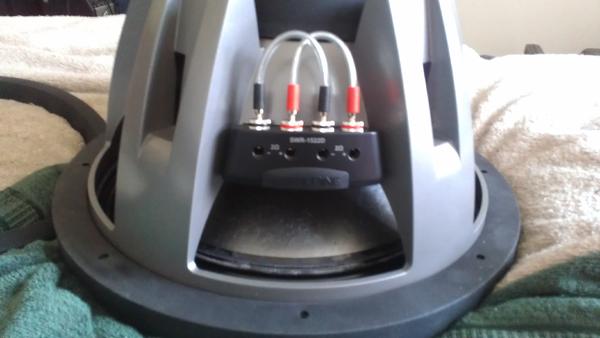
'Dual voice coil' drivers, what does that mean? Dual V.C. drivers are the greatest. They enable the user to decide what load the amp sees by giving you the option of doubling the impedance, or cutting it in half; 'For Example'... My new drivers are dual 2 ohm vc's. If I join them in series, the total system impedance will be 4 ohms. If I wire them in parallel, the total system impedance will drop to 1 ohm. So now I have a choice as to what the amplifier sees.
Take a look at this driver, with this jumper in place, it's voice coils are configured in series:
The total ohms resistance will be 4 ohms, but the total impedance will be cut in half because there are two 4 ohm drivers so the end total will be 2 ohms. This wiring configuration is considered a "series/parallel" wiring scheme.
Now here's a parallel vc wiring scheme using two jumpers:
Confused yet??? Don't be! Just picture two 12 volt car batteries joined together. When wired in parallel, your amperage capacity will double but voltage will remain the same. When the batteries are wired together in series, the voltage will double, giving a voltage output of 24 volts... make sense?
These drivers weigh almost 50lbs each (50 + 50= 100) plus the empty wooden box weighs 50 lbs, so that's 150 lbs which I will not be able to negotiate through the doorway alone. Nor can I heave it up into the truck without help. So I'll have to take the two boxes outside 'empty' then bring all four drivers out 'one-by-one'; that's gonna be fun
"Here goes"!
I've taken the precaution of pre-drilling the speaker mounting holes in the house to avoid the risk of puncturing the drivers w/ the drill; not a good thing, ask me how I know : /
"Continued below"
Last edited: