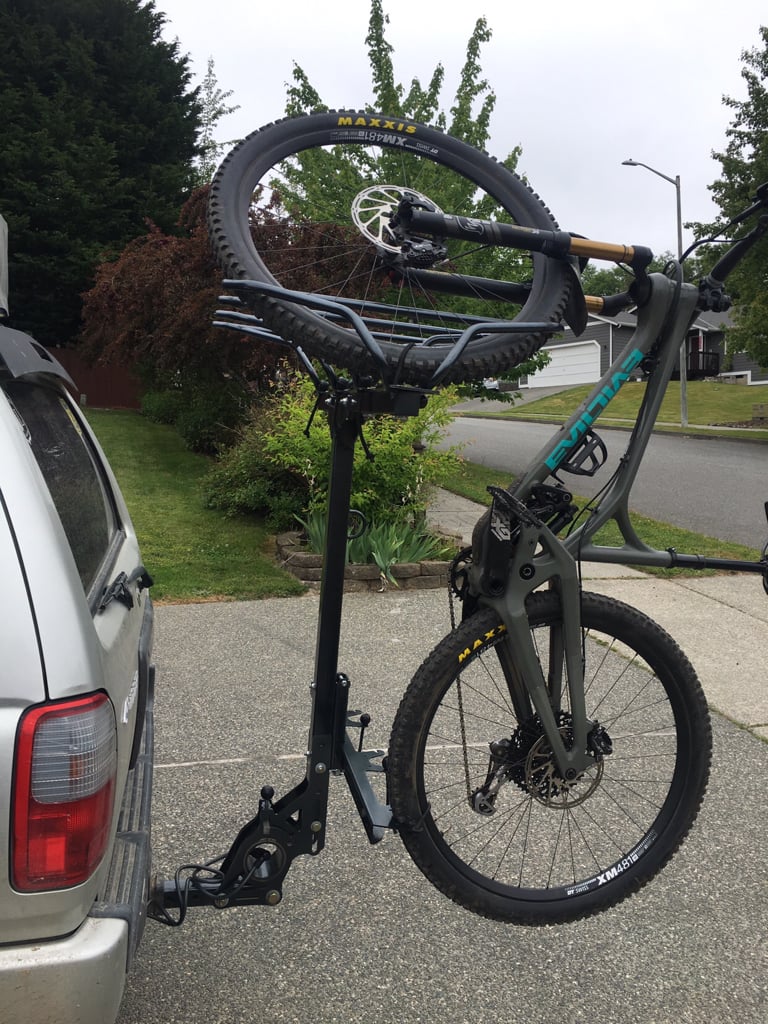
You need to measure the distance from the receiver hitch pin hole to the outer face of the tire and go from there.
Certain racks will have more distance built into them than others. If you need to add an extension, make sure it is tension-able
or the rack will flop around all over - no matter how well it is designed to snug up inside the original receiver tubing.
I use the rack b/c it keeps dirt/crap out of my truck and it's easier to load/unload...especially when tired.If you're traveling with luggage or camping gear inside, I can see the need for racks. But local commutes with no cargo, why use a rack?
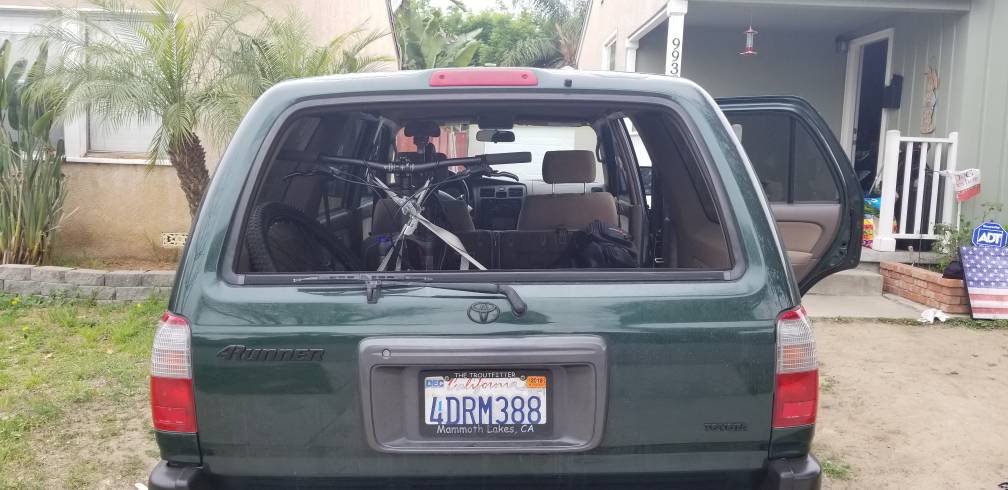
1 bike: Lay it the back. 2 bikes: lay them in the back, 1furniture blanket in between. 3 bikes: same thing, 2 blankets.
Your observations make sense, but just to clarify:I use the rack b/c it keeps dirt/crap out of my truck and it's easier to load/unload...especially when tired.
Plus I keep all my MTB gear in a milk crate just inside the back window. No shuffling, no chain lube all over my interior, etc. MTBs are bigger than ever. You'd be surprised what a PITA it is to load one into the back of a Runner if there's anything else back there.
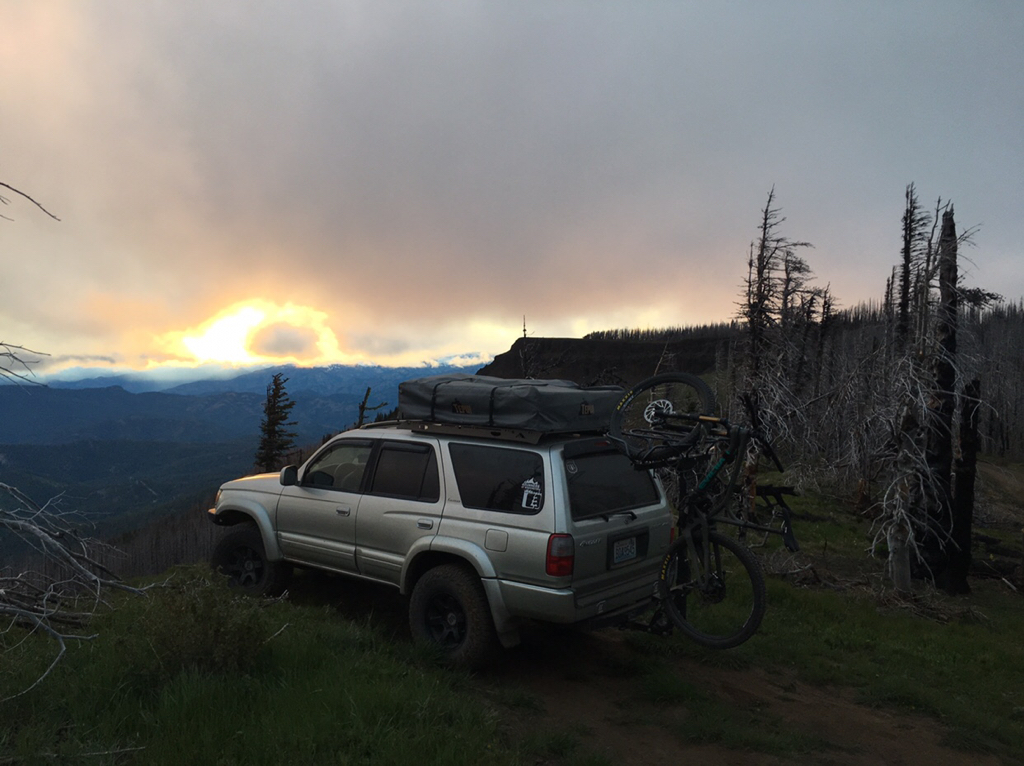
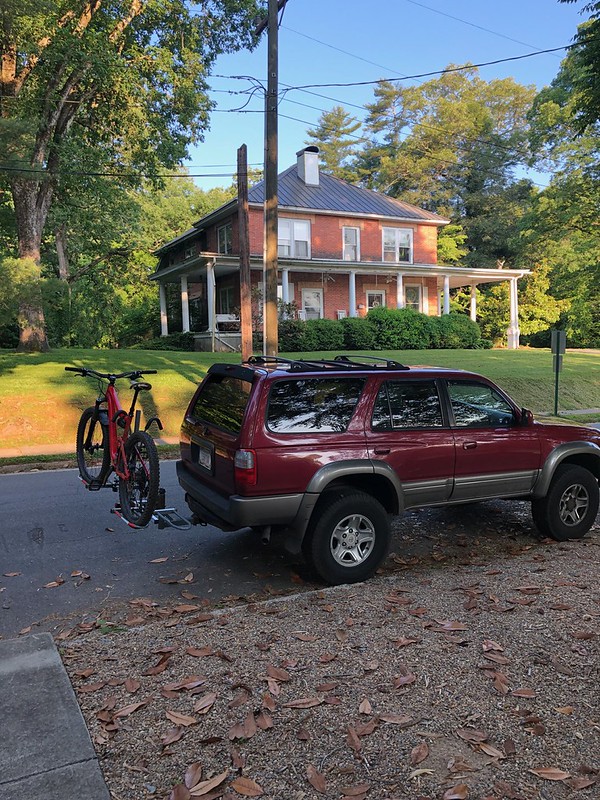
Wherever they fit best at the time:
![]()
(that was pre other mods, but I still have the same bike racks for use)
I like the hitch rack in most cases - better fuel economy, easier loading, can't hit it on the garage, etc. With a rear tire carrier on there, you may not be able to get a hitch setup to work easily.
-Charlie

I’ve had two of these vertical racks now. Previously a north shore and now the recon. They both have holes so you can slide them further in or out, not sure it would clear a rear tire carrier. I have mine all the way out otherwise the hitch insert hits the spare tire underneath.
![]()
My trail bike is ~30.5lbs probably closer to 31.5-32 with mud and a spare tube and 2 CO2 cans strapped to it. I've hung two bikes like mine and a third through the window w/o a weight issue. 3 bikes, 3 dudes, all our gear, NBD.Your observations make sense, but just to clarify:
1. If you ride one of the heavier, downhill-flavored bikes, I can see that weight might be an issue. My bike is light...probably about 28 pounds fully assembled.
2. I take the front wheel off, roll the bike in ass-first on the remaining rear wheel, then lean it over onto the copious other items that are always in the car.
3. Out here in dry California (no/few water crossings), we use dry chain lube that doesn't contain oil and doesn't leave marks or stains.
4. I do have the 4Runner's rear seat bottoms removed most of the time, so if your bike is long (29er, maybe) space could be an issue.
5. Furniture blankets are cheap and can be used to protect the car from the bike, and the bikes from each other.
Good luck with whatever system you decide on.
Newer bikes with larger wheels (and even a newer 26er) are just longer than they were pre-2000. I have a size large 1998 GT avalanche that's probably 4-6" shorter than my size large 2017 Giant Trance. My current bars are 800mm wide and the old ones may be 670. Everything is just larger. I used to run a setup like you described in my Runner before I switched to 27.5. My current Trance will fit inside on a fork-mount alone...but just barely. No room for another bike at all.I haven't ridden a MTB since the late 1980's, but at that time I had a Jeep XJ. Rear seats folded down, strip of ply with a fork mount (actually 2) and the bikes fit perfectly. I could carry a 3rd in a pinch, but no room for that 3rd passenger.
I've used roof racks too, though never a hitch rack, and MUCH prefer my original setup in the vehicle. I hate loading things over-head.