
I found the key to unlocking your 3rd Gens mileage

Schargedtaco

New member
Hey all I have recently found out how to get some very nice mileage gains out if our 3rd gens. This is no bullshi either! I have a 1997 limited v6 with 144k miles running 265/75r16. I've owned it for the last 12 months and put about 20k on it this year. I usually get about 17mpg mixed to 18.5 avg 75-80 mph if I'm mainly freeway. I take the miles driven divided by gallons tell it clicks off. Now to the good stuff. I put half a bottle if Lucas fuel system cleaner in prior to my 1200 mile trip from Salt Lake City to Cali and back. My wife filled up the truck the night before. Our first stop to fillip I was at 17mpg this is loaded with luggage and 4 people, what I expected! The 2nd fill up I added 2 more gallons after it clicked full. The next tank 23 mpg.. This is at 80 mph peeps as I got a 4 year and two year old wining in my ear, no time for dilly dally. On the 3rd tank I hit 25 mpg now I'm saying what the hell, even my wife's blown away and she usually dousnt care about that stuff. From Tahoe down to santaxruz we got a best of 25.6! Climbing from Carson city up to angels camp high sierras it was at 19 due to grade. I kept every fuel stop log and overall achieved 22.4 mpg. Since ive been home i have been adding 2-3 gallons after it clicks basically until a small amount of fuel spills out and have been getting a consistant 22 mpg where i was getting 17- 18.5 at best before. i knew this worked prior in my 2004 carolla 5 speed which normally gets 36 mpg mixed and I now get 40 mpg mixed. My last trip to Cali with the carolla same route I got 45 mpg. The added mpg must come from the extra fuel in the tank compressing and changing the siphoning. I have found the gains are really most noticeable majority highway. Anyway I'd like you guys to give it s shot and let me know if you see similar gains. After all you have nothing to loose!!
 

Attachments
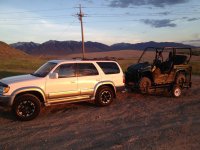
  • image.jpg
    image.jpg
    136.4 KB · Views: 2,195
Last edited:
Register to hide this ad
Hum? I think that if you were to factor in the extra gallons you are adding after the fact you might still be at around 17.
 
Keep adding after it clicks off full to the tune of 2 to 3 gallons, and your charcoal canister is going to hate start to hate you. I've seen older folks do this a few times. They bring their vehicles in for "cutting off when coming to a stop", after filling up. What happens is when the purge valve opens to let the engine consume fuel vapor, but instead liquid form fuel is introduced, the engine can't deal with the unmetered fuel, and it floods out.
 
The secret is to add more gallons after the click? Did I just read that wrong twice?

Sounds like the secret is miscalculation. :ohwell:
 
Yep sounds like miscalculation and the only thing topping it off to the brim will do is screw up your charcoal canister which I think is rather pricey to replace.
 
There is no siphoning in the fuel tank. It has an in-tank electric pump that pushes fuel to the engine. Adding more gas won't affect that at all. If anything, it is remotely possible that the Lucas fuel system cleaner actually worked and you had some gunk on one or more injectors that got removed. A dirty injector will likely hurt mileage since it may spray more fuel than is needed. More likely is miscalculation as already mentioned since 22 MPG is really high for a 3rd gen, even when it's new and everything is clean and fresh. It is possible your mileage improved due to the fuel system cleaner, but I'm skeptical that it's averaging 22.
 
I can see that the Lucas fuel system cleaner may help get an increase in MPG as I use it also and have noticed my MPG numbers being a little higher but adding that much fuel after the "click off" will definitely destroy the charcoal canister in a short time.
 
Well,

Say you put 15 gals in your tank after driving 320 miles, you would calculate a fuel mileage of 21.3, a VERY good fuel mileage by our standards.

If you consider the extra 3 gallons you've been cramming in the tank and filler neck, you're true mileage would be 17.7, a much more plausible mpg given the conditions.

I'm under the impression that LucasOil makes a good product; however, through the last decade of mystifying, magical, fuel juices that claim increases in mpg, we've only reassured the ideas that driving style and maintenance/upkeep are the only true ways to see gains in fuel efficiency.

But if your math is correct, I'd be curious to learn why you have been so successful.
 
I'm hearing a lot about imminent charcoal canister failure... has anyone actually had that happen to them?

I normally add in a good amount of gas after the first click (not sure how much, but I get it to click a few times with gas sometimes spilling out by the end of my fillup). Been doing it since I got my '99 in 2009.

No problems yet, so either I've been lucky or I'm not adding enough to do any potential damage. (Also, I'm in Canada... not sure if that makes a difference in the fuel system or the fuel itself.)

I'm wondering if anyone knows the exact amount that can lead to problems.
 
Sorry bud that doesn't make any sense. Literally none.

I have returned 24mpg once (a month ago). My trip was mostly flat, cruise set at 68mph, one passenger, 200lbs cargo. I made sure to not slow down or speed up to go around cars, just kept a constant velocity and cruised. I don't feel its possible to do much better than this, unless i drove 55, but then id be way under the speed limit. I could see 25-26mpg MAYBE... But that will never happen. Btw 245,000 miles, 3.4 auto 4x4, michelin ltx m/s2's stock size. I typically return 19-21mpg summer.
 
So you're saying that you add more gas than the pump will automatically allow, and somehow this extra gas is doing something to boost mileage by about 7-8mpg? Which:

1. How the hell are you filling up an extra 2 gallons past it clicking?

2. Even if that extra gas somehow changed the fuel system to be more efficient, it wouldn't help at all after that extra 2 gallons was burnt.

Something sounds wrong with your calculations, sorry.
 
If he is dividind milage by the gallons on his slip he's not fibbing. Why would he ignore the gallons after the auto shutoff?

As for the extra mpg, I think its possible that the fuel vapor from the flooded evap canister could be the real answer. But I doubt he will reply back with so many calling him a idiot.

The fuel vapor is the most efficient way to burn gasoline.
 
Just to throw my 2 cents in, he did say all highway and I drive highway every day and average about 20, 21 depending how fast I feel like driving. I feel its plausible with the cleaner, but adding extra gas is just gonna screw you over. The could easily be right but its not the extra gas, its the cleaner. Speaking of which, i'm going to go pick some up today.
 
If he is dividind milage by the gallons on his slip he's not fibbing. Why would he ignore the gallons after the auto shutoff?

As for the extra mpg, I think its possible that the fuel vapor from the flooded evap canister could be the real answer. But I doubt he will reply back with so many calling him a idiot.

The fuel vapor is the most efficient way to burn gasoline.

Yes, but the fuel pump is sucking in liquid not vapor.
 
In regards to snivilous

Do you actually think your 4runner won't hold any more fuel after the pump clicks off? If this is the case you must be kidding or have never tried it!

So when I initially fill up I'm adding say 2 gallons on top of the amount of fuel necessary to click the pump off. So as an example base 14G+ 2 gallons = 16g. The next time I fill up I take 265 miles driven since last fillup divided by 12 gallons which is all the truck will take before the pump clicks off in the 2nd fillup Which is 22 miles per gallon 265\12= 22mpg. I then add 2 more gallons to the tank after click off to top back off until its almost running out. On my 3rd fillup I then tank up at 265 miles adding 12 gallons before click off, divide my mileage and add two more gallons. I think those in here that don't understand this don't realize I'm now getting the same 265 miles on 12 totall gallons with initially starting out with a overflowing full tank and that I'm only putting in a totall of 14 totall 2 over the clickoff , so i am essentially calculating the extra 2 gallons in!
If I had started out with 14g until click and added 2 more on the 2nd tank filluo for a totall if 16 I could see how if the truck took 14 to fill before click getting 265 miles I would need to avg in the 2 gallons more so I would really be getting 265 miles\16= 16.56 mpg but I'm not! I'm able to pull less gallons used at 12 off the 265 miles!
The only explanation I can think of is the fact my cars always get worse mileage in the winter than summer. Why is that aside from additives? I think it may have to do with gas expansion, your putting in the same amount if volume of fuel but the heat, temp cause it to expand and your gas goes further. Anyone with some gas law background wanta chime in on this one? Either way as long as I fill the hell out of the tank each tank thereafter takes nearly 2 gallons less to click off than the first tank click off. So even when I compress and add back in 2 more gallons on the 2nd tank totaling say 14 gallons as an example I'm using the same amount of fuel as I would in general without compressed fillups but I'm getting 265 mi on the 12g instead of 265 mi on the 14g... All I know is its working for me
 
Last edited:
Unless toyota uses the closed intake injection cycle its not vapor entirely when the plug fires. And even then its not 100% vapor. But close......

Closed intake injection cycle and raising the top compression ring closer to the piston crown was a way to lower hydro-carbon emissions.

The canister purge mode while cruising will pull air through the canister evaporating the raw fuel caught by the charcoal. Though in theory most of the raw fuel should have been caught by the liquid chech valve. They don't always work though.
 

Members online

Forum statistics

Threads
278,316
Messages
3,554,120
Members
248,016
Latest member
Advally Service

Trending content

Back
Top