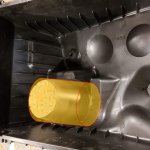
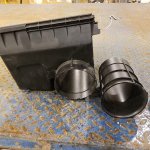
Intake restrictor / insert / reducer / delete from air box

I think the term restrictor came along after it was determined that once removed, the truck got more air. My truck reacted to it upon first start the next morning. So nozzle, diverter, restrictor, call it whatever you want. It restricts air flow.

Now at high rpm, does it cause some sort of turbulence that others have mentioned, "effectively reducing performance" at high rpm's? Dunno, but I do know my truck rarely gets into high rpms.

Sorry, but there is no way that is restriction in airflow.

You do realize the airflow is always being restricted by the throttle blade (by design on a petrol engine).. right? Only at WOT and Max RPM does maximum airflow occur.

Now if that hole was the size of a straw and you opened it up by a few inches... this would be a different story. But nothing like that is going on here. Is there even a measurable diameter change at all? I don't think so.

The point is. You could put an open large cone filter there and it would make no real difference as the majority of your pressure drop is the tubing and bends from the TB all the way to the box (not to mention the accordion...). The only way you would ever see any real difference is to greatly shorten the tubing with smooth transitions and do some type of direct over the radiator feed. And you would still need the MAF in the middle... so packaging gets difficult. Plus, the maf needs smooth airflow to be accurate, so that is always a challenge when running on a MAF modeled ECU.

Trust me I've done many experiments back by data with intakes in the past. You are not chaining anything here besides noise and how dirt hits the filter.

I could be convinced with before and after MAF readings with IAT, RPM, gear and Throttle position. but I'm guessing you don't have that. ;-)

The old butt dyno can be deceiving.... but hey if it works for you all is good. Just don't call it a restrictor and expect not to get some flack here.
 
Last edited:
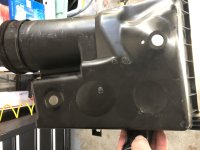
My airbox

Pic of the bottom of my box.
 

Attachments

  • 8714A898-BC12-43C1-A26F-7E863A9FBFE7.jpg
    8714A898-BC12-43C1-A26F-7E863A9FBFE7.jpg
    116.6 KB · Views: 1,689
I found this restrictor in my airbox
Maybe I should take it out
 

Attachments

  • 17801-50040-air-filter-for-toyota-land-cruiser-4runner-lexus-lx470.jpg
    17801-50040-air-filter-for-toyota-land-cruiser-4runner-lexus-lx470.jpg
    101.5 KB · Views: 1,549
I made a post in the "what did you do to/in your 5th gen today" thread which seemed to get a lot of attention so I figure it would be a good idea to make a dedicated post about it.

So I was seeing a bunch of people post stuff about a restrictor in the stock air box which was noticed when replacing with an aftermarket intake. I figured there had to be a way to remove it so I messed around with it tonight after work. Removed the lower air box, removed the water shield from the intake box, tapped the restrictor from the inside once with a hammer, fell right out. May have improved midrange power and it has a subtle throaty sound to it now. Not the sound of an aftermarket intake by any means but I do hear a difference. Only other mod is an AFE Pro Dry drop in filter. 10 minutes and free, works for me!

I don't see any restrictors there. Are you refering to hollow insert?
 
To clarify for many, because I know I was confused. This picture shows where the diverter that is being removed normally sits inside the airbox. there is also a scoop on the outside that sits inside the fender.

The the second picture from the OP shows where the sleeve slides in from the outside.

It diverts the outside airflow more towards the center of the box. vs the far edge.
 

Attachments

  • intake1.jpg
    intake1.jpg
    118.6 KB · Views: 1,664
  • intake11.jpg
    intake11.jpg
    136.3 KB · Views: 1,676
Last edited:
How do you explain the engineering behind the TRD intake? It has no "restrictor" nor any helmholtz resonators. I agree with you to an extent but I don't think this mod is as harmful to the power band as made out.

My experience with this mod has been fairly positive. Butt dyno claims slightly more mid range. I don't spend enough time in the upper RPM range to know whether I've lost any power. Most importantly, mpg has remained the same. I was hoping for mpg improvement but was satisfied that I didnt lose any mpg.

The mod is simple enough to revese so just try it.

I don't know enough engineering to comment on airflow, but how can you know MPG improvements with such a small sample size?
 
To clarify for many, because I know I was confused. This picture shows where the diverter that is being removed normally sits inside the airbox. there is also a scoop on the outside that sits inside the fender.

The the second picture from the OP shows where the sleeve slides in from the outside.

It diverts the outside airflow more towards the center of the box. vs the far edge.

Ok, I'll bite. Doesn't airspeed increase when diameter narrows?

Or does the temporary increase in speed/drop in pressure not matter because we're only talking about volume over a given period of time?
 
I don't know enough engineering to comment on airflow, but how can you know MPG improvements with such a small sample size?

mpg remained the same.. beats having it go down.. i definitely didnt gain mpg from the mod... its just a fun mod... its like kids that wedge playing cards on their bike wheels to make the ticking sound...
 
Ok, I'll bite. Doesn't airspeed increase when diameter narrows?

Or does the temporary increase in speed/drop in pressure not matter because we're only talking about volume over a given period of time?

Here is the best way to think about it in simplistic terms. Let's say you are filling up your bathtub, but you only typically open the valves 50% or so in normal bathing conditions... Now you make the outlet 1/4" bigger and it is already 3.25" in diameter. Will the tub fill up any faster? Obviously not... because all the restrictions limiting flow are upstream. Open the valves all the way and it still won't make any difference. There is just not enough flow potential in the system to need a larger outlet.

Now, hook up a fire hose... then the 1/4" change in diameter would make a difference but that fire hose is the equivalent of a 8.0 v12 making 600+ Hp at redline...

Bottom line the VE (volumetric efficiency) of the motor is not effected by such a minor change on such a low power motor. It simply does not move enough air for such a small change to make any difference. And if it did it would only come into play at absolute peak HP and airflow. If you wanted to make impact, you would do much better off shortening the length vs increasing diameter from 3.x + 1.4" (being generous here).... Or at least cut the entire bottom out of it... (but still won't make a darn difference)
 
Last edited:
Here is the best way to think about it in simplistic terms. Let's say you are filling up your bathtub, but you only typically open the valves 50% or so in normal bathing conditions... Now you make the outlet 1/4" bigger and it is already 3.25" in diameter. Will the tub fill up any faster? Obviously not... because all the restrictions limiting flow are upstream.

Now, hook up a fire hose... then the 1/4" change in diameter would make a difference but that fire hose is the equivalent of a 8.0 v12 making 600+ Hp at redline...

Bottom line the VE (volumetric efficiency) of the motor is not effected by such a minor change on such a low power motor. It simply does not move enough air for such a small change to make any difference. And if it did it would only come into play at absolute peak HP and airflow. If you wanted to make impact, you would do much better off shortening the length vs increasing diameter from 3.x + 1.4" if that....

I think I understand that, but maybe my question was a little different. (Granted, my mechanical knowledge is limited, and dangerous when I comment here)

It's not like this "restriction" is an adjustable valve of any sort, like the throttle valve in a carburetor, but if it is a restriction then would it have any venturi effect at all? Could it help create suction through the accordion filter*? (similar to the restriction before the throttle valve in a carburetor?)

Now I'm confused which side of the filter it's on, but oh well

256px-Carburetor.svg.png
 
Last edited:
I believe you will find Toyota put these devices in the intake tract to alter the sound at different RPM for government sound tests......as long as the Engine cannot draw more volume at WOT than the tract can provide, there is no gain in performance by removing them....just a change in the sound spectrum as RPM changes. The sound is measured at various determined rpm points and these devices are to remove resonance and ''Honking'' sounds that would fail the test. Some makers even retard timing and other tricks at these key points to ''Blunt'' the sound. None of this crap is of value to the user, it is just part of ''Big Government'' and the need to control everything for your own good!:whipping2
 
Here's the bottom line. The inlet side of the air box is smaller than it could be. Call the insert anything you want, doesn't matter. It necks down which makes the air flow more restricted. Does the 1/2" in size make a difference? No idea! Common sense tells you if your engine is not working as hard to draw air in, it will be more efficient. Does this mod make the engine run more efficiently? Again, no idea. I take a few road trips a year, about 250 miles each way and average about 17.5 MPG so when I take my next trip, we'll see what happens. This is a free mod, posted on the internet, it's worth just that. If you don't like it, don't do it! If you do it and change your mind, simply put the insert back in! Nothing about this mod can't be very easily reversed. How do you think we learned over the years? We tried things!
 
I believe you will find Toyota put these devices in the intake tract to alter the sound at different RPM for government sound tests......as long as the Engine cannot draw more volume at WOT than the tract can provide, there is no gain in performance by removing them....just a change in the sound spectrum as RPM changes. The sound is measured at various determined rpm points and these devices are to remove resonance and ''Honking'' sounds that would fail the test. Some makers even retard timing and other tricks at these key points to ''Blunt'' the sound. None of this crap is of value to the user, it is just part of ''Big Government'' and the need to control everything for your own good!:whipping2

That or your average consumer doesnt want or care for the added intake track. Our forum only represnents a small number of the 650,000+ 4runner owners
out there. We are probably a small percentage that modify our vehicles.
 

Members online

No members online now.

Forum statistics

Threads
278,309
Messages
3,554,071
Members
248,016
Latest member
Advally Service

Trending content

Back
Top