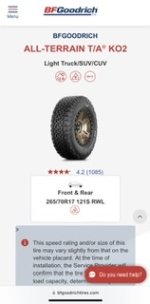
Interesting - KO2 Tire Pressure per BFG site

The "P" to "LT" is correct, and a bigger tire will hold more air. More air (volume) is not more pressure, though. Actually, a bigger tire can have a larger load rating at the same pressure. It has more air (volume) to hold up the weight, and doesn't always need more pressure, if they are both "P" or both "LT". In this case, switching from "P" to "LT" is the reason for the pressure increase.

If you went from one size "LT" tire to a larger "LT" tire, you could decrease the pressure and have the same load rating because you have more volume. Volume is constrained by the size of the tire, pressure is not. Volume holds up the truck, not just pressure.

That's not how tires work.

Also you could definitely require a different pressure changing LT tire sizes depending on the load index.
 
One of our Tire Reps recently went to a BFG/Mich tire testing expo and they actually talked about this. They asked all the attendee's if they went up in tire size and to a LT rated tire, if the stock pressure was 36ish psi where would they typically run the new LT tire....they all pretty much answered lower psi...and were promptly told that was incorrect. They now recommend MORE....they said it was to give the tire the proper footprint, but im still not sold on it lol
 
Running 40 PSI

I have had my BFG AT K02s (265) on for 3 years (55K miles) and have kept them close to 40 psi. Tried a bit higher and that was too stiff and tires wanted to wander a bit) have also run them lower which is great on trails but too squishy (for me) at highway speed. 40 is the sweet spot for my daily use
 
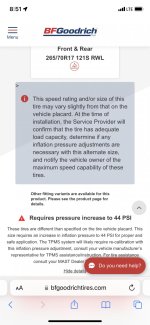
We got the BFG A/T LT KO2s and started them at 44 at the recommendation of the tire place because we were carrying a heavy load. Then taking them in to get balanced the shop put them at 38 psi and the ride became a nightmare, shaking and hopping all over the place. Saw on the bfgoodrich.com site today that for this tire THEY RECOMMEND 44 PSI in bold at the bottom.
It says, “Requires pressure increase to 44 PSI
These tires are different than specified on the tire vehicle placard. size requires an increase in inflation pressure to 44 PSI for proper and safe application. The PMS system will likely require re-calibration with
this inflation pressure adjustment, consult your vehicle manufacturer's representative for TPMS assistance/instruction. For tire assistance consult your MAST Dealer for more details.”
 

Attachments

  • 299C70E1-A525-4C25-B1E0-44FAE0C055CB.jpeg
    299C70E1-A525-4C25-B1E0-44FAE0C055CB.jpeg
    15.3 KB · Views: 501
Here’s the screenshot of the bottom of the BFG website listing for the KO2 tires I mentioned, that shows the 44 psi recommendation for running them on the 4Runner. Hope this helps others get it right the first time! Wish we would’ve known earlier what 4 different shops didn’t know.
 

Attachments

  • B8A1FE75-F8E9-43BB-AF8F-5B3A0A703095.jpg
    B8A1FE75-F8E9-43BB-AF8F-5B3A0A703095.jpg
    134.4 KB · Views: 498
It’s not that wild - I run 40-45 PSI in all my tires, including BFG’s, and get 60k miles out of them because they wear slowly and evenly.

The pictures of tires worn on the edges (underinflation) and centers (overinflation) are examples of EXTREME cases of each. Tire shops love to display these.

But they won’t tell you that in order to produce those exaggerated examples, you need about 20 PSI under or over the recommended pressures, not just 10.

You are free to follow your door jamb sticker from the factory (generally lower) or your tire company’s info (generally higher) but I have run each set of tires in all of the vehicles I’ve owed, collectively at least 10 sets, and have ALWAYS exceeded the mileage rated by 10-20k miles before the tread depth indicated replacement was due.

I’ve never let a set run bald just to squeeze more mileage out of them. This is legal mileage I’ve achieved with an SUV’s weight, 4500-5500 pounds, spread over four 40-45 PSI tires.

You WILL notice a rolling resistance difference between 35 PSI and 45 PSI, but your tires with wear deceptively evenly under both. 45 PSI they just last a little longer.


Sent from my iPhone using Tapatalk
 
It’s not that wild - I run 40-45 PSI in all my tires, including BFG’s, and get 60k miles out of them because they wear slowly and evenly.

The pictures of tires worn on the edges (underinflation) and centers (overinflation) are examples of EXTREME cases of each. Tire shops love to display these.

But they won’t tell you that in order to produce those exaggerated examples, you need about 20 PSI under or over the recommended pressures, not just 10.

You are free to follow your door jamb sticker from the factory (generally lower) or your tire company’s info (generally higher) but I have run each set of tires in all of the vehicles I’ve owed, collectively at least 10 sets, and have ALWAYS exceeded the mileage rated by 10-20k miles before the tread depth indicated replacement was due.

I’ve never let a set run bald just to squeeze more mileage out of them. This is legal mileage I’ve achieved with an SUV’s weight, 4500-5500 pounds, spread over four 40-45 PSI tires.

You WILL notice a rolling resistance difference between 35 PSI and 45 PSI, but your tires with wear deceptively evenly under both. 45 PSI they just last a little longer.


Sent from my iPhone using Tapatalk

I guess that you could call me a BFG KO2 "fanboy" since I have been using them for over 35 years on various 4x4 vehicles. (1/2 ton Chevys/GMC & now exclusively 4R's) On my 4R's, I have had the best wear mileage running between 38-41 PSI. But I'm not saying that you are wrong running 45 PSI. Rarely do I have more than 1 passenger or heavy gear in the back. If my 4R was loaded down more often than not, I would probably up the pressure to 45.
 
I guess that you could call me a BFG KO2 "fanboy" since I have been using them for over 35 years on various 4x4 vehicles. (1/2 ton Chevys/GMC & now exclusively 4R's) On my 4R's, I have had the best wear mileage running between 38-41 PSI. But I'm not saying that you are wrong running 45 PSI. Rarely do I have more than 1 passenger or heavy gear in the back. If my 4R was loaded down more often than not, I would probably up the pressure to 45.


I really wish they would go back to the old design. The KO2 revision with the “flame sidewalls” looks gimmicky and now looks like everyone else.

I forgot when they changed, 2013 or whatnot. They’re the first tire I search for when it’s time for a new set.


Sent from my iPhone using Tapatalk
 
I guess that you could call me a BFG KO2 "fanboy" since I have been using them for over 35 years on various 4x4 vehicles. (1/2 ton Chevys/GMC & now exclusively 4R's) On my 4R's, I have had the best wear mileage running between 38-41 PSI. But I'm not saying that you are wrong running 45 PSI. Rarely do I have more than 1 passenger or heavy gear in the back. If my 4R was loaded down more often than not, I would probably up the pressure to 45.
I’ve had KO’s on multiple vehicles too. They were solid performers. Oddly, BF Goodrich does not recommend them for the 2022 4Runner. When I saw that on their site I emailed to double check, and sure enough their representative confirmed it. I’m still on the stock Dunlops and researching AT tires.

I really wish they would go back to the old design. The KO2 revision with the “flame sidewalls” looks gimmicky and now looks like everyone else.
Yes I agree. The sculpted sidewalls are kid stuff.
 
44psi is because they are an LT tire and not a P tire. The higher inflation acieves the same weight rating as the stock P tire listed on the door jam.

Ive been running the 44 with no issues, just a rougher ride than 32 on the P. If they made a KO2 in P id be all over it for the lower pressure and better ride. Less jarring on the suspension, etc.
 
44psi is because they are an LT tire and not a P tire. The higher inflation acieves the same weight rating as the stock P tire listed on the door jam.

Ive been running the 44 with no issues, just a rougher ride than 32 on the P. If they made a KO2 in P id be all over it for the lower pressure and better ride. Less jarring on the suspension, etc.


And perhaps the most ironic is an E rated BFG KO2 (265/70R17 specifically) ride softest with a 5000 lb vehicle at 45 PSI. Anything less, you lose steering feedback, anything more will firm up the ride significantly.


Sent from my iPhone using Tapatalk
 
How are you determining the proper PSI? Does BFG have a chart or is there some online calculator for this? I just always assumed you went by the PSI on the side of the door? Thanks
 
It’s not that wild - I run 40-45 PSI in all my tires, including BFG’s, and get 60k miles out of them because they wear slowly and evenly.

The pictures of tires worn on the edges (underinflation) and centers (overinflation) are examples of EXTREME cases of each. Tire shops love to display these.

But they won’t tell you that in order to produce those exaggerated examples, you need about 20 PSI under or over the recommended pressures, not just 10.

You are free to follow your door jamb sticker from the factory (generally lower) or your tire company’s info (generally higher) but I have run each set of tires in all of the vehicles I’ve owed, collectively at least 10 sets, and have ALWAYS exceeded the mileage rated by 10-20k miles before the tread depth indicated replacement was due.

I’ve never let a set run bald just to squeeze more mileage out of them. This is legal mileage I’ve achieved with an SUV’s weight, 4500-5500 pounds, spread over four 40-45 PSI tires.

You WILL notice a rolling resistance difference between 35 PSI and 45 PSI, but your tires with wear deceptively evenly under both. 45 PSI they just last a little longer.


Sent from my iPhone using Tapatalk

Are you running E-Load at that pressure like the ones he showed in the pic? Curious how firm an E-Load KO2 rides at that pressure. My 265/70r17 KO2s I had were the C-load and were noticeably firmer than stock even at 32PSI.
 
The "P" to "LT" is correct, and a bigger tire will hold more air. More air (volume) is not more pressure, though. Actually, a bigger tire can have a larger load rating at the same pressure. It has more air (volume) to hold up the weight, and doesn't always need more pressure, if they are both "P" or both "LT". In this case, switching from "P" to "LT" is the reason for the pressure increase.

If you went from one size "LT" tire to a larger "LT" tire, you could decrease the pressure and have the same load rating because you have more volume. Volume is constrained by the size of the tire, pressure is not. Volume holds up the truck, not just pressure.

AK Mule. When you talk about “P” and “LT” tires. Are these letters in front of the tire size? Example,

LT265/70R17 or P265/70R17
 
Yes you are correct. it would say LT or P. and at the end it would say the load rating(C, D, E etc).

Thanks!

Until I read this post I was never aware that LT tires should run at higher PSI. I always went by what was on my door +5 PSI to improve gas mileage. Even my tire shop said they just go by the PSI listed on the door. I did call BFG and they told me they recommended 44 PSI for LT tires on the 5th Gen 4Runner. I did read that many people here prefer to run them at 40 PSI.

Curiosity question. If you run LT tires at 32 PSI listed on the door, can that cause any safety issues or does it just only means you will have less fuel efficiency and uneven wear?

Thanks again.
 
Thanks!

Until I read this post I was never aware that LT tires should run at higher PSI. I always went by what was on my door +5 PSI to improve gas mileage. Even my tire shop said they just go by the PSI listed on the door. I did call BFG and they told me they recommended 44 PSI for LT tires on the 5th Gen 4Runner. I did read that many people here prefer to run them at 40 PSI.

Curiosity question. If you run LT tires at 32 PSI listed on the door, can that cause any safety issues or does it just only means you will have less fuel efficiency and uneven wear?

Thanks again.

I actually had a tire tech argue with me about tire pressure until his boss came over and asked what pressure I wanted in the tires and told his guy to do that. I did at one point mention that I shouldn't know more about tires than he does.

I will say, I am impressed by this site so far, I'm used to people saying they run max PSI because that's what it says on the sidewall...or they run what's on the door sticker but very few in between.
 

Members online

Forum statistics

Threads
278,316
Messages
3,554,120
Members
248,016
Latest member
Advally Service

Trending content

Back
Top