KDSS Lean after install

KDSS lean and sway bar configuration

The typical KDSS lean after a lift is higher on the drivers side lower on the passenger.

There is a KDSS balancing procedure you should try, but we found it to only worked short term for the common KDSS lean.. The lean kept coming back. The only permanent fix was small spacers to raise up the passenger side.

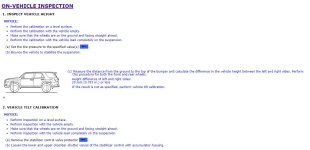
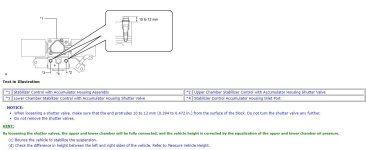
If you do the balancing procedure read the instructions carefully. When they say back out 10mm or whatever... they are talking about measuring from the outer portion of the bolt head, so only back 4mm or so less than the instructions state. ...

I have the dreaded (KDSS?) lean after an ICON stage 7 lift install. Both before and after the lift the passenger side was higher, by 1/2" before the lift and 1" after the lift. Now it's a half inch higher in the front right and 1" higher in the back right side.

What is the KDSS balancing procedure and where can I read it? The video linked above is for a Land Cruiser with KDSS.

The KDSS system has a piston on one side, the driver's side front and back, and a fixed strut on the other side, the passenger side. How can we lift the vehicle 2" to 3" and not change the strut length? This alone must throw off the KDSS system. This is just a question.

The front sway bar is fixed at three points. Two points are on the left and right LCA, with bushings for flexure and rotation. The third point is a fixed length strut to the frame on the passenger side. The KDSS piston is a moving point, responding to changes in length or pressure between the sway bar and the frame.

The back sway bar is a U-shaped bar that rotates on bushings at the two axle mounts. It sits somewhat level behind the axle at rest, anchored to the axle at the front ends of the bar and the KDSS points at the back, at about third points of the U-shape. The sway bar is free to rotate as the back axle moves up and down. It's attached by a fixed length rod on the passenger side. The piston is attached to the left side. Both the rod and the piston are free to rotate around the sway bar as the forward ends move up and down with the axle. As the axle moves it moves the sway bar ends forward or backwards. And of course, the axle does not remain level or move equally up and down on the two sides, but varies with the terrain and sway as the vehicle turns.

The sway bar must move with the axle as it rises or falls on either side. The fixed rod remains the same length below the frame but can rotate and swing backwards as the sway bar rises and falls, and necessarily must move forward and backwards as the axle moves. The KDSS piston can move backwards as the sway bar rises and can also change length.

Understanding the geometry helps to understand what can change as the axle moves. What does the KDSS piston do in response to flexure of the sway bar about these three points?

I'm not supposing to know how KDSS works or if this is part of the problem. It's just food for thought.
 

Attachments

  • tilt1.JPG
    tilt1.JPG
    94.1 KB · Views: 2,587
  • tilt2.JPG
    tilt2.JPG
    84.1 KB · Views: 2,623
Last edited:
KDSS lean correction prcedure

Thanks @wfo9
I really appreciate your posting that procedure. I got a good look at the actuator valve when I was installing my bolt-on rock sliders.

If this doesn't work I may try adding a spacer to the driver's side rear spring and lowering the spring compression on the front right coil-over shock. I'm just not sure how much of a spacer I need over the rear spring. Maybe a 1/2" spacer on the left rear and 1/4" less ring compression on the front right side. The ICON coil-over is fairly easy to adjust with the frame lifted. The rear springs are a lot more work to add a spacer.
 
Its been a while since i started this thread and i actually forgot all about the KDSS lean. In December of 2016 i swapped my 6112/5160 for a TRD Pro suspension for a lower lift and smoother ride. Since then, i haven’t had any issue with the KDSS lean. There must be a certain amount of lift that throws everything off.
Funny enough, i have been reading through other threads, scrolling through instagram and thinking of adding a spacer or two in the runner to gain a little more hight... but once I saw this thread come up again... I’m having second thoughts...


Sent from my iPhone using Tapatalk
 
I have the trd pro suspension on my trail premium I added cornfed spacers and noticed a lean to the right added toytec spacer ontop of that in passenger side rear now I just seem to have a lean on passenger side front it’s killin me I was thinking of adding a spacer to the front passenger but I’m scared it’s gojng to through off the rear
 
I have the trd pro suspension on my trail premium I added cornfed spacers and noticed a lean to the right added toytec spacer ontop of that in passenger side rear now I just seem to have a lean on passenger side front it’s killin me I was thinking of adding a spacer to the front passenger but I’m scared it’s gojng to through off the rear

I’d suggest setting the front shocks even, rather than with sticking with the ‘stock’ lean correction the TRD shocks come with. Were you initially trying to correct a lean, or just anticipating one when the TRD suspension was installed?

Of course, the corrections you made previously might add up to who-knows-what after evening the front.
 
Last edited:
i have an adjustable trac bar and that didn't fix it :( just helping your theories by ruling that out

No change whatsoever? I figured the lean had something to do with the geometry of the trac bar being off after a lift. What about installing an extended mounting bracket for the trac bar, bringing it lower, rather than longer, would that change anything at all or just be the exact same thing as adjustable? The lean is driving me nuts and making me concerned about negatively affecting the car long term or diminishing optimal performance since something obviously isn’t right. I even loaded all my heaviest stuff on the drivers side and it’s still almost 1.5” lower on the passenger side with a full tank
 
From my research, Dobinson provides KDSS specific lift. Maybe someone can chime in to see how effective their setup is to counter the lean.
 
And, after reading through this thread for the first time, there is indeed a tremendous amount of misinformation about KDSS systems, which is compounded by the fact that it is a bit of a 'black box' in regard to how it actually does what it does.


No two KDSS vehicles are the same, and will likely have their own unique lean characteristics, thus the most effective fix being leveling spacers. Ride height from week-to-week can vary by +/- 1/2", regardless of fuel quantity. Lifting the front end absolutely DOES result in weird changes in the back, contrary to assertions in this thread that it does not. Trust me on this one; I went through the exasperation of trying to level the front by initially switching the front L/R shocks (TRD suspension at different perch settings), and it wildly affected the height of the rear. Again, no changes to rear suspension were made, but ride height changed by 2-5/8" in the rear (i.e. the rear went down 1" on on side, and up 1.5" on the other). KDSS did that, there is no other explanation.


Lastly, KDSS vehicles lean opposite of SR5s (go measure a bunch on the lot, I did), and Trail/Off Road variants no longer come with mis-matched shocks, the way the TRD Pros do. Along those lines, my KDSS-equipped TRD suspension was most level in front when the perch settings were identical, not asymmetrical as in the stock TRD Pro.


Just put the pro suspension on my trail and I have the lean. Did you change the driver or passenger perch setting?
 
Last edited:
Why not just add spacers where needed to compensate for any lean? Seems like that is the only tried and true method that works (i added a 1/4” spacer front driver after my Bilstein 5100/Wheelers lift was installed) and I’m good to go.
 
Why not just add spacers where needed to compensate for any lean? Seems like that is the only tried and true method that works (i added a 1/4” spacer front driver after my Bilstein 5100/Wheelers lift was installed) and I’m good to go.


That's what I'll end up doing when I swap the perch setting.
 
From my research, Dobinson provides KDSS specific lift. Maybe someone can chime in to see how effective their setup is to counter the lean.

I have the Dobinson KDSS specific springs and yes it did fix the KDSS lean. I didn't even have to adjust the front coilovers. I have them exactly the same height for the front. :thumb:
 

Attachments

  • With Dobinson Rear Springs 3.jpg
    With Dobinson Rear Springs 3.jpg
    99.1 KB · Views: 1,458
Last edited:
Just put the pro suspension on my trail and I have the lean. Did you change the driver or passenger perch setting?

Yes; swapping left-right didn't fix it, I had to make the perch settings the same to level it (stock Trail (KDSS) shocks are set even). Adding a spacer when I could adjust the perch setting to symmetrical seemed like an inane approach to me.
 
Yes; swapping left-right didn't fix it, I had to make the perch settings the same to level it (stock Trail (KDSS) shocks are set even). Adding a spacer when I could adjust the perch setting to symmetrical seemed like an inane approach to me.

So you are able to adjust the perch settings on the TRD pro suspension?
 
I haven't read this for a while, but I've had some PM conversations regarding it. As of now my working opinion is that you must either spacer or have different springs side/side to balance KDSS lift. I haven't had time to calculate the difference yet or exact measurements to get a better calculation of spring rates. But this is a copy/paste from a conversation I've had about the front to give an idea of what I think is the issue and how to solve it.

Also note that the rear is more complex because of the suspension is "dependent" side to side, so it's a more complicated calculation to get it right.


The downsides are the complexity and one design flaw. The problem with using two pistons in this way is that the piston rod that extends has volume. And as a result as the piston moves the volume of fluid in the combined chambers changes. The excess volume from the piston rod has to go somewhere. To account for this the system uses a pair of accumulators. They are basically just small tanks that act as reservoirs for the extra fluid. But then how do you have a closed system and still allow for expansion without mixing air in the oil? The small accumulator tanks have a rubber diaphragm inside them that is pressurized on one side. - Like a little balloon inside them. As more oil comes in, the balloon full of air gets compressed. No big deal. That's actually exactly the same thing that happens inside of a shock absorber.

Where this becomes an issue is that both pistons are cross linked to make them act as reverse master/slave - when one compresses the other extends. The piston rod area is deducted from the surface area that the hydraulic force of the fluid pushes on. So the top of the piston without the rod has at he full area of the piston, the bottom has the area of the piston minus the rod diameter. Why does that matter? - the answer is that the accumulators are pressurized to about 500psi. And as a result the entire hydraulic circuit set is also pressurized to 500psi. That pressure in the system along with the slight mismatch in the top and bottom of the pistons due to the piston rod means that both KDSS cylinders has a constant pressure pushing down on it of somewhere around 1-300 lbs of force. It's a complex calculation to do without any exact measurements. I can probably do it whenever I get some actual measurements. But my guess is that it results in somewhere around a net force of 100ish lbs of force on the front and rear sway bars pushing down on the driver's side and up on passenger. By that I mean it wants to tilt the vehicle to the passenger side by around 100lbs on each axle. That doesn't sound like a lot -but it results in a slight lean.

If the normal spring rates are around 600lbs/in on the front coils - but they have a 2:1 leverage ratio, that means effectively they are 300lb/in and the same is roughly correct for the rear. If you have 100lbs of extra lift on the front and rear on one side, you would expect approximately 1/6" of lean. It could easily be as high as 300lbs though. I just don't know. If you had 300lbs of effective difference you'd expect a full 1/2 inch of height difference left to right if all else were equal.

For this reason Toyota balances the KDSS lean with slightly longer springs on the passenger side of KDSS 4runners. (Ideally you want a longer spring not a stiffer one - it's a long explanation, just trust me.)

Most aftermarket lift springs will not have a different spring length or spring rate side to side. The result is that you often end up with a "KDSS lean" when you lift them. It's not necessarily a result of the lift, rather it's a result of the spring changes from two different springs to matching ones.

With a 600lb spring and a goal of counteracting the KDSS lean effect, I think you would be pretty darn close by adding somewhere in the range of 3/16 and 1/4" spring spacer to the passenger side front coilover.

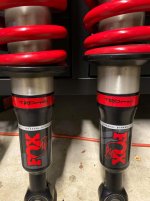
Thanks for posting such detailed thoughts... With that said I have a serious question. I am thinking of getting a lift on my 2016 KDSS. Currently I am looking at 2019 TRD pro fox shocks- Front coils are actually different lengths. See photo below. Would you recommend I install this or an adjustable KING suspension? Futhermore, if I were to install these trd fox shocks- should I send the longer coil to the passenger side?

Thank you for your thoughts.
 

Attachments

  • IMG_1820.jpg
    IMG_1820.jpg
    128.6 KB · Views: 981
Last edited:
Thanks for posting such detailed thoughts... With that said I have a serious question. I am thinking of getting a lift on my 2016 KDSS. Currently I am looking at 2019 TRD pro fox shocks- Front coils are actually different lengths. See photo below. Would you recommend I install this or an adjustable KING suspension? Futhermore, if I were to install these trd fox shocks- should I send the longer coil to the passenger side?

Thank you for your thoughts.

I don't have any personal experience with either King or the Fox TRD Pro shocks, so I can't really give you any advice on one vs the other. If I wanted a stockish height and I had both, I'd probably go for the TRD Pro set over the kings. They should have a better street ride and the bypass setup should also perform very well in the dirt. If you wanted more lift - then the King would be the way to go IMO.

I would put the longer one on the passenger side and then use some thin shims to level it out from there. IIRC the fox TRD Pro shocks actually have two machined slots like the Bilstein 5100/6112 and you could potentially move both of the lower spring seats to the same level by removing the coil, and then moving the circlip to match. That's another option to start with two matching length shocks then adjust to level with some thin spacers on top.
 
I don't have any personal experience with either King or the Fox TRD Pro shocks, so I can't really give you any advice on one vs the other. If I wanted a stockish height and I had both, I'd probably go for the TRD Pro set over the kings. They should have a better street ride and the bypass setup should also perform very well in the dirt. If you wanted more lift - then the King would be the way to go IMO.

I would put the longer one on the passenger side and then use some thin shims to level it out from there. IIRC the fox TRD Pro shocks actually have two machined slots like the Bilstein 5100/6112 and you could potentially move both of the lower spring seats to the same level by removing the coil, and then moving the circlip to match. That's another option to start with two matching length shocks then adjust to level with some thin spacers on top.

I’m looking at them now and can’t see anything, but maybe it’s hidden underneath the lower coil? Do you think I can disassemble these with your standard coil condenser rental at the auto store?
 

Members online

Forum statistics

Threads
278,306
Messages
3,554,045
Members
248,016
Latest member
Advally Service

Trending content

Back
Top