DesertCanyons
New member
KDSS lean and sway bar configuration
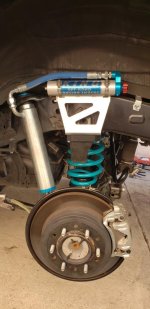
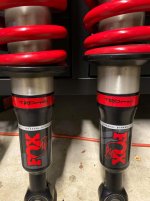
I have the dreaded (KDSS?) lean after an ICON stage 7 lift install. Both before and after the lift the passenger side was higher, by 1/2" before the lift and 1" after the lift. Now it's a half inch higher in the front right and 1" higher in the back right side.
What is the KDSS balancing procedure and where can I read it? The video linked above is for a Land Cruiser with KDSS.
The KDSS system has a piston on one side, the driver's side front and back, and a fixed strut on the other side, the passenger side. How can we lift the vehicle 2" to 3" and not change the strut length? This alone must throw off the KDSS system. This is just a question.
The front sway bar is fixed at three points. Two points are on the left and right LCA, with bushings for flexure and rotation. The third point is a fixed length strut to the frame on the passenger side. The KDSS piston is a moving point, responding to changes in length or pressure between the sway bar and the frame.
The back sway bar is a U-shaped bar that rotates on bushings at the two axle mounts. It sits somewhat level behind the axle at rest, anchored to the axle at the front ends of the bar and the KDSS points at the back, at about third points of the U-shape. The sway bar is free to rotate as the back axle moves up and down. It's attached by a fixed length rod on the passenger side. The piston is attached to the left side. Both the rod and the piston are free to rotate around the sway bar as the forward ends move up and down with the axle. As the axle moves it moves the sway bar ends forward or backwards. And of course, the axle does not remain level or move equally up and down on the two sides, but varies with the terrain and sway as the vehicle turns.
The sway bar must move with the axle as it rises or falls on either side. The fixed rod remains the same length below the frame but can rotate and swing backwards as the sway bar rises and falls, and necessarily must move forward and backwards as the axle moves. The KDSS piston can move backwards as the sway bar rises and can also change length.
Understanding the geometry helps to understand what can change as the axle moves. What does the KDSS piston do in response to flexure of the sway bar about these three points?
I'm not supposing to know how KDSS works or if this is part of the problem. It's just food for thought.
The typical KDSS lean after a lift is higher on the drivers side lower on the passenger.
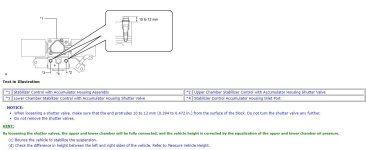
There is a KDSS balancing procedure you should try, but we found it to only worked short term for the common KDSS lean.. The lean kept coming back. The only permanent fix was small spacers to raise up the passenger side.
If you do the balancing procedure read the instructions carefully. When they say back out 10mm or whatever... they are talking about measuring from the outer portion of the bolt head, so only back 4mm or so less than the instructions state. ...
I have the dreaded (KDSS?) lean after an ICON stage 7 lift install. Both before and after the lift the passenger side was higher, by 1/2" before the lift and 1" after the lift. Now it's a half inch higher in the front right and 1" higher in the back right side.
What is the KDSS balancing procedure and where can I read it? The video linked above is for a Land Cruiser with KDSS.
The KDSS system has a piston on one side, the driver's side front and back, and a fixed strut on the other side, the passenger side. How can we lift the vehicle 2" to 3" and not change the strut length? This alone must throw off the KDSS system. This is just a question.
The front sway bar is fixed at three points. Two points are on the left and right LCA, with bushings for flexure and rotation. The third point is a fixed length strut to the frame on the passenger side. The KDSS piston is a moving point, responding to changes in length or pressure between the sway bar and the frame.
The back sway bar is a U-shaped bar that rotates on bushings at the two axle mounts. It sits somewhat level behind the axle at rest, anchored to the axle at the front ends of the bar and the KDSS points at the back, at about third points of the U-shape. The sway bar is free to rotate as the back axle moves up and down. It's attached by a fixed length rod on the passenger side. The piston is attached to the left side. Both the rod and the piston are free to rotate around the sway bar as the forward ends move up and down with the axle. As the axle moves it moves the sway bar ends forward or backwards. And of course, the axle does not remain level or move equally up and down on the two sides, but varies with the terrain and sway as the vehicle turns.
The sway bar must move with the axle as it rises or falls on either side. The fixed rod remains the same length below the frame but can rotate and swing backwards as the sway bar rises and falls, and necessarily must move forward and backwards as the axle moves. The KDSS piston can move backwards as the sway bar rises and can also change length.
Understanding the geometry helps to understand what can change as the axle moves. What does the KDSS piston do in response to flexure of the sway bar about these three points?
I'm not supposing to know how KDSS works or if this is part of the problem. It's just food for thought.




 just helping your theories by ruling that out