Let's talk about KDSS and sway bars

Dalko43

New member
Alright, so I know what KDSS is and how it works.

I know that most aftermarket vendors are able to offer suspension upgrades that are compatible with this system.

Here are my questions/discussion points:

1) Why did Toyota not offer KDSS on the TRD Pro 4runner? Were they worried about how it would function with the different suspension setup?

2) Since it doesn't have KDSS, does the TRD Pro use the standard sway bars?

3) How high can a 4runner be lifted before the standard (non-KDSS) sway bars become an issue? Are there work-arounds (like sway bar disconnect links) for people who choose to keep their swaybars attached when lifting their 4runner?

4) How high can you lift a 4runner (with KDSS) before the system becomes impaired or inoperable?

3) Which system (standard sway bars or KDSS) offers better off-road capabilities, especially wheel articulation, for a 4runner with a modified suspension (looking at a max of a 3 inch lift with tires no bigger than 285's).
 
Register to hide this ad
Alright, so I know what KDSS is and how it works.

I know that most aftermarket vendors are able to offer suspension upgrades that are compatible with this system.

Here are my questions/discussion points:

1) Why did Toyota not offer KDSS on the TRD Pro 4runner? Were they worried about how it would function with the different suspension setup?
The Pro is mostly an appearance package. I'd also imagine margins are probably lower, since the suspension/wheels are installed after arrival stateside, so starting with a cheaper base vehicle provides more room for profit.

2) Since it doesn't have KDSS, does the TRD Pro use the standard sway bars?
Yes

3) How high can a 4runner be lifted before the standard (non-KDSS) sway bars become an issue? Are there work-arounds (like sway bar disconnect links) for people who choose to keep their swaybars attached when lifting their 4runner?
At the moment, 3" off the shelf. An FJ 6" drop bracket kit can be modified to fit. KDSS will need to be disconnected and you will have to run without sway bars in this instance - I'm not sure about the non-KDSS version, but generally these types of kits come with dropped sway bar end links.

4) How high can you lift a 4runner (with KDSS) before the system becomes impaired or inoperable?
3" - see previous answer

3) Which system (standard sway bars or KDSS) offers better off-road capabilities, especially wheel articulation, for a 4runner with a modified suspension (looking at a max of a 3 inch lift with tires no bigger than 285's).
A system with standard sway bars will allow you to run a LT setup.

See answers above
 
Alright, so I know what KDSS is and how it works.

I know that most aftermarket vendors are able to offer suspension upgrades that are compatible with this system.

Here are my questions/discussion points:

1) Why did Toyota not offer KDSS on the TRD Pro 4runner? Were they worried about how it would function with the different suspension setup?

2) Since it doesn't have KDSS, does the TRD Pro use the standard sway bars?

3) How high can a 4runner be lifted before the standard (non-KDSS) sway bars become an issue? Are there work-arounds (like sway bar disconnect links) for people who choose to keep their swaybars attached when lifting their 4runner?

4) How high can you lift a 4runner (with KDSS) before the system becomes impaired or inoperable?

3) Which system (standard sway bars or KDSS) offers better off-road capabilities, especially wheel articulation, for a 4runner with a modified suspension (looking at a max of a 3 inch lift with tires no bigger than 285's).

1. Since nobody here designed the 4Runner suspension, every answer you get will be speculation. Here's my speculation: KDSS is probably the best compromise suspension design for on and off road. It will firm everything up at higher speeds on the road and improve on road handling. Off road it will allow more articulation at low speeds to keep tire to ground contact. The TRD PRO suspension was designed more for higher speed off road, like desert running. Also the KDSS system's inherent swaybar design reduces ground clearance a bit. Lastly, adding a different suspension and KDSS would drive up the price point.

2. Yes.

3. KDSS is only one of several suspension lift limiting factors. More importantly is the CV shaft angle. If you are going to modify your 4Runner to go above 2.5-3" then you are modifying for off road primarily and that defeats the KDSS purpose of on and off road use.

4. It's not the lift as much as the suspension travel. 2.5" to 3" is max for many reasons. Now you can use a FJ inspired body lift but that brings about challenges too.

3. (three again?) Your question is not clear. If you compare a lifted KDSS equipped 4Runner to a lifted non KDSS equipped 4Runner then the KDSS one will be better ON ROAD. Off road it depends on the mods. Many here have already modded SR5's and LE's to be better performers off road.
 
People seriously underestimate the value of KDSS for someone who does most of their driving on pavement.
 
People seriously underestimate the value of KDSS for someone who does most of their driving on pavement.

I am not trying to start a KDSS vs non-KDSS owners argument...I just want to understand the inherent advantages and disadvantages (if any) to each setup when it comes to off-roading.

3. (three again?)

Typo from when I re-ordered the questions.

Your question is not clear. If you compare a lifted KDSS equipped 4Runner to a lifted non KDSS equipped 4Runner then the KDSS one will be better ON ROAD. Off road it depends on the mods. Many here have already modded SR5's and LE's to be better performers off road.

I realize there are other limiting factors when it comes to suspension lifts and performance. My question is concerned with how KDSS affects off-road performance (either negatively or positively) versus how the standard sway bars affect off-road performance when it comes to moderately lifted (1-3in) 4runners.
 
I realize there are other limiting factors when it comes to suspension lifts and performance. My question is concerned with how KDSS affects off-road performance (either negatively or positively) versus how the standard sway bars affect off-road performance when it comes to moderately lifted (1-3in) 4runners.

KDSS will give you a bit more articulation off road. Understand though that the physical geometry and bump stop locations are no different between a KDSS versus non KDSS suspension.
 
Hypothetically speaking

The answers posted here are right on the money. Greg's responses about design intent and suspension behavior are fairly insightful too. I can't add much to what's already been said, except to say that lifting with a taller suspension is more labor intensive if you have KDSS. This further ads to the cost of building the TRD Pro, which is all done here in the US using what appears to be a Trail Edition Premium, sans KDSS and a sunroof.

So I have to ask the OP, [MENTION=120402]Dalko43[/MENTION] is this a hypothetical question or are you shopping for a new 4Runner? Just recently you asked about extended warranty options for your 2011 4Runner.
 
I am not trying to start a KDSS vs non-KDSS owners argument...I just want to understand the inherent advantages and disadvantages (if any) to each setup when it comes to off-roading.

I didn't say/think you were I was just pointing out it's usefulness on road.
 
So I have to ask the OP, [MENTION=120402]Dalko43[/MENTION] is this a hypothetical question or are you shopping for a new 4Runner? Just recently you asked about extended warranty options for your 2011 4Runner.

These questions are purely hypothetical. I am not looking to buy another 4runner with KDSS.

I was reading up on the TRD Pro model, and wondered why Toyota didn't equip it with KDSS, since its supposed to be the most off-road capable 4runner.
 
Alright, so I know what KDSS is and how it works.

I know that most aftermarket vendors are able to offer suspension upgrades that are compatible with this system.

Here are my questions/discussion points:

1) Why did Toyota not offer KDSS on the TRD Pro 4runner? Were they worried about how it would function with the different suspension setup?

The pro is really targeted towards a desert pre-runner type wheeling scenario. think baja for fun..... This is the background of the TRD guys so they naturally gravitate in that direction. KDSS could have worked there, but it was unnecessary. Articulation is not a big deal for wheeling at speed so they most likely eliminated it just to avoid potential reliability issues.

2) Since it doesn't have KDSS, does the TRD Pro use the standard sway bars?
99% sure this is true
3) How high can a 4runner be lifted before the standard (non-KDSS) sway bars become an issue? Are there work-arounds (like sway bar disconnect links) for people who choose to keep their swaybars attached when lifting their 4runner?
There are longer swaybar links available... but 3" is as high as most people want to go.

4) How high can you lift a 4runner (with KDSS) before the system becomes impaired or inoperable?
Lift is not the limt... Wheel travel is.

3) Which system (standard sway bars or KDSS) offers better off-road capabilities, especially wheel articulation, for a 4runner with a modified suspension (looking at a max of a 3 inch lift with tires no bigger than 285's).
For slightly modified, KDSS would be better. For highly modified, no KDSS or KDSS with system removed woud be better.

You can get way more wheel travel in the rear with LT and it is not expensive to add, but KDSS is not really compatible with it since the swaybar will contact things. Someone was talking about trying to make a custom trackbar that would work with KDSS, but I'm not clear on how much it limits the travel overall. Also, if you ever wanted to add LT in the front, the KDSS would need to go.

In summary, basic build for trail use, KDSS would be better.

Dessert runner, skip the KDSS and worry about shocks, bypasses, bump stops and vertical wheel travel.

Hard core trail rig with LT, skip the KDSS, remove the swaybars or come up with a disconnect system.
 
Last edited:
Since this is speculation:

1. The 2014 demo build of the TRD did have KDSS. Why they removed it who knows, I am sticking with cost. As mentioned and from all the builds I have seen, if you are building a long travel setup and/or large lift you probably don't want KDSS anyway (maybe unless someone develops a drop mount for the pistons?)


Ever ask a good question and everyone acts like they didn't hear you?

LOL patience young jedi patience

I would hardly say 12 minutes is an unbearable amount of time to wait for an answer. Too much coffee this morning? :D
 
Since we're on the topic, I'm wondering if anyone can confirm if there's a 'lag' in the KDSS system functionality.
My understanding is that it's a purely hydraulic/ mechanical setup with no 'intelligence' behind it (i.e. adjustments based on inputs from speed, yaw sensors, accelerometer... etc.)
If that's the case, is there a limit on how the 'plumbing' of the system would limit how fast the actuators can cycle in either direction? How would this show in a real world scenario?
Obviously this is a non-issue in things like 4-lo crawling, or even faster runs on relatively flat dirt roads.. But curious on how fast can you push the KDSS setup in the higher speed off-roading direction before it becomes a noticeable hindrance (if it does at all).
 
My understanding is that it's a purely hydraulic/ mechanical setup with no 'intelligence' behind it (i.e. adjustments based on inputs from speed, yaw sensors, accelerometer... etc.) .
That is incorrect, it does have input from VSC system.
8-20-2014%2011-27-53%20AM.png

8-20-2014%2011-29-47%20AM.png
 
Last edited:
Sorry to resurrect an old thread, but as a new member, I cannot create my own and I could not find the answer to my question using the search function.

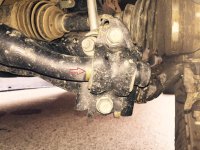
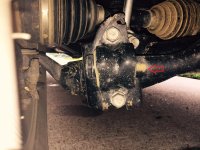
After installing new shocks/struts I noticed some wear on my sway bar near the bushing, indicating the sway bar is moving within the bushings (see pics).

A service adviser at my dealership says that for a KDSS equipped vehicle it is normal for the sway bar to move in and out of the bushing. This does not sound right to me. Can anyone confirm/deny?

On a related note (I suspect), the passenger side, front and rear, sits about an inch lower than the drivers' side.
 

Attachments

  • FullSizeRender (1).jpg
    FullSizeRender (1).jpg
    137.5 KB · Views: 1,897
  • FullSizeRender.jpg
    FullSizeRender.jpg
    136 KB · Views: 1,862
Hi, I will try to answer your question. I had a similar problem with my 2011 Trail with KDSS. I will have to find the repair order but I think the problem is a used bushing. If I remember correctly that's what they replaced on my truck. I will look up my files and confirm. I hope it helps you OP :) !


And this, I know it is in french but its all I can do.


On the second pic, if I translate is says Bushing of the stabilising bar loose. Have the look into it. Then it says order bushing and Calibrate the KDSS system, and steering angle.

I hope you can fix your problem and that the truck is still under warranty. You can see my bill at 0.00.

Let me know how it works out for you.
 

Members online

Forum statistics

Threads
278,310
Messages
3,554,079
Members
248,016
Latest member
Advally Service

Trending content

Back
Top