Limited, Full-Time 4WD vs AWD Differences

A little more: based on my understanding of an "open" diff, both wheels get power as long as both wheels have traction. As soon as one wheel loses traction, it gets all the power and you... lose forward thrust while one wheel spins. Back in my '60s muscle car days, we'd make fun of the guys who did the one wheel burnouts.

With a limited slip, there is either a clutch setup or a rear torsen (yes, they are used as limited slip diffs too). With the clutch setup it keeps the wheels at roughly the same speed (with some slip) when one wheel slips. Sometimes we'd test for Posi-traction (limited slip) by putting one wheel on pavement and one on the grass and then punching it. Open diff: you'd go nowhere. Posi: both wheels would spin. With a torsen I believe it actually transfers torque to the wheel with more grip (again, example is a rear diff). With either a clutch/disc based or torsen based mechanical limited slip, you'd get two stripes if you did a burnout :) With too much abuse the discs wear and you eventually have what amounts to an open diff.

With braked "fake" limited slip, it's an open diff, but when that one wheel starts whizzing away (loses grip), it gets braked (single wheel braking due to the wonders of ABS tech) and then power is "forced" across the axle. In this case you'd probably melt your brakes if you tried to do a burnout.... But, it would very effectively get you off of that grassy shoulder.
 
Last edited:
A little more: based on my understanding of an "open" diff, both wheels get power as long as both wheels have traction. As soon as one wheel loses traction, it gets all the power and you... lose forward thrust while one wheel spins. Back in my '60s muscle car days, we'd make fun of the guys who did the one wheel burnouts.

With a limited slip, there is either a clutch setup or a rear torsen (yes, they are used as limited slip diffs too). With the clutch setup it keeps the wheels at roughly the same speed (with some slip) when one wheel slips. With a torsen I believe it actually transfers torque to the wheel with more grip (again, example is a rear diff). With this you'd get two stripes if you did a burnout :)

With braked "fake" limited slip, it's an open diff, but when that one wheel starts whizzing away, it gets braked (single wheel braking due to the wonders of ABS tech) and then power is "forced" across the axle. In this case you'd probably melt your brakes if you tried to do a burnout....

Yes. One of my opening statements was something to the effect of: “all systems send power to all four wheels until grip is compromised. It’s how each responds that really distinguishes them.” I think there’s a popular misconception that in a traditional 4wd vehicle, only one wheel on each axle gets power. Thats only true when grip is completely lost at each axle.
 
You could be asking two questions. and I'm not sure what you mean by "it".

If you're talking about the Limited:
- I'm using the term "center diff". It's logically in the "center" of the drivetrain and it is a mechanical torque biasing gear set. It isn't "clutches in a transfer case".
- Where is it housed? I don't know. Is it in "the transfer case"? Not sure exactly where it sits but it's "between" the output of the Transmission and it splits the power and sends it to the front and rear axles.

Every time I try to explain how a Torsen works to someone I end up just linking to a youtube video. I'm not smart enough to explain how it works :)

Is the the “Center Differential” for the AWD on the Limited truly a separate differential (from the transfer case) or merely clutches in the transfer case altering the distribution of power front and back?
 
Is the the “Center Differential” for the AWD on the Limited truly a separate differential (from the transfer case) or merely clutches in the transfer case altering the distribution of power front and back?

From info derived in this discussion, its both. Its well-established that there's a torsen t3 center diff on limited. Toyota has referenced it many times. According to [MENTION=2541]02SE[/MENTION], the torsen-t3 center diff is a component of the transfer case.


Does anyone know if it is physically housed in the transfer case? I would bet it is, but I don’t know.
Sent from my iPhone using Tapatalk

[MENTION=2541]02SE[/MENTION] has stated its located in the T/C. Most repair information ive found regarding servicing the center diff is tied to servicing the T/C as well. Would be awesome to have some diagrams to point all this out, but in the absence of that, i think its a safe assumption at this point.
 
Great thread. I still after all these years dont get how brake systems send power from one wheel to the other in an open diff.. I thought you need a LSD to get power to the other side. That GM video is a help.

This is a good question. There's some engineering math that explains it. I get the general idea behind the math but can't go deeper than that.

The idea is that with an open differential, both wheels get equal power all the time, no matter what, even if one has no traction. The math goes something like this. It's based on torque times RPM. In the case where you're stuck with one wheel not moving and the other spinning and you're going nowhere, the math is like this:

Stopped wheel:
High torque times zero RPM = zero power

Spinning Wheel:
Zero torque times high RPM = zero power

With zero power to each wheel you're going nowhere fast.

When you brake the spinning wheel, you lower the RPM of the spinning wheel. The driveshaft RPM remains the same. This means some driveshaft RPM needs to go to the stopped wheel. Since it has some torque, once it gets RPM you now have some power on that side.
 
From info derived in this discussion, its both. Its well-established that there's a torsen t3 center diff on limited. Toyota has referenced it many times. According to [MENTION=2541]02SE[/MENTION], the torsen-t3 center diff is a component of the transfer case.


[MENTION=2541]02SE[/MENTION] has stated its located in the T/C. Most repair information ive found regarding servicing the center diff is tied to servicing the T/C as well. Would be awesome to have some diagrams to point all this out, but in the absence of that, i think its a safe assumption at this point.

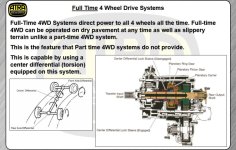
Yes, the center differential is integral to the Full-Time 4WD transfer case.

Here's a cross-section of a Full-Time 4WD transfer case such as is used in the 5th gen Limited 4Runner:
 

Attachments

  • Screenshot 2023-02-17 at 10-50-42 Toyota 4x4 Webinar Handout - toyota_4x4.pdf.jpg
    Screenshot 2023-02-17 at 10-50-42 Toyota 4x4 Webinar Handout - toyota_4x4.pdf.jpg
    94.9 KB · Views: 2,188
This describes the NVG 246 “Autotrac” transfer case in my 1999 K2500 Suburban:

Its similar. The T/C is doing the work. The outcomes are somewhat different. Specifically, this 4WD auto on the suburban (which seems to be the closest equivalent to the full-time 4WD system if I saw all the modes correctly), is completely RWD biased until a loss of traction occurs, in which case power is distributed to the front (if Im reading this correctly). Ours is basically just a 4WD sr5 at all times, some fun front/rear power distribution bells and whistles.

My sense is that you could be alluding to the center diff, as a component of the T/C not somehow being a “true” center diff. Im not sure I agree, but from a purists perspective, the assessment that it is not a standalone component is 100% accurate. To me, it’s like saying turducken is no longer duck, or turkey, or chicken, simply because they’re all encapsulated within one another. Cheaply made parts with such a sophisticated role/operation could easily be a problem, but this system was used on all 4WD 4th gens, as well as the LC and GX. Its not a one-off. Judging by the lack of complaints we see about it, id say it’s proven to be reliable over its many years out in the wild.
 
Last edited:
Its similar. The T/C is doing the work. The outcomes are somewhat different. Specifically, this 4WD auto on the suburban (which seems to be the closest equivalent to the full-time 4WD system if I saw all the modes correctly), is completely RWD biased until a loss of traction occurs, in which case power is distributed to the front (if Im reading this correctly). Ours is basically just a 4WD sr5 at all times, some fun front/rear power distribution bells and whistles.

My sense is that you could be alluding to the center diff, as a component of the T/C not somehow being a “true” center diff. Im not sure I agree, but from a purists perspective, the assessment that it is not a standalone component is 100% accurate. To me, it’s like saying turducken is no longer duck, or turkey, or chicken, simply because they’re all encapsulated within one another. Cheaply made parts with such a sophisticated role/operation could easily be a problem, but this system was used on all 4WD 4th gens, as well as the LC and GX. Its not a one-off. Judging by the lack of complaints we see about it, id say it’s proven to be reliable over its many years out in the wild.

Not alluding to anything. Just wondering where the heck it is as there is only so much room on these things. To me “center diff” implied a whole separate differential physically separate from the transfer case.

Glad these things seem to work, because the NVG 246 on my suburban has had its share of issues. The issues have all been electrical dealing with the shifting and it’s been a huge learning curve for me to diagnose.
 
Not alluding to anything. Just wondering where the heck it is as there is only so much room on these things. To me “center diff” implied a whole separate differential physically separate from the transfer case.
The center diff is inside the transfer case. Have a look at this video. Scrub to 22:56 to see the guts of a center differential transfer case explained.

https://www.youtube.com/watch?v=ESm0PPBkAQQ&feature=youtu.be

If there’s a way to embed videos on this board I can’t find it.
 
Not alluding to anything. Just wondering where the heck it is as there is only so much room on these things. To me “center diff” implied a whole separate differential physically separate from the transfer case.

Glad these things seem to work, because the NVG 246 on my suburban has had its share of issues. The issues have all been electrical dealing with the shifting and it’s been a huge learning curve for me to diagnose.

Don't think of the T-case center diff as resembling a "normal" diff in any way visually, as they are quite different.
 
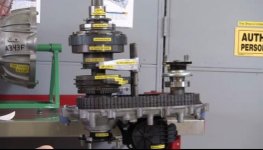
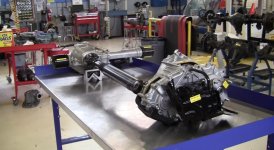
Here are some other videos related to Toyota transfer cases. They don’t address the center differential (but that was addressed in the video I linked to above) but they provide a crystal clear understanding of what’s going on in the transfer case.

This first video shows all the internal components of the t-case working together.

VIDEO LINK

This second video shows the internal components working in a cut-a-way case, with a front propeller shaft and a cut-a-way front differential. The workings of the ADD are also explained.

VIDEO LINK
 

Attachments

  • DB26091C-368B-4757-9983-14CBC4FEE528.jpg
    DB26091C-368B-4757-9983-14CBC4FEE528.jpg
    19.9 KB · Views: 1,199
  • 59327E82-586F-4DF8-8271-F0D509925B74.jpg
    59327E82-586F-4DF8-8271-F0D509925B74.jpg
    130 KB · Views: 1,181
I just got a limited. Can anyone tell me what happens in a situation where i am in H4F in snow/ice and a have one wheel without traction and spinning in front and rear will this caus me to just not move and be stuck b/c all power will be sent to spinning wheels?
 
The center diff is inside the transfer case. Have a look at this video. Scrub to 22:56 to see the guts of a center differential transfer case explained.

https://www.youtube.com/watch?v=ESm0PPBkAQQ&feature=youtu.be

If there’s a way to embed videos on this board I can’t find it.


I just got a limited. Can anyone tell me what happens in a situation where i am in H4F in snow/ice and a have one wheel without traction and spinning in front and rear will this caus me to just not move and be stuck b/c all power will be sent to spinning wheels?
 
I just got a limited. Can anyone tell me what happens in a situation where i am in H4F in snow/ice and a have one wheel without traction and spinning in front and rear will this cause me to just not move and be stuck b/c all power will be sent to spinning wheels?

Switch to L4L and engage ATRAC.

Search YouTube and you can find videos of it in action.
 
Switch to L4L and engage ATRAC.

Search YouTube and you can find videos of it in action.

Oh. But in H4F if one front and one back wheel is not getting traction and spinning does the other non spinning wheel on same axel get power tranfefed to it or does all the power go to the spinning wheel?
 

Members online

Forum statistics

Threads
278,310
Messages
3,554,079
Members
248,016
Latest member
Advally Service

Trending content

Back
Top