I'd consider resealing the oil pan since the engine is already outI did a wet compression test today and the compression numbers basically doubled to about 150+. Looks like the rings are bad, I assume from a fueling issue on the driver side washing the cylinder walls and wearing them down.
So I found a shop to do the motor swap since I don't have the stones. I'm paying more than I care to admit. Before the JDM goes in I'm going to do the timing belt and all the fixins, real main seal, flex plate, injectors (motorwest), knock sensors (yota1) and valve covers with a lash check/adjustment. Anything else I should be looking at?

You are using an out of date browser. It may not display this or other websites correctly.
You should upgrade or use an alternative browser.
You should upgrade or use an alternative browser.
MountainBrew's 98 Build Thread
- Thread starter MountainBrew
- Start date
MountainBrew
New member
I'd consider resealing the oil pan since the engine is already out
Yep the oil pan will be resealed, thanks for the tip
Sent from my iPhone using Tapatalk
MountainBrew
New member
The motor is currently out and all the accessories and many of the engine peripherals are being swapped over as we speak. I have a very important question for you all though...
As I mentioned, my theory as to why all three cylinders on the driver side were low compression is because some sort of fuel system malfunction was washing the oil from the cylinder walls and causing premature (300k mi [emoji848]) wear.
If that is the case, what would be causing that to occur? I admittedly don’t know very much about the inner workings of the fuel system. The injectors are all being replaced, but what could have caused all the injectors on one side to not function properly? Ie what tells the injectors to fire, and what controls how much fuel is delivered per injector? Is the amount of fuel injected to the cylinder variable or the same during every stroke, and only the amount of air is changed?
I initially assumed the fuel rails were at a fixed psi, and the injectors all allowed a fixed amount of fuel to inject during each stroke, but again I know very little about this.
I certainly don’t want to have this continue and ruin cylinders on the replacement motor.
I searched all over and was having trouble finding a good “primer” on the fueling system for the 5vz. Any suggestions would be appreciated.
Edit: so I grabbed a hold of both ears, pulled my head out of my #%$, and read more about fuel injection systems. It seems the amount of fuel delivered to the intake is controlled by the amount of time each injector is told to fire. I’m assuming in the 5vz that is controlled by the evil, which determines the appropriate amount of time/fuel by reading from the MAF and the o2 sensors?
In any case, what would cause fuel wash on all three cylinders on the same side?
Is there a wiring harness that could go bad on just the driver side injectors? Is it possible that bad O2 sensors or vacuum lines could be making the ECU think it’s running lean and cause it to run rich and in turn cause the fuel wash?
The wiring harness that runs under the floorboards/kick panel on the driver side of my vehicle had a short at some point that melted some wiring sheath and keeps my fuel gauge from working correctly. Everything else seems to work fine. Could something that far back be the cause? I can’t imagine the fuel system has any wiring that far back except for the fuel pump wires.
Sent from my iPhone using Tapatalk
As I mentioned, my theory as to why all three cylinders on the driver side were low compression is because some sort of fuel system malfunction was washing the oil from the cylinder walls and causing premature (300k mi [emoji848]) wear.
If that is the case, what would be causing that to occur? I admittedly don’t know very much about the inner workings of the fuel system. The injectors are all being replaced, but what could have caused all the injectors on one side to not function properly? Ie what tells the injectors to fire, and what controls how much fuel is delivered per injector? Is the amount of fuel injected to the cylinder variable or the same during every stroke, and only the amount of air is changed?
I initially assumed the fuel rails were at a fixed psi, and the injectors all allowed a fixed amount of fuel to inject during each stroke, but again I know very little about this.
I certainly don’t want to have this continue and ruin cylinders on the replacement motor.
I searched all over and was having trouble finding a good “primer” on the fueling system for the 5vz. Any suggestions would be appreciated.
Edit: so I grabbed a hold of both ears, pulled my head out of my #%$, and read more about fuel injection systems. It seems the amount of fuel delivered to the intake is controlled by the amount of time each injector is told to fire. I’m assuming in the 5vz that is controlled by the evil, which determines the appropriate amount of time/fuel by reading from the MAF and the o2 sensors?
In any case, what would cause fuel wash on all three cylinders on the same side?
Is there a wiring harness that could go bad on just the driver side injectors? Is it possible that bad O2 sensors or vacuum lines could be making the ECU think it’s running lean and cause it to run rich and in turn cause the fuel wash?
The wiring harness that runs under the floorboards/kick panel on the driver side of my vehicle had a short at some point that melted some wiring sheath and keeps my fuel gauge from working correctly. Everything else seems to work fine. Could something that far back be the cause? I can’t imagine the fuel system has any wiring that far back except for the fuel pump wires.
Sent from my iPhone using Tapatalk
Last edited:
i'm just throwing a random guess your way. one entire side could have low compression simply because something common to that side is leaking, for example head gasket. i had a HG in a 3.slo go the way that so many of those do, and when we disassembled enough to see what was up, the blowout, so to speak, wasn't "everywhere" like i was assuming at the time, but instead it was more along one side. after your tech gets your rig all reassembled, make sure a compression retest happens before you drive it off. also make sure the spark plug wires are in the correct arrangement or that poor engine will try to jump off the mounts.
if they're the actual cause, latent issues like what you were musing about (wiring issues specific to one side) could recur and then you'd know, since at that point you will have replaced a lot of whatever else it could have been. my guess is, it will behave well and that's that. given that the O2 sensors are common to the exhaust in a 48-state model like mine (yours too?), it would be impossible to use that data to change the mixture for just one side. typically, loose or disconnected vacuum hoses cause crappy running that is really obvious in performance or sound, so i'm not going to implicate that since you haven't mentioned any really bad performance or CEL codes for that matter. however now would be an excellent time to replace as many vacuum hoses as you have time and patience for. i used a couple gauges of fuel line to swap out most of mine.
if they're the actual cause, latent issues like what you were musing about (wiring issues specific to one side) could recur and then you'd know, since at that point you will have replaced a lot of whatever else it could have been. my guess is, it will behave well and that's that. given that the O2 sensors are common to the exhaust in a 48-state model like mine (yours too?), it would be impossible to use that data to change the mixture for just one side. typically, loose or disconnected vacuum hoses cause crappy running that is really obvious in performance or sound, so i'm not going to implicate that since you haven't mentioned any really bad performance or CEL codes for that matter. however now would be an excellent time to replace as many vacuum hoses as you have time and patience for. i used a couple gauges of fuel line to swap out most of mine.
MountainBrew
New member
i'm just throwing a random guess your way. one entire side could have low compression simply because something common to that side is leaking, for example head gasket. i had a HG in a 3.slo go the way that so many of those do, and when we disassembled enough to see what was up, the blowout, so to speak, wasn't "everywhere" like i was assuming at the time, but instead it was more along one side. after your tech gets your rig all reassembled, make sure a compression retest happens before you drive it off. also make sure the spark plug wires are in the correct arrangement or that poor engine will try to jump off the mounts.
if they're the actual cause, latent issues like what you were musing about (wiring issues specific to one side) could recur and then you'd know, since at that point you will have replaced a lot of whatever else it could have been. my guess is, it will behave well and that's that. given that the O2 sensors are common to the exhaust in a 48-state model like mine (yours too?), it would be impossible to use that data to change the mixture for just one side. typically, loose or disconnected vacuum hoses cause crappy running that is really obvious in performance or sound, so i'm not going to implicate that since you haven't mentioned any really bad performance or CEL codes for that matter. however now would be an excellent time to replace as many vacuum hoses as you have time and patience for. i used a couple gauges of fuel line to swap out most of mine.
Great points and advice, thank you. I was not throwing any codes and frankly the engine ran great, albeit underpowered because of stock gearing on 285s and lots of armor. Next winter I will correct that issue and spend way too much $ at ECGS.
Does the wiring harness that goes to the injectors treat all injectors the same as far as injection duration is concerned? I know I’m not using the correct terminology and barely know what I’m talking about, but I’m wondering if the system could make the drivers side injectors fire differently than the passenger side? If not, that sort of eliminates a fuel wash issue since the driver and passenger side compression readings were so dramatically different, but also consistent within each side.
Maybe the best bet is to run a leak down on the old motor and that could help narrow it down to a HG issue? That would be ideal since that problem wont transfer over to the new motor.
Certainly going to run a compression check before I pick it up.
Thanks again
Sent from my iPhone using Tapatalk
Great points and advice, thank you. I was not throwing any codes and frankly the engine ran great, albeit underpowered because of stock gearing on 285s and lots of armor. Next winter I will correct that issue and spend way too much $ at ECGS.
Does the wiring harness that goes to the injectors treat all injectors the same as far as injection duration is concerned? I know I’m not using the correct terminology and barely know what I’m talking about, but I’m wondering if the system could make the drivers side injectors fire differently than the passenger side? If not, that sort of eliminates a fuel wash issue since the driver and passenger side compression readings were so dramatically different, but also consistent within each side.
Maybe the best bet is to run a leak down on the old motor and that could help narrow it down to a HG issue? That would be ideal since that problem wont transfer over to the new motor.
Certainly going to run a compression check before I pick it up.
Thanks again
Sent from my iPhone using Tapatalk
hey. i'm sorry but i simply do not know about failures involving the wiring harness. typically when leads break or fail, you get less of something, not more. perhaps check the FSM troubleshooting steps that involve ignition, to see what problems they list.
if signaling were grossly left-right unbalanced, i suspect it'd be with the ECU. they don't crap out without good cause (like inundation or trauma), and thus i kinda circle back to the head gasket or something similarly mechanical as a simpler and thus potentially more common failure point. this engine has (er, had) a lot of miles on it, and HG eventually becomes more prevalent as they age. did you have any white exhaust? needed to top off coolant level with any frequency? my 3.slo that eventually went to the scrapper never catastrophically lost power, but it never had a lot, either, and it just got progressively worse as time went on. the white smoke and kinda rough running were the beginning of the end.
if you're forensically curious, you could simply dismantle the old engine to examine the HG. obviously choose the side that failed your test. you could see some damage or deposits, or stress points. if it's outright broken, it'll be pretty obvious, like gaps with no gasket material between, say, the coolant passages and combustion chambers. you could see some warpage or waviness. the one i 'blew' had some corrosion and rusty deposits everywhere, but it was far worse on one side of the HG. when we saw that, we didn't bother tearing down the other side since that was sufficient info, and the main goal was completing a 5vz-fe swap into the truck.
edit: adding a link to one of the better youtube 5vz-fe teardown videos. this guy (id is WorseThanChiggers) split it up in to six parts and it is extensive and thorough. see part 4, starting around 4:40, for what his troubleshooting started to indicate as the cause of a leak. there weren't any outright HG failures per se, but rather there was a bit of an indent near the #4, that probably was letting coolant come to visit. i first watched through nearly three years ago when the 5vz-fe that replaced the 3.slo died catastrophically due to rod failure.
Last edited:
MountainBrew
New member
Had the motor swap done, it’s running amazing. I will make a post on that shortly.
In the meantime, does anyone know what a drop from this area is? It was dropping pretty quickly. I’m guessing it’s AC evaporator collecting water but not certain. Thoughts?

Sent from my iPhone using Tapatalk
In the meantime, does anyone know what a drop from this area is? It was dropping pretty quickly. I’m guessing it’s AC evaporator collecting water but not certain. Thoughts?
Sent from my iPhone using Tapatalk

JZiggy
Senior Member
Had the motor swap done, it’s running amazing. I will make a post on that shortly.
In the meantime, does anyone know what a drop from this area is? It was dropping pretty quickly. I’m guessing it’s AC evaporator collecting water but not certain. Thoughts?
Sent from my iPhone using Tapatalk
Looks like AC drain to me.
That's the ac evaporator drainHad the motor swap done, it’s running amazing. I will make a post on that shortly.
In the meantime, does anyone know what a drop from this area is? It was dropping pretty quickly. I’m guessing it’s AC evaporator collecting water but not certain. Thoughts?
Sent from my iPhone using Tapatalk
phattyduck
Elite Member
Definitely AC. There should be a little hose/tube on there too. Make sure none is dripping inside the cab.In the meantime, does anyone know what a drop from this area is? It was dropping pretty quickly. I’m guessing it’s AC evaporator collecting water but not certain. Thoughts?
-Charlie
MountainBrew
New member
Been a while since I posted here. Given the insane market for these right now, I considered selling the truck…for about a day. Then I felt immense guilt and dumped a bunch of money into it. Regearing, front locker, new stereo, etc.
In any case, I’m installing some Sonoran Steel rear body mounts as well as some sound deadener. While I had the rear bumper off I ordered the 4 Cam vent/filter replacement since unbeknownst to me, my flap was gone and dust was just pouring into the cab. I’m exclusively on moon dust Colorado trails and the amount of dust that came in was unbelievable. Never knew why.
Good news? The 4Cam vent arrived and installed easily, looks like a quality product.
Bad news?


Found these lovelies hiding behind my fender flares/rear bumper. How would you all proceed?
I don’t care about aesthetics for the time being so my thought was to wire brush away the loose stuff, clean the area, spray on some rust inhibitor and fill the void with something (Great Stuff came to mind but I realize that’s super janky). I will also be putting Dynamat knockoff in that area as well.
Also, I’m assuming those drains are from the sunroof/rails? The one on my drivers side went through the vent, and the 4Cam replacement didn’t account for that. Not sure what to do there other than extend the line and send it through the convenient gaping rust hole…
Sent from my iPhone using Tapatalk
In any case, I’m installing some Sonoran Steel rear body mounts as well as some sound deadener. While I had the rear bumper off I ordered the 4 Cam vent/filter replacement since unbeknownst to me, my flap was gone and dust was just pouring into the cab. I’m exclusively on moon dust Colorado trails and the amount of dust that came in was unbelievable. Never knew why.
Good news? The 4Cam vent arrived and installed easily, looks like a quality product.
Bad news?
Found these lovelies hiding behind my fender flares/rear bumper. How would you all proceed?
I don’t care about aesthetics for the time being so my thought was to wire brush away the loose stuff, clean the area, spray on some rust inhibitor and fill the void with something (Great Stuff came to mind but I realize that’s super janky). I will also be putting Dynamat knockoff in that area as well.
Also, I’m assuming those drains are from the sunroof/rails? The one on my drivers side went through the vent, and the 4Cam replacement didn’t account for that. Not sure what to do there other than extend the line and send it through the convenient gaping rust hole…
Sent from my iPhone using Tapatalk
MountainBrew
New member
So no one is going to talk me out of Great Stuff? I count on you all to keep my jackassery in check. Fine, this is your collective fault as much as it is mine.
Sent from my iPhone using Tapatalk
Sent from my iPhone using Tapatalk

brillo_76
Elite Member
I would clean it up. Use fiberglass to seal the hole and sand the outer side down and paint it.
Fiberglass will keep the water out if you want to sand down and put body filler over it you can as well.
Any kind of spray foam etc. Holds moisture thus rots the steel alot worse.
Sent from my SM-A505U using Tapatalk
Fiberglass will keep the water out if you want to sand down and put body filler over it you can as well.
Any kind of spray foam etc. Holds moisture thus rots the steel alot worse.
Sent from my SM-A505U using Tapatalk
MountainBrew
New member
I ended up filling with FG, then sand and paint. Worked fairly well.
Next step is rear control arms while I wait for my ECGS diffs. Reading all sorts of conflicting information about adjustable/non-adjustable and joints vs bushings. I want to do moderate trails but I also drive long distances on the highway and want it to be comfortable. The more I research the more confused I get...
Next step is rear control arms while I wait for my ECGS diffs. Reading all sorts of conflicting information about adjustable/non-adjustable and joints vs bushings. I want to do moderate trails but I also drive long distances on the highway and want it to be comfortable. The more I research the more confused I get...

MountainBrew
New member
I ended up ordering some beefed up rear lower control arms with rubber bushings since I live in CO and the amount of dust really makes me worry about tons of noise coming from poly or teflon bushings. Squeaks drive me nuts. I ordered some OEM stock uppers for the same reason.
I'm going to do the steering rack and sway bar bushings as well...sounds like Toyota won't even sell you the steering rack bushings without buying a whole new rack...don't need all that. So I may have no choice but to go poly on those and just grease the hell out of them.
I'm going to do the steering rack and sway bar bushings as well...sounds like Toyota won't even sell you the steering rack bushings without buying a whole new rack...don't need all that. So I may have no choice but to go poly on those and just grease the hell out of them.
MountainBrew
New member
Swear jar filled up fast today. Welding in the new cam tabs tomorrow…beer trumped motivation before I got any further. BTW, screw that front diff removal, what a pain


Most of that is mud not rust. Don’t know what the hell I was thinking not going to the car wash before all this.
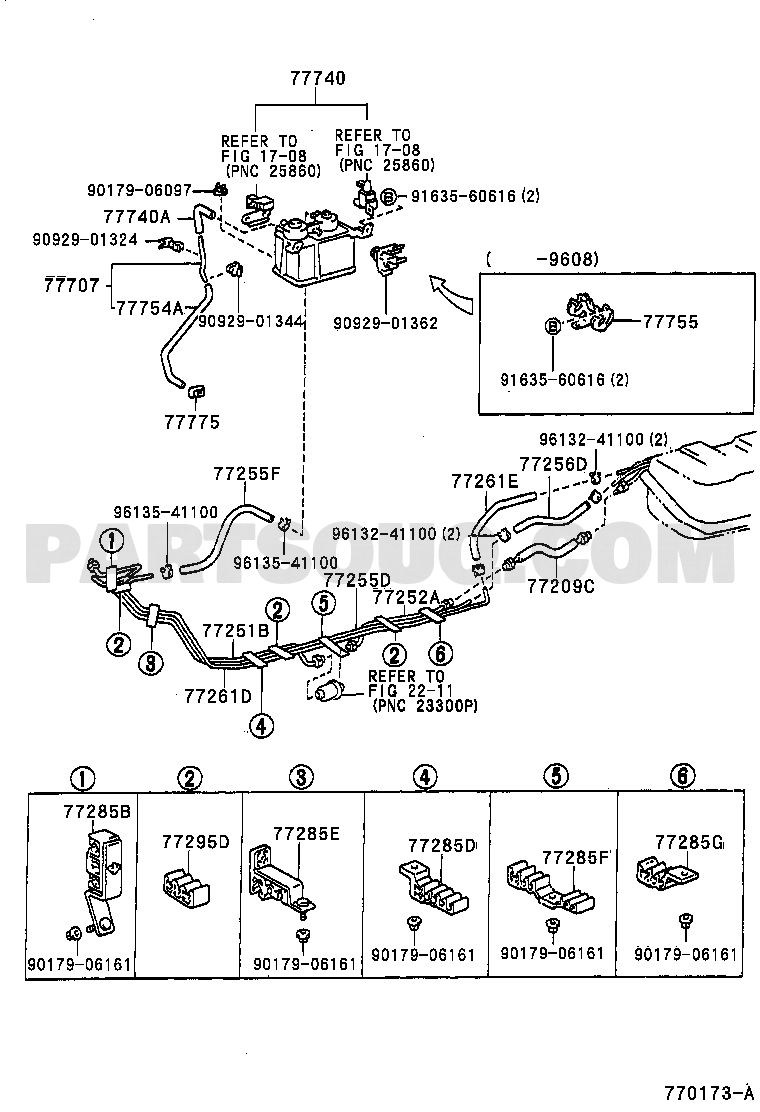
Also, can someone tell me where this vacuum line terminates? Found it not attached to anything and figured I must’ve popped it off when I was messing with the motor mounts

Sent from my iPhone using Tapatalk
Most of that is mud not rust. Don’t know what the hell I was thinking not going to the car wash before all this.
Also, can someone tell me where this vacuum line terminates? Found it not attached to anything and figured I must’ve popped it off when I was messing with the motor mounts
Sent from my iPhone using Tapatalk

sleepydad
Senior Member
Swear jar filled up fast today. Welding in the new cam tabs tomorrow…beer trumped motivation before I got any further. BTW, screw that front diff removal, what a pain
Also, can someone tell me where this vacuum line terminates? Found it not attached to anything and figured I must’ve popped it off when I was messing with the motor mounts
Sent from my iPhone using Tapatalk
pretty sure that is just the vent to atmosphere, there is a little plastic gourmet like thing that just goes into the frame.
GUIDE, CHARCOAL CANISTER OUTLET 77775

cl4Rk
Member
Like [MENTION=168172]sleepydad[/MENTION] said, it’s the vent hose. My plastic fitting at the frame rail broke during my frame swap, and as far as I can tell it’s no longer in production. Mine is also just hanging freely, with no negative side effects it seems. If you didn’t like it dangling, you could probably run new rubber hose and vent it anywhere you’d like low on the frame.
MountainBrew
New member
Thanks for the info, no wonder I couldn’t find a diagram that showed what it connected to.
Next up…

Sent from my iPhone using Tapatalk
Next up…
Sent from my iPhone using Tapatalk
Similar threads


- Replies
- 33
- Views
- 13K


