Multiple transmission overheating episodes

XswampX

New member
Transmission overheated multiple times up in Death Valley and the Eastern Sierras (CA) this past weekend.

61k on vehicle now. Magnuson Supercharger installed at around 40k miles (probably not relevant). Replaced factory trans fluid at around 9k miles (yes I know supposedly a lifetime fluid) with Valoline MaxLife ATF (full synthetic). My buddies stock SR5 had no issues.

It was warm on a slow climb in low gears (2Hi or 4Hi). Nothing close to as steep as what the vehicle can handle. Just going slow as it was a both bumpy/rocky and somewhat steep. It was basically a single lane dirt fire/access type of road. Vehicle was full of camping gear, food, water and 2 little ones. Nothing being towed. It was warm but not above 95 degrees. I kept going for a mile or so driving more gently after the first episode. No limp mode or forced stop (don't know if our trucks do so). Warning message was gone after leaving the truck sitting (engine off) for 20-30 minutes. Continued on up to the 8k foot summit without recurrence.

On the second overheating, similar conditions, I stopped immediately and the warning message was gone after a very short cool down, maybe 5 minutes max. It did not come back over the next 2 hours of climbing up to 10k feet.

It seems that the SC low temperature radiator blocks some considerable portion of the stock radiator (which as I understand it houses the transmission cooler), but largely speculative if this could be the cause or a contributor. I do also have some much bigger rubber than my buddy, 285 70 R17 BFG K02, but also doubt that is a factor. Anyone else experience this? I can't imagine I need an aftermarket trans cooler. I have not checked trans fluid level.
 
Last edited:
Register to hide this ad
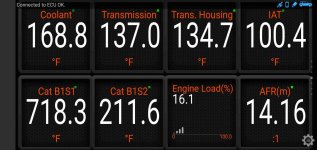
I would get torque pro or a standalone transmission fluid temp reader to monitor temps before the check light comes on. By that time some of the fluid may be degrading already from excessive heat.

Maybe a full flush(not drain and fill) with toyota atf.
 

Attachments

  • Screenshot_20190822-152950_Torque_compress76.jpg
    Screenshot_20190822-152950_Torque_compress76.jpg
    145.3 KB · Views: 2,027
You caused this by putting the wrong transmission fluid in it. Sorry to be the bearer of bad news. Next time use the real stuff. Toyota fluid is more expensive, but it's the only ATF that is appropriate for this transmission. And you should never change it. Maybe you can flush it and put Toyota fluid back in and it'll work better. Hopefully you didn't damage the clutches.

This video will help explain why you should use the correct ATF.

<iframe width="1280" height="720" src="https://www.youtube.com/embed/t73jM6mT8sU" frameborder="0" allow="accelerometer; autoplay; encrypted-media; gyroscope; picture-in-picture" allowfullscreen></iframe>
 
Last edited:
The guys saying the Valvoline Synthetic Transmission Fluid caused this are full of shit. You aptly pointed out that the Supercharger Aftercooler blocked a good portion of the radiator which houses the transmission cooler. Then you were slow going up a rocky grade working the transmission hard with minimal airflow. Supercharger also working with aftercooler dumping heat in front of the radiator. That combination right there is your problem. Don’t listen to the OCD Toyota Fluids crowd.
 
The guys saying the Valvoline Synthetic Transmission Fluid caused this are full of shit. You aptly pointed out that the Supercharger Aftercooler blocked a good portion of the radiator which houses the transmission cooler. Then you were slow going up a rocky grade working the transmission hard with minimal airflow. Supercharger also working with aftercooler dumping heat in front of the radiator. That combination right there is your problem. Don’t listen to the OCD Toyota Fluids crowd.

Different oils have different lubrication properties. The wrong ATF results in clutch packs that slip more than they do with the correct fluid and create a lot more heat. This isn't rocket science. If you put brake fluid in your differential - it isn't going to last very long. If you put rotella in your gas engine - it isn't going to last very long. And if you put the wrong ATF in your transmission... guess what?; it isn't going to last very long.

It doesn't have to be OEM Toyota fluid - but it DOES have to be the correct fluid. And currently only Toyota, Aisin, and Ravenol (possibly) make the correct lubricant for these transmissions. Valvoline ATF is about as close to WS as 5-20 engine oil. As explained in the video if it's T4 compatible - it is not compatible with WS fluid.

Also FWIW - Toyota WS is actually pretty cheap. Less than $10/qt.

EDIT: After a search there are a few other "WS" fluids at least on the label. Idemitsu claims to have one that is WS formulated (and not T4).
 
Last edited:
You caused this by putting the wrong transmission fluid in it. Sorry to be the bearer of bad news. Next time use the real stuff. Toyota fluid is more expensive, but it's the only ATF that is appropriate for this transmission. ....

<

X2 on this!
 
my bet is slow going with poor airflow. Putting toyota fluid in and seeing if the problem happens again is easier than adding an aux tranny cooler tho. Adding an Aux tranny cooler is stupid easy btw.
 
Thanks all.

The guys saying the Valvoline Synthetic Transmission Fluid caused this are full of shit. You aptly pointed out that the Supercharger Aftercooler blocked a good portion of the radiator which houses the transmission cooler. Then you were slow going up a rocky grade working the transmission hard with minimal airflow. Supercharger also working with aftercooler dumping heat in front of the radiator. That combination right there is your problem. Don’t listen to the OCD Toyota Fluids crowd.

I think we are on the same page here.

There is plenty of discussion online on Maxlife ATF vs. WS ATF and plenty of empirical evidence that it is perfectly fine in Toyota ATs. I think Maxlife is superior for the same basic, well established reasons that synthetic motor oil is better than conventional. Some also have pointed out that Maxlife has/likely has a superior additive package.
 
Last edited:
Thanks all.


I think we are on the same page here.

There is plenty of discussion online on Maxlife ATF vs. WS ATF and plenty of empirical evidence that it is perfectly fine in Toyota ATs. I think Maxlife is superior for the same basic, well established reasons that synthetic motor oil is better than conventional. Some also have pointed out that Maxlife has/likely has a superior additive package.


I'd probably add a tranny cooler and put in toyota ATF for peace of mind...but its your money.........
 
Toyota WS is very likely full synthetic. But it's not fully disclosed anywhere I'm aware of. The additive package cannot be "better" unless you know what film thickness you're designing for, what porosity the friction pads have, etc. It is not possible to make an ATF that is better both for a honda transmission and a Toyota transmission for example.

You know what the problem is. You can deal with it how you'd like.
 
It seems that the SC intercooler blocks some considerable portion of the stock radiator (which as I understand it houses the transmission cooler), but largely speculative if this could be the cause or a contributor.

Visual inspection of the radiator? Is it dirty/muddy, are the fins bent, etc? Did this problem occur after a run in with some dirty conditions or something that would have damaged the fins?

With the IC blocking flow, I’d imagine any reduced efficiency due to the above could push your temps out of the normal operating range.
 
Better to have gone with Toyota WS or Aisin WS (most likely the exact same thing as Toyota WS).

I don't trust those Valvoline universal ATF for our transmissions.
 
So if it was the inter cooler blocking air flow, whats the fix? Duel fans, moving the trans cooler, larger radiator?
 
Transmission overheated multiple times up in Death Valley and the Eastern Sierras (CA) this past weekend.

61k on vehicle now. Magnuson Supercharger installed at around 40k miles (probably not relevant). Replaced factory trans fluid at around 9k miles (yes I know supposedly a lifetime fluid) with Valoline MaxLife ATF (full synthetic). My buddies stock SR5 had no issues.

It was warm on a slow climb in low gears (2Hi or 4Hi). Nothing close to as steep as what the vehicle can handle. Just going slow as it was a both bumpy/rocky and somewhat steep. It was basically a single lane dirt fire/access type of road. Vehicle was full of camping gear, food, water and 2 little ones. Nothing being towed. It was warm but not above 95 degrees. I kept going for a mile or so driving more gently after the first episode. No limp mode or forced stop (don't know if our trucks do so). Warning message was gone after leaving the truck sitting (engine off) for 20-30 minutes. Continued on up to the 8k foot summit without recurrence.

On the second overheating, similar conditions, I stopped immediately and the warning message was gone after a very short cool down, maybe 5 minutes max. It did not come back over the next 2 hours of climbing up to 10k feet.

It seems that the SC intercooler blocks some considerable portion of the stock radiator (which as I understand it houses the transmission cooler), but largely speculative if this could be the cause or a contributor. I do also have some much bigger rubber than my buddy, 285 70 R17 BFG K02, but also doubt that is a factor. Anyone else experience this? I can't imagine I need an aftermarket trans cooler. I have not checked trans fluid level.
unless you regeared, this is your issue. if not the entire issue, a large part of it.
 
So if it was the inter cooler blocking air flow, whats the fix? Duel fans, moving the trans cooler, larger radiator?

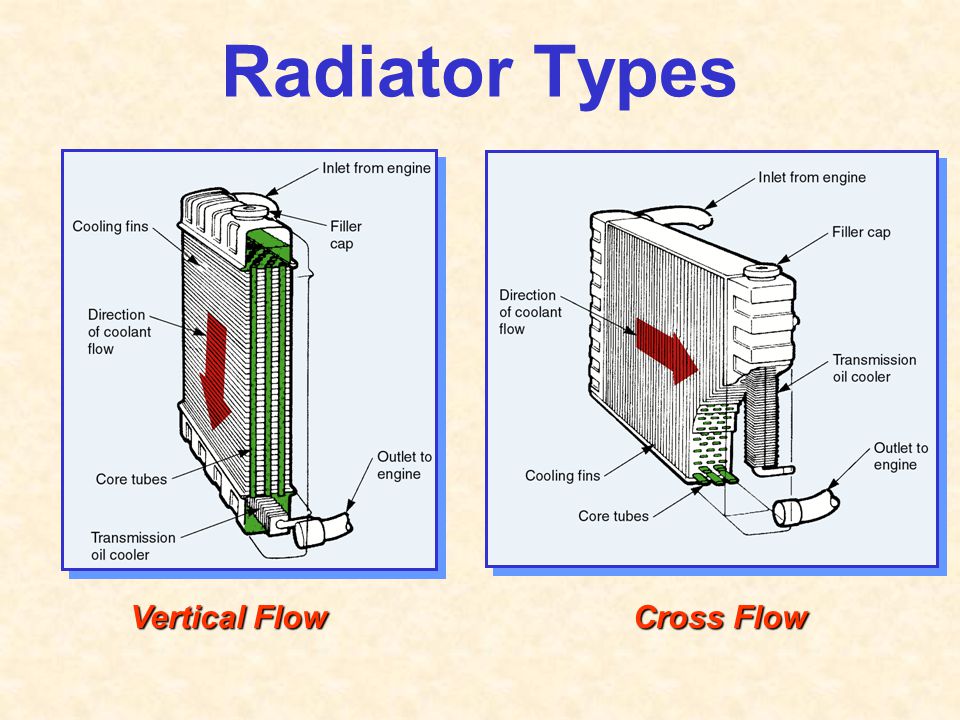
The transmission cooler is a liquid to liquid cooler circuit where the ATF is run through a heat exhanger with the engine coolant in the bottom of the radiator.

The inside looks like this (the one on the left):
Radiator+Types+Vertical+Flow+Cross+Flow.jpg


If the engine isn't overheating - the transmission cooling circuit is usually cooling as well as it can given the design. A larger primary engine radiator would have no benefit unless it was producing significantly colder coolant temps at the bottom of the radiator where the transmission cooling heat exchange is. A separate transmission cooler can add additional cooling capacity. The shared radiator circuit has limits. None of those options would overcome an internal thermal runaway problem.

The other way to help cool the transmission is air flow over the actual transmission. Some skid plates will block air flow more than others.
 
Different oils have different lubrication properties. The wrong ATF results in clutch packs that slip more than they do with the correct fluid and create a lot more heat. This isn't rocket science. If you put brake fluid in your differential - it isn't going to last very long. If you put rotella in your gas engine - it isn't going to last very long. And if you put the wrong ATF in your transmission... guess what?; it isn't going to last very long.

It doesn't have to be OEM Toyota fluid - but it DOES have to be the correct fluid. And currently only Toyota, Aisin, and Ravenol (possibly) make the correct lubricant for these transmissions. Valvoline ATF is about as close to WS as 5-20 engine oil. As explained in the video if it's T4 compatible - it is not compatible with WS fluid.

Also FWIW - Toyota WS is actually pretty cheap. Less than $10/qt.

EDIT: After a search there are a few other "WS" fluids at least on the label. Idemitsu claims to have one that is WS formulated (and not T4).
Rotella is fine in gas engines. A lot of the turbocharged crowd even uses it.
 
The transmission cooler is a liquid to liquid cooler circuit where the ATF is run through a heat exhanger with the engine coolant in the bottom of the radiator.

The inside looks like this (the one on the left):
Radiator+Types+Vertical+Flow+Cross+Flow.jpg


If the engine isn't overheating - the transmission cooling circuit is usually cooling as well as it can given the design. A larger primary engine radiator would have no benefit unless it was producing significantly colder coolant temps at the bottom of the radiator where the transmission cooling heat exchange is. A separate transmission cooler can add additional cooling capacity. The shared radiator circuit has limits. None of those options would overcome an internal thermal runaway problem.

The other way to help cool the transmission is air flow over the actual transmission. Some skid plates will block air flow more than others.

Good point about the skid plates.
 
Being in 4lo in these situations where you're slow going for a long period uphill will help moderate transmission temperatures as there is less slipping higher in the power band than when you're grunting along at low rpm. It will also allow the fan to kick in at a higher RPM and move more air through the engine/transmission radiator. Not sure if the fluid change makes any difference, only thing I can think of is if when it was changed, it wasn't filled properly and is low on fluid. Less fluid=less ability to disperse heat. Something to consider.
 
Last edited:

Members online

No members online now.

Forum statistics

Threads
278,306
Messages
3,554,045
Members
248,016
Latest member
Advally Service

Trending content

Back
Top