Multiple transmission overheating episodes

Wow, just wow. Can't believe there's such a fundamentally STUPID video as that one, at 40+ freaking minutes, with such weak logic.

Let me get this straight. Some old, anal, ocd retired engineer presumes he can "out" two very big automotive chemical companies for making products with nearly completely fabricated credentials/specs, just because they don't list the LICENSES on the actual bottles, and instead do some in paperwork else where most likely?

I freaking guarantee you Valvoline has all the licenses necessary to make the claims on their bottle, as evidenced not being sued by everyone who ever put that stuff in their car.

What a blowhard.

Listen to the myriad of other folks who said it ain't the fluid. It's the blocking of radiation and possibly extra load. Fix that and you'll be good.

I made it less than a minute in and shut off. Guy is from Weber St. LOL. Might as well be from Boise St school of trucking.:banana::wtf:
 
[MENTION=118321]Jetboy[/MENTION]: While I am not sure about the tranny fluid, I strongly disagree with your assessment that Rotella is bad for a gas engine. Yes, you might ruin your cat over time, but the engine itself will be very happy with the Rotella. Especially with the 5w-40 synthetic.
 
yea its just simply an opinion from an expert.. nothing scientific.. no analysis.. just a guy rehashing the same crap that's already been all over the internet..

now if we can get Project Farm from youtube to run analysis of Toyota WS then that would convince me
 
With outdoor temps in the 80s and light city driving (via Torque) my tranny temps are running 160-190. I decided to buy the Hayden 697 cooler and was able to mount it well spaced off of the SC LTR with some coupling nuts used as spacers. I also found an off the shelf 90 deg metal bracket at the hardware store that secured the bottom of the cooler to the 90 deg tab off the inside of the front bumper structural cross beam. Pretty clean mounting. Curious to see the drops, expecting at least 20 degrees. Out of an abundance of caution I am also going to fully flush the fluid and get fresh Valvoline MaxLife ATF back in. Not to rehash but from the Valvoline website,

"Suitable for use in ... Toyota WS"
 
c -- same petroleum engineers filling orders for Toyota engineers.

Do what you wish. My transmission doesn't overheat and I understand mechanics a hell of a lot more than you.

I'm a physicist. I sort of doubt that you do. But if you'd like to tell me the stokes number ideal for the clutch packs in the A750F - please educate us all! I'd love to learn about the particulate suspension differences between Type 4 and WS. Obviously we already know that WS is very different from Type 4 in both viscosity and additives based on lab tests. There's still a lot we don't know. Maybe you could help out?


It's not Toyota's engineers. It's the engineers from Aisin - who specifically state in the manual for the A750F not to use type 4. The viscosity is too high.
 
Last edited:
Yep reduced airflow on a cooling circuit pushed beyond its thermal limit by an added supercharger. Non-OEM Synthetic ATF had nothing to do with this and never will.

You’re fixated on a damn manual that specs OEM fluids made for them by the same manufacturers of off the shelf fluid. They know this works on simple minds.

Im with Jetboy on this. If it doesnt meet the specs..it doesnt meet the specs. I have seen similar issues on Honda where supposively comparable fluids arent comparable and transmissions are crunched.

Hey you know best..use what you want. We will all setup a death pool gambling league on guessing the exact date when your tranny will grenade. Tickets..only $1 dollar...proceeds go to me and Jetboy for cheap women and liquor.

Whats left over you can use for the bus pass!!!
 
07-isis-toyota-hilux.w700.h467.2x.jpg

i wonder if ISIS uses Toyota WS or some alternative
 
I think so. They're very particular about vehicle maintenance.
 

Attachments

  • 1512976972.jpg
    1512976972.jpg
    43.2 KB · Views: 561
4low requires less work (lower heat) and typically allows more water pump flow and atf pump flow.

If you are really in a pinch turn the heater on to full blast. Preferably heat on floor or vent. Avoid any type of defrost. Defrost activates air conditioning. Humans will be uncomfortable but equipment will be happy.

Check the owners manual for cooling a hot transmission. It will probably say leave engine running in neutral with vehicle safely parked. "Park" does not always pump fluid through the transmission.


Regardless of which type of fluid is in the transmission, change it. ATF does not appreciate high temps. You could have 100 miles total on the fluid. It became hot, change it.
 
I'm a physicist. I sort of doubt that you do. But if you'd like to tell me the stokes number ideal for the clutch packs in the A750F - please educate us all! I'd love to learn about the particulate suspension differences between Type 4 and WS. Obviously we already know that WS is very different from Type 4 in both viscosity and additives based on lab tests. There's still a lot we don't know. Maybe you could help out?


It's not Toyota's engineers. It's the engineers from Aisin - who specifically state in the manual for the A750F not to use type 4. The viscosity is too high.

I am a Physicist also, along with Mechanical Engineer and Mathematician as well. These do not make me a Petroleum Engineer, Automotive Engineer nor most relevant here a Tribologist. I think my education and profession help inform me day to day on making good decisions on many related things but they also give me an appreciation for knowing what I don't know...

There are some funny pics posted up here but let's agree to disagree. Folks seem to fall into four camps; "OEM fluids only", "non OEM but meeting OEM spec", "I'll carefully choose my own" and "anything works". It's my educated guess that folks in any of the first three camps will be just fine in the long term with all automotive fluids (engine oil, transmission, dies, brake, coolant, etc.).

Let's all get back OT, I should have some updated temp data to share soon.
 
4low requires less work (lower heat) and typically allows more water pump flow and atf pump flow.

If you are really in a pinch turn the heater on to full blast. Preferably heat on floor or vent. Avoid any type of defrost. Defrost activates air conditioning. Humans will be uncomfortable but equipment will be happy.

Check the owners manual for cooling a hot transmission. It will probably say leave engine running in neutral with vehicle safely parked. "Park" does not always pump fluid through the transmission.


Regardless of which type of fluid is in the transmission, change it. ATF does not appreciate high temps. You could have 100 miles total on the fluid. It became hot, change it.

Thanks, good stuff, as noted definitely changing the fluid due to the 2 brief overheats.
 
I don't think anyone has asked - are you sure it actually overheated and you don't have a bad sensor? A short in the inlet temp sensor will be identified by the ECU as over-temp and will tell you that the transmission is overheating. The inlet temp sensor (No. 2) is the one used for the dash light for overheating.

https://shop.ukrtrans.biz/wp-content/uploads/catalogs/A750E.pdf (just don't read the part about not using type 4 :) )

More full diagnostic sequence can be found here:
http://fjcruiser-club.com/docs/RM/A750F Automatic Transaxle.pdf
 
Last edited:
Perhaps you overheated because the slow speed and off road terrain did not allow your torque converter to lock up. When the transmission is not 'locked up' or in 'flex lockup' mode it generates a lot more heat, I have seen this pulling a trailer up grades. Look at the graphic in this post:

https://www.toyota-4runner.org/2024686-post12.html

The way I read it, a larger throttle opening and low speed will keep the transmission un-locked and generating more heat. I would guess 4-Lo might work better. S4 should also reduce 'flex lockup'.
 
I don't think anyone has asked - are you sure it actually overheated and you don't have a bad sensor?
...

Based on the loading conditions (vehicle load, grade and exterior temperature) as well as the behavior of the transmission after removing those larger loads, I think the sensors are all A-OK. They also read ambient temperature when vehicle is cold.
 
Temps are running about 15-20 deg F cooler now with the external cooler mounted. Just home from the shop and a WOT up a decent pavement climb for a 1/2 mile was seeing 150 - 170 deg F. I saw close to 190 under similar or even lighter conditions pre cooler.

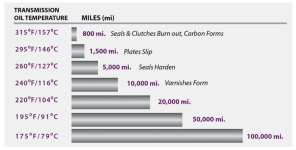
Although I realize this chart from Hayden is a rule of thumb more so than definitive, this should probably contribute to a significant lengthening of my transmission life (and fluid change intervals).

Does anyone know at what temperature the warning light turns on? I googled around a bit but could not find it. Some references say 250 deg F but it was not vehicle/manufacturer specific.
 

Attachments

  • Screen Shot 2019-09-12 at 10.13.41 PM.png
    Screen Shot 2019-09-12 at 10.13.41 PM.png
    131.5 KB · Views: 430
Last edited:
Temps are running about 15-20 deg F cooler now with the external cooler mounted. Just home from the shop and a WOT up a decent pavement climb for a 1/2 mile was seeing 150 - 170 deg F. I saw close to 190 under similar or even lighter conditions pre cooler.

Although I realize this chart from Hayden is a rule of thumb more so that definitive, this should probably contribute to a significant lengthening of my transmission life (and fluid change intervals).

Does anyone know at what temperature the warning light turns on? I googled around a bit but could not find it. Some references say 250 deg F but it was not vehicle/manufacturer specific.

When lit up when I hit 240 at the tc
 
Wrong oil,

long slow climbs in 4 HI

33' tires on stock gearing

no trans cooler (not required but a huge asset)


all of your problems right here.

im running 33' stt pros (62lbs per tire) with an aux tranny cooler and i still get warm in long slow climbs in 4Lo (220F)

learn how to use your Hi/Low Ranges properly. and you'll avoid overheating
 
Im with Jetboy on this. If it doesnt meet the specs..it doesnt meet the specs. I have seen similar issues on Honda where supposively comparable fluids arent comparable and transmissions are crunched.

Hey you know best..use what you want. We will all setup a death pool gambling league on guessing the exact date when your tranny will grenade. Tickets..only $1 dollar...proceeds go to me and Jetboy for cheap women and liquor.

This guy did his homework on the Toyota WS vs Valvoline Synthetic Max Life. He's able to show that the WS breaks down badly with heat, while the Valvoline does not.

WS transmission fluid is garbage . Get it out of your transmission now | Tacoma World

Post #80 in that thread:

Not sure where the OP is coming from, but I can tell you where I am at, and how I got here.

I have owned and maintained a fleet of four cars for the last fifteen years, currently two are Toyotas and two are Subarus and all four are automatics.
When it came time to change the fluid in the Tacoma, at 60k not the 100k as originally sold, as there seems to be a problem with particulates forming in the fluid per Toyota, I was sticker shocked by the cost of this WS Toyota fluid.

Being the inquisitive type, I wanted to know what this expensive fluid was doing for me, and with an engineering background I was able to understand the properties of the fluid.
The short version is that I was unimpressed with the qualities of the product, especially at that price, so I looked at the alternatives.
I ran the properties of the WS and the Valvoline Maxlife past the experienced eye of an engineer at a hydraulics engineering firm that handles large hydraulics systems (like canal gates) and the response was that while the WS is thinner at low temperatures, the Valvoline has much better high temperature performance.
Nearly 10k miles later on the Valvoline and I am satisfied. Smoother shifting, better idle, and converter lock-up at lower speeds.
I can tell you that the WS was definitely showing 'particulate masses' when I drained it.
Good luck in whatever you decide to do.


We have 195K miles on the 2014 SR5 and trans and going strong. They say these transmissions go an average of 140K to 190K miles, so I guess we won. We'll be selling it at 250K and looking for a new 4Runner. At this point, it's not like a transmission failure is going to break me. I am a 0.5%er, yet I do all my own work. I'll never be on the bus. Suck on that.

 
Last edited:

Members online

Forum statistics

Threads
278,309
Messages
3,554,070
Members
248,016
Latest member
Advally Service

Trending content

Back
Top