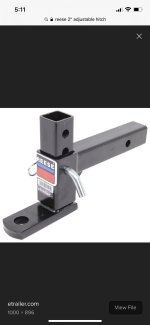
Never owned a hitch - want to get something - for a trailer maybe but also for trash

Never owned a hitch - want to get something - for a trailer maybe but also for trash cans too.

I don't want to spend a lot of money. I hope I can get something off of Amazon.
But I have ZERO experience with hitches (or trash can holders for that matter).

I have the base 97 2WD 4Runner, stick.

What's a suggested Amazon simple bolt-on that I can do myself?
Or do I need it welded on?
 
Register to hide this ad
A Class 3 receiver hitch shouldn't pose much of a challenge assuming the frame isn't fried.
You shouldn't need to drill any new holes and you most certainly don't want it welded to the frame.

You could check your local FB marketplace/CL for a take-off, or purchase a new hitch.
Take-offs come with their own little adventure, as you will need to ensure the weldnut plates
(that go inside the frame) + the associated hardware are present and in good shape.

Otherwise, a new hitch isn't prohibitively expensive - this Curt model as an example: 13087
would work very well and even provides a bit more clearance than the factory/port installed options.
Installation PDF

That and offering a friend some lunch to help install it and you're off!

ETA: You may also need a trailer light wiring kit. While easy to install, I have more experience
with just the hitch (i.e. bike racks and recovery point.) I think the link offers one to add if desired.
 
Last edited:
You have a 2 component mechanical requirement:
1) the receiver bolted to your frame.
2) the hitch that slides into the receiver and is secured with hitch pin.
For casual use adjustable hitches easily align your receiver height (off the ground) with a trailer ball socket height off the ground.
My 5th gen has the simple factory 2"receiver so I added a 2" hitch (found on Offer Up for $15).
I modified into bike rack for my semi recumbant beach cruiser and my Mt. Bike.
Rental utility trailers usually come with surge brakes on the trailer axle.
You will need a wiring adaptor installed on your truck for trailer lights- running, brake, turn.
The 5th gen come prewired with the 4 and 7 pin connectors.
 

Attachments

  • IMG_4211.jpg
    IMG_4211.jpg
    101.4 KB · Views: 471
I have had the factory stock hitch and an aftermarket hitch on different 4runners. One advantage of the factory hitch is that I can run a bigger spare tire and wheel than the factory spare. I can run a 2657516 spare, cant wiht aftermarket...or at least the one I had.
dont let someone just go in and cut and splice wires to get trailer lights to work, my first one I bought that way and it had problems. Get the conversion kit, its all plug and play into stock harness
 
Use e-trailer.com instead of Scamazon...

Just put in your truck, pick your hitch (there are at least 4 options), get a plug-n-play wire harness and install. That will get you a basic tow setup (4-wire harness and 2" receiver)

Then you just need the actual hitch ball, mount and pin. The drop and ball size needs vary between trailers, so that is up to you to figure out... Also, trailer brakes are another possible issue - also trailer dependent.

-Charlie
 
Use e-trailer.com

Trying that helpful suggestion, I was surprised the base 2WD vehicle is no different from the 4WD SR5 as they have no options other than 97 4runner.
1997 Toyota 4Runner Vehicle Accessories | etrailer.com

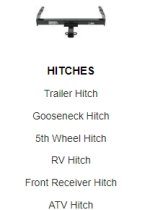
That gives a half dozen options:
1. Trailer Hitch
2. Gooseneck Hitch
3. 5th Wheel Hitch
4. RV Hitch
5. Front Receiver Hitch
6. ATV Hitch

Is it the "Trailer Hitch" is what I need to just tow "something" (I don't know what yet, but nothing special) and for adding a trash-can hitch to the back?

Assuming I need a "Trailer Hitch" then this is the link of options
1997 Toyota 4Runner Trailer Hitch | etrailer.com

I never heard the words "Class 3" which, looking them up, I see it's
Access to this page has been denied

1. Class 1 1.25-inch receiver tubes 2,000 pounds
2. Class 2 1.25-inch receiver tubes 3,500 pounds
3. Class 3 2-inch receiver tubes 8,000 pounds
4. Class 4 2-inch receiver tubes 10,000 pounds
5. Class 5 commercial duty hitches 20,000 pounds

I see why now, given it's where the 2-inch standard "receiver tubes" start, why people recommended "class 3". But what's a receiver tube?

Apparently this is a receiver tube.
https://www.harborfreight.com/class-iii-18-in-x-2-in-standard-receiver-tube-69815.html

It looks like it bolts onto the frame somehow where the pictures seem to show it bolts on at both sides along the side of the frame. Is that right?
 

Attachments

  • hitch.jpg
    hitch.jpg
    20.3 KB · Views: 391
The receiver is what is mounted on the vehicle. The hitch shank is what is inserted into the receiver. These terms are often used interchangeably but they are actually different. The receiver can be tubular, round or square, and bolts to the frame, rear cross member or bumper. The bumper is the least reliable. The coupler is mounted to the front of the trailer on the A-frame and connects to the ball on the hitch.

Over the many years of towing, if my vehicle didn't come from the factory with the hitch, I always went to a local hitch installer. U-Haul is one but there are many others in most towns. After meeting with them they can advise you on the type of setup you need. It's best to get it done right so you don't end up losing your trailer and injuring someone. :)

Also, look for the towing regulations in your state.
 
Last edited:
U-Haul is one but there are many others in most towns. After meeting with them they can advise you on the type of setup you need. It's best to get it done right so you don't end up losing your trailer and injuring someone. :)

Also, look for the towing regulations in your state.

At this point, I say go this route.
It does not sound like OP is that comfortable installing his own hitch.

"Scamazon" or not, the correct unit info was provided.
Copy/Paste the part # somewhere else if you want.
 
At this point, I say go this route.
It does not sound like OP is that comfortable installing his own hitch.

"Scamazon" or not, the correct unit info was provided.
Copy/Paste the part # somewhere else if you want.


agree with this, they can be a bit tricky to a novice. For me installing a used factory hitch, I had to have all bolts loose until things lined up, and the ones inside frame can be tricky for some without correct tools. Even though the wire harness adapter is plug and play you might have to drill a small hole to pass the wires to the outside
 
Reiterating a couple mentions above:
You may also need trailer wiring harness. That might require pulling out the interior panels and splicing an adapter kit into the tail lights wiring. Not a big deal, but can be done well ... or not.
 
It does not sound like OP is that comfortable installing his own hitch.

It's not a question of comfort at all but a question of knowledge, or, in my case, lack of knowledge.

If the parts just bolt on, I'm OK with that. Can I confirm there's no need to weld anything?

And if parts just bolt on, why do some of pictures of (what appear to be) hitches seem to just be a single long receiver tube while others have a goal-post shape?
 
I may well have missed the jist somewhere along the way here, but what's wrong with bolting on the OEM factory hitch (from a salvage yard or a big Yota dismantler ? Every frame should have the holes, just get the bolts and the captive nut brackets for the frame rails (might not be the correct term).

I have one I'd love to get rid of and it's the rarer 3-piece unit that allows the long-dead 'flip-hitch mod' :)

Or, go with the package deal people mention from a pro installer - probably less hassle now that I think about it. I bought a Curt brand tow hitch and had it welded onto my 2nd Gen 4Runner - never failed me.

Edit - I came across this guy bolting up a Curt brand hitch to a 3rd Gen by himself: https://www.youtube.com/watch?v=H6iGLC8n6JA
 
Last edited:
And if parts just bolt on, why do some of pictures of (what appear to be) hitches seem to just be a single long receiver tube while others have a goal-post shape?

The goal post shape is a frame hitch, which distributes the load on the hitch ball to the truck frame. A single long receiver, bolted or welded to the rear puts all of the weight on the absolute rear-center of the truck. If you want to carry your vehicle's maximum capacity you would want a frame hitch. If you're just going to carry light loads then a simple cross member hitch would be okay.

Visit a respected hitch shop with your truck and get your answers from them. They can see the condition of the vehicle and make recommendations on what you want/need for your applications. Usually there is no charge for this information.
 
Trying that helpful suggestion, I was surprised the base 2WD vehicle is no different from the 4WD SR5 as they have no options other than 97 4runner.
1997 Toyota 4Runner Vehicle Accessories | etrailer.com

That gives a half dozen options:
1. Trailer Hitch
2. Gooseneck Hitch
3. 5th Wheel Hitch
4. RV Hitch
5. Front Receiver Hitch
6. ATV Hitch

Is it the "Trailer Hitch" is what I need to just tow "something" (I don't know what yet, but nothing special) and for adding a trash-can hitch to the back?

Assuming I need a "Trailer Hitch" then this is the link of options
1997 Toyota 4Runner Trailer Hitch | etrailer.com

I never heard the words "Class 3" which, looking them up, I see it's
Access to this page has been denied

1. Class 1 1.25-inch receiver tubes 2,000 pounds
2. Class 2 1.25-inch receiver tubes 3,500 pounds
3. Class 3 2-inch receiver tubes 8,000 pounds
4. Class 4 2-inch receiver tubes 10,000 pounds
5. Class 5 commercial duty hitches 20,000 pounds

I see why now, given it's where the 2-inch standard "receiver tubes" start, why people recommended "class 3". But what's a receiver tube?

Apparently this is a receiver tube.
https://www.harborfreight.com/class-iii-18-in-x-2-in-standard-receiver-tube-69815.html

It looks like it bolts onto the frame somehow where the pictures seem to show it bolts on at both sides along the side of the frame. Is that right?
Phew, you are starting from the beginning here... Ok...

A true base model 4Runner is a 4 cylinder, which is rated to tow 3500lbs. A V6 is rated to tow 5000 lbs, whether 2WD or 4WD. Small utility trailers, etc. will all be below 3500lbs. Towing RVs, car trailers, etc. is when you will get above 3500lbs.

Regarding those towing options:
1. Trailer Hitch - this is a standard 'bumper-pull' trailer hitch, what the 4Runner will use.
2. Gooseneck Hitch - applicable to (full-size) trucks only, a 'ball' in the middle of the bed
3. 5th Wheel Hitch - applicable to (full-size) trucks only, a small plate in the middle of the bed, a smaller version of semi-truck and trailer attachment
4. RV Hitch - for RVs (not a 4Runner...)
5. Front Receiver Hitch - give you the ability to mount hitch-based accessories on the front (bike racks, etc.)
6. ATV Hitch - only for ATVs

For you, only the first item is applicable.

2" receiver tubes are most common, both for pulling trailers and for attachments that go in them. Most of those are class 3. You have no need for class 4, since the 4Runner can't handle that and there are no off-the-shelf options for the 4Runner that are rated that high. 1 1/4" (class 1/2) are undersized for the 4Runner capabilities.

A receiver tube is the part that receives (!!!) the ball mount or hitch accessory (bike rack, cargo carrier, etc.). It is just one component of the hitch that you will purchase to bolt on to the frame of your 4Runner. The reciever tube you linked from Horrible Fright is a component used to MAKE (ie, weld) a complete hitch together in a custom application. Not something you need, since there are AT LEAST 4 complete bolt-on hitch options for your 4Runner that you can still buy new (and two versions of the OEM hitch you can buy used). The OEM hitches are tucked back even with the bumper but sit lower, the aftermarket options are 2-3" higher but stick out. Check out the e-trailer options (put in your exact vehicle and see the hitch application pictures)

Sounds like its time for you to look under your 4Runner. There will be tow tie-down loops bolted to the frame at the back. Those each have two welded nuts up in the frame that will be used to bolt on a hitch, along with some extra holes are used with a bolt and nut combination to hold it to the frame.

NBC7Yle.jpg


Plug-n-play harnesses to require you to get behind some interior panels, but you can drop the harness down out the bottom of the 4Runner though slits in the square plugs under the lower trim at the cargo area opening. That's where the factory runs the wiring. You can see the harness drop down into the square plug on the left in this pic (some harnesses go down on the right, follow the specific directions for your unit).

TVm1Bg0.jpg


If you are towing a trailer, you need to know the ball-size it is expecting (1 7/8", 2", 2 5/16", etc.) and the wiring connection. 4-pin flat for non-brake applications and 7-pin round for most braked applications. If you tow something with brakes, you will also need a brake controller and some extra wiring beyond the lighting connections provided by a 4-flat connector.

Watch as many videos as you can and search google for anything that is not 4Runner specific. Towing is towing once you get to the standard receiver opening and wiring...

Pretty soon, you'll be doing sketchy towing like the rest of us!

7ZxikkH.jpg


ZB4JNaG.jpg


Or less-sketchy things:
BHQ8K7P.jpg


-Charlie
 
When I had a U-HaUL HITCH INSTATED ON MY 1999 SR5 everything went very smoothly. The key is holding the part that fits to the frame while bolting it in place. The '99 has the electric plug a play installed and walking on the left rear wheel well. A little tight to get to but not a big deal. The flat-4 plug stores in the cargo hatch on the right rear of the '99. It can be led under the hatch to the trailer connection. As I left the U-Haul lot my gas gauge dropped to zero and has never worked properly again. I have tried every suggestion and no luck. I am convinced that problem is somewhere in the wiring which I have redone several times. I am stillll open to suggestions: but, be careful with the wiring and if you have the installation done at a shop check the gauge before you leave.l
 
Use e-trailer.com instead of Scamazon...

Seconded. Continuing to think Amazon is the only option for anything, is the quickest way to ruin what's left of Americas small and independent businesses, all of whom started with a mission to deliver goods and services you want, rather than luring you in with cheap junk, just so you could help make Jeff Bezos a billionaire multiple times over.
 

Members online

No members online now.

Forum statistics

Threads
278,315
Messages
3,554,125
Members
248,016
Latest member
Advally Service

Trending content

Back
Top