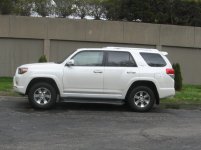
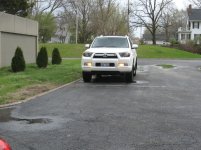
What is everyone doing (besides lifting) to cure the stock SR5 nose up and nose down syndrome? I don't mind how it rides on the highway, but around town kinda bobs around like a teeter totter....jeez!
You can install Bilstein 5100 shocks and set the fronts at the lowest setting, .85. This will get rid of the nose dive and will improve the overall ride stiffness without really lifting the front end very much.
Tires help considerably.
Suggest you (use the Google option) Search "nose dive" - you should find enough posts to keep you busy for hours.
Front 5100's @ .85 will level the truck. And 4 of them will firm up the overall ride nicely. They will not "get rid" of the nose dive - they will reduce the nose dive, for many to an acceptable level, for me I still find it annoying. I am personally convinced that stiffer springs are the only true solution for an SR5.
A damned hunky, manly truck should not bob up and down like a Chevy Caprice with blown shocks.![]()
Tires help considerably.
I have brand new stock sized P rated Revo 2's on all 4 corners. I might tweak the air pressure a bit...
what? How does a tire prevent the suspension from "diving" ?Tires help considerably.
Yes. I am running my Cooper Discoverer AT3's at 37 psi. They are "P" rated.
Any pics of a Stock 4 Runner running 5100's at .85 all the way around? I have been digging in the lifted 4 runner thread, but everyone is looking for max lift it seems in those threads...


what? How does a tire prevent the suspension from "diving" ?
As 1engineer states, tires do help, a lot. But what do they help with? Well, as Philsey indicates, new tires in his case did not do much for nose dive. But I do not think the OP was referring just to nose dive. He stated "bobbing around", to me, that means "bouncy". (Notwithstanding the nose dive). I too felt that bobbing or floating type feeling with the OEM P rated tires. Every time I made a sharp turn, I really felt as though the tires were going to pop off the rim! They didn't, and I did try various PSI's, but after 1800 miles, just had to drop those OEM tires.
My concerns were completely eliminated when I got the tires listed in my sig block. It also reduced nose dive considerably. Not completely gone, I agree with Philsey, new springs and shocks or at least springs and tires, might make it totally go away, but frankly, just with the tires I got it is now very manageable so no need to spend the big bucks.
IMHO, "P" rated sidewalls from some manufacturers are so soft, that unless you really up the PSI, they will not perform (to the extent of my liking) and it is a personal opinion, compared to a stiffer side wall of an LT tire, be it C,D, or even E load.

Tires and suspension work together, especially if you have a tall sidewalled tire like a 265-285. The stiffer the sidewall and running a higher pressure (within reason) will change the dynamics of your suspension as a whole. Anyone who has aired down for the beach or trails and unwittingly drove on the road before airing up will know precisely what happens with suspension.what? How does a tire prevent the suspension from "diving" ?
Pump them up within reason and limit of the tire. When I got my new tires I again went through testing what pressure would be best for my in my application. I went from 32 psi to 40 psi in this order: 32, 35, 37, 40. I feel safe running at 37 psi as it is well within limits of tire and even though we can have a large temperature delta from night to day (sometimes from the 50's at night to 90's during day) that temperature change will only increase or decrease tire pressures 3-4 psi accordingly. It helped a lot on handling and normal braking.OK. Well then, I'm gonna pump 'em up and see what happens. Thanks for your insight.
Just trying to help lol.:redbrick: Here we go. You see, 1engineer always posts those purposefully short, concise replies for moments exactly like this...
Very good explanation! Gotta respect those unbreakable laws. If some of you want to go a little deeper into gas compressibility look up the ideal gas laws or even deeper is Bernoulli's Hydrodynamica which is the basic theory behind kinematic behavior of gases.The nose of the truck dives as a result of the suspension and tires; the suspension doesn't dive. The suspension and tires simply compress as a result of the kinetic energy of the truck during braking. Stiffer tires and stiffer suspension = less nose dive. Physics, you know?
Slamming on the brakes will still give you nosedive in just about any multi use vehicle. Hit the front brakes on a motorcycle sometime lol.Ditto. I took his advice (thanks again) and definately noticeable improvement on the things mentioned. Now, I haven't slammed on the brakes to test the nosedive, but I have braked hard and have noticed less of a dive.