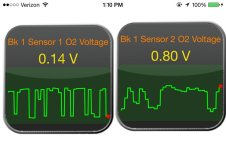
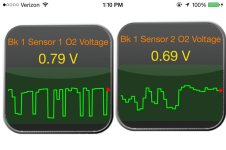
You'd be surprised how much the rear O2 on some vehicles can control the fuel trim. I have seen some interesting case studies where they spoofed rear O2 readings and the ECM ignored front O2 Sensor readings (i.e. they made the ECM think the rear O2 was rich and the vehicle cut fuel drastically despite the front O2s screaming how lean it was running and rich codes were set). Despite many manufacturer's saying that rear O2 only contributes maybe 4% fuel adjustment that's not always true if you've ever seen faulty rear O2s.
I had a formula written down somewhere how you could backwards calculate Total Fuel Trim on a Toyota to see how much control on Fuel Trim the rear O2 is exerting, I forgot where I put it though.

As for the OP, that looks about right. Ideally your rear O2 should be fairly "lazy" looking compared to the front O2 Sensors as the rear O2 is trying to determine Catalyst efficiency based on Oxygen storage capability. If all is working well you shouldn't see a significant change in O2 post cat as it's being ideally used up for the catalytic conversion of exhaust gases. Your scantool/reader is pulling from the diagnostic port and the bandwidth of that older OBDII system is more than likely not going to accurately show the complete switching with nearly as much accuracy as a DSO would. I'd say that it looks okay for an older vehicle and it's within the tolerances of the ECM.