O2 sensor voltages. Is this normal?

Drcoffee

Senior Member
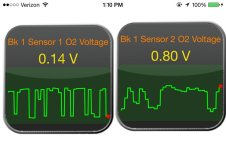
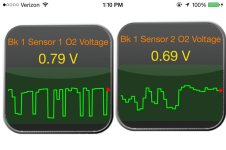
I was towing a uhaul trailer yesterday and monitored the up and down stream O2 sensors. The bank 1/sensor 1 was swinging from .8v to .12v and the down stream sensor 2 seemed erratic. I believe that the sensor 1 should cycle from rich to lean and my obd2 engine link app probably is recording data much slower than a scanner would. My question though is that the sensor 2 is should be more steady? Is this a problem upstream or downstream sensor.

Upstream was changed 55,000 ago.

attachment.php
 

Attachments

  • image.jpg
    image.jpg
    45.4 KB · Views: 53,660
Last edited:
Register to hide this ad
I assume you have a non-California '99? What's the time base on the graph? (how fast are the data points being plotted?)

That actually looks about right. A narrow band O2 goes between lean and rich right at each side of stoichiometric, and the ECU will look for that oscillation to make sure it is at the right AF ratio. The rear O2 sensor has the cat in the way, which 'filters' the exhaust and slows the signal down. The ECU really only uses this feedback to make sure the cat is working correctly (ie, the signal switches, but much slower/less often than the front O2 sensor).

-Charlie
 
The front is supposed to drop in voltage 8 times on average every 10 seconds or something like that. Unless you have a highly sensitive voltmeter and are tapping the diagnostic port I'd not be worried. The chart is trying to reflect that, so it looks normal. If it drops to 6 or so a code will pop up anyway.

The rear sensor works very different than the front. It should NOT be measuring high volumes of oxygen like the front does. Hence the different voltage. The rear also does not have nearby as much impact on fuel as the front, if any at all.
 
well the first O2 sensor isn't really a normal O2 sensor (it is called a A/F sensor), so it won't create the tipycal sinusoidal wave you see with most bank 1 sensor 1 o2 sensors.

Second O2 sensor seems to react to how hard you press on the gas. IIRC, going easy on the gas while rolling gives a low voltage response, but as soon as you floor it, you should see a jump in voltage as long as you floor it.
 
Last edited:
well the first O2 sensor isn't really a normal O2 sensor (it is called a A/F sensor), so it won't create the tipycal sinusoidal wave you see with most bank 1 sensor 1 o2 sensors.

Second O2 sensor seems to react to how hard you press on the gas. IIRC, going easy on the gas while rolling gives a low voltage response, but as soon as you floor it, you should see a jump in voltage as long as you floor it.
It is an AF sensor on '99+ California vehicles and '01+ Federal vehicles... Otherwise it is a normal O2, which is why I asked in my first post.

-Charlie
 
You look fine to me.

When I was going through my P0171, my readings looked like that, and still do.

I can get you pics/video tomorrow at some point, if you'd like.


Sent from my PRC-119 using morse code
 
The front is supposed to drop in voltage 8 times on average every 10 seconds or something like that. Unless you have a highly sensitive voltmeter and are tapping the diagnostic port I'd not be worried. The chart is trying to reflect that, so it looks normal. If it drops to 6 or so a code will pop up anyway.

The rear sensor works very different than the front. It should NOT be measuring high volumes of oxygen like the front does. Hence the different voltage. The rear also does not have nearby as much impact on fuel as the front, if any at all.

You'd be surprised how much the rear O2 on some vehicles can control the fuel trim. I have seen some interesting case studies where they spoofed rear O2 readings and the ECM ignored front O2 Sensor readings (i.e. they made the ECM think the rear O2 was rich and the vehicle cut fuel drastically despite the front O2s screaming how lean it was running and rich codes were set). Despite many manufacturer's saying that rear O2 only contributes maybe 4% fuel adjustment that's not always true if you've ever seen faulty rear O2s.

I had a formula written down somewhere how you could backwards calculate Total Fuel Trim on a Toyota to see how much control on Fuel Trim the rear O2 is exerting, I forgot where I put it though. :(

As for the OP, that looks about right. Ideally your rear O2 should be fairly "lazy" looking compared to the front O2 Sensors as the rear O2 is trying to determine Catalyst efficiency based on Oxygen storage capability. If all is working well you shouldn't see a significant change in O2 post cat as it's being ideally used up for the catalytic conversion of exhaust gases. Your scantool/reader is pulling from the diagnostic port and the bandwidth of that older OBDII system is more than likely not going to accurately show the complete switching with nearly as much accuracy as a DSO would. I'd say that it looks okay for an older vehicle and it's within the tolerances of the ECM. :)
 
Great. I thought the upstream would be more stable in the sine graph. What's your thoughts on E10 and E15 gas. The truck lives in IA and they greatly discount the corn fuel over the normal 87 oct regular gas. My concern is the technology in 1999 wasn't designed for crap gas like that. Will it shorten the life of the O2 sensor?
 
Great. I thought the upstream would be more stable in the sine graph. What's your thoughts on E10 and E15 gas. The truck lives in IA and they greatly discount the corn fuel over the normal 87 oct regular gas. My concern is the technology in 1999 wasn't designed for crap gas like that. Will it shorten the life of the O2 sensor?

Just saying, the least of my concern would be the shorter life of the o2, as they are relatively cheap to buy (I got 2 denso for 140$ on amazon) and easy to replace. Ethanol is corrosive, high percentage could degrade parts in the fuel system, I would not go over E10. E10 is present all around canada and USA and does not seem to present problems.
 
You'd be surprised how much the rear O2 on some vehicles can control the fuel trim. I have seen some interesting case studies where they spoofed rear O2 readings and the ECM ignored front O2 Sensor readings (i.e. they made the ECM think the rear O2 was rich and the vehicle cut fuel drastically despite the front O2s screaming how lean it was running and rich codes were set). Despite many manufacturer's saying that rear O2 only contributes maybe 4% fuel adjustment that's not always true if you've ever seen faulty rear O2s.

I had a formula written down somewhere how you could backwards calculate Total Fuel Trim on a Toyota to see how much control on Fuel Trim the rear O2 is exerting, I forgot where I put it though. :(

As for the OP, that looks about right. Ideally your rear O2 should be fairly "lazy" looking compared to the front O2 Sensors as the rear O2 is trying to determine Catalyst efficiency based on Oxygen storage capability. If all is working well you shouldn't see a significant change in O2 post cat as it's being ideally used up for the catalytic conversion of exhaust gases. Your scantool/reader is pulling from the diagnostic port and the bandwidth of that older OBDII system is more than likely not going to accurately show the complete switching with nearly as much accuracy as a DSO would. I'd say that it looks okay for an older vehicle and it's within the tolerances of the ECM. :)

While we're on the subject...
Ever since I purchased my Ultragauge about a year ago, the rear O2 has constantly read zero, but I've never gotten a code. Is the long fuel trim reading within spec?
I see differing opinions on the importance of the rear O2, with most saying it isn't that critical so I've never bothered to replace it since there's no code and no other issues. Mine has one cat BTW.

4fy62r.jpg
 
While we're on the subject...
Ever since I purchased my Ultragauge about a year ago, the rear O2 has constantly read zero, but I've never gotten a code. Is the long fuel trim reading within spec?
I see differing opinions on the importance of the rear O2, with most saying it isn't that critical so I've never bothered to replace it since there's no code and no other issues. Mine has one cat BTW.

4fy62r.jpg

Well, if you take what the manufacturer and what is taught to technicans at face value; the rear O2 doesn't really matter. In reality the answer is a bit more complex as I mentioned earlier. The entire purpose of the OBDII system is emissions, it's meant to keep things running smoothly and to keep the Catalytic Converter happy.

Notice that pretty much all the contingencies built into the vehicle (limp mode, flashing MIL, forcing lean/rich mixtures) is mainly designed to keep the Cat functioning as it should and preventing damage to it. I've had one instructor/friend even jokingly refer to it as "all hail the great Cat!"

From what you're taught and explained at face value, the front O2's are the workhorses of the fuel trim meant to keep the engine at a happy stoichoimetric and the rear O2 is there strictly for checking Oxygen Storage Capacity (indirect efficiency) of the catalytic converter. From some case studies and some oddball vehicles I've seen, the ECM will listen to the rear O2 far more than the textbooks say. From an OBDII/Emissions standpoint it makes sense though, why bother with the front O2s if the rear one is telling you the Cat is dying/being flooded with fuel/being burned out from a lean mixture? So ideally if the system is working properly the rear O2 shouldn't have to do much more than the typical 0~4% adjustment some manufacturers say is the limit of the Rear O2. I'd go more into it, but I'd have to dig up some more of the information I had regarding this behaviour to really get the technical aspect accurate; which I may do later (I do keep meaning to sit down and rewrite/update the Toolbox thread...)

In your case, I wonder if your Scangauge is not playing right as I would expect the voltage to be stable but not zero. In fact if the rear O2 was zero volts it should set a circuit DTC. Also while the Long Term seems to indicate a rich condition, it's not extremely far off from what many technicians would consider acceptable (DTCs start setting at the +/- 20% range, most technicians won't really be concerned as long as Long Term Fuel Trim doesn't stray too much beyond 10% +/-). Factoring in age of the vehicle and the unknown conditions at which you took that picture, I'd say that it's running a bit rich; but probably not going to cause any damage/issues besides some drop in mpgs and some higher HCs.
 

Members online

Forum statistics

Threads
278,309
Messages
3,554,063
Members
248,016
Latest member
Advally Service

Trending content

Back
Top