Off-road situations where the A-Trac really shines?

Please don't get sidetracked into what's the best way of wheeling, tires, pressure and what not.

No, the frame wasn't touching. And the person outside was watching both wheels from the front and then from the back. Only when reaching about 1500 RPM the dash informed me about tire slippage and that was also the moment the other tires started spinning as well, together with the regular grinding noise. Other people reported same findings on this forum and I got to experience that first hand. Don't take it as exact science though, it's in the ballpark of 1500 and it might as well have nothing to do with that. However below that RPM value the system seems to have stayed dormant.
And as an FYI, the car was not going side to side either. It was still stationary as it happily started digging holes in the snow and then in the soft ground with the two tires spinning, as I reported in my original post.

Thanks for all your posts, but I do feel though there's a lot of speculation involved unfortunately. We report what we experience, but I would love to know more, or to see some more in-depth documentation on the subject, rather than the simple "oh it just tricks the open differential by braking the tires with less resistance". We all know that already.

However, you guys did touch on a point. The system might behave differently in motion versus being stationary, or the information from the sensors might get disseminated differently. Because I could swear the truck feels more sure footed even in let's say "normal conditions" in this mode versus the counterpart 4L terrain select, as I wrote in my first post, when wheeling on dry trails with loose rocks and steep inclines. And with none of the ABS sounds or light lit on the dash which means no detected slippage and hence no wheel braking, right? The animal feels like it's sticking claws into the ground when it climbs. So what else goes on behind the scenes in this particular mode? Or maybe I'm imagining things...


Don't get sidetracked with the best way of wheeling? WTF. These constants don't change.. Electronic gizmos will never make up for first hand experience and the laws of physics that never change.

Now I understand you want to be spoon fed the exact algorithms, limiters and strategies used by the ATRAC system internally. But you are simply never going to find that out. It's locked up and unpublished.... You just have to go with the speculation presented here and experiencing it in different situations. It does have a bit of a mind of its own...but its pretty good for what most people encounter.

It is simply not 100% predictable. I have found that very slow movement without stops works fantastic... Once you come to a complete stop, it still works but there is some minor delay and a bit of guessing on how well it will do (this is where you are much better off with a locker). I have also found steep hill climbs that require momentum are problematic for ATRAC.

Overall, my go to combo for difficult situations is ATRAC on with the rear locker also on. But that is not always the best choice. You are not going to gain the knowledge you desire reading... Get out there and use the truck in different situations and you will realize the exact data you seek is not that important.
 
Last edited:
This is actually going to be a really good thread for future people who and learn about atrac. Sorry if I was a little abrasive with my comments OP. This a 4runner forum, not Lexus so we are not always as civilized. I do like me some grey poupon though.
 
The wheel sensors are set up to detect a delta between the wheels, just like VSA. When you have all wheels in the snow who knows WHAT wheel will be the one with traction. So in essence a wheel needs to spin at a differential RPM from the other wheels before the processor will analyze the signal and determine the best course of action for that specific wheel. Now, it has to also determine that this differential RPM is NOT caused by common everyday occurrences like: Sharp turns, worn tires, low air pressure in one tire, etc. You see, all these things will cause a differential RPM between wheels too so the differential between wheels has to be GREATER than it would be in everyday driving. In addition to this, you need to note that ATRAC works at other speeds besides "stuck" which is the ONLY condition you tested. So, while in your specific case the speed the ATRAC actuated "felt" excessive, if you were traveling 15 mph then the ATRAC would be performing it's task of braking spinning wheels without any discernible trigger.

You're really making my truck look bad. Because remember, my particular situation already steadied itself with one wheel spinning and the other one remaining perfectly still. I'm not making this up. If the system needs 1500 RPM delta to figure out it's not a normal occurrence, then Toyota needs to go back to the drawing board. :)

if you are stationary on a slick hill and you need to move forward you can turn VSC off and allow your tires to break traction and spin in order to get on that "edge" of traction. ATRAC or VSC in that situation will brake your wheels or retard your throttle and keep you stuck!

As much as I don't want to, I'm gonna have to respectfully disagree with you here. Disabling ALL systems would work. Sort of. Because I'd be too lazy to go out every second and check if maybe one tire found some better ground or not. So breaking the rule I've tried to impose for this thread :), let's assume I'd engage the rear locker. Check, both rear tires will get equal torque. What about the front? Well, the only system that would ensure that both tires are getting some would be the ATRAC and nothing else. And will also not retard the throttle either. Think of it as a safety mechanism for torque distribution. If the hill in question is all slick, then both would spin anyways with a negligible delta for the ATRAC to brake them, so win win, right?
 
Last edited:
Bear Camp Snow Run

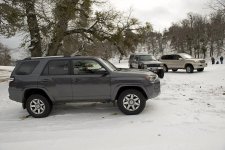
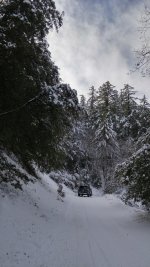
I went out in the snow yesterday with these 3 vehicles: my 4Runner TE, a 1985 Toyota 4x4 pickup and a Lexus GX470. I used 4 Hi, 4Lo and the locking rear differential occasionally in 4Lo. I turned off the traction control and never once wanted to use A-Trac or Variable Speed Control (what's it called?). I didn't want to apply any braking. I just kept all 4 wheels on the ground and the car rolling most of the time. I did go into a slide or sideways crab once with the locking diff engaged but just steered into the slide and came right out of it.
 

Attachments

  • BearMtnSize6710.jpg
    BearMtnSize6710.jpg
    107.5 KB · Views: 521
  • 0109161137_HDR.jpg
    0109161137_HDR.jpg
    135.9 KB · Views: 435
Last edited:
I'm still hung up on using M/T instead of ATRAC. I used it in 4H and was able to keep the wheels spinning on the edge of traction as [MENTION=66316]1engineer[/MENTION] states without the throttle reduction. I expect I need to try the same in 4L and then ATRAC to see if there is a difference. Wish I would have seen this thread a few days ago when we were in the local mountains.

It IS reducing the throttle. I remember specifically a moment where, with multi-terrain active in 4H, and the pedal to the floor, the truck refused to rev up.
 
https://www.youtube.com/watch?v=9OIMRuY1Wpk

At :12 you can see ATRAC working when the front passenger tire comes off the ground. There is nothing about the situation that requires ATRAC but it was fun taking the videos.

https://www.youtube.com/watch?v=YMV3fDlwdMM

No ATRAC in this video but on this very hill, I always have ATRAC on when going uphill. I have found ATRAC to be unbelievably useful when traveling uphill in loose material or bone dry conditions. On this hill with ATRAC on, I can go as slow as I want, stop at any point and then continue without losing traction. With ATRAC off, I have to carry my momentum if I don't want to lose traction. For whats it's worth, this is without airing down. 45 psi with ATRAC: go straight up. 45 psi without ATRAC I slip everywhere. When I am not lazy and I air down, ATRAC barely gets to play.
 
Off-road situations where the A-Trac really shines?
...
Saying that, I do have another question though. I have a feeling there is more than meets the eye with this system. I felt that the truck gets better traction and performs better overall, for example on steep inclines on dried up trails filled with loose rocks, with A-TRAC on, better than using its terrain management setting, even when no slippage is detected. However I couldn't find any info on that. Is there more to it than braking freely spinning tires or is it just the Placebo effect?
You asked for situation where ATRAC really shines.

You really need at least one wheel with good traction for ATRAC to shine. A situation like "dried up trails filled with loose rocks" is a good example of this. If three wheels hit loose rocks, the locked transfer case and ATRAC will send power to that one wheel on solid ground. And loose rocks are highly variable; a loose cobble may key in and provide traction for a split second before rolling, but ATRAC will take advantage of that split second to grab a little momentum.

Moguls and diagonal ditch/rut crossings are two more good examples. Any place where open diffs would leave you with two tires spinning, ATRAC will shift power and keep you moving.

Your snow situation is an example where ATRAC won't help much. Deep sticky mud holes and steep slick inclines (snow or slick solid rock) are the worst. If all four wheels are spinning, then ATRAC simply shifts power from one spinning wheel to the other.
 
You asked for situation where ATRAC really shines.
You really need at least one wheel with good traction for ATRAC to shine. A situation like "dried up trails filled with loose rocks" is a good example of this. If three wheels hit loose rocks, the locked transfer case and ATRAC will send power to that one wheel on solid ground. And loose rocks are highly variable; a loose cobble may key in and provide traction for a split second before rolling, but ATRAC will take advantage of that split second to grab a little momentum.

Thanks for touching on this particular question in my post. I felt the same thing but now after my winter experience I started having doubts.

To me it really doesn't make sense to react in a fraction of a second so I wouldn't hear it or see it on the dash in those dried up conditions but behave so poorly in snow.

People hinted at the processor having a hard time picking up delta wheel spins for abnormal conditions (even if the delta was actually HUGE in my experiment), but hey, it can do that in a fraction of a second on loose cobble! Really?
 
Last edited:
A bit disingenuous to go back and edit your post without either admitting you were wrong or meant something else don't you think?

I wouldn't have bothered saying anything but after the condescending attitude towards people trying to help you I think it's ridiculous.

You were picking on every single detail or omission for the sake of starting a fight. I already wrote in the original post they're not the same.
 
A bit disingenuous to go back and edit your post without either admitting you were wrong or meant something else don't you think?

I wouldn't have bothered saying anything but after the condescending attitude towards people trying to help you I think it's ridiculous.

Here is a quote from my first post in case you couldn't be bothered to read it fully "I heard people saying A-TRAC is a very good replacement for lockers. Couldn't disagree more due to the way it behaves but let's not talk about that now."

Happy now?
 
Last edited:
A bit disingenuous to go back and edit your post without either admitting you were wrong or meant something else don't you think?

I wouldn't have bothered saying anything but after the condescending attitude towards people trying to help you I think it's ridiculous.

Let's be realistic. I read his OP and I have read his responses. He obviously needs to learn how to drive in snow instead of worrying about the more arcane operations of ATRAC. if there is any driving condition that requires momentum it's deeper snow. ATRAC works in many situations and does not in certain instances as evidenced by the numerous correct responses in this thread.
 

Members online

Forum statistics

Threads
278,316
Messages
3,554,105
Members
248,016
Latest member
Advally Service

Trending content

Back
Top