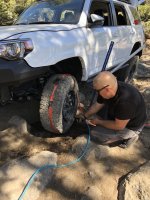
Popped a Bead. Couldn't change tire because of A-arm Skid.

Bottle jack works just fine in a number of places. It makes no difference whether you're stock or lifted. (not counting long travel here). The suspension doesn't change when you put a 3" lift on. You have to lift it the same height off the ground as a stock one.
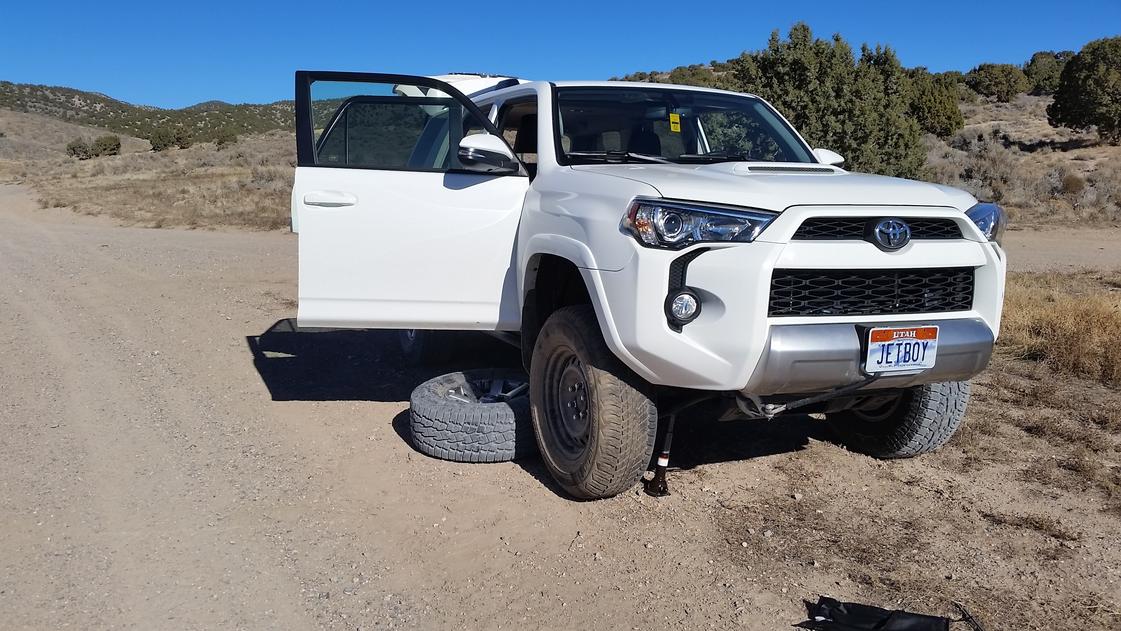
180169d1447619019-downside-p-metric-tires-20151114_133817-jpg


Also RTFM... Toyota 4Runner: If you have a flat tire - Steps to take in an emergency - Owners Manual
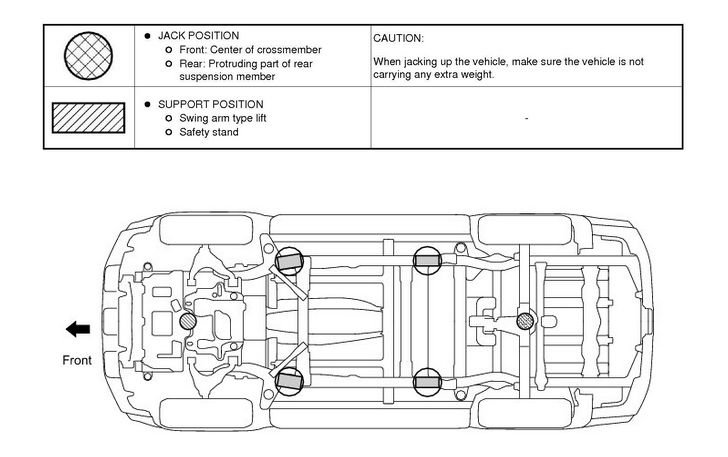
4runner-jack-points-jpg.5169


Also - I would remove the A-arm skids because they're pointless. But not for changing a tire.


Yeah...I did look at the manual during the tire change and....I must have been under too much duress/pressure. There was a line of rigs behind me that couldn't pass until I got moving again. I think I switched up the front/rear and saw that the rear needed to be on the axle and was thinking that was the front axle.

XWCGcjJ.jpg


This is really where I should have put it, where the a-arm skid is not involved at all ->

xOFMxK4.png


Now, I assume the 'real' jack location IS affected by having a lift or not, so if I have a 2-3" lift, all I need to make sure I have is some wood to make up for that 2-3"s. I don't have a long travel suspension so I don't think it matters if I'm using the stock bottle jack or not.
 
Now, I assume the 'real' jack location IS affected by having a lift or not, so if I have a 2-3" lift, all I need to make sure I have is some wood to make up for that 2-3"s. I don't have a long travel suspension so I don't think it matters if I'm using the stock bottle jack or not.

The real jack location is not changed with a lift. Your stock control arms only go up so far and down so far. When you lifted it - you probably didn't change that at all. They still only go up so far and down so far. What happened is you changed where they start. So... they still stop going down at the same point. Meaning you do not have to lift it any higher off the ground than you would have without a lift.

* some lifts do allow for around 1" of additional down travel. And if you have 33" tires - that's about 0.5 inches extra of tire height. So in reality it's possible that you could need as much as 1.5 inches of extra height. But the stock jack should easily handle that much difference.

Just put the jack under your engine skid and crank it up until the tire is off the ground. Easy peasy. Ideally near the rear center like the FSM shows. The skid should work just fine.

Good luck!
 
Last edited:
Now, I assume the 'real' jack location IS affected by having a lift or not, so if I have a 2-3" lift, all I need to make sure I have is some wood to make up for that 2-3"s. I don't have a long travel suspension so I don't think it matters if I'm using the stock bottle jack or not.

All of that seems correct to me but this.

I'm not sure on the exact numbers but any bolt-on coilover would only give you a negligible amount of extra downtravel from stock front suspension as far as the factory jack is concerned. Bilstein 5100 front shocks have more downtravel than any of the King, Icon, or Fox's have believe it or not.

Your factory jack should still work with any lift kit, its pretty long, except for maybe +2" and +3.5" long travel. (These are added width kits not inches of lift #s). It just takes forever to extend it all the way out.

Edit: Jetboy beat me to it.
 
The real jack location is not changed with a lift. Your stock control arms only go up so far and down so far. When you lifted it - you probably didn't change that at all. They still only go up so far and down so far. What happened is you changed where they start. So... they still stop going down at the same point. Meaning you do not have to lift it any higher off the ground than you would have without a lift.

* some lifts do allow for around 1" of additional down travel. And if you have 33" tires - that's about 0.5 inches extra of tire height. So in reality it's possible that you could need as much as 1.5 inches of extra height. But the stock jack should easily handle that much difference.

Just put the jack under your engine skid and crank it up until the tire is off the ground. Easy peasy. Ideally near the rear center like the FSM shows. The skid should work just fine.

Good luck!

If I'm putting the jack in the center of the engine skid and lifting the entire front...that sounds more dangerous than just trying to lift one side? It seems like its much more likely to possibly fall to a side.
 
I can totally see how the crowd made the situation worse due to actual or perceived pressure to act fast.

A few comments:
--What pressures were you running for that to happen? What rating do your tires have? If you are running P or LT-C you should not have to air down as a standard procedure. Too much pressure can get you a tread puncture by a sharp rock, but what you experienced is far more likely. Plus, it is debatable if lower pressures add traction in snow. If you have E-rated tires, then, yes, traction at street pressures won't be great.

--I understand that some enjoy clubs, etc, but I am not personally a fan of big groups of any kind. Having different types of vehicles in the group makes things even worse.

--One of the advantages of the air jack over the HiLift is that it can be easily used on uneven ground. I have a Chinese version off Ebay that I have only used in testing but I re-tested it recently and it still works. It has been wasting space on trail for years, but you never know.... That said, the rig can easily move after the air jack lifts it off the ground, so I would not call it a safe solution. Just different, a lighter tool that is easier to store.

--If we are to critique the skid plate package, the unprotected rear LCA brackets are #1 issue to address for any ledges, followed by the stock rear LCAs themselves, then the aluminum package, then the weak design of the front lip of the RCI tank skid. I don't want A-arm skids, but once there.... Also, after a lift the rear differential is quite exposed. Won't be damaged easily as a whole but the drain plug can.

Take or throw any of the above comments/suggestions at will, just my opinion based on what I do. I am not saying I know better what is good for you.

Overall, my best guess is that the entire situation was caused by unnecessarily low tire pressures. Or you really messed up on that spot, which is okay, we all have those moments!
 
Last edited:
Says the bro with a kitchen sink of mods in his sig line :lmao:

Dang got me good, I mean it's not cool enough to have my IG handle, some """Molle""" shit, and a """attic"" but it'll do.


anyways, LCA's are pretty beefy, just seems pretty odd to need more sheet metal bolted to them :shrug:
 
Bottle jack works just fine in a number of places. It makes no difference whether you're stock or lifted. (not counting long travel here). The suspension doesn't change when you put a 3" lift on. You have to lift it the same height off the ground as a stock one.

180169d1447619019-downside-p-metric-tires-20151114_133817-jpg


Also RTFM... Toyota 4Runner: If you have a flat tire - Steps to take in an emergency - Owners Manual
4runner-jack-points-jpg.5169


Also - I would remove the A-arm skids because they're pointless. But not for changing a tire.

But i'm the ******* for saying a arm skids are pointless:flamewar::flamewar:
 
I can totally see how the crowd made the situation worse due to actual or perceived pressure to act fast.

A few comments:
--What pressures were you running for that to happen? What rating do your tires have? If you are running P or LT-C you should not have to air down as a standard procedure. Too much pressure can get you a tread puncture by a sharp rock, but what you experienced is far more likely. Plus, it is debatable if lower pressures add traction in snow. If you have E-rated tires, then, yes, traction at street pressures won't be great.

--I understand that some enjoy clubs, etc, but I am not personally a fan of big groups of any kind. Having different types of vehicles in the group makes things even worse.

--One of the advantages of the air jack over the HiLift is that it can be easily used on uneven ground. I have a Chinese version off Ebay that I have only used in testing but I re-tested it recently and it still works. It has been wasting space on trail for years, but you never know.... That said, the rig can easily move after the air jack lifts it off the ground, so I would not call it a safe solution. Just different, a lighter tool that is easier to store.

--If we are to critique the skid plate package, the unprotected rear LCA brackets are #1 issue to address for any ledges, followed by the stock rear LCAs themselves, then the aluminum package, then the weak design of the front lip of the RCI tank skid. I don't want A-arm skids, but once there.... Also, after a lift the rear differential is quite exposed. Won't be damaged easily as a whole but the drain plug can.

Take or throw any of the above comments/suggestions at will, just my opinion based on what I do. I am not saying I know better what is good for you.

Overall, my best guess is that the entire situation was caused by unnecessarily low tire pressures. Or you really messed up on that spot, which is okay, we all have those moments!


I was running about 15 psi on snow/ice. Have C-rated ridge grapplers (285/70/r17). Felt a lot of pressure from the group where everyone was airing down, though another 4nr didn't and did fine, though he did use chains on a certain section.

And...yeah, I think more than anything it was caused by driver error. I probably should have tried to slow down more on that section but it was icy.I went out to get experience and....got some!

I do have rear LCA bracket skids...I wasn't aware of a problem with the front lip of the RCI fuel tank skid. Is there a mod or fix for that?
 
I was running about 15 psi on snow/ice. Have C-rated ridge grapplers (285/70/r17). Felt a lot of pressure from the group where everyone was airing down, though another 4nr didn't and did fine, though he did use chains on a certain section.

And...yeah, I think more than anything it was caused by driver error. I probably should have tried to slow down more on that section but it was icy.I went out to get experience and....got some!

I do have rear LCA bracket skids...I wasn't aware of a problem with the front lip of the RCI fuel tank skid. Is there a mod or fix for that?

Well, I will say the 15 psi is your culprit, not you. I don't air down for the heck of it on my P-metric Wildpeaks. The issue is more in the Sonoran desert because we have so many sharp nasty rocks, even when small. They are not as "nice" as the Sedona or Utah slickrock. Air down for soft or deep sand and volcanic ash and such. Do you have volcanic ash drives in Idaho? Around Craters of the Moon?

On P or LT-C, I would not do under 28 in most areas. In AZ or SoCal deserts, it depends. Deep sand, of course.

With D or E load is different. You have to air down both to keep your fillings and to ensure traction. The D/E loads have very stiff sidewalls, less footprint on vehicles too light for them, and hence less traction at equivalent pressures.

No, you have the skid you have and you have a lift to boot so I would not lose any sleep over it. The reason I did not get the RCI gas tank skid and endured instead the painful install of the Shrock one is that front lip: it is where you hit that skid plate the most. So an unsupported protruding lip will cave in after one impact. The Shrock and C4 designs are far stronger.

But again, be alone the judge, don't let forums and groups make decisions for you; just use us as data points. My goal is to drive all I care to drive at stock height. So the best armor is essential for me.

EDIT: presumably lots of people in your group had MT tires. So that's another difference from yours. MT tires are E-rated though I have never had or intend to have any unless I get a dedicated trail rig. So I won't comment about MTs.
 
Last edited:
But i'm the ******* for saying a arm skids are pointless:flamewar::flamewar:

They're actually worse than pointless. They make the LCA worse by tapping mud, creating unnecessary galvanic corrosion, adding weight and have no benefit. And apparently they also make it harder to use the jack


My beef is with the sellers. Not everyone is an experienced fabricator or offroader. They're relying on the "expert". But no one in the history of 5th gens has ever damaged an LCA in a way that a skid like that could help. Ever. Not once. And it never will happen. People who buy them do so because they don't know the difference and rely on sellers pushing a phony product. That's not cool.
 
Last edited:
If I'm putting the jack in the center of the engine skid and lifting the entire front...that sounds more dangerous than just trying to lift one side? It seems like its much more likely to possibly fall to a side.

I generally lift one side for safety also. But it's not bad to go right in the middle. In my shop I just put the jack under the center with the floor jack. Mostly because it's fast and easy. In the field go for the most stable option you can. Also use the spare as a safety in case it falls. It'll also make it easier to get a jack under again if it falls and lands on the spare vs the ground. Finally once it's up in the air. Give it a good shake. See if you can push or shake the vehicle off the jack. Make sure it's stable before you start taking lugnuts off.

It's easy to feel rushed with a group. They should recognize you're new and help you sort it out so you have more experience. I would not use a high lift to change a tire unless it was all I had. They're not very stable. But they are handy and fast.

Also one other tip. To reseat a bead without a big compressor, wrap a tie down strap around the tread pin the tire and as you tighten it down it'll push the beads out to the wheel so you can refill and reseat them. But take it off as soon as it starts to fill up. Otherwise it will break the strap.
 
Last edited:
They're actually worse than pointless. They make the LCA worse by tapping mud, creating unnecessary galvanic corrosion, adding weight and have no benefit. And apparently they also make it harder to use the jack


My beef is with the sellers. Not everyone is an experienced fabricator or offroader. They're relying on the "expert". But no one in the history of 5th gens has ever damaged an LCA in a way that a skid like that could help. Ever. Not once. And it never will happen. People who buy them do so because they don't know the difference and rely on sellers pushing a phony product. That's not cool.

Lighten up Francis or switch to decaf....we’re talking about $100 bucks in sheet metal.
 
They're actually worse than pointless. They make the LCA worse by tapping mud, creating unnecessary galvanic corrosion, adding weight and have no benefit. And apparently they also make it harder to use the jack


My beef is with the sellers. Not everyone is an experienced fabricator or offroader. They're relying on the "expert". But no one in the history of 5th gens has ever damaged an LCA in a way that a skid like that could help. Ever. Not once. And it never will happen. People who buy them do so because they don't know the difference and rely on sellers pushing a phony product. That's not cool.

I wanted to add, if you manage to destroy an A-arm, you probably destroyed everything else connected to it.

I'm going to admit, I bought mine cuz it looked cool....lol.
 
I generally lift one side for safety also. But it's not bad to go right in the middle. In my shop I just put the jack under the center with the floor jack. Mostly because it's fast and easy. In the field go for the most stable option you can. Also use the spare as a safety in case it falls. It'll also make it easier to get a jack under again if it falls and lands on the spare vs the ground. Finally once it's up in the air. Give it a good shake. See if you can push or shake the vehicle off the jack. Make sure it's stable before you start taking lugnuts off.

It's easy to feel rushed with a group. They should recognize you're new and help you sort it out so you have more experience. I would not use a high lift to change a tire unless it was all I had. They're not very stable. But they are handy and fast.

Also one other tip. To reseat a bead without a big compressor, wrap a tie down strap around the tread pin the tire and as you tighten it down it'll push the beads out to the wheel so you can refill and reseat them. But take it off as soon as it starts to fill up. Otherwise it will break the strap.

This is sage advice, OP.
 

Attachments

  • DBCE39AA-B399-4F3A-BEDA-74D4B6D1D9B3.jpg
    DBCE39AA-B399-4F3A-BEDA-74D4B6D1D9B3.jpg
    138.1 KB · Views: 222

Members online

Forum statistics

Threads
278,315
Messages
3,554,123
Members
248,016
Latest member
Advally Service

Trending content

Back
Top