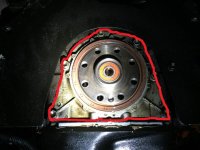
Rear main seal

I'm doing the clutch anyways, you should see how nasty the trans fluid was. I put redline in 8k ago, it cleaned up the nastyness from the original fluid.
 
Do your starter contacts, too, if they haven't been done. Mine were very thin and would not have lasted much longer.

Do I just go to my local auto parts store and ask for contacts for the starters for our truck? I assume they are like the contacts on power tools where you just unbolt and replace them?
 
Do I just go to my local auto parts store and ask for contacts for the starters for our truck? I assume they are like the contacts on power tools where you just unbolt and replace them?

I got mine on Amazon. We stickshifters have a smaller starter than the slushboxers so this is only for 5-speeds. Works great.

http://www.amazon.com/gp/product/B0031HMS7C?psc=1&redirect=true&ref_=oh_aui_detailpage_o03_s00

Here is a DIY:

http://www.toyota-4runner.org/3rd-gen-t4rs/63228-another-starter-contacts-removal-thread.html

Obviously you will want to disregard the part about working through the wheel well. Undo the wires and do it on your bench or kitchen table or whatever.
 
"We stickshifters have a smaller starter than the slushboxers..."

We do? Any chance you have a picture of a side by side. I left my starter alone when I did my clutch, it was a pretty clean looking Napa Gold from the P.O., sticker was still legible. I'm just curious if it will be any easier to swap out when it comes to it.
 
We do? Any chance you have a picture of a side by side. I left my starter alone when I did my clutch, it was a pretty clean looking Napa Gold from the P.O., sticker was still legible. I'm just curious if it will be any easier to swap out when it comes to it.

Where would I get a slushbox starter? I think they LOOK identical. They fit in the same hole, after all. The 5-speed is 1.4kW 28100-62050 and the autos have 1.8kW 28100-62030. Except some 5-speeds with the cold weather package may have the big one. I had the small one.

In any case, pulling the starter on a 5-speed even not during a clutch job, is MUCH easier. Some of the big obstacles for the slushers are the tranny cooler lines and the tranny dipstick, neither of which we have. You can get it out through the wheel well or drop it down. Plus the bolts will have been pulled during the last clutch job, as opposed to being factory tight and on there for 15+ years.

 
Last edited:
Where would I get a slushbox starter? I think they LOOK identical. They fit in the same hole, after all. The 5-speed is 1.4kW 28100-62050 and the autos have 1.8kW 28100-62030. Except some 5-speeds with the cold weather package may have the big one. I had the small one.

In any case, pulling the starter on a 5-speed even not during a clutch job, is MUCH easier. Some of the big obstacles for the slushers are the tranny cooler lines and the tranny dipstick, neither of which we have. You can get it out through the wheel well or drop it down. Plus the bolts will have been pulled during the last clutch job, as opposed to being factory tight and on there for 15+ years.

Fair enough, right on. do you know if the contacts can be replaced without removing the starter by chance?
 
Fair enough, right on. do you know if the contacts can be replaced without removing the starter by chance?

The DIY I posted above does it that way. On a 5-speed, I'd say it's easier to take it out. Some have tried to do it on the truck and didn't like it, but it CAN be done.

Read the thread.
 
I recently changed mine and it was around $32-34 from the local dealer.

I actually did it twice, unfortunately. The seal I bought from the dealer is an updated part and the number molded into the seal is different. I think it may be slightly thinner than the seal that was originally in there but I didn't measure anything. So the first time I drove the seal in a little too deep and it leaked.

The second time I used a short section of 4" PVC, sanded smooth on one side so it didn't damage the new seal and with a 4" end cap on the other, to drive the seal in. It covers the seal but is also slightly larger so it stops when it hits the metal housing on the engine. Using the pipe it was pretty easy to get the seal flush with the housing. And best part, it didn't leak anymore.

Well it seems that i am in the same boat....I think your post scared me into not putting the seal in far enough. You just pushed it in to be flush with the block?
 

So another question. I am assuming that the item highlighted in red is the seal retainer that was talked about earlier in this thread. So that has to come off and the seal needs to be pushed in until flush with the block? Previously i drove it flush with the item highlighted in red, but i just want to confirm, pulling the transmission a 3rd time is not to my list of desires.

Additionally, if that part does need to come off, it sounds like I need to put some FIPG on it on the surface that seats against the block?
 

Attachments

  • retainer.jpg
    retainer.jpg
    105.3 KB · Views: 8,563
So now im getting myself all sorts of confused. Previously i drove the seal to be flush with what i think is the seal retainer (the sides you can see in the picture were flush to eachother). Post 5 and post 30 seem to contradict each other though. If I were to drive the seal any further than flush as before, then it would contact the block, which I would assume as in post 5, would be too far, however, in post 30 im told that i should push it in until flush with the block. Has anyone done this recently to know what i should be doing?!?! Flush to the front of the seal retainer? or flush up to the block? Any help would be appreciated!
 
So another question. I am assuming that the item highlighted in red is the seal retainer that was talked about earlier in this thread. So that has to come off and the seal needs to be pushed in until flush with the block? Previously i drove it flush with the item highlighted in red, but i just want to confirm, pulling the transmission a 3rd time is not to my list of desires.

Additionally, if that part does need to come off, it sounds like I need to put some FIPG on it on the surface that seats against the block?

retainer stays in place. no need to remove or replace as it is not a wear item. it being installed helps in centering the seal when installing it. unless you beat on the seal, it bottoms out and is flush with retainer when installed. done. almost 30 years wrenching and have always done it this way.
 
So now im getting myself all sorts of confused. Previously i drove the seal to be flush with what i think is the seal retainer (the sides you can see in the picture were flush to eachother). Post 5 and post 30 seem to contradict each other though. If I were to drive the seal any further than flush as before, then it would contact the block, which I would assume as in post 5, would be too far, however, in post 30 im told that i should push it in until flush with the block. Has anyone done this recently to know what i should be doing?!?! Flush to the front of the seal retainer? or flush up to the block? Any help would be appreciated!

flush with retainer, just like the original.
 
flush with retainer, just like the original.

Well, the issue is that the new part is slightly smaller than the original seal. So from my understanding, tight to the block will not produce flush with the retainer. So which one is right? Flush to retainer or snug to block?
 
don't know what you mean by tight to block. retainers all have a lip that the seal bottoms out on. is your seal an aftermarket one? and it's thinner? i'd get an OE one.
 
Ok, let's take a deep breath.

It appears that my attempt to avoid confusion, created confusion. For simplicity sake, I assumed (silly me) that when you mentioned the back of the block earlier in the thread you were referring to the seal retainer. I didn't want to start splitting hairs and confuse anyone.

To be clear, the seal retainer bolts to the back of the block and is sealed with FIPG. I see no reason to remove the seal retainer unless you know for a fact that the FIPG is leaking. The seal presses into the seal retainer, and NEEDS TO SIT FLUSH WITH THE SEAL RETAINER. If you bottom out the seal in the seal retainer, it will leak. The problem is that the OEM seal superceeded to a new part number and the new part number is slightly thinner than the original seal. So even if you buy the OEM part from Toyota, you can seat it too far into the retainer.

p.s. Thanks for the mention. I might not have ever seen this if I didn't get an email.
 
don't know what you mean by tight to block. retainers all have a lip that the seal bottoms out on. is your seal an aftermarket one? and it's thinner? i'd get an OE one.

Well if you read the post at the bottom of page 2, midcoma states that it should be pushed in flush to the block. Are you certain that ALL retainers have this and that the retainer for the 3.4l with manual transmission does? I already had the retainer out when you posted your original reply, I looked it over pretty good before reintalling and I never saw any sort of lip, I can look again when I get home.

If you look at the top of page 2, I state that I bought an oem seal. Post 5 details that the new part number is slightly different than the old.
 

Members online

Forum statistics

Threads
278,310
Messages
3,554,080
Members
248,016
Latest member
Advally Service

Trending content

Back
Top