Recovery Gear Options

When I had my winch, I opted for southeast Overland's brand of synthetic..great bargain. Out west can a different creature though, it doesn't like rubbing on rocks.

So here goes..

-5" hi lift extreme with a lift mate (you basically can do the same thing with a ratchet strap though)

2-D shackles http://www.amazon.com/ARB-ARB207D-B...8&qid=1453327521&sr=8-1&keywords=arb+shackles

-2- 30' ARB straps http://www.amazon.com/ARB-ARB705US-...TF8&qid=1453327100&sr=8-1&keywords=arb+straps

1 - Snatch Block http://www.amazon.com/ARB-ARB209-Sn...d=1453327612&sr=8-2&keywords=arb+snatch+block

-1 60'-85' winch line extension line with eyes

-4 soft shackles Amazon.com: Safe-T-Line® XD Soft Shackles in "SAFETY ORANGE" (PAIR) (4X4 VEHICLE RECOVERY): Automotive

10' length of chain Amazon.com: RECOVERY CHAIN WITH HOOKS - 3/8 inch X 10 ft (OFF-ROAD RECOVERY): Automotive

30' kinetic rope http://www.amazon.com/KINETIC-RECOV...d=1453327405&sr=8-3&keywords=30'+kinetic+rope

6' ARB Tree Strap optional out west

Safety gloves, line damper, safety glasses
and an idea how to use all this stuff...it can be extremely dangerous used by the wrong person. No money saved by buying cheap shit will be remembered, after you or someone else, is injured or maimed on the trail or a recovery.
 
Hi Carlo,

I've seen this and other videos on using a hi lift for a winch. It has a short pulling range and is harder to rig than a come along. The cost of a high lift is less than for a good come along. I don't see using it as a jack for the 5th Gen T4R. Do you?

Check out this video on using the Wyeth-Scott come along. look for part two where he uses it to lift. It's an interesting view from a can-do rancher and logger.

https://www.youtube.com/watch?v=bQBiRQDoISs

Or this video about a bargain recovery kit based on the come along.

https://www.youtube.com/watch?v=Oxi7W7ez_9k

the come along does look pretty good.

i don't understand how you don't see using a hi lift as a jack for the 5th gen when you're in the middle of no where. if i'm stuck in mud or even soft sand and I don't have anyone around, I'd be glad i had the hi lift to lift it up and add some stuff under the wheel to get me going. If i needed to take off a wheel in the same scenario, it would be pretty hard to get a bottle jack or regular car jack working in mud or soft sand.
 
Thanks Jetboy,


Where and how do you use a short piece of chain? I can see it connecting two straps with D-rings, but I don't see how it works alone.

I4WDTA trainers teach looping straps through each other and not using shackles. Metal shackles in a kinetic recovery have the potential to be some deadly projectiles. Get yourself some soft shackles. You can use them to go around your sliders (or rear recovery point) to jack the vehicle up.

Also, forget a flat recovery 'strap' and go with a kinetic rope. Buy an actual hitch recovery point. You can easily damage a strap with an off angle pull when fed directly into the receiver.

With a winch on the front you can start to alter your drive patterns to keep in the best position for self-recovery. Always back up to turn around so the nose is never down in a ditch, etc. I'd invest in a pull pal if I was flying solo in a harsh environment.
 
One problem with a winch is it won't do anything for pulling you out backwards.

You can use a front mounted winch to pull yourself backwards. With 3 snatch blocks and a couple of d rings you can get yourself out backwards.

If you're in a desert, then yea you probably wont be able to winch yourself backwards but if there are trees around you , you can most definitely winch out backwards.

This video teaches you how.

https://www.youtube.com/watch?v=ampWzHMez28
 
you mentioned 2 d-rings, that would be a good START.

just today I ordered 4 more.

I recommend getting the 3/4", just make sure whatever you're attaching them to, has a large enough hole for the pin. the 3/4" are nice, because it can easily fit 2 ends of a strap. but it might not be a bad idea to have a couple 5/8" also. just in case.
 
great thread :)

I'm building my recovery set as well. So far I have:

1. first aid kit
2. Smittybilt 2781 5.65 CFM Universal Air Compressor
3. ARB ARB705US 2-3/8" x 30' Recovery Strap
4. 2 Smittybilt 13047B 3/4" Black D-Ring
5. TRED PRO recovery
6. ARB ARB505 E-Z Deflator
7. Antigravity Batteries Micro-Start Jump Starter XP-1


should I go with a kinetic strap as well? or would the ARB recovery strap be okay. I'm like the OP, I only do mild trail but want to be prepare in case I get stuck.

I still need to research on shovel. A small collapse one that fit underneath the cargo slider is prefer but a big one that can attach to the roof rail along with the tred pro would be okay as well.

I'm also waiting on the stock tire to wear out but might jump on a good deal if the KO2 come up for sale around the holiday...*cross fingers*

any other suggestion to my list?
 
So I'm going to state the obvious. I'm new to this forum, so go easy, and have left the Wrangler world behind. Getting my 4R in early Feb.

Prevent it to start with

- A travel buddy do not go alone. If it's the desert southwest there are no trees to use as a recovery point for a winch. The only thing of substance is a saguaro.... Don't use the saguaros... it's just not a good idea


- #1 for the Desert SW, get decent tires with sidewall protection. It's mostly rocks out here and the occasional bit of glass. Most 285's are D or E and have it. Many of us ran load range C but brought a....

- FULL sized spare

- Air down! #1 thing for comfort lots of washboard and bumpy roads here. Just have something to air yourself back up... and the truck air from checker auto parts will not cut it or will overheat and take forrrreverrrrr. Viair or something from ARB works nicely


If you do have to be recovered

On rocky trails it's not like mud where a straight pull from a buddy will likely get you out. You need to get your vehicle UP over something and then in a direction. So a high lift jack with the High lift mate is tons easier than trying to jack up the corner of a bumper with lots of suspension flex. With this attachment, you lift it up by the wheel much faster, find another rock, put it under the wheel detach and then you can pull in the desired direction.

- Recovery strap. NOT a tow strap, one gives the other does not. Most are rated at Xlbs and then have a "working" rating. The working rating is what you want to be more than the weight of your vehicle. Get two cheaper ones (not Harbor Freight cheap!) vs 1 expensive one

- Recovery point. You only need 1-2 D rings but a place to put one on each of the 4 corners if you are serious about it. I'm not even sure where a 4R has them but it's the FIRST thing I will do once I get one.

- Water. I keep the 2.5 gallon blue square type filled.

- Tools. Sockets, wrenches and.... and... can I Get a duct tape/Zip ties hallelujah? Gotta keep that whatever is dragging tucked back up in there. ...or is that just a Jeep thing because everything is always falling off them and we just don't understand that a vehicle can be made with some reliability? I digress.. it's late.

I'll go now and have fun in the SW it's great out here... in the winter =)
 
Recovery tool list

These are all great responses. I've been out all afternoon and just got in to read this thread. It's late now. I'll read them again tomorrow and try to reply to all the ideas.
Thanks a heap!
Dave in So Cal :)
 
hi lift as recovery gear

the come along does look pretty good.

i don't understand how you don't see using a hi lift as a jack for the 5th gen when you're in the middle of no where. if i'm stuck in mud or even soft sand and I don't have anyone around, I'd be glad i had the hi lift to lift it up and add some stuff under the wheel to get me going. If i needed to take off a wheel in the same scenario, it would be pretty hard to get a bottle jack or regular car jack working in mud or soft sand.

[MENTION=123578]carlomagne[/MENTION]
Hi CarloMagne,

Yes, if you're mired in deep sand or mud you can't get under the axle with a bottle jack. You are unlikely to also have a flat when you're stuck in the sand. If you do, you have two problems and probably you were driving with a flat when you got stuck.

There just aren't a lot of points on a 5th Gen T4R to lift from. The rock sliders will lift the whole side. The trailer hitch will lift the back axle once you lift high enough to overcome the normal suspension sag. If you have a lift bracket or strap for a wheel you can lift it, but at that point you can't change/remove that tire. You have to set the axle on something else and let it back down. I wouldn't trust that without a jack stand or several blocks of good lumber.

For a recovery device, pulling with the come along is easier. Looking back at just your photos of Anza Borrego I don't see a hi-lift on anyone's truck. Did you carry one? And unrelated to the jack, did you drive out for the day or camp overnight out there? It's 2 to 3 hours from here.

You live close enough that we could have this conversation over a cup of coffee or a hamburger. :)
 
I4WDTA trainers teach looping straps through each other and not using shackles.
Yeah, just make sure to use a bung otherwise the two straps can fuse together on a really hard pull. Rolled up newspaper or magazine will do the trick.

- Tools. Sockets, wrenches and.... and... can I Get a duct tape/Zip ties hallelujah? Gotta keep that whatever is dragging tucked back up in there. ...or is that just a Jeep thing because everything is always falling off them and we just don't understand that a vehicle can be made with some reliability? I digress.. it's late.
I'll add a 3' long 1/2" drive breaker bar to that as well.

The trailer hitch will lift the back axle once you lift high enough to overcome the normal suspension sag.
Never use a Hilift in the hitch, it's a disaster waiting to happen. Either you'll put the Hilift through the back window (the jack begins to angle towards the vehicle as you lift it) or the entire vehicle will become unstable and slip to one side. I've seen people use that as a legitimate recovery technique, but they did it on purpose and knew what they were doing. Still dangerous as hell though.

While it isn't specifically the hitch, you can see what I'm talking about in this video.

https://youtu.be/0xsV2FJin_A?t=2m22s
 
List of recovery gear

When I had my winch, I opted for southeast Overland's brand of synthetic..great bargain. Out west can a different creature though, it doesn't like rubbing on rocks.

So here goes..
...
6' ARB Tree Strap optional out west

Safety gloves, line damper, safety glasses
and an idea how to use all this stuff...it can be extremely dangerous used by the wrong person. No money saved by buying cheap shit will be remembered, after you or someone else, is injured or maimed on the trail or a recovery.

Thanks [MENTION=47340]Titanpat57[/MENTION]

It's a good list. This includes everything I've been looking at. When ordering through Amazon you can end up paying individual shipping for each item because they all come from different suppliers. I'm looking for one source that might sell all of the items I want. I think I found one in Gardena, CA that carries or can order most of everything I need.

I like your last comment. Safety first. Best safety device is between your ears. You have to know how to use this stuff properly.
 
I have the WS come along you mentioned. I find it very useful for both recovery and other misc scenarios where pulling power is required (in fact I've used it for non recovery more than recovery). Combine it with some straps or extensions, soft shackles, D ring shackles, and a few snatch blocks and you can recover out of just about anything where an anchor point exists. The only downside is speed and coordination. A mounted powered winch is quick and allows a single operator to run the winch and the truck at the same time. The power puller is slow and a bit more time consuming to setup. Way faster easier and lighter weight than winching with a hi-lift, but still nothing like a powered winch.

Mounting a receiver on the front of the truck is a horrible idea IMHO. It will create a serious hang up spot unless you can come up with a really custom setup. The out of the box ones I have seen are terrible for clearance and will get you into all kinds of trouble.

Hi lifts are interesting. They are both the best and worst tool for many scenarios... You just have to decide what you would use it for and make sure you have the appropriate accessories to go with it. The wheel hook is a real good one for the 5th gen, but that won't help you change a tire... They are generally vary scary to use. I go to it as a last resort. (see below for example of where it was the perfect tool for a situation last weekend)

Maxtrax are another great light recovery tool. These are probably the most utilized tool in an overlanders recovery bag of tricks. Money well spent.. quick and easy for many light recovery situations.

The thing about recovery tools is that there is a bunch of overlap in function and much of it depends on your particular setup and the type of terrain you will hit.

Here is what I carry in my 5th gen when fully geared up.
- Hilift
- WS power puller
- 25ft winch line extension
- 1 tow strap
- 1 snatch strap
- 1 Tree saver
- 1 soft strap
- 3 D shackles
- 2 snatch blocks
- 2 Maxtrax
- 1 wood base 2x12x2'
- 1 jackstand with integrated bottle jack

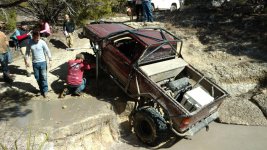
Speaking of the hilift... here is a pic from this past weekend where I let my friend try a rather crazy line in my trail rig (the picture makes this look easy, but trust me when I say it was insanity). Unfortunately, it resulted in losing an outer bead in a really awkward situation. The hi-lift plus a soft strap on the slider ended up being the perfect lifting solution. Not using the soft strap just resulted in the hilift siding on the slider... From there we just used on-board air + a ratcheting strap to get the tire to seat... and we were on our way in 15 minutes.
 

Attachments

  • 3.jpg
    3.jpg
    148.8 KB · Views: 1,026
Last edited:
Recovery Pulling Backwards

You can use a front mounted winch to pull yourself backwards. With 3 snatch blocks and a couple of d rings you can get yourself out backwards.

If you're in a desert, then yea you probably wont be able to winch yourself backwards but if there are trees around you , you can most definitely winch out backwards.

This video teaches you how.

https://www.youtube.com/watch?v=ampWzHMez28

That guy is funny! He did eventually make it work with 3 snatch blocks and he explained why it worked. I was amazed to see it work, given the line configuration.

I will say this would be easier with a rear mounted winch or a come along with the line attached to two anchor points behind the vehicle. With the come along the snatch block goes on the back of the truck, the come-along gets rigged close to either one of the anchors and you start pulling. The only problem is the tension on the line is far greater than the pulling force of any straight, one-line pull. The force gets big as the angle between the V-shaped line gets wider. But the capacity to pull the vehicle out is greater. Just be sure the tensile capacity of the winch or come-along line is not exceeded and know (guestimate) how much force it will take to pull the vehicle free.
 
I have the WS come along you mentioned. I find it very useful for both recovery and other misc scenarios where pulling power is required (in fact I've used it for non recovery more than recovery). Combine it with some straps or extensions, soft shackles, D ring shackles, and a few snatch blocks and you can recover out of just about anything where an anchor point exists. The only downside is speed and coordination. A mounted powered winch is quick and allows a single operator to run the winch and the truck at the same time. The power puller is slow and a bit more time consuming to setup. Way faster easier and lighter weight than winching with a hi-lift, but still nothing like a powered winch.

Mounting a receiver on the front of the truck is a horrible idea IMHO. It will create a serious hang up spot unless you can come up with a really custom setup. The out of the box ones I have seen are terrible for clearance and will get you into all kinds of trouble.

Hi lifts are interesting. They are both the best and worst tool for many scenarios... You just have to decide what you would use it for and make sure you have the appropriate accessories to go with it. The wheel hook is a real good one for the 5th gen, but that won't help you change a tire... They are generally vary scary to use. I go to it as a last resort. (see below for example of where it was the perfect tool for a situation last weekend)

Maxtrax are another great light recovery tool. These are probably the most utilized tool in an overlanders recovery bag of tricks. Money well spent.. quick and easy for many light recovery situations.

The thing about recovery tools is that there is a bunch of overlap in function and much of it depends on your particular setup and the type of terrain you will hit.

Here is what I carry in my 5th gen when fully geared up.
- Hilift
- WS power puller
- 25ft winch line extension
- 1 tow strap
- 1 snatch strap
- 1 Tree saver
- 1 soft strap
- 3 D shackles
- 2 snatch blocks
- 2 Maxtrax
- 1 wood base 2x12x2'
- 1 jackstand with integrated bottle jack

Speaking of the hilift... here is a pic from this past weekend where I let my friend try a rather crazy line in my trail rig (the picture makes this look easy, but trust me when I say it was insanity). Unfortunately, it resulted in losing an outer bead in a really awkward situation. The hi-lift plus a soft strap on the slider ended up being the perfect lifting solution. Not using the soft strap just resulted in the hilift siding on the slider... From there we just used on-board air + a ratcheting strap to get the tire to seat... and we were on our way in 15 minutes.

When I had my Jeep I had the problem of the hi lift sliding on the bumpers. This is very dangerous. I solved this problem by drilling/tapping holes near the ends of the bumpers that I could thread a bolt into. The head of the bolt would keep the jack from sliding off. This would also work on sliders.
 
I have the WS come along you mentioned. I find it very useful for both recovery and other misc scenarios where pulling power is required (in fact I've used it for non recovery more than recovery). Combine it with some straps or extensions, soft shackles, D ring shackles, and a few snatch blocks and you can recover out of just about anything where an anchor point exists. The only downside is speed and coordination. A mounted powered winch is quick and allows a single operator to run the winch and the truck at the same time. The power puller is slow and a bit more time consuming to setup. Way faster easier and lighter weight than winching with a hi-lift, but still nothing like a powered winch.

Mounting a receiver on the front of the truck is a horrible idea IMHO. It will create a serious hang up spot unless you can come up with a really custom setup. The out of the box ones I have seen are terrible for clearance and will get you into all kinds of trouble.

Hi lifts are interesting. They are both the best and worst tool for many scenarios... You just have to decide what you would use it for and make sure you have the appropriate accessories to go with it. The wheel hook is a real good one for the 5th gen, but that won't help you change a tire... They are generally vary scary to use. I go to it as a last resort. (see below for example of where it was the perfect tool for a situation last weekend)

Maxtrax are another great light recovery tool. These are probably the most utilized tool in an overlanders recovery bag of tricks. Money well spent.. quick and easy for many light recovery situations.

The thing about recovery tools is that there is a bunch of overlap in function and much of it depends on your particular setup and the type of terrain you will hit.

Here is what I carry in my 5th gen when fully geared up.
- Hilift
- WS power puller
- 25ft winch line extension
- 1 tow strap
- 1 snatch strap
- 1 Tree saver
- 1 soft strap
- 3 D shackles
- 2 snatch blocks
- 2 Maxtrax
- 1 wood base 2x12x2'
- 1 jackstand with integrated bottle jack

Speaking of the hilift... here is a pic from this past weekend where I let my friend try a rather crazy line in my trail rig (the picture makes this look easy, but trust me when I say it was insanity). Unfortunately, it resulted in losing an outer bead in a really awkward situation. The hi-lift plus a soft strap on the slider ended up being the perfect lifting solution. Not using the soft strap just resulted in the hilift siding on the slider... From there we just used on-board air + a ratcheting strap to get the tire to seat... and we were on our way in 15 minutes.
too bad they don't make one of these for the 5th gen yet...

4th gen 4Runner High Clearance Front Receiver Hitch | CBI Offroad Fab
 
Thanks [MENTION=47340]Titanpat57[/MENTION]

It's a good list. This includes everything I've been looking at. When ordering through Amazon you can end up paying individual shipping for each item because they all come from different suppliers. I'm looking for one source that might sell all of the items I want. I think I found one in Gardena, CA that carries or can order most of everything I need.

I like your last comment. Safety first. Best safety device is between your ears. You have to know how to use this stuff properly.

Look for items on Amazon with free shipping. The price and free shipping changes almost daily on many items so keep watching them.
 
When I had my Jeep I had the problem of the hi lift sliding on the bumpers. This is very dangerous. I solved this problem by drilling/tapping holes near the ends of the bumpers that I could thread a bolt into. The head of the bolt would keep the jack from sliding off. This would also work on sliders.
I never did get around to doing it, but I had an idea to combat this problem.
I was going to take 2" lengths of 1/4" straight rod, or rebar, and weld them to the bottom of the bumper. tacked in the middle, the using a hammer, pounding it down, until it followed the profile of the bar, then welding it the rest of the way.
 
[MENTION=123578]carlomagne[/MENTION]
Hi CarloMagne,

Yes, if you're mired in deep sand or mud you can't get under the axle with a bottle jack. You are unlikely to also have a flat when you're stuck in the sand. If you do, you have two problems and probably you were driving with a flat when you got stuck.

There just aren't a lot of points on a 5th Gen T4R to lift from. The rock sliders will lift the whole side. The trailer hitch will lift the back axle once you lift high enough to overcome the normal suspension sag. If you have a lift bracket or strap for a wheel you can lift it, but at that point you can't change/remove that tire. You have to set the axle on something else and let it back down. I wouldn't trust that without a jack stand or several blocks of good lumber.

For a recovery device, pulling with the come along is easier. Looking back at just your photos of Anza Borrego I don't see a hi-lift on anyone's truck. Did you carry one? And unrelated to the jack, did you drive out for the day or camp overnight out there? It's 2 to 3 hours from here.

You live close enough that we could have this conversation over a cup of coffee or a hamburger. :)

I really can't tell if you're serious or just trolling. Several people use/bring a hi lift for those just in case moments. We all hope to not have to use it to lift the truck up but will be glad we have it when it's needed. You make it seem like the only safe way you'll lift your truck up when offroading is if you have a 4 post lift.

You work with what you have. A hi lift is better than no hi lift. I'm not about to trailer around a 4 post lift.

And yes, we do have hi lifts. Mine is mounted on the rear like my cousin's and the tacoma has his secured to the rack.

23896672153_82d16ce30a_b.jpg


Hi lifts were mounted upside down with the base plate and handle inside the trunk to allow more clearance with our departure angles.
 
Last edited:
Working Load vs Ulimate strength

you mentioned 2 d-rings, that would be a good START.

just today I ordered 4 more.

I recommend getting the 3/4", just make sure whatever you're attaching them to, has a large enough hole for the pin. the 3/4" are nice, because it can easily fit 2 ends of a strap. but it might not be a bad idea to have a couple 5/8" also. just in case.

Thanks for the reply. I think you need at least two D-Rings to attach to both of the front recovery loops on the frame. After that you need them to connect recovery straps to tree strap anchors. Using them in line between two straps, cables or chains is dangerous because they add a big weight that can fly, causing injury or vehicle damage. They need to be attached to fixed points that can't move if the line breaks anywhere.

I saw a video that stated that any D-Ring that doesn't have a rating listed on the cast loop has an unknown capacity and is unreliable for that reason. "Only use D-rings with ratings stamped on the loop", he said.

A lot of people don't know the difference between working load and ultimate strength, including the West Australian guy in the video. Ultimate load is often 4 to 5 times the Working load. For steel, that's because the ultimate strength is when it breaks and that can vary, the point of failure is also where the steel has already yielded and elongated and most importantly, because you want to use the steel within it's elastic limits - where the stress/strain ratio is linear (engineering speak) and the steel will retain it's strength and original shape when the load is removed.

I'm not sure how this working load vs ultimate load works for recovery straps and kinetic ropes. But you need to know what the safe working load is and not load it anywhere near the ultimate breaking strength.
 

Members online

Forum statistics

Threads
278,312
Messages
3,554,089
Members
248,016
Latest member
Advally Service

Trending content

Back
Top