And I have the exact opposite experience. With a properly aligned vehicle such a small track width shouldn't make any difference and why I don't run spacers.
Other reasons include generating clearance issues, needlessly stressing the wheel/hub components, and the possible concerns of a dumbass lazy tech not tightening things at the dealership and sending a wheel to infinity and beyond while on the highway.
I'm firmly in the anti-spacer crowd and have never run them on any 4x4 I've owned.
I can understand your stance on wheel spacers. Track width does make a difference. Admittedly, many of the changes they make are not noticeable by many drivers. For example, extending the wheel's position outwards from the vehicle increases the leverage upon the LCA and finally the spring. This can change how the spring compresses due to the increased mechanical advantage. Additionally, increasing the track width also changes the scrub radius which can mimic the behavior of increased camber. Reduced bump steer, heavier snap to center, and a generally more stable feeling over uneven terrain.
Of course, I could be pulling this all out of my ass, and trying to justify a $100 placebo effect. But, hey, don't take my word for it. Drive to Phoenix. I'll remove the wheel spacers, you can drive for 30 mins over varied terrain. Then, we'll reinstall the spacers and repeat. Then you can tell me for yourself if there's a difference.
Finally, I've never trusted a dealer tech (or any mechanic for that matter) to correctly torque my lug nuts and I'm not about to start now. Double checking these values often should be standard practice, regardless of your views on wheel spacers.
There are many things wrong with your post and [MENTION=92049]LandCruiser[/MENTION] corrected one of them. Another one is the suspension geometry of the race truck is a lot different than our 4Runners so watching that video will only show people that, on that particular truck, the track width changes from full droop to full compression. As far as much more stable? No. What makes a vehicle more stable is dropping the CG not lifting it.
I believe you're inferring something I wasn't implying. I simply embedded the video of the race truck to show how track width changes as the suspension cycles. This was the ONLY reason it was linked. I thought it a neat visual reference for those with learning styles such as mine.
As far as CoG being the only variable in vehicle stability, please refer to Keith's refresher course on triangles below.
You're obvobviously correct on your statement but you cannot dismiss that as COG raises increasing the width of the vehicles track increases stability. It's the fundamental basis of the triangle. Not Confusing the mechanical integrity of the spacer woth its physics improvement, just sayin. ��
Just to be clear, my intention was not to make a case for the safety of wheel spacers. I sought only to discuss the myriad of other changes that happen when a driver increases their track width. There are many cons that can't be ignored. Clearance issues are absolutely a fair concern. I actually downsized tires just to make my wheel spacers "work". Safety concerns are valid, though admittedly I see little evidence to support
not running them, aside from improper installs. Wear/tear on components is also a very valid point. If track width is increased, hub/bearing wear is increased, no disputing that.
I just sought to highlight some of the potential benefits that come from running a reasonable wheel spacer that's been properly installed.
The track width reduction would be a function of a number of things. Geometry doesn't change much though in terms of 3" of lift. Most likely would be the available caster adjustment afterward, and in many cases also a product of new wheels afterward.
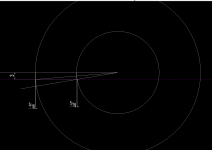
consider the function of IFS and the affect of the radius of your LCA with a 3" lift.
If the LCA pivot point was 18" from the face of the hub (small circle) you would see a reduction of track width of 5/16" each side for a total of 5/8".
The larger circle is 3' in diameter, and you can see that the difference over 3" becomes smaller.
It's a small difference, but add caster and a change in backspacing, it could become greater than an inch easily.
I'll admit, this is fascinating but way over my head, so I won't even try to suss out where you are going with it. Love learning new things though, thanks!