Supercharger Disadvantages

Jidaran

New member
I tried to search the forums for an answer to this question, but didn't find much.

I grew driving / working on Volvo 240s and 740s and my dad told me "never buy a turbo" - the reason being that it put more stress on the engine and it's one more piece of equipment that was liable to break.

I was wondering what the consensus was on the 3.4 SC. I'm in the market for a 3rd gen, and while I don't have any good reason so seek out one with an SC, I'm wondering if there's any reason to avoid them if everything else about the truck is right. Anyway, here are my questions:

What sort of loss in MPG should you expect with a SC vs a standard 3.4? I've seen numbers all over the place, from 13 to 17.

Do you have to run Premium, or is that just a "best performance" sort of thing?

Are the SCs cause other aspects of the engine to fail more often? Do they stress the engine in any significant way?
 
Register to hide this ad
Daily driving a SC vehicle and not deliberately beating the hell out of it would last longer than someone beating the hell out of a non-SC'd engine.

In the shortest definition possible, all a charger is doing is increasing the air induction and cylinder pressure.

Gas mileage all depends on how "harsh" you use your vehicle, regardless of SC or not. I think from factory, Toyota has recommended Premium for sc'd vehicles. Due mainly to the fact that premium gas burns better under load (increased cylinder pressure). The extra pressure can cause the engine to ping and prematurely detonate without higher octane. Sometimes the knock sensors will read this and correct the ping by retarding the timing but your performance will suffer and likely put extra stress on the internals. If I recall correctly, I don't think these engines with a SC like low octane gas.
 
Last edited:
I tried to search the forums for an answer to this question, but didn't find much.

I grew driving / working on Volvo 240s and 740s and my dad told me "never buy a turbo" - the reason being that it put more stress on the engine and it's one more piece of equipment that was liable to break.

I was wondering what the consensus was on the 3.4 SC. I'm in the market for a 3rd gen, and while I don't have any good reason so seek out one with an SC, I'm wondering if there's any reason to avoid them if everything else about the truck is right. Anyway, here are my questions:

What sort of loss in MPG should you expect with a SC vs a standard 3.4? I've seen numbers all over the place, from 13 to 17.

Do you have to run Premium, or is that just a "best performance" sort of thing?

Are the SCs cause other aspects of the engine to fail more often? Do they stress the engine in any significant way?

Turbos are tried and proven power adders. In a way your dad is right but that's a very old school way of thinking. That being said the supercharger is a lot more reliable and easy to install than a turbo.
 
In a way your dad is right but that's a very old school way of thinking.
My dad is very old school. Maybe 240s / 740s are particular bad with turbos. Or maybe it's just one of the many things that my dad is weirdly moralistic about "There's no legitimate reason for it and you're just complicating things." He also dislikes electric windows.
 
Do you have to run Premium, or is that just a "best performance" sort of thing?

Are the SCs cause other aspects of the engine to fail more often? Do they stress the engine in any significant way?
You have to run premium.

The supercharger puts (basically) no extra load on the engine in most circumstances - it has a bypass valve that is open for low throttle inputs (cruising, idle, etc.).

The only downside I see is cost - purchase price and fuel costs are both higher.

-Charlie
 
You definitely need to run premium. Fear not about the longevity with a supercharger. My '00 TR4 had 210k miles on it when I bought it 5 years ago. The 2nd Gen supercharger was installed at the dealer when it had 10,000 miles on it. I still have the original paperwork from when it was installed. It was still running like a top when I bought it. The previous owner had the timing belt and water pump done right before I bought it. Apparently the mechanic either didn't use a brand new harmonic balancer bolt as suggested, or he didn't torque it down to the 218 ft. lbs that is recommended. The bolt backed out, fell out...and caused the harmonic balancer to slip forward on the crank and grind the woodruff key out of existence. It broke my heart to see that. I wanted to know what I could have gotten out of that engine. There's no way I would have torn that engine all the way apart to just replace the crank, without fully rebuilding it. To save money, I just found a low mileage engine, swapped the supercharger over, and reinstalled it. Currently sitting at just over 280,000 miles now and running like a scalded ape! Still on the original transmission as well.
 
Are you running the extra injector as well? I thought I read you could add a 7th injector to the mix..

You can for sure. While it would be nice, I just can't justify the cost. It already runs amazing enough for me as it is. This is coming from a guy who drove an '02 Limited 4X4 that was naturally aspirated for 8 years. I sold it after buying my current one, sight unseen. The power difference is day and night. I also am not running mine at high altitude, where extra fuel and tuning would be necessary.
 
Fuel becomes a pretty critical part of performance and engine safety especially on high compression and forced induction setups. I would run the highest octane pump gas you have available and tune for that if you want the best performance and protection against knocking.

I know a lot of people who have a MAP switch so they can run E85 in addition to high octane pump gas. E85 for special occasions, race / track, or just because you feel like being a boss filling 108 octane.
 
I would say the biggest negatives are if you run into pinging issues and the higher cost of fuel. As far as gas mileage, mine is all over the place. The city mileage seems to suck (and winter blends add more suck on top of that), but highway mileage actually improved. You can tell why just by driving it. It doesn't struggle at all to maintain 60-70 mph.
 
There would be a very high probability that previous owners drove it like they stole it. Usually not the history that you're looking for in a used vehicle.
 
The biggest downside of an SC for me is diminishing returns at altitude, especially when compared with a turbo. That and the unexiciting powerband.
 
My 2001 4Runner has been s/c since the first 5k miles according to the records on it. The only issue was the 2nd owner was a dipsh!t and tried street racing it so the transmission started wearing badly. I bought the rig at 200k miles with the transmission already having work done to it once. I ran it another 100k miles and ended up replacing the transmission at 300k miles. The only other non-service schedule work done to it was I replaced the steering rack and pinion at 275k miles.

I daily drive the 4Runner with no issues and enjoy the passing power when needed. The only * to my statement is I generally live and drive between 750' and 1,200' MSL. So guys that live above 5,000' MSL do see tune and power differences; but at this low elevation it is great.

I have driven other 3rd gens without a s/c and I would not DD one like that after having the s/c for so long. My biggest issue was keeping my foot out of it to avoid tickets after I first got it.
 
I don't have an SC but I'd gladly take one if anyone is giving one away. IMO there are 3700 reasons to skip out on the SC, more like 4,500 reasons if you live ~sea level and need to buy and tune for a proper 7th injector setup.

I found this formula online:

Code:
HP Loss = (elevation x 0.03 x horsepower @ sea level)/1000

For a v6 3rd gen at 4,500 ft, HP loss = (4500 x 0.03 * 190) / 1000
--> loss of 25.6 HP, leaving you with ~ 164.4 HP (at flywheel not wheels)

For a v6 3rd gen at 6,500 ft, HP loss = (6500 x 0.03 * 190) / 1000
--> loss of 37 HP at flywheel, leaving you with 153 HP


What I am getting at is there is a reason that for plenty of guys at sea level doing a CAI, exhaust and maybe headers plus not carrying around excessive weight can equal a truck that is more than zippy enough. But a whole lot of the guys living at elevation value a SC more than having $3-4K in the bank. If I moved to CO I would definitely consider it. When I drive up to 6K and above my truck is a total dog.

:car:
 
There would be a very high probability that previous owners drove it like they stole it. Usually not the history that you're looking for in a used vehicle.

Normally I'd agree with you on buying a used boosted-engine car, but I think a supercharged 4Runner is a bit safer buy. It's not a ton more power and being it's an SUV, it's not like you can race it around too hard. Now, totally still possible that a previous owner still ran it hard, just saying a bit less likely that say buying a used M3 or something.
 
My dad is very old school. Maybe 240s / 740s are particular bad with turbos. Or maybe it's just one of the many things that my dad is weirdly moralistic about "There's no legitimate reason for it and you're just complicating things." He also dislikes electric windows.

I have a 740 turbo and a 740 NA. The turbo engine is 100% reliable. It's a 28 year old car that is still a daily driver year round. that said, it is also a hell of a lot more complicated and more difficult to work on (but still way less cramped than a modern car)

I was thinking of swapping the turbo engine into the NA car as that's the one I want to keep, but figured why complicate matters? Sure, the turbo is more powerful, but- (same as with the 4runner) by modern standards both are under powered. In that case I'll agree with your dad and KISS.
 
I grew driving / working on Volvo 240s and 740s and my dad told me "never buy a turbo" - the reason being that it put more stress on the engine and it's one more piece of equipment that was liable to break.
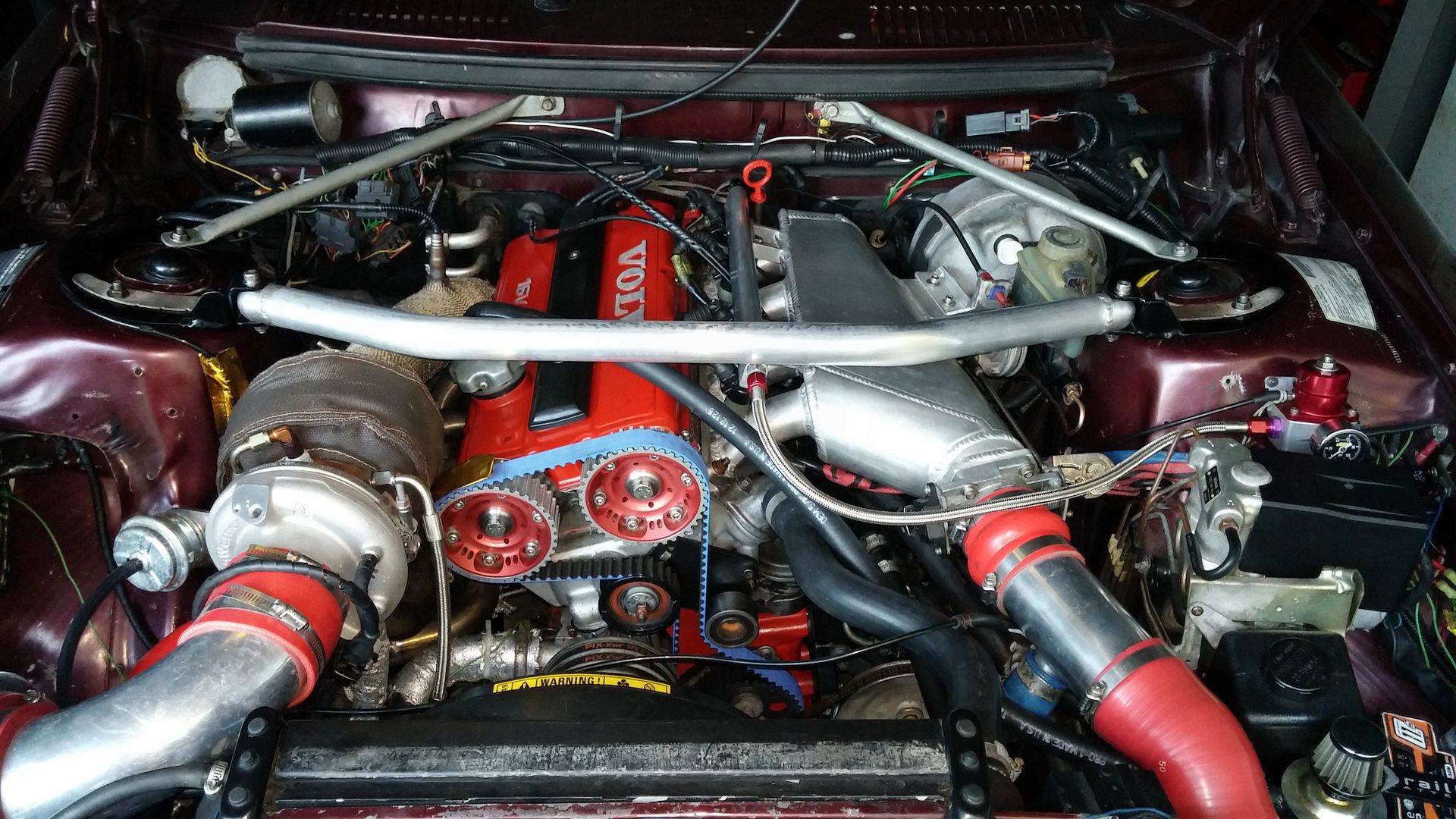
Here's an older pic of my 1993 Volvo 240 wagon turbo:
20150925_074012_zpse1byyuqd.jpg


Your dad is maybe partly correct. If you leave a factory Volvo turbo motor alone, stock boost levels, it will last forever, pretty much as long as a non turbo Volvo will. Keep changing the oil, keep up with the little stuff that a Volvo needs (it's very DURABLE, but not quite as RELIABLE as a Toyota), it will keep going.

BUT: If you start tweaking it. The first extra 50 HP is practically free. A $20 manual boost controller. Then a cheap set of 36# junkyard injectors. And you're up to 200 hp in a snap. Then you get used to that, and you start doing more. A bigger turbo, a bigger exhaust, a bigger intercooler, bigger injectors, upgraded ignition, a stronger transmission..... Yeah, it's very easy to develop a terminal (for the motor... hopefully) case of 'two-foot-itis'. You just get used to 200 hp, and you want more. Then you get used to 250 hp, and you want more. Then you get used to 300 HP.

And each extra HP costs more than the last. And, maybe if you're a MASTER engine builder (you're quickly out of the realm of mere 'parts swapping') you won't hurt the reliability too much? But a very highly stressed motor simply has less leeway for problems. A slight bit aggressive on the timing map? You'll break something. Tune it for 93 pump, but get an iffy tank somewhere? You might not hear the detonation that breaks the rings.

I got the above engine up to about 350 rwhp, but at that point, it seemed to only go about 5 - 10K between coming apart for something or another. Large things sometimes (broken rings, one time a near-miraculous broken wrist pin that did NOT scatter the bottom end), sometimes small (head gaskets - Cometic MLS and flat head and block and properly torqued ARP head studs? I would still eventually start blowing compression into the water jacket.

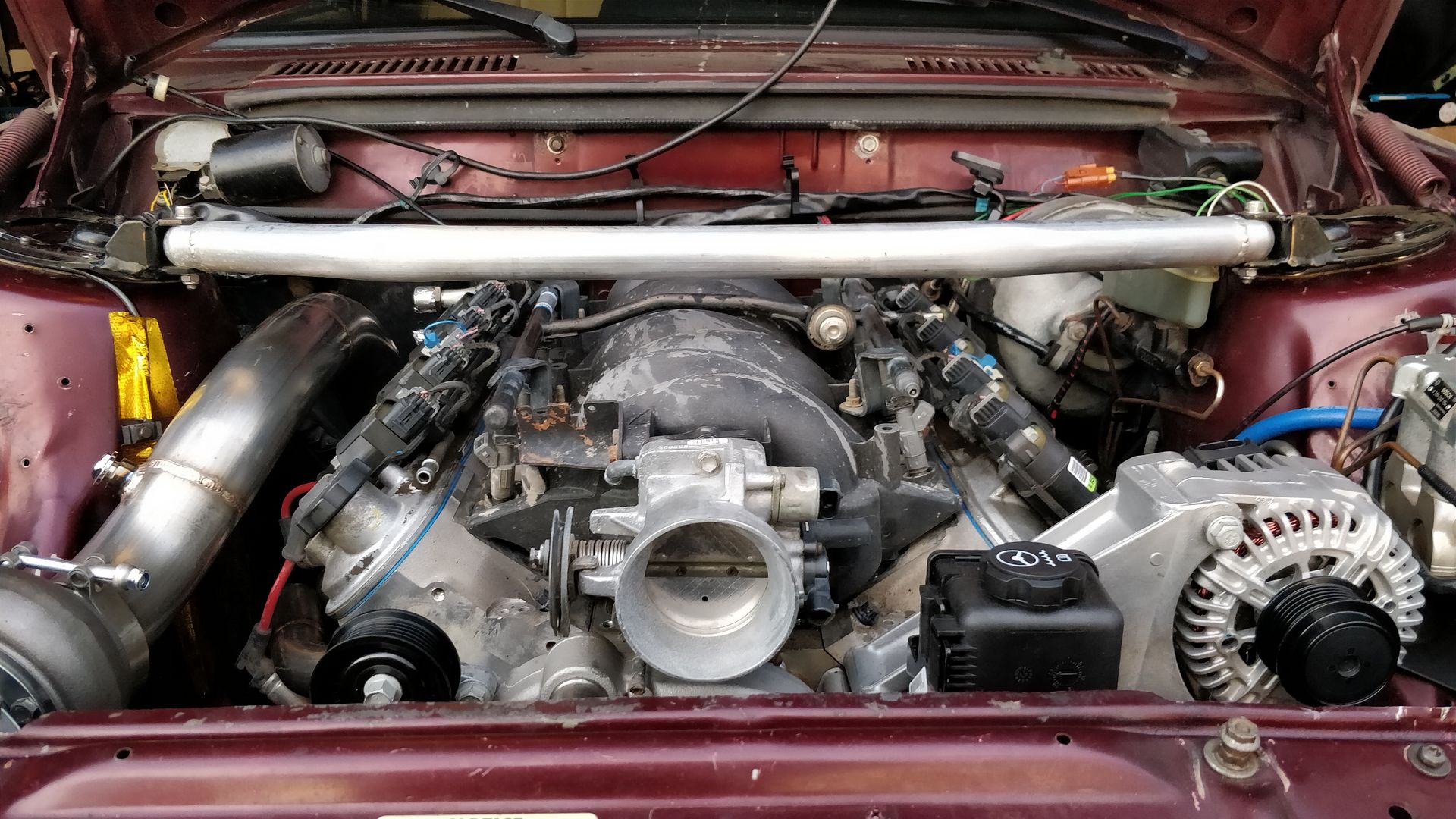
Yeah, after a while I got tired of the yearly rebuilds, so I've spent a while (still midway on it) doing this:
IMG_20180417_192510_zpsmutrrpe7.jpg

Should run by spring. 550 - 600 whp. 6 speed Nissan manual trans, Ford 8.8 rear axle.
 
These roots-type superchargers are pretty easy on the engine. Like someone else already said, it has a bypass valve that keeps from building any boost pressure for what, roughly 95% of driving. Only say, 5%, the supercharger is actually putting out any boost under moderate to heavy acceleration.

If you plan on putting oversized tires on it or additional weight, the supercharger becomes even more attractive to help with acceleration. My stock weight, stock height 4Runner has enough power to move itself around on its own (after intake & headers like Brian mentioned) but the fun factor really improves when you get on it!

My engine made it 221k miles supercharged. The engine failure I had was not because of the supercharger but because of aftermarket camshafts.
 
Having more expensive fill-ups due to the higher/highest octane needed is the main deterrence for me.

I have a SCd MINI that I've modified quite bit, including a lot of weight reduction. I can get close to 40 miles to the gallon if I drive to the ScanGauge II (zero boost, coasting at times, etc), or get around 12 mpg if flogging it on canyon roads...

Regardless, the need for premium gas makes it expensive to fill. With a capacity of 13.2 gallons, it's almost identical to the 3rd gen's gas tank. The price difference to fill both tanks is noteworthy.
 
I've learned to live by the Smiles per gallon rule. If you're worrying about the cost of fuel, then you probably don't need it! I have a '10 Jeep SRT8 that's pushing 700hp. It gets around 6 mpg in the city, and gets between 9-12 on the highway...depending on my current mood!
 

Members online

Forum statistics

Threads
278,309
Messages
3,554,070
Members
248,016
Latest member
Advally Service

Trending content

Back
Top