Supercharger or bust...

Thanks guys. Well... suffice to say but this was more of a "bust"... started the truck w/ the maps I posted above and it was really hard to start / keep running. I ended up moving the fuel map values to near zero and it started and ran rough. The AFR was in the 18s which freaked me out so I started moving the fuel up to around 26.6 making the AFR ~ 14.7 - 15.5. What's super curious are a couple of other things:

1) I'm getting a P0100 error code

2) When I step on the gas the MAP gets lower and lower (no boost?) -- well into the vacuum side of things (PSIA of 4... 3... etc.). The supercharger is definitely spinning nicely. Shouldn't it be boosting even in park when I am in the 2,000 - 3,000 range?

NOTE: I do not have an IAC check valve but have a 2002 so I don't think I need it?

I'm tempted to tear it down and go to stock injectors and get it running that way. What do you think?
 
Thanks guys. Well... suffice to say but this was more of a "bust"... started the truck w/ the maps I posted above and it was really hard to start / keep running. I ended up moving the fuel map values to near zero and it started and ran rough. The AFR was in the 18s which freaked me out so I started moving the fuel up to around 26.6 making the AFR ~ 14.7 - 15.5. What's super curious are a couple of other things:

1) I'm getting a P0100 error code

2) When I step on the gas the MAP gets lower and lower (no boost?) -- well into the vacuum side of things (PSIA of 4... 3... etc.). The supercharger is definitely spinning nicely. Shouldn't it be boosting even in park when I am in the 2,000 - 3,000 range?

NOTE: I do not have an IAC check valve but have a 2002 so I don't think I need it?

I'm tempted to tear it down and go to stock injectors and get it running that way. What do you think?

I think you are getting ahead of yourself. Don't pull any fuel unless you need to. Zero out all fuel map cells, only add or remove fuel if you need to. Like I mentioned earlier, it takes a few cycles for the fuel trims to adjust. You aren't going to hurt anything idling in your garage at 18 AFR's, I promise.

1. Pull the EFI fuse again with the engine off and put it back it. The code is most likely because the computer is super confused.

2. The supercharger has a bypass valve so it only builds boost under moderate-heavy throttle so you won't get it in boost in Park or Neutral.

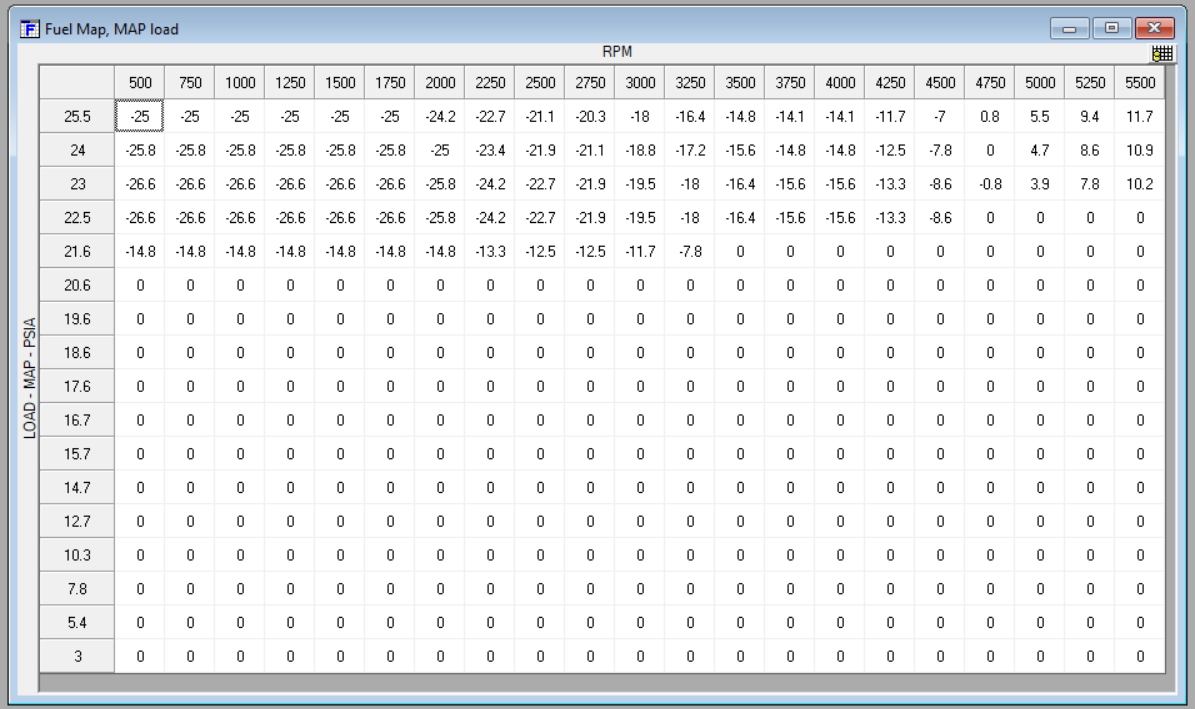
For reference, here is my fuel table. The only reason why I pull fuel around 20ish PSIA is that's when my methanol injector kicks in. But notice how there's 0's all the way until then. Let the ECU do it's job and adjust the fuel trims for you.

314859d1539313272-3-4l-trd-supercharger-thread-untitled.png
 
Last edited:
I think you are getting ahead of yourself. Don't pull any fuel unless you need to. Zero out all fuel map cells, only add or remove fuel if you need to. Like I mentioned earlier, it takes a few cycles for the fuel trims to adjust. You aren't going to hurt anything idling in your garage at 18 AFR's, I promise.

1. Pull the EFI fuse again with the engine off and put it back it. The code is most likely because the computer is super confused.

2. The supercharger has a bypass valve so it only builds boost under moderate-heavy throttle so you won't get it in boost in Park or Neutral.

For reference, here is my fuel table. The only reason why I pull fuel around 20ish PSIA is that's when my methanol injector kicks in. But notice how there's 0's all the way until then. Let the ECU do it's job and adjust the fuel trims for you.

314859d1539313272-3-4l-trd-supercharger-thread-untitled.png

Sooo… Jerod... you made my night: I went back to the base map (all zeroes) and just tried it out and what do you know -- it starts and runs fine! I end up going for a ~10 mi drive (including some highway on-ramps, a long hill) and sure enough, the ECU was working its hardest to keep it in the 14.7 AFR ballpark. Clearly I was trying too hard w/ the FIC-6 maps -- this is a good lesson for others who are doing something similar -- just try it out w/o messing w/ the maps to get it going. The EFI reset of course is important here.

What I noticed however was while it was making supercharger whine, it wasn't making more power that I could tell (nor was it showing boost in the LOAD gauge). Well, I parked it and took a close look at the bypass valve and found it was stuck open. I closed it and naturally had to go for the same ride: completely different animal! Louder whine but more importantly... *hello boost* and power. Not a moment to forget. Surely there is work to be done but I end my night on a very happy note. THANK YOU.

One thing I did notice: when I started it cold, all zeroes, 380s... it actually started and ran like normal (was super confused honestly, but I went with it). When I started it hot with the same setup it did run a little rough at idle. I'm guessing this is like the chainsaw that needs extra priming in cold weather -- the richness of the 380s are more tolerable to the ECU on a cold start but warm... you're going to feel it. Like I said, more work to be done but this is a good, good day.
 
This is a rough but close map... couldn't find my newest file, and this was pre-finding a crack in the vacuum line that T'd to my computer. Most fun bit about the tuning has been the open and closed loop tuning for different parts of the map. Been pretty good so far though.

I've been playing with leaving full timing past 3000k rpm, which is when the knock senors on the factory ECU kick in.

Thank you! Another good map to study and learn from. Having examples goes a long ways!
 
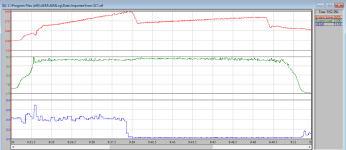
We're at 14.3 atmospheric here in CT and if this graph is right, 23.3 means I apparently hit 9 lbs of boost? (not bad on the 2.37 pulley) The AFR flatlined at 10ish on the later half of the pull -- thinking the ECU is still super confused.
 

Attachments

  • SC_FirstLog_1.PNG
    SC_FirstLog_1.PNG
    117.5 KB · Views: 140
We're at 14.3 atmospheric here in CT and if this graph is right, 23.3 means I apparently hit 9 lbs of boost? (not bad on the 2.37 pulley) The AFR flatlined at 10ish on the later half of the pull -- thinking the ECU is still super confused.

Glad you got it figured out! The ECU also has to learn the fuel ratios for warm starts as well as cold, it'll figure it out over time. That's also an insanely high amount of boost for the stock pulley!

Now you are getting into the real part of the tuning process. See where it goes from the 14's to 10? That's the ECU going from closed loop (air/fuel ratios controlled by the Oxygen sensor) to open loop (air/fuel ratios controlled by preset fuel amounts). To tune the 14's, you'll skew the O2 sensor by removing voltage, tricking it into thinking it's lean so it add fuel. For open loop, you'll need to remove fuel on your fuel table at those high boost/high RPM cells to lower that to 11.8. That's the optimal AFR at max boost. For the O2 skewing, you'll want to see numbers in the 13's to mid 12's as you near max boost.

Takes some time but you'll get it. In my build thread I posed my O2 skewing map, it's a very good starting point that you can refine from there. Note that my rows and column numbers might be difference since I edited them to show a max RPM of 5500 and max PSIA of 26. http://www.toyota-4runner.org/3rd-g...-supercharged-t[u]rd-build-7.html#post2975905
 
Sooo… Jerod... you made my night: I went back to the base map (all zeroes) and just tried it out and what do you know -- it starts and runs fine! I end up going for a ~10 mi drive (including some highway on-ramps, a long hill) and sure enough, the ECU was working its hardest to keep it in the 14.7 AFR ballpark. Clearly I was trying too hard w/ the FIC-6 maps -- this is a good lesson for others who are doing something similar -- just try it out w/o messing w/ the maps to get it going. The EFI reset of course is important here.

What I noticed however was while it was making supercharger whine, it wasn't making more power that I could tell (nor was it showing boost in the LOAD gauge). Well, I parked it and took a close look at the bypass valve and found it was stuck open. I closed it and naturally had to go for the same ride: completely different animal! Louder whine but more importantly... *hello boost* and power. Not a moment to forget. Surely there is work to be done but I end my night on a very happy note. THANK YOU.

One thing I did notice: when I started it cold, all zeroes, 380s... it actually started and ran like normal (was super confused honestly, but I went with it). When I started it hot with the same setup it did run a little rough at idle. I'm guessing this is like the chainsaw that needs extra priming in cold weather -- the richness of the 380s are more tolerable to the ECU on a cold start but warm... you're going to feel it. Like I said, more work to be done but this is a good, good day.


Part of this too is that the ECU runs open loop and rich until the coolant temp warms up - that was part of why I had to skew the low RPM / no boost numbers just for start-up purposes.
 
ALSO! Made a huuuuuge diffference for me - check the version of the FW on the FIC6 - I can't remember the numbers off the top of my head, but IIRC the 'honda' version of the FW worked best for me. I had a lot of hesitations and even random engine kills till I updated.
 
Glad you got it figured out! The ECU also has to learn the fuel ratios for warm starts as well as cold, it'll figure it out over time. That's also an insanely high amount of boost for the stock pulley!

Now you are getting into the real part of the tuning process. See where it goes from the 14's to 10? That's the ECU going from closed loop (air/fuel ratios controlled by the Oxygen sensor) to open loop (air/fuel ratios controlled by preset fuel amounts). To tune the 14's, you'll skew the O2 sensor by removing voltage, tricking it into thinking it's lean so it add fuel. For open loop, you'll need to remove fuel on your fuel table at those high boost/high RPM cells to lower that to 11.8. That's the optimal AFR at max boost. For the O2 skewing, you'll want to see numbers in the 13's to mid 12's as you near max boost.

Takes some time but you'll get it. In my build thread I posed my O2 skewing map, it's a very good starting point that you can refine from there. Note that my rows and column numbers might be difference since I edited them to show a max RPM of 5500 and max PSIA of 26. http://www.toyota-4runner.org/3rd-g...-supercharged-t[u]rd-build-7.html#post2975905

Thanks Jerod! My SC is a TRD "new old stock" unit so I'm thinking it hasn't seen the wear that others have had -- perhaps that's driving the 8-9 lbs boost on the 2.37 vs. the 7-8 lbs. I do have the URD 2.2" pulley on the way - I don't think it will sit around for 2 years this time ;-)

As for the tuning, I'll definitely read your thread and continue to digest this process. There is definitely a learning curve to the AEM FIC-6 but it feels like a rewarding journey. Going to let the truck get settled in w/ the ST and LT trims before I start messing w/ the maps again. Will keep everyone posted on what I learned, as you have.

Thanks again!
-Steve
 
Part of this too is that the ECU runs open loop and rich until the coolant temp warms up - that was part of why I had to skew the low RPM / no boost numbers just for start-up purposes.

Was thinking this exact thing: will see if the truck's ECU can get stable w/ the 380s at cold and warm idle on its own but I suspect I'll need to do some low RPM fuel reduction before all is done.

As for the FW version, I used the latest one and haven't seen any problems yet except for the one described earlier in this thread -- a random slow start (cranking noticeably longer than usual). Any idea which one is the "Honda" one? (what #?) I can research this -- and may switch to that if I have more issues.

Thank you.
 

Members online

Forum statistics

Threads
278,309
Messages
3,554,071
Members
248,016
Latest member
Advally Service

Trending content

Back
Top