Lindenwood
New member
Howdy, friends.
I have been doing some knapkin math with roll-related numbers based on both the debate to run anti-sway bars, and a discussion on another forum about how to calculate a truck's resistance to rolling over in near-static conditions.
Bottom Line Up Front: The anti-sway bars on these trucks add something like 4% to the maximum laterial stability of the vehicles.
I used the below webpage to calculates the spring rate of an anti-sway bar (I also have other documentation showing this formula's ability to closely approximate effective anti-sway bar spring rate given some basic assumptions like uniform material).
Sway Bar Rate Calculator | GTSparkplugs
Our front sway bars have a spring rate of roughly 490lb/in. Given they are mounted about 1" outboard of the lower shock mount, that gives them an effective spring rate of about ((9"/8") * 490), or 540 lb/in relative to the coils themselves.
The rear sway bar, being thinner and longer in every dimension, only has an effective spring rate of about 61 lb/in. However, because the ends are mounted well outboard of the coils, that gives them an effective spring rate of about 90lb/in compared to the coils themselves.
For the front, my coils are mounted about
For the rear, the coils are mounted about half way between the tire and the vehicle's centerline. Thus, from a rolling perspective, this roughly halves the effective spring rate of the outboard coil. For me, this means my coils provide 95lb/in of force against a rolling moment, and the anti-sway bars provide about 90ln/in.
So, lets look at the extreme examples, starting with the assumption of a 5000lb vehicle (mine is about 4900 with me in it). Of note, based on the continued observation that driver's side springs need to be about .5" longer to offset driver and fuel weight, I calculate that the weight of a driver and full tank of fuel move the CG left of center by about 1.5".
Then, lets say you manuevered hard enough, or were at a sufficient angle, to put all the vehicle's weight on the left side of the vehicle. Without anti-sway bars, on my 5000lb rig, (subtracting an estimated 700lb for the various unspring masses like wheels / tires, brakes, control arms, and rear axle), this situation would cause the left side of the vehicle to settle about 6.75" below static height, and the right side to inherently lift by the same amount. (To be clear, I don't think I have have that much up-travel, of course, so take this as an extreme example). However, with both anti-sway bars, this same situation causes the left side of the vehicle to squat about 3.5" below static, with the same amount of rise on the left side.
The roll center of a vehicle lies somewhere between the two ends of the panhard bar. On my rig, that is about 20" off the ground. Per the NHTSA, the center of gravity on a bone stock 4runner is about 28" above the ground. Given my lift (about 2" over stock) and added weight (armor, drawers, winch, and accessories), I conservatively estimate my CG at about 33" above the ground with me in the vehicle.
Thus, in this rolling situation, my CG moves to the left by about 2.9", versus about 1.5" with both anti-sway bars.
My truck measures about 35" from the vehicle's center to the outer edge of the tire contact patch. Conservatively, we can go to the center of the tire, which is about 30". The NHTSA uses the distance to the center of the tire when making its Static Stability Factor calculations, so we'll stick with this. However, I think a properly-inflated tire would not deform quite this much that it would provide no support outside of the static tire centerline, so again, these numbers are probably conservative.
Now remember that the weight of a full tank of fuel + driver moves the CG left by about 1.5".
So, in this situation, with the CG at 33" height, a full roll without anti-sway bars moves the CG a total of 4.4' left of center, or 25.6" from the center of the left [outside] tire. Doing some quick trig, that means my truck could balance precariously on a 40.5-degree side hill. With the bars, the CG ends up 3" left of center, allowing a 42-degree side hill before rolling over.
For anything dynamic--anything from a hard, evasive manuever to a sideways slide into a curb--it would simply be more accurate to directly compare those static roll angles and determine that taking the anti-sway bars off results in a ~3.7% increase in rollover risk.
FWIW, I broke 3 of 4 rear sway bar mount bolts the first week I had the truck (and thus never put it back on), and have been running with the front bar disconnected for about 1500 miles now. Having the front disconnected made an immediate and significant difference in offroad ride quality, and seems to be having a pretty noticable impact on traction given my open F/R diffs.
Background: I used to teach physics before I joined the USAF to fly.
I have been doing some knapkin math with roll-related numbers based on both the debate to run anti-sway bars, and a discussion on another forum about how to calculate a truck's resistance to rolling over in near-static conditions.
Bottom Line Up Front: The anti-sway bars on these trucks add something like 4% to the maximum laterial stability of the vehicles.
I used the below webpage to calculates the spring rate of an anti-sway bar (I also have other documentation showing this formula's ability to closely approximate effective anti-sway bar spring rate given some basic assumptions like uniform material).
Sway Bar Rate Calculator | GTSparkplugs
Our front sway bars have a spring rate of roughly 490lb/in. Given they are mounted about 1" outboard of the lower shock mount, that gives them an effective spring rate of about ((9"/8") * 490), or 540 lb/in relative to the coils themselves.
The rear sway bar, being thinner and longer in every dimension, only has an effective spring rate of about 61 lb/in. However, because the ends are mounted well outboard of the coils, that gives them an effective spring rate of about 90lb/in compared to the coils themselves.
For the front, my coils are mounted about
For the rear, the coils are mounted about half way between the tire and the vehicle's centerline. Thus, from a rolling perspective, this roughly halves the effective spring rate of the outboard coil. For me, this means my coils provide 95lb/in of force against a rolling moment, and the anti-sway bars provide about 90ln/in.
So, lets look at the extreme examples, starting with the assumption of a 5000lb vehicle (mine is about 4900 with me in it). Of note, based on the continued observation that driver's side springs need to be about .5" longer to offset driver and fuel weight, I calculate that the weight of a driver and full tank of fuel move the CG left of center by about 1.5".
Then, lets say you manuevered hard enough, or were at a sufficient angle, to put all the vehicle's weight on the left side of the vehicle. Without anti-sway bars, on my 5000lb rig, (subtracting an estimated 700lb for the various unspring masses like wheels / tires, brakes, control arms, and rear axle), this situation would cause the left side of the vehicle to settle about 6.75" below static height, and the right side to inherently lift by the same amount. (To be clear, I don't think I have have that much up-travel, of course, so take this as an extreme example). However, with both anti-sway bars, this same situation causes the left side of the vehicle to squat about 3.5" below static, with the same amount of rise on the left side.
The roll center of a vehicle lies somewhere between the two ends of the panhard bar. On my rig, that is about 20" off the ground. Per the NHTSA, the center of gravity on a bone stock 4runner is about 28" above the ground. Given my lift (about 2" over stock) and added weight (armor, drawers, winch, and accessories), I conservatively estimate my CG at about 33" above the ground with me in the vehicle.
Thus, in this rolling situation, my CG moves to the left by about 2.9", versus about 1.5" with both anti-sway bars.
My truck measures about 35" from the vehicle's center to the outer edge of the tire contact patch. Conservatively, we can go to the center of the tire, which is about 30". The NHTSA uses the distance to the center of the tire when making its Static Stability Factor calculations, so we'll stick with this. However, I think a properly-inflated tire would not deform quite this much that it would provide no support outside of the static tire centerline, so again, these numbers are probably conservative.
Now remember that the weight of a full tank of fuel + driver moves the CG left by about 1.5".
So, in this situation, with the CG at 33" height, a full roll without anti-sway bars moves the CG a total of 4.4' left of center, or 25.6" from the center of the left [outside] tire. Doing some quick trig, that means my truck could balance precariously on a 40.5-degree side hill. With the bars, the CG ends up 3" left of center, allowing a 42-degree side hill before rolling over.
For anything dynamic--anything from a hard, evasive manuever to a sideways slide into a curb--it would simply be more accurate to directly compare those static roll angles and determine that taking the anti-sway bars off results in a ~3.7% increase in rollover risk.
FWIW, I broke 3 of 4 rear sway bar mount bolts the first week I had the truck (and thus never put it back on), and have been running with the front bar disconnected for about 1500 miles now. Having the front disconnected made an immediate and significant difference in offroad ride quality, and seems to be having a pretty noticable impact on traction given my open F/R diffs.
Background: I used to teach physics before I joined the USAF to fly.

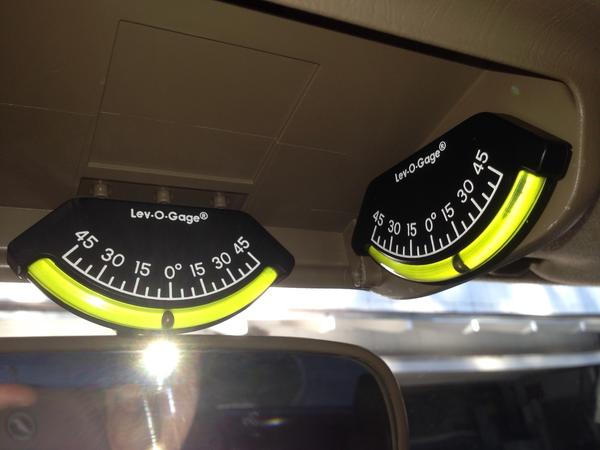
 . Nobody said we should just drive around across the side of mountains. But, most offroaders don't wheel on hotwheels tracks and some trails involve non-lateral obstacles. For example, my inclinometer hit 25.2 degrees of [body] roll on some trails just last weekend, and I know I've gone over that. If I went a few inches further right, the roll would have been worse, and a few inches further left and I'd have been grinding against tree trunks.