The 3.4L TRD Supercharger Thread

Seems a little high when a new one (Magnuson) can be bought for about 3 grand today and $2,700 during BF.

But this is a TRD (same as above but different labeling) and those are no longer available.

Lower PSI should help keep SC related issues down but there is no chance it'll be as reliable and dependable as an NA engine.

Good luck,

Eddie


found a used TRD supercharger in my area for 2200. is it worth it.. guy says it has 50 k on it and has everything needed except the belt.

Also I just rolled over 280k am I crazy to do this? from my reading people seem to think the 3.4 is tough enough.
I'd really only want to run it at "stock" psi.. so 6-7 ish
 
Last edited:
What’s missing? Asking for my own knowledge since I have a second hand one now that I’m trying to source all the extra pieces for


Sent from my iPhone using Tapatalk

Check page 1 of this thread, it's all listed out with photos. It's missing the dynamic tensioner, for starters!
 
He said there is also the tensioner and bolts not in the pic

Have him send you pics of everything he has and like Gamefreakgc said above, go to page 1 and go through the entire list.

There's also having the correct bracket depending on your year as well as the dip stick relocation bracket.
 
I know this is the supercharger thread but the 7th thread is dead. Figured I'd post here.

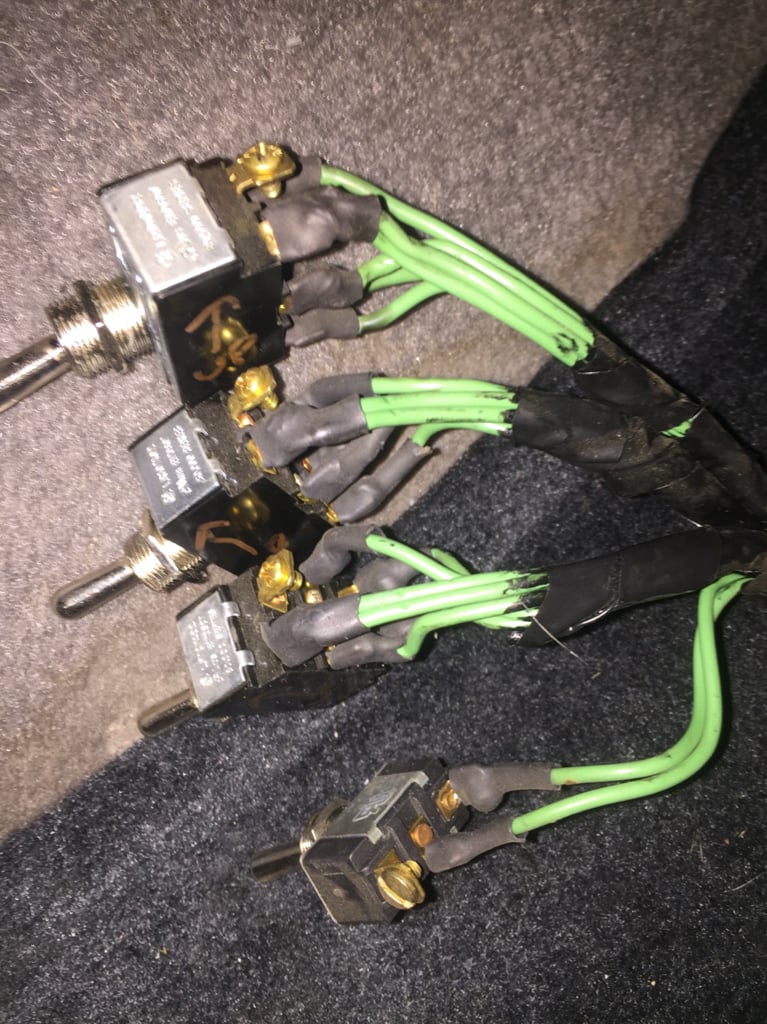
Originally I had hard wired in bypass toggle switches for each sensor used (crank, cam, O2) for the event the URD went haywire or smog became an issue I could switch it all and have it run from sensor to ECU as normal. Haven't used the switches even once in 2 years and it makes dash component removal a PITA.

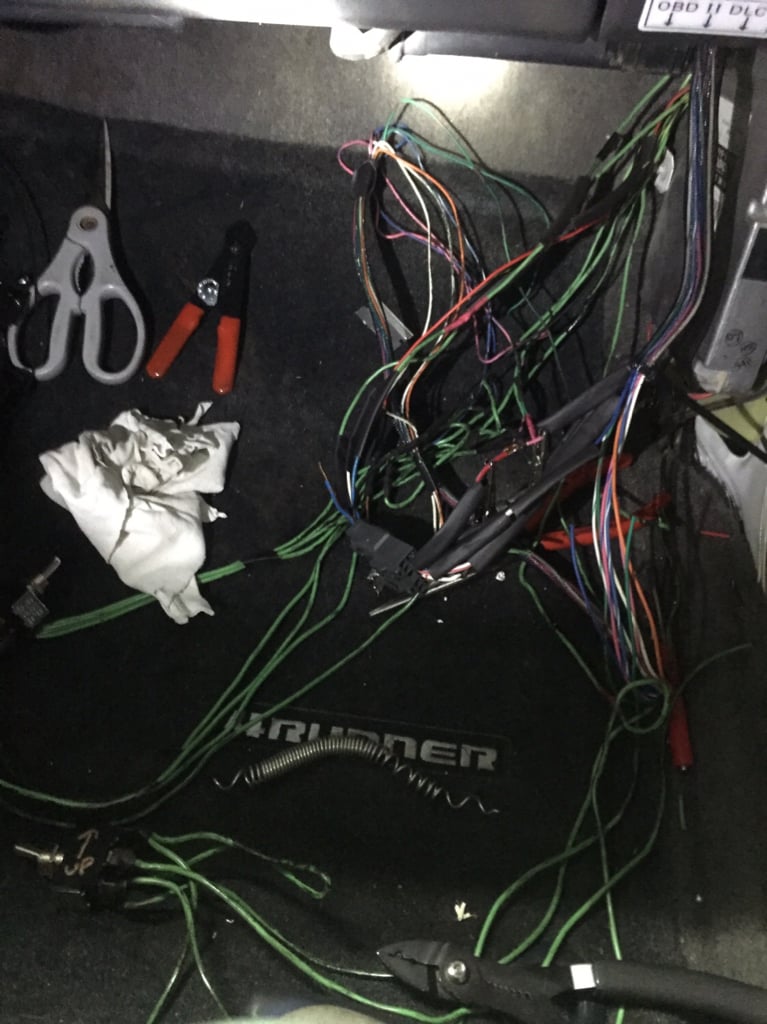
Since I'm installing a CB and removing a fair portion of the dash, figured it was time to reevaluate. I'm removing the switches and instead wiring in matching junkyard aquired male/female connectors for inputs/outputs to the URD. This way, URD goes haywire I can pop a panel and swap plugs and also bypass URD or diag on the trail, whatever. Plus later removal of dash etc is easier since things aren't hard wired.

Note to all: if you're going to do something ridiculous and overly complex like this, don't be a moron and use a single wire color, all unlabeled.

Old bypass switches, using only green wires
0734def38fd60adbcc4e0bc00a800635.jpg


Current state
58f3007fbac2a1fe99a432c9f43eaeec.jpg


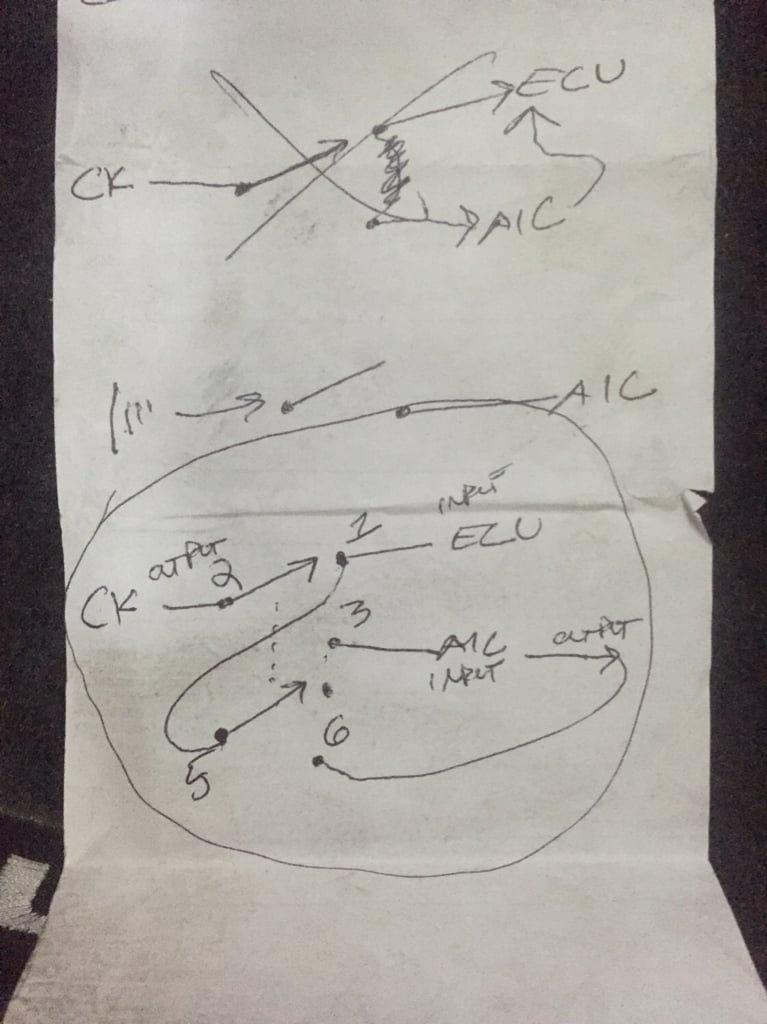
You can see the grey connector in the middle. The matching duplicate connector is blue and I'm going to wire it so it'll go sensors/inputs>male>female>URD>male>female>ECU. This way a bypass is first male to second female and it'll run as if stock.

Totally stupid and complicated but this is the best that this mad scientist can come up with for now. Seems like a great all around solution to my concerns.

Luckily I found my old doodle labeling the pins for the DPDT switches

0a1cdf295b0a385abdc949e2501cd9e5.jpg


I'll post final pics when I'm done. Soldering iron ran out of butane tonight. What a disaster I've created hahaha. Been running great however.
 
Hey guys I am hoping someone can help me out with an issue that has come up with my gen 1 SC. I have noticed that when the car is in drive and stopped with the AC on there is a bad rattling from the front cone. If I turn the AC off while still stopped and in gear the rattle goes away. It doesnt seem to change anything power wise or vibration wise.

I know this is brief I will work on getting a video posted.
 
Wanted to post some observations after owning two supercharged engines.

My old engine with 200k miles or so, had almost no ping. It would only ping a little at high boost/low RPM situations and only when the engine was real hot, on a summer's day. I never had to pull any timing on it. However, the engine had low compression and had lost compression in cylinder 6, so there's no way I was seeing the full stock 9.6 compression rating in that engine. My compression readings, dry, would not surpass the 160 range.

Fast forward to engine number 2. It has lower mileage of 80k miles now and it pings like crazy at low RPM! I need to re-do my timing map again. I'm already pulling 1-2 degrees of timing but going up steep grades on I-80 towards Reno it really starting pinging bad going 70 MPH unless I turned of OD. However, the compression numbers on this engine are off the charts: it reads 190 dry, and about 220 wet compression! Add 5-6 pounds of boost at 2000 RPM's and tada, you get ping!

Hope that helps clarify why some people experience low-end ping and others don't. For the record though, I have never had the high-rpm ping on either engine because I have a tune and methanol injection. I had roughly the same tune on either engine too, one pings and the other didn't. All came down to that compression number and how strong the engine is!
 
No boost at boost port on supercharger (vacume only)

I'm having a weird issue, hopefully someone has some insight. I put on a 2nd gen (black) supercharger about a year ago, definitely noticed some power increase, but nothing huge. I rebuilt the nosecone before installing it. At initial install i didn't have a boost gauge and didn't install one, the routing from boost port in the back went straight to the fuel pressure regulator. Now I just installed a snow methanol injection kit that includes a programmer with integrated boost. I teed into the boost port/FPR line and fired up the truck after the install. The gauge showed no boost-0. I started investigating and discovered that with the engine running at any rpm range there is a strong vacuum at the boost port, never positive pressure. I have checked all the hoses against multiple install manuals and forum posts and I'm 100% sure that I am using the boost port with barbed fitting. The bypass valve seems to be working, and opens under throttle, and closes down at idle, but the position of the bypass valve has no effect on the vacuum at the boost port. All the other hose connections on the super charger pull vacuum while running so I'm pretty sure I haven't confused it, but I'm at a total loss and Magneson dosn't have any ideas? I can blow into the boost gauge line and get it to register 2/3 psi so the gauge seems to work, but during a test drive at WOT the gauge never registered above 0psi.
 
I'm having a weird issue, hopefully someone has some insight. I put on a 2nd gen (black) supercharger about a year ago, definitely noticed some power increase, but nothing huge. I rebuilt the nosecone before installing it. At initial install i didn't have a boost gauge and didn't install one, the routing from boost port in the back went straight to the fuel pressure regulator. Now I just installed a snow methanol injection kit that includes a programmer with integrated boost. I teed into the boost port/FPR line and fired up the truck after the install. The gauge showed no boost-0. I started investigating and discovered that with the engine running at any rpm range there is a strong vacuum at the boost port, never positive pressure. I have checked all the hoses against multiple install manuals and forum posts and I'm 100% sure that I am using the boost port with barbed fitting. The bypass valve seems to be working, and opens under throttle, and closes down at idle, but the position of the bypass valve has no effect on the vacuum at the boost port. All the other hose connections on the super charger pull vacuum while running so I'm pretty sure I haven't confused it, but I'm at a total loss and Magneson dosn't have any ideas? I can blow into the boost gauge line and get it to register 2/3 psi so the gauge seems to work, but during a test drive at WOT the gauge never registered above 0psi.

You've got a massive boost leak. Double check your hose routing against the installation manual, something's wrong. The most common boost leak locations are:

1. Missing one-way valve on IAC valve (I did this once! Made hardly any power under boost)
2. Intake manifold gaskets leaking, bolts not tight enough (12 lbs tq not enough)
3. 4WD VSV, EVAP hose or brake hose routing wrong or has leaks

Double check these and report back if you can. The IAC valve hose can be found on the bottom of the throttle body, not to be confused with the two coolant lines. It should be a rubber hose with no clamps but will be cut in the middle with a white one-way valve.
 
You've got a massive boost leak. Double check your hose routing against the installation manual, something's wrong. The most common boost leak locations are:

1. Missing one-way valve on IAC valve (I did this once! Made hardly any power under boost)
2. Intake manifold gaskets leaking, bolts not tight enough (12 lbs tq not enough)
3. 4WD VSV, EVAP hose or brake hose routing wrong or has leaks

Double check these and report back if you can. The IAC valve hose can be found on the bottom of the throttle body, not to be confused with the two coolant lines. It should be a rubber hose with no clamps but will be cut in the middle with a white one-way valve.

1-I have already checked the IAC to make sure it wasn't clogged or in wrong.
2-Intake is on tight
3-The two vacuum ports on the drivers side of the SC go to the brake booster, and the Evap system. All those hoses look correctly routed and un-leaking.

I have been searching for vac leaks but I have a hard time imagining a vacuum leak big enough to negate any boost from the SC at high rpm. Still stumped. As I mentioned in the first post I have had the SC on for over a year, so I can't imagine that the internals are seized or broken.
 
1-I have already checked the IAC to make sure it wasn't clogged or in wrong.
2-Intake is on tight
3-The two vacuum ports on the drivers side of the SC go to the brake booster, and the Evap system. All those hoses look correctly routed and un-leaking.

I have been searching for vac leaks but I have a hard time imagining a vacuum leak big enough to negate any boost from the SC at high rpm. Still stumped. As I mentioned in the first post I have had the SC on for over a year, so I can't imagine that the internals are seized or broken.

The other issue could be the bypass valve is not closing, allowing all boost to bypass the system altogether. It's hard to diagnose this over the internet... but you have a boost leak, that's guaranteed. Need to find where that pressure is going.

Actually, I thought of one other thing. People have mentioned that some of the t-fittings used to connect the boost hose were defective and actually would close. Any chance that's the case? There's no need for a clamp if you have the right size fitting.
 
Last edited:
The other issue could be the bypass valve is not closing, allowing all boost to bypass the system altogether. It's hard to diagnose this over the internet... but you have a boost leak, that's guaranteed. Need to find where that pressure is going.

Actually, I thought of one other thing. People have mentioned that some of the t-fittings used to connect the boost hose were defective and actually would close. Any chance that's the case? There's no need for a clamp if you have the right size fitting.

I have tested the bypass valve manually opening and closing fully while the engine is running and no change in the vacuum at the boost port is noticed.

Since I discovered the issue I haven't even been using a t-fitting, just running the boost hose direct and letting the FPR hose remain unattached.
 
Wanted to post some observations after owning two supercharged engines.

My old engine with 200k miles or so, had almost no ping. It would only ping a little at high boost/low RPM situations and only when the engine was real hot, on a summer's day. I never had to pull any timing on it. However, the engine had low compression and had lost compression in cylinder 6, so there's no way I was seeing the full stock 9.6 compression rating in that engine. My compression readings, dry, would not surpass the 160 range.

Fast forward to engine number 2. It has lower mileage of 80k miles now and it pings like crazy at low RPM! I need to re-do my timing map again. I'm already pulling 1-2 degrees of timing but going up steep grades on I-80 towards Reno it really starting pinging bad going 70 MPH unless I turned of OD. However, the compression numbers on this engine are off the charts: it reads 190 dry, and about 220 wet compression! Add 5-6 pounds of boost at 2000 RPM's and tada, you get ping!

Hope that helps clarify why some people experience low-end ping and others don't. For the record though, I have never had the high-rpm ping on either engine because I have a tune and methanol injection. I had roughly the same tune on either engine too, one pings and the other didn't. All came down to that compression number and how strong the engine is!


That’s a great write up! Did you use stock injectors in your setups??


Sent from my iPhone using Tapatalk
 
That’s a great write up! Did you use stock injectors in your setups??


Sent from my iPhone using Tapatalk

No, I installed the piggyback ECU and larger Lexus/Supra injectors. However, I think I could have stayed with stock injectors and methanol injection, since it works very similar to the 7th injector.
 
What is the general root cause behind the pinging on 3rd Gen 4Runners. I'm on the fence to buy one. However, if I'm going to fork out over $3,500 for the supercharger and 7th injectors it better perform well.
 
What is the general root cause behind the pinging on 3rd Gen 4Runners. I'm on the fence to buy one. However, if I'm going to fork out over $3,500 for the supercharger and 7th injectors it better perform well.


I'm sure it's mentioned somewhere in this thread already but here's my take:

The 3.4's when supercharged produce an excessively lean mixture at very particular instances, especially at high gear/low rpm. (3rd gear for MT at 2-3k rpm is my experience). This lean mixture is too hot and causes predetonation which means the mixture explodes prior to the spark being sent and this acts on the piston in an unintended manor which causes the audible ping or knock.

These engines are equipped with a set of knock sensors which tell the ECM to dial back timing however these sensors are "ignored" below 3k rpm which is the problem area. so by adding a 7th injector kit you get to:
1) enrichen the mixture to cool it down and prevent the ping
2) pull back the timing artificially so that the ping doesn't occur, however power is suffered a bit. But it saves the engine.

Overall, these trucks do just fine with a supercharger. You just have to be a little more aware when driving them to prevent the danger zone ping.
 
I'm sure it's mentioned somewhere in this thread already but here's my take:

The 3.4's when supercharged produce an excessively lean mixture at very particular instances, especially at high gear/low rpm. (3rd gear for MT at 2-3k rpm is my experience). This lean mixture is too hot and causes predetonation which means the mixture explodes prior to the spark being sent and this acts on the piston in an unintended manor which causes the audible ping or knock.

These engines are equipped with a set of knock sensors which tell the ECM to dial back timing however these sensors are "ignored" below 3k rpm which is the problem area. so by adding a 7th injector kit you get to:
1) enrichen the mixture to cool it down and prevent the ping
2) pull back the timing artificially so that the ping doesn't occur, however power is suffered a bit. But it saves the engine.

Overall, these trucks do just fine with a supercharger. You just have to be a little more aware when driving them to prevent the danger zone ping.

Thanks for the feedback. Just seems crazy to spend that type of money including the 7th injector to help mitigate pinging, only to still have to drive tentatively and cautiously. Was really hoping for a low boost/low risk solution to my power problems but I’m not interested writing posts on the T4R Supercharger thread every Friday trying to troubleshoot my issues like many of you have done. I’m sure many people have had no problems boosting but with page after page of posts I’m a little concerned.
 
Most people posting the issues are trying to squeeze every ounce of power out it. That's where the rabbit hole begins. There's plenty of folks who put on a SC and have zero issues. I'm one of them. I had it SC'd (no 7th) for like 2-3 yrs. I knew when my truck would ping and would simply not PUNCH it in that area. Once I was out of that area, I could be as aggressive as I wished without any ill effects.

These SC's have a vacuum operated bypass valve which mean the right pedal controls when it boosts; light throttle=no boost, heavy throttle=boost baby! The 7th is expensive, works great, but is totally unnecessary. It's a cute add on that I recommend just so you can be assured your engine isn't being damaged. For example: I have mine dialed in pretty darn good for a balance of power and zero to no ping EVER.

Once you start dropping pulley sizes and all that, that's when you chase the rabbit down the hole of power issues. Buy the SC, put it on, love it like everyone else does, and save the box; if you don't like it, I PROMISE you'll find a buyer on here in 14 seconds.
 
I'm going to be installing a AEM wideband Air/Fuel Ratio Gauge. Can someone please tell me the correct position to have the exhaust shop weld in the bung for the sensor? Like, where exactly would it go in this picture?
d1421b599ea918995fcefc2d403c101d.png


I'm assuming between the converter (#5 in the pic) and the catalytic converter (#6 in the pic). Is that correct?

Thanks.
 

Members online

No members online now.

Forum statistics

Threads
278,312
Messages
3,554,089
Members
248,016
Latest member
Advally Service

Trending content

Back
Top