Thermometer Reading Off - 2015 Trail

:shrug:

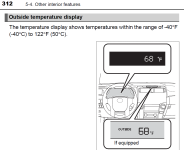
That's what the FSM says... I never bothered to actually check the ranges on it to be honest?

Edit-
Went outside and blasted my 4th Gen's unit with canned air to flash freeze it, went to -22F ... unfortunately it does not seem to want to go back up, even after running it under warm water... so I'm gonna say it doesn't like much more than -22F? lol :doh:

Oh, it goes to -25F as it did last January here. Here is a thread with a few more cold pics: http://www.toyota-4runner.org/5th-gen-t4rs/158859-im-sorry-canada-north-dakota-all-cold-places.html
 
page from owners manual :

.
 

Attachments

  • manual pic.png
    manual pic.png
    57.7 KB · Views: 222
Last edited:
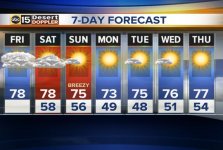
Not sure if mine is off or not; but don't really have to worry about it with the 7-day forecast like this! :)
 

Attachments

  • weather.jpg
    weather.jpg
    37.8 KB · Views: 205
Last edited:
Awesome! Breaking out the multimeter tonight..

Min: -23.3°C (-9.94°F) (Also the Temperature that shows when the circuit is Open)
Max: 65.95°C (150.71°F) (Also the Temperature that shows when the circuit is Shorted)

View attachment 136430

10°C (50°F) - 3.00 to 3.73 kΩ
15°C (59°F) - 2.45 to 2.88 kΩ
20°C (68°F) - 1.95 to 2.30 kΩ
25°C (77°F) - 1.60 to 1.80 kΩ
30°C (86°F) - 1.28 to 1.47 kΩ
35°C (95°F) - 1.00 to 1.22 kΩ
40°C (104°F) - 0.80 to 1.00 kΩ
45°C (113°F) - 0.65 to 0.85 kΩ
50°C (122°F) - 0.50 to 0.70 kΩ
55°C (131°F) - 0.44 to 0.60 kΩ
60°C (140°F) - 0.36 to 0.50 kΩ
 
Make sure the vehicle is in movement to get the correct temperature, as per the manual:
In the following situations, the correct outside temperature may not be displayed, or the display may take longer than normal to change:
- When the vehicle is stopped, or moving at low speeds (less than 14 mph [24 km/h])
- When the outside temperature has changed suddenly (at the entrance/exit of a garage, tunnel, etc.)
 
So...you're driving 70MPH in -17° weather and taking pictures of your dash?? Nice! Safety first!!

Hmm. Rural northern Nevada highway. 4 am. Flat, straight section of highway. Dry pavement. Not another vehicle within a mile (probably within 5 miles). iPhone that will take a snap with one hand. Other hand on wheel. Obviously no time spent getting the correct frame and focus.

I've done worse.
 
Hmm. Rural northern Nevada highway. 4 am. Flat, straight section of highway. Dry pavement. Not another vehicle within a mile (probably within 5 miles). iPhone that will take a snap with one hand. Other hand on wheel. Obviously no time spent getting the correct frame and focus.

I've done worse.

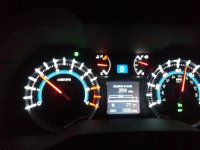
I'm just messing with you! I'm just as bad....here's mine doing 70MPH as well and taking a pic when my ODO reached 1000. Let's see if I can capture a pic every 1k.
 

Attachments

  • 20141027_211756.jpg
    20141027_211756.jpg
    130.9 KB · Views: 189
"...Seriously though, wonder if it's not factoring in wind chill..."

Hi flatspin,

FYI: Windchill cannot be measured with a thermometer. The WF is a result of the rate/speed at which heat is lost or is leaving the body. The actual temperature remains the same, but the effect of the rapid heat loss makes you 'feel' much colder... learned that working in the hvac field for the last 30 yrs! :faint: Rgds
 
"It's located on the radiator post behind the grill."

Well that would explain just why it's necessary for the vehicle to be moving at a steady/consistent speed 'forward' for it to measure the outside temp properly; when standing still, radiating heat from the radiator will affect it's ambient POV!

rigtec, cheers
 
"That's odd. Here is -17F. I saw it go down to -28F, but no photos."

Hi Bilbo,

I believe the readings that are observed when the sensor probe maxes out are arbitrary/random and cannot be trusted because the sensor is in effect, "non-existent". My Field Piece 'hand-held' electronic thermometer will read "Overload" when it's out of range... but this is a toyota :noidea: Rgds!
 
Hi flatspin,

FYI: Windchill cannot be measured with a thermometer. The WF is a result of the rate/speed at which heat is lost or is leaving the body. The actual temperature remains the same, but the effect of the rapid heat loss makes you 'feel' much colder... learned that working in the hvac field for the last 30 yrs! :faint: Rgds

this also applies to any object that produces heat (not just human bodies) until it reaches ambient temp, then wind chill is no longer a factor.

ie : example if the outside temp is -20F, you turn off an engine outside, it will lose heat faster if there is wind until it reaches -20F, then it has no more heat to lose, since its the same temp as ambient. more/less wind wont make any difference in the temp of the engine.

I learned that also in hvac in the air force in north Dakota :)
 
Does anybody know where the probe is located?

On a 2013 in front of and center of the radiator clipped into the center support. I have no idea if that still exists in the "mouth" I would imagine so.

EDIT: Damn that was answered pages ago! :doh:
 
Last edited:
this also applies to any object that produces heat (not just human bodies) until it reaches ambient temp, then wind chill is no longer a factor.

ie : example if the outside temp is -20F, you turn off an engine outside, it will lose heat faster if there is wind until it reaches -20F, then it has no more heat to lose, since its the same temp as ambient. more/less wind wont make any difference in the temp of the engine.

I learned that also in hvac in the air force in north Dakota :)

Hi NoDak,

100% correct! Ever done any pipe welding outdoors, then the wind picks up... it's hard to keep the right amount of heat focused at the target so it takes a lot longer to get it done(!), another example/form of the WCF at work, Best!
 

Members online

Forum statistics

Threads
278,309
Messages
3,554,071
Members
248,016
Latest member
Advally Service

Trending content

Back
Top