Thread w/ Q's & INFO on towing... (Different from others!)

I'm pretty sure my 2008 SR5 V8 is rated at 7000lbs, and the 2WD models were rated at 7300 last time I checked which is not the same as the V6. But regardless, I don't pull anything near that heavy!!


This thread brings up some good points and is useful data for sure. Last summer I pulled my 20' Chris Craft on a custom steel trailer (load around 4200lbs) from Burlington VT to Ithaca NY and back and never had a problem (or so I think). My trailer is a dual axle, with electric over hydraulic disc brakes on both axles, controlled by a tekonsha p3 which definitely helps control the weight.


You're absolutely correct. It was just 2003 they screwed us over with the V8 tow capacity.


Sent from my iPhone using Tapatalk
 
How Trans temp affects fluid change & transmission life...

Great points! Don't rely on dummy lights. Install temp gauges or go with the wireless OBD II and apps that allow realtime monitoring.

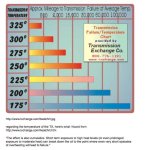
Here's some interesting data on transmission temp.

TransTempChart.jpg

I'd use this as a rough guideline rather than a hard and fast rule.
For example the type of transmission tested and the type of fluid used
would yield different results.

Nonetheless, the point is that high temps
shorten transmission life and can lead to earlier transmission failure.

Also, they claim that the effects of high temps are cumulative, meaning if your transmission is run for long periods of time at fairly high temps, then even a relatively short burst of very high temps could cause fluid breakdown to the point of eventual transmission failure.

(5 years ago I had the trans blow on an old --1989-- Benz.... $4.5K later the tranny was rebuilt and good as new.
I wish I knew more about trans fluid back then. I would have flushed the tranny years earlier, and probably saved myself almost $5K in the process!)

To me, the chart implies that if you exchange your transmission fluid before it has suffered a large degree of breakdown, you will minimize the effect of the high-heat, and prolong your transmission life.

Maybe 30K to 40K miles is too long of a change interval if you often run your trans at temps about 210 F ?

Realize that these charts are published by companies that have a financial interest in seeing you buy their products, so while I wouldn't take their claims as gospel, I do think that they are useful as a general guideline.

Lastly, the newer 4th gens with the sealed transmissions use Toyota-WS fluid which is Toyota's newest and best fully synthetic trans fluid.

It probably withstands heat and sheer better than older fluids, especially non-synthetic or synthetic blends. I just don't know HOW much better WS is compared to older and non-synthetic fluids.

All of this has me thinking that I might exchange my fluid again after about 10,000 more miles or so. After all, I *did* run my trans up to about 275 F for maybe 30 miles or so last summer, and now that I have my aux cooler installed, I expect that my trans won't go above about 220 F, even when towing my boat up hill on a hot summer day -- so one more exchange is probably a good idea. :boink:

Last point (for now), I read that if your transmission temp does get alarmingly high, that you should pull off the road, put your truck and park, and let the engine continue to idle. This will allow the transmission fluid to cool down. If you stop and turn off your engine, the temp will rise even higher before it starts to cool down.

-Phil
 

Attachments

  • TransTempChart.jpg
    TransTempChart.jpg
    47.6 KB · Views: 730
Last edited:
I've been depending on the ATF temp idiot light which is supposed to light up at 225 degrees F. I know the light works because it lights up on startup as all the idiot lights do. I haven't seen it light up with load on the Tundra 4.7 or the 4Runner 4.7 when towing apx 3500-4000lbs plus apx 300lbs cargo in the truck. YMMV.

Whether or not the temp sensor is working correctly I don't know. I think the stock trans cooler does a good job unless you're running at high RPM's.

Having said that an aux trans cooler is a good idea. E-trailer has a good writeup on aux trans coolers - https://www.etrailer.com/faq-about-engine-transmission-coolers.aspx
 
Trans Temp info from Field Service Manual (good stuff !!!)

I've been depending on the ATF temp idiot light which is supposed to light up at 225 degrees F. ...

OK. I found some really good info about the AT Temp for the A750F (sealed) 5 speed transmission.

:party: :drum:

Source: 2008 4Runner Limited Field Service Manual (FSM)


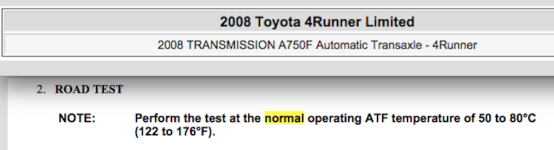
1) "Normal" operating range for the transmission is 122F to 176F, although the temp can and will go higher.

(For me this means that I will add a bypass lever for my 2nd aux trans cooler for use when I am NOT towing during the cold winter months,
because it turns out that my trans was running a little too cool on cold winter days.)

Normal Trans Temp.png


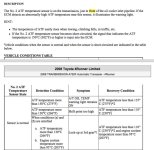
2) The A/T Overheat light comes on at 302 F !!!! ... and turns back off at 275 F
(Note the typo in the FSM... 150C is 302F, not 275F)

trans_condition_table.jpg

The A/T Overheat light comes on at 150 C (which is 302 F !!!), and goes off at
130 C (275 F) (The chart has a typo on the conversion from 150 C).

This means that you could heat your trans fluid all the way up to 300 F, and STILL not have the overheat light come on !!!!!
It also means that when the overheat light goes off, you're at 275F, and can go all the way back up to 300 F without the light re-illuminating.

Clearly, the light is only a warning for the truly extreme over-heating situations, and should not be relied upon to see if everything is OK while towing.
On a long trip, you could (theoretically) have your trans temp at 300 F for a good portion of the trip, and your A/T Temp light would NEVER turn on!


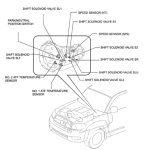
3) The Transmission has two different temp sensors. The overheat light reads the newly cooled fluid as it re-enters the tranny.

The first temp sensor is inside the transmission unit itself, and the second is at the front of the transmission where the newly cooled fluid re-enters the transmission.
Overheat conditions are based on the 2nd temp sensor, which appears to be the sensor that my Ultragauge Blue is reading.

trans_diagram.png


4) The trans temp easily rises while towing, climbing hills and in traffic.

(See the "Hint:" above in item 2.)

(Just image what might happen while towing if you get stuck in traffic while climbing a long, steep hill !!! ) (heh heh!)

(It happened to me last summer, and my trans rose to 275 F !!! I stopped my trip, drove to an auto parts store, bought and installed my (2nd) aux cooler, and only then continued my trip !)


5) If your trans gets too hot, let your engine idle in "P" or "N". Don't turn your truck off to cool down an over-heated trans.

trans conditions hints.png


Hint *2 tells us that the transmission should cool to less than 135 C (275 F) within 5 minutes the engine idling while in "P" or "N".
If you simply turn off your truck, your trans temp will actually RISE before it eventually cools down.

6) Tow on the highway with the shift lever in "D" or in "4". Avoid extended highway towing in "3".

In "D", the trans will lock-up in 5th gear. Shift to "4" if you want it to lock up in 4th gear.
Also, avoid extended periods of towing on the highway in 3rd gear, because the trans can get very, very hot (>266 F)!.

Hint *1 tells us that with the shift lever in "D", the transmission will lock up in 5th gear (lock-up is good!),
and that if we change the lever to "4" that the transmission will lock up in 4th gear.
So it's OK to shift to "4" when towing if you need some extra torque and power.


Hope this helps! :rapture:
-Phil
 

Attachments

  • Normal Trans Temp.png
    Normal Trans Temp.png
    128.9 KB · Views: 894
  • trans_condition_table.jpg
    trans_condition_table.jpg
    75.3 KB · Views: 930
  • trans conditions hints.png
    trans conditions hints.png
    35.8 KB · Views: 782
  • trans_diagram.png
    trans_diagram.png
    126 KB · Views: 1,239
Last edited:
All great info, I've subscribed to this topic for any other great info posted!

I especially like seeing the transmission info from the FSM, very good to know!
 
Last edited:
I have a 2008 SR5 V8 4x4 and we tow a camper that weighs a little over 3k lbs. with everything in it and as we drive through the North Carolina mountains on our way to the beach from TN, I will see temps spike at 230 with my scangauge II. Otherwise, it would normally be under 200. I felt that was pretty normal, but it's nice to know it stayed cooler than 275! I would probably piss my pants if I saw it get that high, but on the plus side, my wife and kids would probably get a good laugh. :D


I also wanted to comment on Drake's setup...
Great looking 4Runner and trailer :rockon:...but I really like the light pole you mounted to the top of your 4Runner :frog:,
I imagine it comes in handy when camping in dark locations, of course you have to avoid low hanging trees limbs, going under bridges and the drive-thru at McDonald's!!
 
Last edited:
You're absolutely correct. It was just 2003 they screwed us over with the V8 tow capacity.


Sent from my iPhone using Tapatalk

My roommates 03 v8 is rated for 7000lbs

I have the v6 rated at 5000, I live up in the mountains and bring my boat to the lake pretty consistently during the summer. I would like to add a tranny cooler because on my ride home on hot days the temp light has popped on (in which I pull over and let it cool down). Is there anything specific I should look for when trying to purchase the cooler for a v6? Anyone care to post links to some that will work? How hard is it to install?
 
My roommates 03 v8 is rated for 7000lbs


I have the v6 rated at 5000, I live up in the mountains and bring my boat to the lake pretty consistently during the summer. I would like to add a tranny cooler because on my ride home on hot days the temp light has popped on (in which I pull over and let it cool down). Is there anything specific I should look for when trying to purchase the cooler for a v6? Anyone care to post links to some that will work? How hard is it to install?


Look at my previous post for types. I have a Derale plate and fin on my other car. If I replace the one on the 4Runner, I'll probably do the stacked plate and stick with Derale. It's held up well and was an easy install. Hayden and B&M are also good brands.

If you go to www.derale.com, you'll get an idea under the various product specs regarding GVW they are rated for.


Sent from my iPhone using Tapatalk
 
My roommates 03 v8 is rated for 7000lbs

I have the v6 rated at 5000, I live up in the mountains and bring my boat to the lake pretty consistently during the summer. I would like to add a tranny cooler because on my ride home on hot days the temp light has popped on (in which I pull over and let it cool down). Is there anything specific I should look for when trying to purchase the cooler for a v6? Anyone care to post links to some that will work? How hard is it to install?

Here's a thread with a great writeup on installing an aux trans cooler.

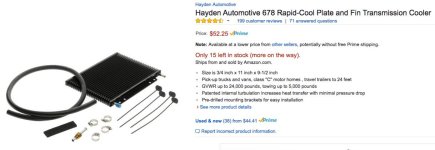
The installation is straightforward. Most of the transmission cooler kits
come with foam pads and plastic fasteners to attach the transmission cooler to your radiator. I would recommend using them. You may need pliers, or even long needle nose pliers to push them through, grab the end and tighten a connector on the end. In my opinion that is the most difficult part.

trans_cooler.jpg
(Example from Amazon.com showing a cooler and the fasteners).

If your cooler doesn't come with any hoses, then be sure to buy TRANSMISSION FLUID HOSES. Not fuel hoses, or coolant hoses, or anything else. They do make hoses that say "Transmission fluid" directly on the hose.
I'm not sure of the harm in using different hoses, but I wouldn't want to risk it... after all, only your transmission is at stake!


The images in that post are linked to an external site, so I have uploaded several of them to this forum, just to make sure that they don't go away someday.

All credit for this post goes to the original author: [MENTION=45103]bobbarker[/MENTION].

-Phil


2011-09-1816.07.02.jpg

2011-09-1816.07.25.jpg

2011-09-1816.08.01.jpg

2011-09-1816.09.04.jpg
 

Attachments

  • 2011-09-1816.07.02.jpg
    2011-09-1816.07.02.jpg
    62.4 KB · Views: 613
  • 2011-09-1816.07.25.jpg
    2011-09-1816.07.25.jpg
    68.1 KB · Views: 616
  • 2011-09-1816.08.01.jpg
    2011-09-1816.08.01.jpg
    136.6 KB · Views: 615
  • 2011-09-1816.09.04.jpg
    2011-09-1816.09.04.jpg
    76.2 KB · Views: 624
  • 2011-09-1816.10.26-2.jpg
    2011-09-1816.10.26-2.jpg
    97.2 KB · Views: 626
  • trans_cooler.jpg
    trans_cooler.jpg
    62.9 KB · Views: 628
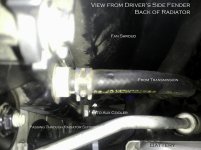
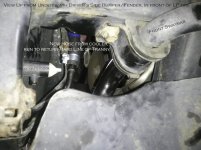
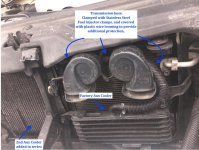
Photos of how I added a 2nd Aux trans cooler (keeping the factory aux cooler too!)

Look at my previous post for types. I have a Derale plate and fin on my other car. If I replace the one on the 4Runner...

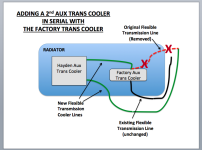
I have a hayden cooler. It's good. I added it IN ADDITION to my factory auxillary cooler.

It's connected in series with the factory aux cooler.

trans cooler diagram.png

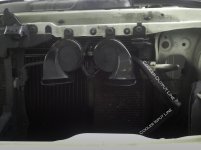
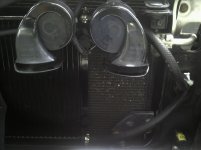
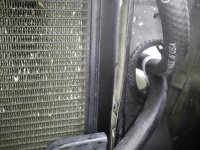
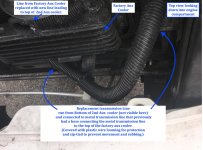
Here's what it looks like installed:

trans cooler 1.jpg

trans cooler 2.jpg

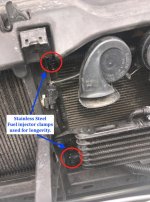
(I sprayed all of the clamps with black spray paint
for additional weather protection)

trans cooler 3.jpg


At some point I will add more connectors and a bypass valve, so that I can have the trans fluid bypass my 2nd aux cooler on cold winter days when I'm not towing. It turns out, in 20 F weather, with the 2 coolers, my trans temp is around 110F, which is a little cooler than ideal.

(Once I install the bypass, I'll do a post with drawings and photos... but it might be a while... I'm working on other projects too!)
 

Attachments

  • trans cooler 2.jpg
    trans cooler 2.jpg
    90.4 KB · Views: 634
  • trans cooler 3.jpg
    trans cooler 3.jpg
    132.6 KB · Views: 768
  • trans cooler 1.jpg
    trans cooler 1.jpg
    136.7 KB · Views: 1,545
  • trans cooler diagram.png
    trans cooler diagram.png
    136.1 KB · Views: 677
Last edited:
Thread w/ Q's & INFO on towing... (Different from others!)

I'm loving this thread so thank you to the OP. It's really got me thinking about when I upgrade from my 900 lb teardrop to over 4000 lbs r-pod or the like. 1st, you guys prompted more research on my end and Toyota changed the tow rating on the 2003 V8 midway through production, so it seems. That's why mine is listed so much higher if I have a WD hitch. Toyota started installing a class IV hitch midway through production of the 2003 instead of the class III hitch that's on mine. That's my understanding at least.

On running two coolers, I have questions coming to mind. Wouldn't running 2 coolers in series be less efficient than splitting them off and running in parallel? Seems one would be doing most of the work and the other barely having to do anything. If they were y'd off, then wouldn't each be doing an equal load of work? And wouldn't the pressure be affected more in series? I'm trying to wrap my head around it, so I welcome feedback. I certainly don't know or I wouldn't be asking. And at the point of installing a 2nd auxiliary cooler (the 1st being the factory aux), wouldn't it be more efficient to just get rid of the factory aux cooler and get a good quality large single auxiliary cooler, like a remote cooler? Then you can turn the fan on and off for extra cooling or less cooling in winter.

I'm glad you all are prompting me to think about this now instead of later.


Sent from my iPhone using Tapatalk
 
Last edited:
OK. I found some really good about the AT Temp for the 750F (sealed) transmission unit.

:party: :drum:

Source: 2008 4Runner Limited Field Service Manual (FSM)


1) "Normal" operating range for the transmission is 122F to 176F, although the temp can and will go higher.

(For me this means that I will add a bypass lever or make a cover for my 2nd aux trans cooler for use while NOT towing during the cold winter, because my trans was running a little cooler in the winter when not towing.)

View attachment 247087


2) The A/T Overheat light comes on at 302 F !!!! ... and turns back off at 275 F
(Note the typo in the FSM... 150C is 302F, not 275F)

View attachment 247089

The A/T Overheat light comes on at 150 C (which is 302 F !!!), and goes off at
130 C (275 F) (The chart has a typo on the conversion from 150 C).

This means that you could heat your trans fluid all the way up to 300 F, and STILL not have the overheat light come on !!!!! It also means that when the overheat light goes off, you're at 275F, and can go all the way back up to 300 F without the light re-illuminating.

Clearly the light is only a warning for the truly extreme over-heating situations, and should not be relied upon to see if everything OK while towing. On a long trip, you could (theoretically) have your trans temp at 300 F for a good portion of the trip, and your A/T Temp light would NEVER turn on!


3) Temp measured inside transmission where newly cooled fluid re-enters the tranny.

This temp is measured where the fluid returns from the transmission cooler and enters back into the transmission unit itself. Also, towing, hill climbing and traffic can rapidly heat up the transmission.

(Quote)
The No. 2 ATF temperature sensor is on the transmission, just in front of the oil cooler inlet pipeline. If the ECM detects an abnormally high ATF temperature near this sensor, it illuminates the warning light.
HINT:
--The temperature of ATF easily rises when towing, climbing hills, in traffic, etc.
(end quote)
View attachment 247091

4) The trans temp easily rises while towing, climbing hills and in traffic.


5) If you're trans gets too hot, let your engine idle in "P" or "N". Don't turn your truck off to cool down an over-heated trans.

View attachment 247090

Hint *2 tells us that the transmission should cool to less than 135 C (275 F) within 5 minutes the engine idling while in "P" or "N".


6) Tow on the highway with the shift lever in "D" or in "4".

In "D", the trans will lock-up in 5th gear. Shift to "4" if you want it to lock up in 4th gear. Locking up in 3rd gear can make the trans very, very hot (>266 F)!.

Hint *1 tells us that with the shift lever in "D", the transmission will lock up in 5th gear (lock-up is good!), and that if we change the lever to "4" that the transmission will lock up in 4th gear. So it's OK to shift to "4" when towing if you need some extra torque and power.

The table also indicates that when the transmission locks-up in 3rd gear, that the trans temp can get very high (>266 F), so I would avoid extended periods of towing on the highway in 3rd gear.


7) The Transmission has two different temp sensors...

The first is inside the transmission unit itself, and the second is at the front of the transmission where the newly-cooler fluid re-enters the transmission. Overheat conditions are based on the 2nd temp sensor, which seems to be the sensor that my Ultragauge Blue is reading.

Hope this helps! :rapture:
-Phil

Thank you very much for that info. I see additional trans cooling in my future and a fluid flush. I've been in D or 4 locked 98% of the time.

In D when it unlocks I manually drop it into 4 so the torque converter locks again. I had read that it's better to be in 4 locked than in D unlocked.
 
I also wanted to comment on Drake's setup...
Great looking 4Runner and trailer :rockon:...but I really like the light pole you mounted to the top of your 4Runner :frog:,
I imagine it comes in handy when camping in dark locations, of course you have to avoid low hanging trees limbs, going under bridges and the drive-thru at McDonald's!!

Custom light pole mod FTW! I'll be doing a write up soon. :D
 
(1) I'm loving this thread so thank you to the OP. ...

(2) On running two coolers, I have questions coming to mind. Wouldn't running 2 coolers in series be less efficient than splitting them off and running in parallel?
...

(3) And wouldn't the pressure be affected more in series?
...

(4) wouldn't it be more efficient to just get rid of the factory aux cooler and get a good quality large single auxiliary cooler, like a remote cooler? Then you can turn the fan on and off for extra cooling or less cooling in winter.

(1) Thanks! Welcome to the party!!! :party: :drummer:

(2) I didn't give parallel much thought. It would require several "T" adapters, and I wasn't sure about the flow, efficiency, fluid dynamics, etc. Serial just seemed simpler to me.

(3) I think that Serial is fine, as long as you don't add a any restrictions to the system with your choice of cooler, connectors and hoses.

Let's assume that the trans cooler doesn't add any restrictions. This seems like a valid assumption, because the cooler that I bought has 3/8" connectors and internally is, in fact, a parallel flow cooler.

Next, I used the same size diameter line as the original factory lines. (I used 3/8" == .375", the factory is either 9mm or 10mm which are .354" and .393", respectively.
... that's close enough for me to be considered "the same".)

The net increase in hose length is modest when compared to the total length of hard lines and flexible lines, and the transmission fluid is pressured in those lines,
so I really don't think that the line size, line length or additional connections and equipment add any meaningful increased restriction, and any slight increase in restriction would be more than offset by the substantial increase in cooling capacity.

These assumptions are easily supported by my "before and after" temp readings on the day that installed my 2nd aux cooler in the middle of a mall parking lot somewhere between "here" and "there" on my 600 mile trip.

When considering all of these factors, I don't believe that I've added any significant restrictions or bottlenecks to the system, and I know that I've significantly increased my cooling capacity.


(4) I bought one of the larger (or maybe largest) hayden trans coolers, but it IS aftermarket, and sometimes OEM parts are better than aftermarket.

So I figured that I'd keep the factory cooler too, that way I'd be certain that I would get even more cooling than the original factory setup.

Let's assume that the factory cooler drops the temp by about 25 degrees F (say from 260 F to 235 F)...

the second cooler can then drop the temp by another 25 F (say from 235 F to 210 F). (!!!)


These numbers seem realistic...

they are at least in the ball park, based on readings I saw on the day when I added my 2nd aux cooler.

I was hitting 275 F towing 4000+ lbs in stop-and-go traffic, going up long, small mountainside on a 95 F degree day.

After the change, when moving I was down around 210 F and sometimes 200 F, and even in stop and go or taxing situations I would see 230 F to maybe 245 F for a few brief moments, but then I would see the temp rapidly drop.

(4) (2nd point)... To your point -- A very good Aux cooler with an electric fan might be a better and more straight forward installation...

especially if the fan is controlled by a thermostat, so that it kicks on and off automatically,

but it just seemed like more work, and more unknowns.

I figured that the factory cooler was probably good since the 4Runner is a quality truck, so I would simply augment it with more cooling, and then I could be certain that I improved the system.

I didn't even want to contemplate removing the factory cooler, because I would then have to wonder:

-- Did I actually increase or decrease the cooling capacity?
-- Is the mounting location of my aux cooler as effective as the factory one (flush to the radiator, vs in front of it with an inch or so of clearance space)? etc, etc.

The price of being wrong is too steep, and I was trying to make an improvement, without doing a full engineering study !!! (heh heh!)
 
Last edited:
Bypass plans, preview & 1 question...

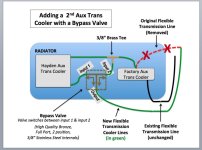
Here are my plans and materials for adding a bypass valve to the 2nd Aux trans cooler...


QUESTION: Does anyone know if connecting brass fittings to the bronze valve will cause any problems because of the dissimilar metals?

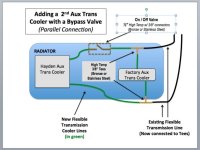
1) Design

trans_diagram_w_bypass.jpg

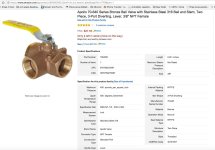
2) Bypass valve (Bronze, high quality, full port.)

trans_bypass_valve_bronze.jpg

Description of the valve from Amazon.com

The Apollo 70-640 series bronze two-piece three-port diverting ball valve has a lever handle and female National Pipe Taper (NPT) threads on all three ends. The body of this valve is made of bronze for higher strength and corrosion resistance than brass, and the ball and stem are made of stainless steel 316 for greater corrosion resistance than standard steel. This three-port valve has a ball with an L-port flow pattern to allow fluids to flow from the inlet to one of the two outlets in an L-shaped path; a quarter turn of the lever switches the flow between the two outlet ports. It has a zinc-plated steel lever handle with a vinyl sleeve for changing the direction of the flow, and it is standard (or regular) port for reduced valve size and cost. Reinforced polytetrafluoroethylene (RPTFE) seats and multifill polytetrafluoroethylene (MPTFE) stem packing reduce the possibility of leakage, and the valve has NPT threads for creating tighter seals than straight threads. The maximum pressure rating is 400 pounds per square inch (gauge) (psig) for water, oil, and gas (WOG), and the temperature range is -20 to 450 degrees Fahrenheit. This ball valve is for use in water lines, processing plants, and agricultural applications and meets standard MSS SP-110 for quality assurance.

Ball valves use a spherical disc to control the flow between pipes, tubes, or hoses. Flow is allowed when the hole that pierces the ball-shaped disc is in line with the inlet and outlet of the valve. Flow is blocked when the ball is horizontally swiveled 90 degrees, so that the hole of the ball is perpendicular to the opening of the valve. Ball valves can be referred to as full port or reduced port (also known as regular or standard port) depending on the inner diameter of the valve. A ball valve is full port if the hole of the ball is the same size as the inner diameter of the connecting pipeline (resulting in lower friction) and is reduced port if the hole of the valve is one pipe size smaller than the pipe, resulting in less flow through the valve than through the shaft of the pipe. Ball valves may have a handle or lever that aligns with the ball’s position (open or closed) for manual operation. They are primarily used in air, gas, liquid, and steam applications.​

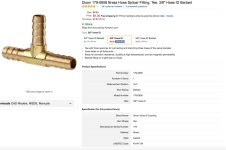
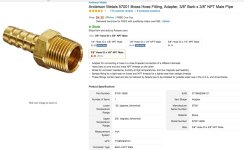
3) Brass Fittings

trans_brass_tee.jpg

trans_brass_fitting.jpg

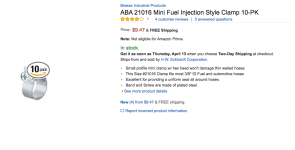
4) Plated steel clamps
(not stainless steel... couldn't find that.
Spray paint after installation for protection)

trans_hose_clamp_plated_steel.png

5) Other supplies...

You'll need 3/8" transmission hose,
1/2 wire looming to protect your hoses (optional)
Teflon tape for the screw-in brass fittings.
Assorted zip ties
Materials and stainless steels screws or hardware to make a mounting plate for the bypass valve.

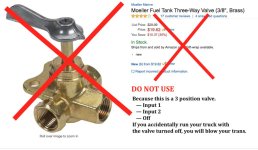
6) DON'T USE THIS TYPE of 3-Position valve

trans_bypass_do_not_use.jpg


Notes:

-- All of my "T" adapters and other fittings are brass or bronze and have a full-size 3/8" inner diameter. This is important, because some fittings listed as "3/8", have smaller internal passageways which means that that will restrict the flow of transmission fluid.

-- My bypass valve is high quality bronze with a full-sized port and it doesn't have an "OFF" position. It's important not to have a 3-position valve, because you NEVER want to run the risk of turning it off, even by accident.


-- I bought steel fuel injector hose clamps. Once installed, I will spray paint them for protection from weathering.

-- Use teflon tape at all of the screw-together connections. This helps to ensure a good, leak-proof seal.

-- Support every brass & bronze connection...
I'll probably use 2 or 3 zip ties for the brass T.

I'll probably make a mounting bracket for the bypass valve, and secure
the bracket to the truck. 1/4 or 3/8" aluminum plate is what I'm planning to
use for the bracket.​

I'm not likely to install this before the fall... No need for the bypass during the summer.


Note: These are top secret plans...

:spy: :spy: :spy:
Don't share them! :)
 

Attachments

  • trans_brass_fitting.jpg
    trans_brass_fitting.jpg
    101.6 KB · Views: 615
  • trans_brass_tee.jpg
    trans_brass_tee.jpg
    88.4 KB · Views: 501
  • trans_bypass_do_not_use.jpg
    trans_bypass_do_not_use.jpg
    75.2 KB · Views: 1,066
  • trans_bypass_valve_bronze.jpg
    trans_bypass_valve_bronze.jpg
    112.3 KB · Views: 534
  • trans_hose_clamp_plated_steel.png
    trans_hose_clamp_plated_steel.png
    113.6 KB · Views: 493
  • trans_diagram_w_bypass.jpg
    trans_diagram_w_bypass.jpg
    86.9 KB · Views: 597
I don't think you'll have any issues using bronze and brass together, they're very similar in composition,
brass is a alloy of copper and zinc, bronze is a alloy consisting of mainly copper with usually tin, sometimes other metals,
but both are mostly copper so should be fine together.
 
Teflon tape is a good thing. My dim memory forgot what a great thing it is to have in the tool kit. Have it on the list.
 
Last edited:
Teflon tape is a good thing. My dim memory forgot what a great thing it is to have in the tool kit. Have it on the list.

Yes it is, I have a roll in every drawer in my tool box, I also have a roll or two in the console/glove box of every vehicle I own and a few rolls in various drawers in my house!!
 
Need to rethink bypass design...

Here are my plans and materials for adding a bypass valve to the 2nd Aux trans cooler...


QUESTION: Does anyone know if connecting brass fittings to the bronze valve will cause any problems because of the dissimilar metals?

1) Design

View attachment 247369

2) Bypass valve (Bronze, high quality, full port.)

View attachment 247363

Description of the valve from Amazon.com

The Apollo 70-640 series bronze two-piece three-port diverting ball valve has a lever handle and female National Pipe Taper (NPT) threads on all three ends. The body of this valve is made of bronze for higher strength and corrosion resistance than brass, and the ball and stem are made of stainless steel 316 for greater corrosion resistance than standard steel. This three-port valve has a ball with an L-port flow pattern to allow fluids to flow from the inlet to one of the two outlets in an L-shaped path; a quarter turn of the lever switches the flow between the two outlet ports. It has a zinc-plated steel lever handle with a vinyl sleeve for changing the direction of the flow, and it is standard (or regular) port for reduced valve size and cost. Reinforced polytetrafluoroethylene (RPTFE) seats and multifill polytetrafluoroethylene (MPTFE) stem packing reduce the possibility of leakage, and the valve has NPT threads for creating tighter seals than straight threads. The maximum pressure rating is 400 pounds per square inch (gauge) (psig) for water, oil, and gas (WOG), and the temperature range is -20 to 450 degrees Fahrenheit. This ball valve is for use in water lines, processing plants, and agricultural applications and meets standard MSS SP-110 for quality assurance.

Ball valves use a spherical disc to control the flow between pipes, tubes, or hoses. Flow is allowed when the hole that pierces the ball-shaped disc is in line with the inlet and outlet of the valve. Flow is blocked when the ball is horizontally swiveled 90 degrees, so that the hole of the ball is perpendicular to the opening of the valve. Ball valves can be referred to as full port or reduced port (also known as regular or standard port) depending on the inner diameter of the valve. A ball valve is full port if the hole of the ball is the same size as the inner diameter of the connecting pipeline (resulting in lower friction) and is reduced port if the hole of the valve is one pipe size smaller than the pipe, resulting in less flow through the valve than through the shaft of the pipe. Ball valves may have a handle or lever that aligns with the ball’s position (open or closed) for manual operation. They are primarily used in air, gas, liquid, and steam applications.​

3) Brass Fittings

View attachment 247361

View attachment 247360

4) Plated steel clamps
(not stainless steel... couldn't find that.
Spray paint after installation for protection)

View attachment 247364

5) Other supplies...

You'll need 3/8" transmission hose,
1/2 wire looming to protect your hoses (optional)
Teflon tape for the screw-in brass fittings.
Assorted zip ties
Materials and stainless steels screws or hardware to make a mounting plate for the bypass valve.

6) DON'T USE THIS TYPE of 3-Position valve

View attachment 247362


Notes:

-- All of my "T" adapters and other fittings are brass or bronze and have a full-size 3/8" inner diameter. This is important, because some fittings listed as "3/8", have smaller internal passageways which means that that will restrict the flow of transmission fluid.

-- My bypass valve is high quality bronze with a full-sized port and it doesn't have an "OFF" position. It's important not to have a 3-position valve, because you NEVER want to run the risk of turning it off, even by accident.


-- I bought steel fuel injector hose clamps. Once installed, I will spray paint them for protection from weathering.

-- Use teflon tape at all of the screw-together connections. This helps to ensure a good, leak-proof seal.

-- Support every brass & bronze connection...
I'll probably use 2 or 3 zip ties for the brass T.

I'll probably make a mounting bracket for the bypass valve, and secure
the bracket to the truck. 1/4 or 3/8" aluminum plate is what I'm planning to
use for the bracket.​

I'm not likely to install this before the fall... No need for the bypass during the summer.


Note: These are top secret plans...

:spy: :spy: :spy:
Don't share them! :)


So I may need to re-think my plans....

I'm now thinking of changing components and maybe doing this:

trans_diagram_parallel_w_bypass.jpg


I noticed that the brass fittings are only rated to 200 F. Not good.
Will need to find higher temp bronze or stainless steel ones.

Also, I mis-understood the valve I bought. It has 3/8 connectors, but the internal opening is "one size smaller", which I think means 5/16" (although... maybe they mean 1/4"... I'll have to measure).

I'll look for a larger quality high temp valve that has 3/8" internals.

For the bypass, they make a 1/2" model, that should be either 3/8" or 7/16" internally. I still need to find brass or bronze (or possibly other COMPATIBLE metal fittings) with 1/2" NPT male fittings on one end, and 3/8" hose barbs on the other.

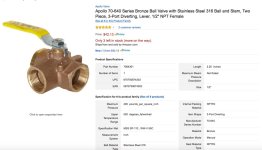
Here's a better valve choice:

trans_bypass_half_inch.jpg

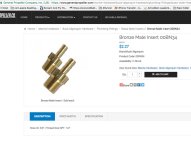
and I found some bronze fittings too,

trans_bronze_fittings.jpg

but it doesn't show their temperature ratings.

I guess I'll have to do more research on bronze and it's heat tolerance, or contact the supplier and manufacturer and see if I can get better specs.

Lastly, depending on the equipment I find, I'd be willing to consider changing my two cooler so that they are connected in parallel, and then simply having a bronze shut off valve to block the flow to the 2nd cooler in the winter.

If anyone finds good supplies, feel free to post. I hate the idea of paying $42 for one bypass valve, especially when I have already had *two* false starts by purchasing two different bypass valves that I probably won't use. (!!!!)


Also, I found out that previous posters are correct... brass and bronze are compatible.

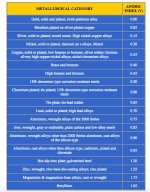
I found this info which is a more general guide for metal compatibility.


Source: Galvanic and Corrosion Compatibility Dissimilar Metal Corrosion - Engineers Edge

trans_metal_compatibility_chart.jpg


Quality engineering and design requires an understanding of material compatibility. Galvanic corrosion (some times called dissimilar metal corrosion) is the process by which the materials in contact with each other oxidizes or corrodes. There are three conditions that must exist for galvanic corrosion to occur. First there must be two electrochemically dissimilar metals present. Second, there must be an electrically conductive path between the two metals. And third, there must be a conductive path for the metal ions to move from the more anodic metal to the more cathodic metal. If any one of these three conditions does not exist, galvanic corrosion will not occur. Often when design requires that dissimilar metals come in contact, the galvanic compatibility is managed by finishes and plating. The finishing and plating selected facilitate the dissimilar materials being in contact and protect the base materials from corrosion.

For harsh environments, such as outdoors, high humidity, and salt environments fall into this category. Typically there should be not more than 0.15 V difference in the "Anodic Index". For example; gold silver would have a difference of 0.15V being acceptable.

For normal environments, such as storage in warehouses or non-temperature and humidity controlled environments. Typically there should not be more than 0.25 V difference in the "Anodic Index".

For controlled environments, such that are temperature and humidity controlled, 0.50 V can be tolerated. Caution should be maintained when deciding for this application as humidity and temperature do vary from regions
-Phil
 

Attachments

  • trans_bypass_half_inch.jpg
    trans_bypass_half_inch.jpg
    83.9 KB · Views: 359
  • trans_bronze_fittings.jpg
    trans_bronze_fittings.jpg
    65.6 KB · Views: 315
  • trans_metal_compatibility_chart.jpg
    trans_metal_compatibility_chart.jpg
    97.3 KB · Views: 338
  • trans_diagram_parallel_w_bypass.jpg
    trans_diagram_parallel_w_bypass.jpg
    55.5 KB · Views: 402

Members online

Forum statistics

Threads
278,316
Messages
3,554,113
Members
248,016
Latest member
Advally Service

Trending content

Back
Top