
Driveshaft Thump Fixed
I greased my driveshaft and it seems to have fixed the thump.
I used Amsoil Polymeric Synthetic Off Road Grease. It's a calcium-sulfonate complex grease which are compatible with most other greases (likely what's in there is lithium or lithium complex) so it shouldn't turn whatever is in there into play dough. It's a synthetic grease and has 5% molybdenum disulfide content (which is high) and temp range of -23c to 177c (-10 to 350f). Having moly as well as regular multi-purpose grease on hand requires two grease guns, but it's a small investment to fix this problem.
Moly grease is specified by Toyota for the slip joint, although a lot of people just use whatever they have on hand - normally some lithium complex like Mobil 1. Toyota technicians are known to admit to using whatever multi-purpose is in the grease gun in the shop - which normally isn't a moly grease since it's normally not used on roller bearings.
I suspect that some of the cases of driveshaft thump are due to incorrect type of grease. Some trucks wont have any troubles with a plain red grease., but moly is intended for sliding surfaces like the slip joint and provides very good lubrication.
I suspect that some cases of driveshaft thump are due to inadequate greasing. There's a misconception that over greasing this joint can cause damage to transfer case and/or differential bearings. There isn't a single case anywhere that anyone can cite where greasing a driveshaft put excess pressure on the drive line causing failure.
What is certain is that the thump that I hear inside the truck and causes the whole vehicle to bounce slightly (because the drive shaft is binding and preventing the rear suspension from compressing) is putting extreme pressure on the entire drive line in a manner not intended by it's design. This surely could cause damage, although despite all the cases of thump, I haven't really read anything about engine mounts, T-case or diff bearings failing.
It's true that the driveshaft will extend as you grease it, and will keep extending until there's no room left and the excess grease escapes through the joint - which is exactly what the FSM tells you to do. Every vehicle I've ever owned with a slip joint has been the same: grease until the old, dried out and contaminated grease is squeezed out of the joint.
I'm the second owner and I doubt the previous owner did any greasing at all. Who knows how much was added over the years, or if the factory fill was very much.
It took about 80 shots of grease from the gun until some began to squeeze out of the joint. I cleaned off the joint with some WD-40 first, and as I added grease, bubbles were visible around the seal as air was pushed out. I put about 30 more shots into it until the old, dirty grease was pushed out and the new grease was visible. With each shot of grease, the shaft extended slightly and as the pressure escaped, it contracted slightly. Once the clean stuff started to flow, it got easier to put more in. The old grease was very thick and dirty - likely why the slip joint was binding.
5 or 10 shots of grease likely isn't going to do much if that's all you put in every 10k miles. You want to see clean stuff escaping - think if it like an oil change.
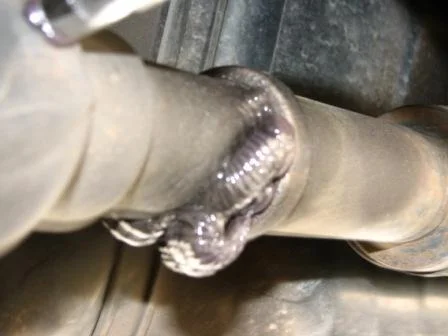
My driveshaft looked like this, except much more grease escaping:
AMSOIL Synthetic Polymeric Off-Road Grease, NLGI #2
I greased my driveshaft and it seems to have fixed the thump.
I used Amsoil Polymeric Synthetic Off Road Grease. It's a calcium-sulfonate complex grease which are compatible with most other greases (likely what's in there is lithium or lithium complex) so it shouldn't turn whatever is in there into play dough. It's a synthetic grease and has 5% molybdenum disulfide content (which is high) and temp range of -23c to 177c (-10 to 350f). Having moly as well as regular multi-purpose grease on hand requires two grease guns, but it's a small investment to fix this problem.
Moly grease is specified by Toyota for the slip joint, although a lot of people just use whatever they have on hand - normally some lithium complex like Mobil 1. Toyota technicians are known to admit to using whatever multi-purpose is in the grease gun in the shop - which normally isn't a moly grease since it's normally not used on roller bearings.
I suspect that some of the cases of driveshaft thump are due to incorrect type of grease. Some trucks wont have any troubles with a plain red grease., but moly is intended for sliding surfaces like the slip joint and provides very good lubrication.
I suspect that some cases of driveshaft thump are due to inadequate greasing. There's a misconception that over greasing this joint can cause damage to transfer case and/or differential bearings. There isn't a single case anywhere that anyone can cite where greasing a driveshaft put excess pressure on the drive line causing failure.
What is certain is that the thump that I hear inside the truck and causes the whole vehicle to bounce slightly (because the drive shaft is binding and preventing the rear suspension from compressing) is putting extreme pressure on the entire drive line in a manner not intended by it's design. This surely could cause damage, although despite all the cases of thump, I haven't really read anything about engine mounts, T-case or diff bearings failing.
It's true that the driveshaft will extend as you grease it, and will keep extending until there's no room left and the excess grease escapes through the joint - which is exactly what the FSM tells you to do. Every vehicle I've ever owned with a slip joint has been the same: grease until the old, dried out and contaminated grease is squeezed out of the joint.
I'm the second owner and I doubt the previous owner did any greasing at all. Who knows how much was added over the years, or if the factory fill was very much.
It took about 80 shots of grease from the gun until some began to squeeze out of the joint. I cleaned off the joint with some WD-40 first, and as I added grease, bubbles were visible around the seal as air was pushed out. I put about 30 more shots into it until the old, dirty grease was pushed out and the new grease was visible. With each shot of grease, the shaft extended slightly and as the pressure escaped, it contracted slightly. Once the clean stuff started to flow, it got easier to put more in. The old grease was very thick and dirty - likely why the slip joint was binding.
5 or 10 shots of grease likely isn't going to do much if that's all you put in every 10k miles. You want to see clean stuff escaping - think if it like an oil change.
My driveshaft looked like this, except much more grease escaping:
AMSOIL Synthetic Polymeric Off-Road Grease, NLGI #2
Last edited:


