
You are using an out of date browser. It may not display this or other websites correctly.
You should upgrade or use an alternative browser.
You should upgrade or use an alternative browser.
tire rotational direction for 06 SE
- Thread starter Jacobzky
- Start date

Register to hide this ad

sharp4runr
New member
The AT20 are not directional and BC4Runner is correct about the arrows that tell you if they are directional.
Yes, a directional tire would be very obvious. There are big arrows on the sidewall, and you'd notice that the tread has a distinct pattern that would not leave the same footprint if you turned it around and put it on the other side of the truck. There would be curves or large arrow-shaped structures that point in only one direction.
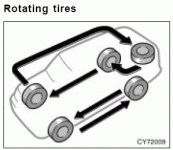
Nonetheless, the recommended rotation pattern is similar to that of a directional tire. It's called "same-side rotation" with the spare always going on the same side (if you choose to include it).
This is from the 06 Owners Manual:
Nonetheless, the recommended rotation pattern is similar to that of a directional tire. It's called "same-side rotation" with the spare always going on the same side (if you choose to include it).
This is from the 06 Owners Manual:
Attachments
The Wanderer
New member
the 5 tire rotation suggested from Toyota does not seem logical in the sense that the passanger side gets rotated among 3 tires while the drivers gets only two. This would allow more wear on the drivers two tires then the other side.

JB.
New member
The Wanderer said:the 5 tire rotation suggested from Toyota does not seem logical in the sense that the passanger side gets rotated among 3 tires while the drivers gets only two. This would allow more wear on the drivers two tires then the other side.
The reason is apparently to keep the circumference of the spare within acceptable limits. I don't rotate the spare in but I do use the same-side rotation as specified in the manual. 4 tires for the price of 5 is pretty expensive.
sharp4runr
New member
JB. said:The reason is apparently to keep the circumference of the spare within acceptable limits. I don't rotate the spare in but I do use the same-side rotation as specified in the manual. 4 tires for the price of 5 is pretty expensive.
I think what he's trying to say is that the driver's side doesn't have a 3rd tire in the rotation sequence, so that side wears faster. I guess you could switch the spare to the driver's side every other rotation to make up for it. I never gave it much thought, but thanks for bringing it up.
That would be too expensive to do with a directional tire. Every second oil change you'd have to get the tire removed from the rim, flipped over, and re-installed and re-balanced in order to install it on the other side. My feeling is that your spare tire should be just that... a spare. It should not be a directional tire so that you can use it safely on either side of the vehicle in any situation, and in my opinion, there's no need to include it in the rotation.sharp4runr said:I think what he's trying to say is that the driver's side doesn't have a 3rd tire in the rotation sequence, so that side wears faster. I guess you could switch the spare to the driver's side every other rotation to make up for it. I never gave it much thought, but thanks for bringing it up.

TechWrench
Senior Member
I too do not understand the rational for Toyota's 5 tire rotation pattern. I have the OEM Bridgestone H/Ts, and Bridgestone recomends on their site a different 5 tire rotation. It is close to the Toyota pattern, except they recommend you cross the front tires when moving them to the rear, with the left front going to the spare position. This, IMHO, makes more sense, all five tires eventually get to all five positions on the vehicle. To me, this is the best method for equalizing tire wear between all tires as long as you don't have directional tires. Then a straight front to rear, rear to front is necessary. Of course, if you have directional tires, then you have to determine which side of the vehicle is correct for the spare, and include it in that sides rotation, if you want to use all five tires in your rotation plan.
IMHO, it makes more sense to include the spare in the mix. Why would you want to not make use of the spare? I have heard some argue that when it comes time to replace their tires, they only need to get three instead of five. But, when it comes time to buy new tires, how do you know the exact same tire will still be available so you have a matched set? With the spare in the mix, you should get about 20% more overall tire life on the set. And when it comes time to replace them, you may wnat an entirely different type of tire. Then what do you do with the 3-4 year old 'new' spare. Considering the constant advances in tire technology, it is quite likely that you will find a better tire in 3-4 years than what you have now. And even though it may not have been in use, the tire still has aged hanging under the back, do you want to trust it like you would new ones? And if you remove the spare everytime you rotate, you get to check its pressure, condition, and clean the debris off the wheel that tends to accumulate under there.
IMHO, it makes more sense to include the spare in the mix. Why would you want to not make use of the spare? I have heard some argue that when it comes time to replace their tires, they only need to get three instead of five. But, when it comes time to buy new tires, how do you know the exact same tire will still be available so you have a matched set? With the spare in the mix, you should get about 20% more overall tire life on the set. And when it comes time to replace them, you may wnat an entirely different type of tire. Then what do you do with the 3-4 year old 'new' spare. Considering the constant advances in tire technology, it is quite likely that you will find a better tire in 3-4 years than what you have now. And even though it may not have been in use, the tire still has aged hanging under the back, do you want to trust it like you would new ones? And if you remove the spare everytime you rotate, you get to check its pressure, condition, and clean the debris off the wheel that tends to accumulate under there.

rustyrazor
New member
the burnout method - hill billy rotation
Here's a tire rotation method that I used when I was a teenager (read wreckless driver).
Say you start with 4 normal tires, now do burnouts and peel the tires as much as you want, because you're young and care-free. By doing this you should wear out your rear tires really fast, this should be no longer than 1 year, if it does go longer than a year than you need to practice doing more burnouts.
Once the rear tires are bald, or large chunks of rubber start to shred off during your routine burnouts, you rotate the tires. The rotation method is easy. Buy new tires and put them on the front. Take the front ones and put them on the back. Take the back tires and use them to start the bonfire at your next hill billy family reunion.
Warning: The author of this post advices that this method should be used at your own risk and said author will not be held responsible for any wreckless driving tickets, injuries caused by flat tires, or illness due to eating marshmallows that were roasted over a tire-fire.
Here's a tire rotation method that I used when I was a teenager (read wreckless driver).
Say you start with 4 normal tires, now do burnouts and peel the tires as much as you want, because you're young and care-free. By doing this you should wear out your rear tires really fast, this should be no longer than 1 year, if it does go longer than a year than you need to practice doing more burnouts.
Once the rear tires are bald, or large chunks of rubber start to shred off during your routine burnouts, you rotate the tires. The rotation method is easy. Buy new tires and put them on the front. Take the front ones and put them on the back. Take the back tires and use them to start the bonfire at your next hill billy family reunion.
Warning: The author of this post advices that this method should be used at your own risk and said author will not be held responsible for any wreckless driving tickets, injuries caused by flat tires, or illness due to eating marshmallows that were roasted over a tire-fire.
JB.
New member
I've been trying to get good info on this subject (<a href="http://www.toyota-4runner.org/showthread.php?threadid=11774&highlight=tire" target="_blank">thread</a> <a href="http://www.toyota-4runner.org/showthread.php?threadid=11381&perpage=15&highlight=miles%20rotation&pagenumber=3" target="_blank">thread</a>) for over a year now. The tire manufacturers recommend a cross pattern BUT that is secondary to following the vehicle manual. Apparently, Toyota thinks there's a measure of safety (legal safety?) to be had by keeping the tires spinning the same direction. Unless new information has appeared since the last time I exhaustively researched this, good luck getting clarification on the web. The manager at my local Discount Tire says they always rotate same-side. I asked him clearly and specifically about this and he said it's the newest information on tire rotation and comes from information and research resulting from the Ford/Firestone case. So I go with the owners manual same-side rotation. I don't rotate in the spare, therefore it doesn't have an internal rotational wear pattern and, presumably, won't cause an explosion of nuclear proportions should I ever have to put it in use.:bugeye:
Last edited:
TechWrench
Senior Member
JB. said:I've been trying to get good info on this subject (<a href="http://www.toyota-4runner.org/showthread.php?threadid=11774&highlight=tire" target="_blank">thread</a> <a href="http://www.toyota-4runner.org/showthread.php?threadid=11381&perpage=15&highlight=miles%20rotation&pagenumber=3" target="_blank">thread</a>) for over a year now. The tire manufacturers recommend a cross pattern BUT that is secondary to following the vehicle manual. Apparently, Toyota thinks there's a measure of safety (legal safety?) to be had by keeping the tires spinning the same direction. Unless new information has appeared since the last time I exhaustively researched this, good luck getting clarification on the web. The manager at my local Discount Tire says they always rotate same-side. I asked him clearly and specifically about this and he said it's the newest information on tire rotation and comes from information and research resulting from the Ford/Firestone case. So I go with the owners manual same-side rotation. I don't rotate in the spare, therefore it doesn't have an internal rotational wear pattern and, presumably, won't cause an explosion of nuclear proportions should I ever have to put it in use.:bugeye:
I too have done a lot of online and direct tire dealer research on this, and have found that many tire shop personnel don't have any real understanding about how the products they sell are made or supposed to perform. I am sure there are some good tire professionals out there, but most tire store managers I have met are more salesmen than professional mechanic. According to everything I know and have read, the belief that changing rotational direction on a tire will cause it to fail is a myth that no longer applies to modern radial tires. This theory goes back to bias ply tires, and the early US manufacturer attempts at radial tires. I have read a lot of the published information on the Ford/Firestone issue, and have not seen anything that suggested tire rotation direction was in any way an issue there. If you want to read an interesting, eye opening analysis of the issue, check this link out. http://www.citizen.org/documents/rootcause.pdf
Though Firestone, IMHO, should take some of the blame for their actions, Ford was the party that should shoulder the majority of the blame. Ford was the 500 lb gorilla leading Firestone on a chain.
I don't mean to suggest that anyone who choses to follow the Toyota rotation pattern is wrong. I am only trying to point out that following the tire manufacturers pattern will not result in a catrastrophic tire failure of a well made radial tire. As for not including the spare in the rotation, there is a very interesting article on TireRack.com which goes into a lot of detail about the possible effects of mismatched tires and their effect on 4wd systems. Up till now I had thought that a slight mismatch in tire size wouldn't be a big thing. This article is giving me cause to re-think that position. http://www.tirerack.com/tires/tiretech/techpage.jsp?techid=18
In the end, I guess it boils down to, there is no one 'right' or 'wrong' way to do a lot of things. You ask questions, do your homework, and then hopefully make an educated choice. Then if it works out, let us all know.

Last edited:
sharp4runr
New member
GSGALLANT said:That would be too expensive to do with a directional tire. Every second oil change you'd have to get the tire removed from the rim, flipped over, and re-installed and re-balanced in order to install it on the other side. My feeling is that your spare tire should be just that... a spare. It should not be a directional tire so that you can use it safely on either side of the vehicle in any situation, and in my opinion, there's no need to include it in the rotation.
yeah but we don't have directional tires so we don't have to worry about that now do we


spyne
New member
My understanding is that the one side only recommendation came about when radial tires were first introduced on a wide scale basis in the late '60's/early '70's. Apparently after a couple of thousand miles the cords in the early tires would take on a preference to rotate in the direction in which they were originally oriented. If the tires were then put on the opposite side of the car, rotating in the other direction, they occasionally would experience belt separation and fail. With the expected bad results.
Newer technology has eliminated this problem, (with the obvious exception of directional tires) but there are still a lot of companies that don't want to take the chance of a lawsuit. So they recommend one side only rotations. Personally, I've rotated radial tires from one side to the other for over 20 years and have never had a problem. This includes some VERY spirited driving at high speeds.
In my T4R I do a 5 tire rotation that swaps the tires from side to side and have had no problems. The pattern I use is spare to LR, LR to RF, RF to LF, LF to RR, RR to spare. I do my own rotations so this gives me a great chance to clean all of the crud off the rear of the wheels and it keeps all 5 tires at about the same wear.
Newer technology has eliminated this problem, (with the obvious exception of directional tires) but there are still a lot of companies that don't want to take the chance of a lawsuit. So they recommend one side only rotations. Personally, I've rotated radial tires from one side to the other for over 20 years and have never had a problem. This includes some VERY spirited driving at high speeds.
In my T4R I do a 5 tire rotation that swaps the tires from side to side and have had no problems. The pattern I use is spare to LR, LR to RF, RF to LF, LF to RR, RR to spare. I do my own rotations so this gives me a great chance to clean all of the crud off the rear of the wheels and it keeps all 5 tires at about the same wear.
TechWrench
Senior Member
GSGALLANT said:That would be too expensive to do with a directional tire. Every second oil change you'd have to get the tire removed from the rim, flipped over, and re-installed and re-balanced in order to install it on the other side. My feeling is that your spare tire should be just that... a spare. It should not be a directional tire so that you can use it safely on either side of the vehicle in any situation, and in my opinion, there's no need to include it in the rotation.
If you have directional tires, then it would make sense to have a standard, non-directional tire for a spare, so you could use in on either side when necessary. Of course, you would expect to repair/replace the damaged directional tire as soon as possible and return the spare to its stand-by position. There are some vehicles that have different front and rear tires, like the Corvette, which don't get tires rotated at all. But, that's another story.

Hoomiester
New member
I have a 04 V6 with the Dunlops. I rotate all 5 tires every 5K miles and change sides in the same pattern each time. All 5 tires go around the vehicle every 5 rotations. Right now they have 73K on them and they appear to have about 20K miles left on them. I'm buying Revos in 2 months and I drive like an old lady. I still have the original brakes on it too and every time I have someone check the pads, they can't believe the great shape they are in. I've been lucky and can only hope it continues to be this good as it ages.

Fro-Runner
New member
It use to be said in the early days of the steel belted radial tire that criss-crossing the front tires to the rear during a tire rotation caused the steel belts to buckle within the tire. This buckling effect would give your tire a hippty-hop ride after a couple thousand miles. This also caused some of the tires (uniroyal, firestoned) to develop knots on the outside tread of the tire. My mom's tires did this when I was young in the 70's.
I believe today's tires are made with a more flexible steel belt and/or some other strengthing material to prohibit this knotting of a tire's tread..
I believe today's tires are made with a more flexible steel belt and/or some other strengthing material to prohibit this knotting of a tire's tread..
The five tire rotation used by a fleet of pickups and suv's that has worked out the best after 20 years of tracking, with non-directional tires, is spare to right front, right front to right rear, right rear to left front, left front to left rear and left rear to spare, every 10 k miles. We have very carefully collected data since 1982 with an average of 600 vehicles a year with mileage from 10k to 50k per year per vehicle, 60 percent on average are pickups, the rest are suv's. 12 to 14 percent are 4x4's and just under have of those 4x4's are serious off road vehicles that see more severe duty off road than highway. The spare is always stored with 2 to 5 psi over the pressure of the tires on the ground to make sure there's enough air in the tire incase it has to be placed in service because of a flat. This method was worked out with the help of Michelin tire tech, as opposed to sales people. I use this method on my 03 V8 with Michelin Cross-T's and have 40k+ that have about half their tread left.
JB.
New member
Louie said:...carefully collected data since 1982 with an average of 600 vehicles a year with mileage from 10k to 50k per year per vehicle...
Great post. I don't check in here as often as I used to, but I'm sure glad I didn't miss this one. This appears to be the best info I've seen on the subject. Thanks.
Last edited:

icantsee
Banned
Regardless of directional or non directional tires, I only rotate front & back.
Reason being, if I had a nail & then I rotated it, then I know where it is, if you cross rotate & 5 tire rotate, the conclusion will be all over the place.
Oil change every 3,000
Rotation every other oil change 6,000
And since the wheels are off, I clean the inside of the wheels, plus clean off the hub & mounting service.
If your wheels stick like my friend's M3, then you should apply some anti-seize.
Reason being, if I had a nail & then I rotated it, then I know where it is, if you cross rotate & 5 tire rotate, the conclusion will be all over the place.
Oil change every 3,000
Rotation every other oil change 6,000
And since the wheels are off, I clean the inside of the wheels, plus clean off the hub & mounting service.
If your wheels stick like my friend's M3, then you should apply some anti-seize.
Similar threads
- Replies
- 2
- Views
- 2K

- Replies
- 1
- Views
- 959


