To cool or not to cool?

Run 4 Fun

New member
Alright so I purchased a 97 SR5 about 5 months ago that has 115k miles on it. Concerned about the pink milkshake I went ahead and ordered a new Denso Radiator off Amazon which is now sitting in my garage waiting for a nice day to be put on. I'm going back and forth on whether I should purchase a transmission cooler as well. I doubt I will ever pull anything with it, mostly use it for a camping/light off-road vehicle and don't see myself putting a lot of miles on it since I use it as a second vehicle.

If you were in my situation what would you do; install the new radiator and call it good, buy cooler and run tranny fluid through it, or buy cooler and run tranny fluid through both radiator and cooler? Regardless I'm going to keep the radiator and install it as I've purchased hoses, thermostat and gasket and coolant. I don't want the hassle of shipping everything back. Your thoughts are much appreciated.
 
Register to hide this ad
Cheap insurance my friend. I have a new Denso Radiator on order and opted for the B&M 70264 Transmission Cooler too. $64 is a lot cheaper than a 2-3K transmission rebuild, worse case scenario. There are lots of write-ups on Trans Coolers install...
 
I would add a transmission cooler and bypass the radiator completely, that way there's no chance it will ever happen.
 
I bought a new OEM radiator, straight from the dealer, and a trucool, and i've never seen more than 210 from my transmission
 
Bypass it. If you're putting in an aftermarket cooler, there is no need to run it with the radiator.

Thats not actually true. To get full advantage you would want to still keep the OEM style cooling from the radiator. The radiator helps warm the tranny when cold quicker and it also keeps temps way down during towing applications. If you tow a lot you want to run in series. If you never tow than just bypass it because the air to air is good enough. But usually toyota knows best and thats why they installed a liquid cooler and not an air to air originally. Both had cons and pros. But if I was towing I would never remove the radiator cooler.

If you run a new radiator with toyota coolant its entire life you most likely wont get the milkshake issue. Its when people introduce the green stuff when corrosion starts.
 
Bypass it. If you're putting in an aftermarket cooler, there is no need to run it with the radiator.

That's the way I see it it too. So far, the hottest I've seen my transmission temp go was 200° while going up Signal Mountain, TN. Normal city and highway driving sees anywhere between 120° and 145°. I wish I had been able to monitor temps before I did the bypass.
 
I ran it in series on my last 3rd gen. It never had the pink milkshake and last I heard it still hasn't with upwards of 235k mi.

There is no harm in bypassing it completely which is what I will do this time around. I have since built all my vehicles this way when using a transmission cooler and have seen lower temps during long pulls and hard use when paired with a good plate style cooler. If someone was really concerned with whether the transmission is coming up to operating temp, you can just install a thermostat in line with the cooler lines.

Improved Racing makes a nice unit that you can outfit with whatever inlet/outlet fittings you may need.
 
Last edited:
the b&m units have a built in thermostat

They advertise the B&M units as having a bypass valve that sends the trans fluid right back to the trans if it's too cold. Personally I don't think that valve is worth a damn, because my trans fluid will stay pretty cold when ambient temps are low. It doesn't bother me though, because I don't think cool temps will hurt the trans.
 
My opinion ....

Install the new radiator and call it a day.

I'm at 226k miles on my original trans and I have no slippage. The factory cooling setup has worked great me over the last 10+ years of ownership.

Even with an outside air temp of 105 F @ Big Bear in the summer my coolant / water temp (not trans) never went above 205 F. It's normal around town temp is 195-198 F.

Also if you (or anyone else here) is concerned about trans temps then DO NOT get a belly pan skid plate. A front skid like bud built or Savage is fine but if you do the complete front to rear skid package your trans will warm up a bit hotter. At least that is what I've read on multiple threads.
 
Last edited:
Thank you all for the replies. I guess it wouldn't be any harm in installing the radiator now and waiting to put in a cooler later? I really don't put a lot of miles on the thing. Had it about 5 months and maybe put 1200 miles on it. In your opinion do you think the aftermarket cooler works better than the stock setup going through radiator? I'm in Utah and it can sometimes get in the teens in the winter, but again I only drove it a handful of times this winter.
 
Did you bypass the stock cooler, or run it in series?

I ran mine in series... With the new radiator, I figure no point in skipping out on extra cooling.

To the others, that extra slight bit of cooling comes in handy with the rock crawling when things are slow, compared to highway hill driving
 
Got 4wd?

I guess it wouldn't be any harm in installing the radiator now and waiting to put in a cooler later? In your opinion do you think the aftermarket cooler works better than the stock setup going through radiator?

milkshake issue only applies to 4wd units. Not sure which is more effective but have a look at a factory cooler then you decide. any body ever crack-opened up OEM rad, if not, here we go! - YotaTech Forums

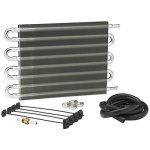
Its pretty tiny, the issues is with its seals, not so much the engine radiator. You can get a decent 15k btu cooler for about $35 on ebay....cheap insurance.
 

Attachments

  • Cooler.JPG
    Cooler.JPG
    16.7 KB · Views: 72

Members online

Forum statistics

Threads
278,312
Messages
3,554,084
Members
248,016
Latest member
Advally Service

Trending content

Back
Top