Well, since you asked nicely: Toyota's anti-skid technology and skid computer depend on several variables to enable the correct functioning of the system. Note that both the engine control and skid control systems are integrated, meaning they cannot operate independently. If it is determined by the ECU that a harmful or out of specification condition exists regarding the emissions system, the computer (by federal law) must show the owner that an out of specification condition exists via a "check engine light". The MIL light indicates that an out of specification emissions condition is occurring and by default may alter or change the ignition timing, VVTI timing, spark clearance, throttle response or any combination of any of those parameters to mitigate the excess emissions of harmful or otherwise non-approved fumes, gases or particulate emissions from any of the federally mandated emissions systems. A side effect of the computer attempting to mitigate the excess emissions from a non-functioning system is a reduction in torque or power under high calculated loads. Due to the reduction in power from the engine, the skid computer (which uses engine power to operate), may have a different response to terrain irregularities than what was originally programmed by the firmware engineer who designed the skid control ECU's response patterns to tire-slip conditions. At this point, it is additionally required by federal law that if a vehicles anti-skid or anti-slip system is operating out of specification and may cause unintended and unexpected vehicle maneuvers which can possibly affect the stopping distance or rollover prevention mechanisms of the skid computer, a light is illuminated to indicate such a condition exists.
Any questions?

THIS^^^^^^^^^^^^^^^^^^^^Well, since you asked nicely: Toyota's anti-skid technology and skid computer depend on several variables to enable the correct functioning of the system. Note that both the engine control and skid control systems are integrated, meaning they cannot operate independently. If it is determined by the ECU that a harmful or out of specification condition exists regarding the emissions system, the computer (by federal law) must show the owner that an out of specification condition exists via a "check engine light". The MIL light indicates that an out of specification emissions condition is occurring and by default may alter or change the ignition timing, VVTI timing, spark clearance, throttle response or any combination of any of those parameters to mitigate the excess emissions of harmful or otherwise non-approved fumes, gases or particulate emissions from any of the federally mandated emissions systems. A side effect of the computer attempting to mitigate the excess emissions from a non-functioning system is a reduction in torque or power under high calculated loads. Due to the reduction in power from the engine, the skid computer (which uses engine power to operate), may have a different response to terrain irregularities than what was originally programmed by the firmware engineer who designed the skid control ECU's response patterns to tire-slip conditions. At this point, it is additionally required by federal law that if a vehicles anti-skid or anti-slip system is operating out of specification and may cause unintended and unexpected vehicle maneuvers which can possibly affect the stopping distance or rollover prevention mechanisms of the skid computer, a light is illuminated to indicate such a condition exists.
Any questions?
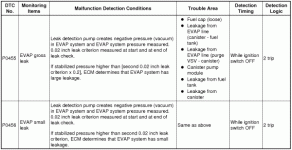
You may have cleared the code, but the system runs checks when the car is off. It might be days before the code returns. Dont pat yourself on the back just yet.
Aaaaaand....since I'm on a roll....if you are curious about the EVAP I/M monitor, here are the requirements for it to run. Where step c(1) mentions "Connect the Techstream to the DLC3, you can get a scan tool that shows all the I/M monitor status. This will show pass/fail/incomplete
3. EVAP SYSTEM MONITOR (KEY OFF TYPE)
(a) Preconditions
The monitor will not run unless:
The fuel tank is less than 90% full.
The altitude is less than 8000 ft (2450 m).
The vehicle is stationary.
The engine coolant temperature is between 4.4 and 35°C (40 and 95°F).
The intake air temperature is between 4.4 and 35°C (40 and 95°F).
Vehicle was driven in an urban area (or on a free-way) for 10 minutes or more.
(b) Monitor Conditions
(1) Turn the ignition switch OFF and wait for 6 hours.
HINT: Do not start the engine until checking Readiness Monitor status. If the engine is started, the step described above must be repeated.
(c) Monitor Status
(1) Connect the Techstream to the DLC3.
(2) Turn the ignition switch ON.
(3) Turn the tester or scan tool ON.
(4) Check the Readiness Monitor status displayed on the tester or scan tool.
If the status does not switch to Complete, restart the engine, make sure that the preconditions have been met, and then perform the Monitor Conditions again.