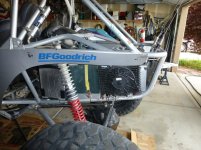
so youre saying dual coolers is gonna make it too cool? the FSM states that the transmission fluid can be checked at operating temps, operation temp is defined as the point where the transmission will shift into overdrive... that is roughly around 120*. if you think 120* is too cool feel free to stick your hand in 120* water on the stove and tell me its too cold (hint dont try that with oil). i run dual coolers and temps rarely climb above 180* normally, revently its been in the high 90s around here and ive been averaging closer to 180* +/- 10* in cold weather ie snow and freezing rain i only get down into the 150* range. i have never had a problem with the truck not shifting into overdrive. yes on cold mornings it takes a little longer, a couple miles, but by the time i hit the freeway im good. the main reason most of us here bypass the radiator all together is to prevent the pink milkshake -search for it. the only way you can completely eliminate this from happening is bypass the system. why do you think all new vehicles keep their trans coolers and radiators separate and no longer hose them in the same unit? also another thing to consider here is if you link the two together such as is done in stock set up, if one of the two components overheats it "infects" the other... if you are towing a heavy load and heat up the trans it will in turn heat the coolant and put more heat into the system than the radiator was designed to handle. same for the motor, if you start overheating the motor you can quickly overheat the transmission and burn up both. another thing to consider here is that the heat will compound on itself, and temps will rise exponentially faster the higher they go and the longer they stay there.
the system was designed around a stock vehicle with stock tires. bigger tires, aftermarket bumpers, sliders, roof top tents ect. means more work for the transmission and they simply where never designed to handle that kinda load. same goes with the cooling system, and since i have yet to find a larger aftermarket radiator that is not a one off custom made unit for under ~$900 keeping the radiator load as low as possible is also crucial.
Hmmm, where should I start? Ok, first off if you think the operating temp for ATF is 120 degrees, you are mistaken. Optimum operating temperature for ATF is around 170 degrees. According to my FSM, normal operating temp is between 158-176.
Comparing human beings to an automatic transmission. Not a very logical argument. Of course we are going to think 120 degrees is hot. We run at 98.6.
Now I have no doubt you are able to keep your temps down with your dual cooler set-up but I'm having a hard time believing you're achieving 150 degree trans temps in freezing weather unless you're climbing up steep grades. Even with my inferior in-series cooler set-up in warm Summer California temps doesn't achieve 150 for quite a while especially if I'm cruising down the highway. I'm pretty much saying you must be exaggerating a little to say you're able to reach 150 trans temps in cold weather in a few miles. I just did a 15 minute drive, partial highway and partial city streets in 80 degree weather and my trans never got above 140.
As for the Pink Milkshake fear, it's my belief as well as many others that the possibility of this happening is way less than we think. What percentage of the 4runner owners in the world frequent this forum. Maybe .1%. Just a total guess. Somebody reports a pink milkshake and people rush out to bypass the radiator cooler because of it. If it makes you sleep better at night, then you made the right choice. I'm just trying to give people more info so they can make as informed of a decision as possible. I did my research and I chose to replace the radiator as preventative maintenance and decided running the external cooler in-series was the best choice for me based on how I use my rig.
I have seen that when I'm climbing hills in the heat, like I did recently on a trip, the coolant temps will climb a little higher than normal and the trans temps in turn will be higher. Is it enough to be a concern, not really. In the summer heat, my coolant temps run around 190-194. When pushing the rig hard on a grade on a 90-100 degree day, loaded down with gear, I've seen it go up as high as 197.
Now, your assertion that an overheating motor can cause the transmission to
quickly overheat and vice versa by using the stock trans cooler in the radiator is probably not all that plausible. Yes, if the engine is starting to overheat, the higher coolant temps will transfer some of that heat to the trans fluid since the trans cooler is bathed in the coolant. And, hotter trans fluid could transfer heat to the coolant. I've heard plenty of stories of an engine overheating, or an automatic transmission overheating but I've never heard of an engine and transmission overheating at the same time.
I'm also having a hard time believing most new vehicles have separate trans coolers but I have no research to back this up. I'm sort of believing you don't have the research to back up your claim as well unless you're an automotive engineer and are in the know.
Anyway, to each his own. You're obviously very happy about the choice you went with, and I'm happy about my choice as well.
Finally, I'll leave you with a Question and Answer from the True Cool Website Frequently Asked Questions:
Should I disconnect the radiator in-tank oil cooler when I install a Tru-Cool cooler?
Do not disconnect the in-tank oil cooler if you can avoid it. Your in-tank cooler offers additional cooling and helps preheat the transmission. In colder climates the in-tank cooler should never be disconnected from the system.
Happy trails.