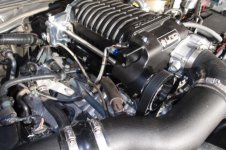
URD Supercharger 5th gen

There is a nice write up here:

Auxiliary Fuel Tank

I would then have to figure out where to put the spare and I fall further down the rabbit hole. I did look for a bigger tank but did not see anything specific to the 5th gen and I would loose some armor to boot. Lets get this thing in and running and see what happens. I am finding it is getting quite cold on the garage floor here. :smow:

Still waiting on the relay, I think I will trigger the fuel relay from the power to the Supercharger cooling pump. URD has the cooling pump relay triggered by the Number one Spark plug coil. The relay for the cooling pump sits behind the fuse box and is accessible to my tap for the fuel pump relay. Both will run on separate circuits on the BlueSea 5045. I have an 8ga supply wire running to the BlueSea which should be able to handle the 100A the box can run. One thing I noticed with the BlueSea was that the post to the battery really hangs out there when the cover is off. :eek:

Don't avoid the rabbit hole, just jump right on down it! I'm way down here already and I've got the beer. It's really unavoidable and causes more work and expense to do everything twice.

See auxiliary tank here:
TL460GXA24G-US - Long Range America

Get yourself a rear bumper and you're good to go!
 
While searching the repair manual (thanks to Doug) TOYOTA 2016-2019 4Runner Repair Manual RM27F0U I came across this page.

It appears the ECU is doing some management of the fuel pump. I may have to switch the lead for the relay. I do not want the surge tank pump pumping when the main tank is not pumping. Although, any excess fuel will just be returned to the surge tank. :frusty: URD has their included pump installed in the fuel tank and it is managed by the ECU. With my modified I have an always on situation. Hmm, gotta think about this one. :tinfoil3:
 

Attachments

I've had the URD kit installed for a couple years now. I don't run the tank low when I'm doing grades like you mention, but I do plan my fuel stops so that it's not an issue. I have run the 4Runner on mostly level ground below the 1/4 tank mark and not had any issues with the SC or lack of power. Up/down grades is of course a different story. I know fuel stations are more remote, especially high octane out in the country.
If you're going to do the aux pump, I'd use a relay to trigger it so that it's only on when the main pump is on. Either that or put a switch on the dash you can turn it on before grades/terrain. Most small airplanes have an engine driven pump and an electric pump. The latter is only run (by switch) for aerobatics, or take-off/landing.
 
I've had the URD kit installed for a couple years now. I don't run the tank low when I'm doing grades like you mention, but I do plan my fuel stops so that it's not an issue. I have run the 4Runner on mostly level ground below the 1/4 tank mark and not had any issues with the SC or lack of power. Up/down grades is of course a different story. I know fuel stations are more remote, especially high octane out in the country.
If you're going to do the aux pump, I'd use a relay to trigger it so that it's only on when the main pump is on. Either that or put a switch on the dash you can turn it on before grades/terrain. Most small airplanes have an engine driven pump and an electric pump. The latter is only run (by switch) for aerobatics, or take-off/landing.

we had to manually lean out the mixture on our cessnas :shrug: lol
 
I've had the URD kit installed for a couple years now. I don't run the tank low when I'm doing grades like you mention, but I do plan my fuel stops so that it's not an issue. I have run the 4Runner on mostly level ground below the 1/4 tank mark and not had any issues with the SC or lack of power. Up/down grades is of course a different story. I know fuel stations are more remote, especially high octane out in the country.
If you're going to do the aux pump, I'd use a relay to trigger it so that it's only on when the main pump is on. Either that or put a switch on the dash you can turn it on before grades/terrain. Most small airplanes have an engine driven pump and an electric pump. The latter is only run (by switch) for aerobatics, or take-off/landing.

I am leaning towards having the aux pump trigger off the main pump. Internet research :smash: shows Toyota using 4 different methods of regulating the main pump. My guess from my limited ability of reading circuits is that ours is an on/off because there are no resistors in the circuit.:twitch: I can not tell what the ECU is using as a data source.
 
If I don't want to drop the fuel tank, I could tap the number 1 wire here as this is the Fuel Pump Control ECU. It is not my favorite solution as it is so exposed. It may be worth dropping the tank enough to access the pump wire.
 

Attachments

  • PB202884.jpg
    PB202884.jpg
    33.2 KB · Views: 1,656
If I don't want to drop the fuel tank, I could tap the number 1 wire here as this is the Fuel Pump Control ECU. It is not my favorite solution as it is so exposed. It may be worth dropping the tank enough to access the pump wire.

I believe you need to drop the tank anyway with the URD kit to install the new fuel pump inside the tank, unless you already completed that part.
 
So with the fuel pump stalled due to my uncertainty as to the trigger wire, I thought I would fool around with other parts of the install.

Today it was the front bumper area. Now the instructions do not tell you to remove the front bumper. Any mechanic who can install the inter-cooler, pump and hoses with the front bumper on is a person with super amazing talent. After a failed attempt to put just the pump on and failing, I took the bumper off. I YouTubed it and found taking it off VERY easy (Except for the passenger Fog light. WTF would you put a shroud over it?:gun6:) I took the electrical supply off the driver side and gently laid the bumper down. Then removed the shroud on the passenger side and disconnected the passenger side fog light. The bumper then came free.
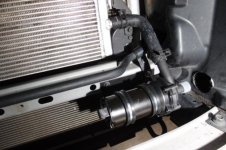
Various bits were removed so I had clear access to where the inter-cooler went. The instructions are pretty clear and relatively easy as I successfully completed that part of the install.

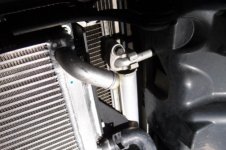
I installed the pump and drilled a pilot hole for where a supply line has to go. I connected the pump to the inter-cooler. REMEMBER! There is a plug on the radiator that needs to be removed(you can see one in the picture) and I almost cut one leg of the hose too short. :eek: I am having a bit of a problem figuring out the remaining hoses as there is a description for the hose routing but no pictures in the instructions. But it is late and a beer is calling :cheers:
 

Attachments

  • PB212891.jpg
    PB212891.jpg
    46.4 KB · Views: 1,609
  • PB212892.jpg
    PB212892.jpg
    40.8 KB · Views: 1,591
Supercharger is done! :reddance:

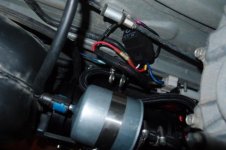
At Mechanic for a week, install time about 16 hrs. Most of issues came from external fuel surge tank install coupled with huge external filter. Feedback from the Mechanic was the kit is very well built but the instructions were a bit confusing at times.

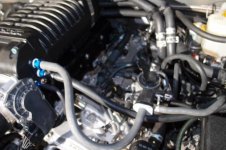
My first impression is that I can see the engine again.

I am currently in the learning phase for the piggyback ECU and transmission. No 4x4 burnouts yet. :lookout:
 

Attachments

  • PC032900.jpg
    PC032900.jpg
    30.3 KB · Views: 1,559
  • PC032898.jpg
    PC032898.jpg
    41.6 KB · Views: 1,696
  • PC032899.jpg
    PC032899.jpg
    50.7 KB · Views: 1,555
Driving Impressions first quarter of tank:

1) MPG at 19.6 (everything reset during build). This is my normal winter gas mpg so no change.
2) Fuel Surge tank is still noisy. The trigger for the surge tank relay is 100% all the time. The lift pump in the tank is controlled by the ECU so the Surge Tank may be running at less than 100% full. More research is needed. One solution is to have the Surge tank controlled by the ECU and have the tank pump at 100%. PWM control by the ECU of the fuel pump causes headaches for duplication of signal.
3) Idle noise from the Supercharger is noticeable in drive at stops. If I have it in neutral, no noise. I am not sure if Whipple uses Helical Gears on the supercharger drive unit.
4) Still in learning mode for the transmission and piggyback ecu so I have not been on the gas much. The few times I did it was great!
 
Great summary of the outcome so far! Do you plan to run on dyno once the tune is dialed in?

I am not sure. Today I did an uphill load test.... Holy Carp! I pegged the Ultra Gauge at 23 Lb boost. It was a completely different experience from driving the same hill W/O the Supercharger. The trans still needs training as I was pulling hard with no issues in 5th and then the trans downshifted on me and I was over 5k RPM. I noticed there were various levels of sound from the Supercharger. No load = No Sound, Moderate Load = Just getting started Sound, High Load = Deep Growl Get out of the way sound. :bat:

I also tested a quick merge onto the freeway. Could only get part way into the throttle as 35 to 75 was just so quick I overshot 75 and had to hit the brakes. :mod:

I did some 4wheeling on snow packed forrest service roads. No issues noted. The Supercharger did not engage at any time and the engine was its normal predictable self.

MPG is now at 20.2 as I has some highway time. Most of my MPG hit comes from the first 2 miles of driving. The Ultra Gauge indicates most of my driving is done Closed Loop, Very little boost or a little vacuum and timing advance 25-30 deg.
 
I am not sure. Today I did an uphill load test.... Holy Carp! I pegged the Ultra Gauge at 23 Lb boost. It was a completely different experience from driving the same hill W/O the Supercharger. The trans still needs training as I was pulling hard with no issues in 5th and then the trans downshifted on me and I was over 5k RPM. I noticed there were various levels of sound from the Supercharger. No load = No Sound, Moderate Load = Just getting started Sound, High Load = Deep Growl Get out of the way sound. :bat:

I also tested a quick merge onto the freeway. Could only get part way into the throttle as 35 to 75 was just so quick I overshot 75 and had to hit the brakes. :mod:

I did some 4wheeling on snow packed forrest service roads. No issues noted. The Supercharger did not engage at any time and the engine was its normal predictable self.

MPG is now at 20.2 as I has some highway time. Most of my MPG hit comes from the first 2 miles of driving. The Ultra Gauge indicates most of my driving is done Closed Loop, Very little boost or a little vacuum and timing advance 25-30 deg.

Awesome! Looking forward to some accel and sound videos!

I've never used Ultra Gauge, but 23 lbs boost? That must be reading in absolute pressure, right? Assuming sea level atmospheric pressure, 23 psi would be 15 psi atmosphere + 8 psi boost?
 
Last edited:
23 psi....seems like a lot for a stock internals (engine).
The magnuson are running less than 10....7 or 8 me thinks.

Will it hold up long term?
 
23 psi....seems like a lot for a stock internals (engine).
The magnuson are running less than 10....7 or 8 me thinks.

Will it hold up long term?

yea.....doubt thats the actual boost its building. if it is, hes gonna have some awesome videos to post, especially the one where he sends the internals to the moon.
 
I am pretty sure the 23 psi "boost" data he is reading is actually 23 psi MAP. So, absolute pressure in the intake manifold. At sea level, the atmosphere is ~15 psi. So, 23 psi = 15 psi atmosphere + 8 psi supercharger boost. When people discuss "boost" pressure they generally discuss in terms of gage pressure, not absolute pressure.

However, if discussing compressor maps, pressure ratio is used, which is PR: gage (boost) pressure + atmospheric pressure / atmospheric pressure. So, 2:1 pressure ratio is ~15 psi of boost. Or in the OP's case, a PR of ~1.5.
 
I am pretty sure the 23 psi "boost" data he is reading is actually 23 psi MAP. So, absolute pressure in the intake manifold. At sea level, the atmosphere is ~15 psi. So, 23 psi = 15 psi atmosphere + 8 psi supercharger boost. When people discuss "boost" pressure they generally discuss in terms of gage pressure, not absolute pressure.

However, if discussing compressor maps, pressure ratio is used, which is PR: gage (boost) pressure + atmospheric pressure / atmospheric pressure. So, 2:1 pressure ratio is ~15 psi of boost. Or in the OP's case, a PR of ~1.5.

Not sure either: Just reporting on the screen... Data is taken from OBD2 interface. MAF2 is calculated. Aprox elevation was 4500 above sea.
 

Attachments

  • Screenshot_20211215-192452[1].png
    Screenshot_20211215-192452[1].png
    66.3 KB · Views: 1,498
Last edited:

Members online

Forum statistics

Threads
278,312
Messages
3,554,085
Members
248,016
Latest member
Advally Service

Trending content

Back
Top