weight distributing hitch

BTW, i didn't install the sway bars coz the trailer doesn't sway and never noticed it to sway.
Those are spring bars, not sway bars. They are the mechanism that transfers weight from the tongue of the trailer to your front axle. Until you connect and properly adjust those, you do not have a weight distribution hitch.
 
Now I am not at all sure what it is exactly you are asking. With each successive post you make, the numbers and information provided seem to change. With the conflicting information provided, I don't think I can provide any further assistance. I suggest you go to a local U-Haul or RV service center and let them try to help you with your situation.

:frusty:

Uhaul in my place is retarded. I asked about weight dist hitches and the worker there was confused. Seems it was so alien to him.
 
Those are spring bars, not sway bars. They are the mechanism that transfers weight from the tongue of the trailer to your front axle. Until you connect and properly adjust those, you do not have a weight distribution hitch.

Yes ur right!

I wanted to put swaybar in my system however there's no port as to where to put it.
 
Yes ur right!

I wanted to put swaybar in my system however there's no port as to where to put it.

It now seems apparent that you did not get the weight distribution system you are trying to use new. If you had, you would have a manual, which would show you exactly how to setup the system. From the pics you posted, you do have an attachment point for the sway control system on the ball mount. it is the cast part that sticks out of the hitch on the right side. The spring bars attach to the hitch in the two large holes on either side of the hitch, just below the ball. I believe your system uses a shock type sway control system, which needs a mount installed on the 'A' frame of the trailer to attach the other end to. I would suggest you look online. You should be able to find an owners manual for your hitch, which would explain how all the necessary components work and how to set them up. You can also go to the e-trailer site. I believe they sell Reese hitches, and they have a lot of How-to info available there.
 
It now seems apparent that you did not get the weight distribution system you are trying to use new. If you had, you would have a manual, which would show you exactly how to setup the system. From the pics you posted, you do have an attachment point for the sway control system on the ball mount. it is the cast part that sticks out of the hitch on the right side. The spring bars attach to the hitch in the two large holes on either side of the hitch, just below the ball. I believe your system uses a shock type sway control system, which needs a mount installed on the 'A' frame of the trailer to attach the other end to. I would suggest you look online. You should be able to find an owners manual for your hitch, which would explain how all the necessary components work and how to set them up. You can also go to the e-trailer site. I believe they sell Reese hitches, and they have a lot of How-to info available there.
Yeah i got this used. I'm looking online now for the manuals. Thanks!
 
It now seems apparent that you did not get the weight distribution system you are trying to use new. If you had, you would have a manual, which would show you exactly how to setup the system. From the pics you posted, you do have an attachment point for the sway control system on the ball mount. it is the cast part that sticks out of the hitch on the right side. The spring bars attach to the hitch in the two large holes on either side of the hitch, just below the ball. I believe your system uses a shock type sway control system, which needs a mount installed on the 'A' frame of the trailer to attach the other end to. I would suggest you look online. You should be able to find an owners manual for your hitch, which would explain how all the necessary components work and how to set them up. You can also go to the e-trailer site. I believe they sell Reese hitches, and they have a lot of How-to info available there.
I think this video https://www.youtube.com/watch?v=Wgi-gAxvnPw

is exactly the same as mine.

But my hitch bar is pointed downwards and 4runner isn't as high or tall as pickup trucks. I might just remove the hitch and reinstall it so that the hitch bar would be pointing upwards thus the bar wouldn't hit the ground during humps.


here's the manual http://www.reeseprod.com/content/downloads/installation/N66022.pdf
 
I think this video https://www.youtube.com/watch?v=Wgi-gAxvnPw

is exactly the same as mine.

But my hitch bar is pointed downwards and 4runner isn't as high or tall as pickup trucks. I might just remove the hitch and reinstall it so that the hitch bar would be pointing upwards thus the bar wouldn't hit the ground during humps.


here's the manual http://www.reeseprod.com/content/downloads/installation/N66022.pdf

The direction of the hitch, pointing up or down, is determined by where the
ball height has to be in order for the trailer to ride as level as possible when hooked up to the tow vehicle. The specifics of each weight distribution systems setup will vary a bit between manufacturers, but he overall process is similar. You first have to make the necessary adjustment to the hitch/ball mount so that the trailer rides level when hooked up. Then the adjustments are made to achieve the correct amount of weight transfer on the tow vehicle. The easiest method I have found to set the ball height, is to set the trailer on LEVEL ground and using the lift jack, adjust the nose of the trailer up or down until the frame sits level. Then measure from the ground to the top of the ball socket on the trailer. This will establish the height the top of the tow ball has to be at when the tow bar is inserted into the hitch receiver on the tow vehicle. You then make the necessary adjustments to the hitch bar and ball mount to achieve that height.

I haven't read the owners manual for your specific system, but this process should be explained in it. Just be sure to follow the instructions closely. Also, make sure all fasteners, especially the ones holding the ball mount to the hitch bar are set to the recommended torque settings. If not, they will come loose at the most inopportune time. You will need a heavy duty torque wrench for this process. Also, check the manual for a list of all the parts and components that are supposed to be with the system. I wouldn't be surprised if you find that you don't have everything you are supposed to to makie the system work properly.
 
The direction of the hitch, pointing up or down, is determined by where the
ball height has to be in order for the trailer to ride as level as possible when hooked up to the tow vehicle. The specifics of each weight distribution systems setup will vary a bit between manufacturers, but he overall process is similar. You first have to make the necessary adjustment to the hitch/ball mount so that the trailer rides level when hooked up. Then the adjustments are made to achieve the correct amount of weight transfer on the tow vehicle. The easiest method I have found to set the ball height, is to set the trailer on LEVEL ground and using the lift jack, adjust the nose of the trailer up or down until the frame sits level. Then measure from the ground to the top of the ball socket on the trailer. This will establish the height the top of the tow ball has to be at when the tow bar is inserted into the hitch receiver on the tow vehicle. You then make the necessary adjustments to the hitch bar and ball mount to achieve that height.

I haven't read the owners manual for your specific system, but this process should be explained in it. Just be sure to follow the instructions closely. Also, make sure all fasteners, especially the ones holding the ball mount to the hitch bar are set to the recommended torque settings. If not, they will come loose at the most inopportune time. You will need a heavy duty torque wrench for this process. Also, check the manual for a list of all the parts and components that are supposed to be with the system. I wouldn't be surprised if you find that you don't have everything you are supposed to to makie the system work properly.

Yeah i didn't know this to be that complex. I will probably leave the hitch alone and assume that once the torsion bars are installed, the hitch bar wouldn't move up and down as much during towing and prevents it to bang the ground as compared if the torsion bars aren't installed.
 
Those are spring bars, not sway bars. They are the mechanism that transfers weight from the tongue of the trailer to your front axle. Until you connect and properly adjust those, you do not have a weight distribution hitch.

When I installed the spring bars the clearance from the ground is only 6 inches. Is that too low? Do I need to reverse the hitch bar to make the hitch and spring bars sit higher?


28tao0n.jpg
 
Yep, too low. There is a rough guide for the height you want to set the ball in the instructions you linked. There is a good chance you will need to flip it.
 
When I installed the spring bars the clearance from the ground is only 6 inches. Is that too low? Do I need to reverse the hitch bar to make the hitch and spring bars sit higher?


28tao0n.jpg

According to the pic, the part you are measuring is the end of the spring bar where the chain that suspends it from the trailer 'A' frame is. When you are setting up the system to achieve the correct amount of weight transfer, the tension bars need to be lifted by the chains to create the correct amount of tension on the bars. In your pic, the bar does not appear to be under any tension, which is why the end of the bar is so close to the ground. The proper way to create this tension on the bars is to use the trailer lift jack, once the coupler is locked onto tee ball, to raise the front of the trailer. Because the trailer is coupled to the tow vehicle, it also raises the rear of the tow vehicle. This causes the free ends of the spring bars to pivot up toward the trailer frame. This causes the length of chain necessary to catch on the support hooks to shorten. Once you have raised the ends of the spring bars enough to be able to hook the correct chain link on the hooks,(the correct chain link is determined during the initial setup process) you then lower the trailer jack. As the trailer tongue lowers, the chain connection to the spring bars now creates the tension on the spring bars, which then forces the tow vehicle frame to rotate across the rear axle and force some of the load to the front axle. If you have the proper chain link hooked, the tension bars will be under a lot of tension, and the ends should not be close enough to the ground to hit (under normal circumstances). As for changing the position of the ball mount/hitch, if the trailer is riding level with the current setup, flipping the hitch bar upside down will not change anything, because you will still have to remove the ball mount and then reattach the ball mount in the correct mounting holes, so that it still rides level, which will be at the same height that it now is.

Again, I strongly suggest you carefully read the manual, several times if necessary, until you fully understand how to correctly setup and use the system. If you don't, you stand the very real risk of having a serious failure of the system or getting hurt.

 
When I installed the spring bars the clearance from the ground is only 6 inches. Is that too low? Do I need to reverse the hitch bar to make the hitch and spring bars sit higher?


28tao0n.jpg


How does the trailer sit? Should be level to slightly nose down.
 
According to the pic, the part you are measuring is the end of the spring bar where the chain that suspends it from the trailer 'A' frame is. When you are setting up the system to achieve the correct amount of weight transfer, the tension bars need to be lifted by the chains to create the correct amount of tension on the bars. In your pic, the bar does not appear to be under any tension, which is why the end of the bar is so close to the ground. The proper way to create this tension on the bars is to use the trailer lift jack, once the coupler is locked onto tee ball, to raise the front of the trailer. Because the trailer is coupled to the tow vehicle, it also raises the rear of the tow vehicle. This causes the free ends of the spring bars to pivot up toward the trailer frame. This causes the length of chain necessary to catch on the support hooks to shorten. Once you have raised the ends of the spring bars enough to be able to hook the correct chain link on the hooks,(the correct chain link is determined during the initial setup process) you then lower the trailer jack. As the trailer tongue lowers, the chain connection to the spring bars now creates the tension on the spring bars, which then forces the tow vehicle frame to rotate across the rear axle and force some of the load to the front axle. If you have the proper chain link hooked, the tension bars will be under a lot of tension, and the ends should not be close enough to the ground to hit (under normal circumstances). As for changing the position of the ball mount/hitch, if the trailer is riding level with the current setup, flipping the hitch bar upside down will not change anything, because you will still have to remove the ball mount and then reattach the ball mount in the correct mounting holes, so that it still rides level, which will be at the same height that it now is.

Again, I strongly suggest you carefully read the manual, several times if necessary, until you fully understand how to correctly setup and use the system. If you don't, you stand the very real risk of having a serious failure of the system or getting hurt.
Thank you so much for your help. I'll probably need to visit an RV service center to help me set up the hitch.
 
Trailer looks to be at a good angle. I think you'll need to adjust the angle of the ball/hitch on the draw bar. The manual should explain this process. That would raise the end of the torsion bars up. Also, just looking at the picture, I'm not sure about your measurements. Seems to have lowered the rear more than 1.5 inches and raised the front a couple.
 
IMO I like WDH

TechWrench Since my last post I have been checking into the WD hitch and the V-6. I am yet to find ANY documentation from Toyota confirming this. I have talked to a service manager and a parts manager at a dealer and they can find nothing from Toyota to confirm this.

It does state that for the V8 to carry it full weight you need a weight distributing hitch. But I have been unable to find any claim from Toyota stating or advising against using a WD hitch with the V6.

Where do you get your info? I do see posts from individuals who say what you say but I see post from individuals that disagree. Peoples opinions are just that, opinions. What proof is there to say that you shouldn't use a WD hitch with a V6?

I am currently on hold with a Toyota rep who is researching this.

They mentioned exactly what is in the manual:

Towing capacity (trailer weight + cargo
weight), kg (lb.):
For weight carrying hitch 2268 (5000)
Also for weight distributing hitch2UZ- FE engine only
Two- wheel drive models
3311 (7300)
Four- wheel drive models
3175 (7000)

According to the rep I spoke to there are no issues, notices warning or whatever that speak about problems or other issues using a WD hitch with the V6. The rep then stated had there been any problems associated with this they would be able to reference them.

I have checked with Toyota three different ways and I have found nothing from Toyota that states there is a problem using a WD hitch with the V6 as long as I stay within the recommended weight limits outlined in the owners manual.

*I agree. I didn't see anything and the manual and I don't care to look. IMO it would be safer and better for the vehicle to have WDH than just letting the rear end sag with up to 500 pounds pounds of weight on it. The XREAs suspension isn't cheap to replace.
My camper just bounced up and down the (one time) short ride I didn't use the WDH. I payed for the ride of a Limited 4Runner, not a bucking bull. :)
 
Last edited:
*I agree. I didn't see anything and the manual and I don't care to look. IMO it would be safer and better for the vehicle to have WDH than just letting the rear end sag with up to 500 pounds pounds of weight on it. The XREAs suspension isn't cheap to replace.
My camper just bounced up and down the (one time) short ride I didn't use the WDH. I payed for the ride of a Limited 4Runner, not a bucking bull. :)

It's your vehicle, and you can do what you will with it. Just because you don't wish to look at the manual, doesn't mean the warning isn't there. If you have a V6 with the lighter duty, crossmember mounted hitch, it is NOT rated for use with a WDH system. If you decide to use one anyway, that is your choice. And if your vehicle suffers any damage to the rear crossmember from using WDH, that is on you. If you took the time to fully read all the posts in this, and other threads on this topic, you should have seen all the reasons that support my, and others, answers to the original questions. But, if you still insist on ignoring the information provided, that is your choice. Enjoy it.
 
Hello,

First post here, lots of great info, specially in this thread. I'm on the same boat as some, trying to figure out what travel trailer I can safely tow. I didn't see a post covering this aspect of the WD vs WC receivers so I thought I would resurrect this thread and hope to contribute.

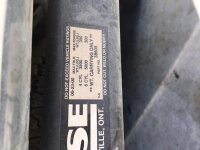
To either clear up or add to some of the confusion, I have a 2000, 2WD, 6 cyl. with the OEM receiver. It is mounted to the frame but it is stated on the placard that it is to be used for "WT. CARRY ONLY" so for my truck the mounting style is not definitive proof that it will work with a WDH.

Sorry for the pictures being sideways. Not sure why they loaded that way.
 

Attachments

  • IMG_4430.jpg
    IMG_4430.jpg
    135.9 KB · Views: 450
  • IMG_4354.jpg
    IMG_4354.jpg
    131.5 KB · Views: 416
Last edited:
It seems pretty obvious, to me. The ratings on the label are specific, " WT. Carrying Only", with a max weight limit of 3500 lbs and a max tongue weight limit of 350 lbs for the V4 equipped vehicle, and 5000lbs/500lbs max limit on the V6 equipped vehicle. Therefore, the engineers that designed the vehicle/hitch system did not want you to use a WD/Weight Distribution towing system with it. So, to answer what I think is your initial question, Yes, the fact that the hitch receiver is mounted to the frame, does not mean you can ignore the warning label and use a WD towing system.

If you have the V6 model, then the 500lb/500lb max limits using ONLY a Weight Carrying tow system are your designed limits. If you wish to ignore these warnings, and use a WD system, it's your choice. You will have to live with the possible consequences.
 
Last edited:
It seems pretty obvious, to me. The ratings on the label are specific, " WT. Carrying Only", with a max weight limit of 3500 lbs and a max tongue weight limit of 350 lbs for the V4 equipped vehicle, and 5000lbs/500lbs max limit on the V6 equipped vehicle. Therefore, the engineers that designed the vehicle/hitch system did not want you to use a WD/Weight Distribution towing system with it. So, to answer what I think is your initial question, Yes, the fact that the hitch receiver is mounted to the frame, does not mean you can ignore the warning label and use a WD towing system.

If you have the V6 model, then the 500lb/500lb max limits using ONLY a Weight Carrying tow system are your designed limits. If you wish to ignore these warnings, and use a WD system, it's your choice. You will have to live with the possible consequences.

It wasn't a question. Like I wrote, I was contributing to this thread on an aspect I did not see had been discussed. Pointing out that the installation method is not proof of the capability as that may not be obvious if someone is missing their placard.
 

Members online

Forum statistics

Threads
278,309
Messages
3,554,075
Members
248,016
Latest member
Advally Service

Trending content

Back
Top