Weight vs diameter effect on mpg?

Northern 4Runner

New member
Been reading a lot about tires and haven't come across what I'm looking for.

P285/70/17 cooper at3 are only 45 lbs.

My stock TE's bridgestone's (who's idea was that anyway!?) weigh 39 lbs.

Most 265/70/17 replacement tires I have looked at weigh more than the 45 lbs the at3 285's weigh.

My question is this, will the larger diameter 285 at3 have the same effect on my mpg as going with a heavier a/t tire in the stock 265 size?
If so I'd rather have the added clearance and the better looks the 285's bring.

Anyone have experience with a similar situation to what I'm describing?

Thanks:yo:
 
Register to hide this ad
Probably yes -
weight of tire makes big difference but also particular tires rolling resistance and, when you change diameter, also changing final drive ratio a little
 
Probably yes -
weight of tire makes big difference but also particular tires rolling resistance and, when you change diameter, also changing final drive ratio a little


I can also get cooper atw in a p series 285 that is a low rolling resistance tire because of silica compounds.

Anyone running cooper 285/70/17 in a p series and can comment on their mpg?
Just curious before I drop about $1000 that's all. Really like a 285 but don't want to loose 3 mpg or more. Currently I see 10.5-11 l/100km on my 1h15min drive to work.
 
Been reading a lot about tires and haven't come across what I'm looking for.

P285/70/17 cooper at3 are only 45 lbs.

My stock TE's bridgestone's (who's idea was that anyway!?) weigh 39 lbs.

Most 265/70/17 replacement tires I have looked at weigh more than the 45 lbs the at3 285's weigh.

My question is this, will the larger diameter 285 at3 have the same effect on my mpg as going with a heavier a/t tire in the stock 265 size?
If so I'd rather have the added clearance and the better looks the 285's bring.

Anyone have experience with a similar situation to what I'm describing?

Thanks:yo:

You will lose 2-3 mpg going to 285's. There is no way around that. Why?

You speak of weight but that is a misnomer. Really you should be talking about unsprung rotational mass. There is a big difference. Sure, there are tires heavier out there in a smaller size, but the key is the mass and where the mass is located. Almost all of a tire's mass is in the tread. Just the one inch diameter change, coupled with an additional six pounds, means it is going to affect the efficiency of the 4Runner's acceleration characteristics, especially around town where you are constantly stopping and starting. On the highway you won't see a big difference.

Now you have to factor in the tire tread and tread width and the coefficient of adhesion and how that affects the rolling resistance. Suffice to say it is a big deal, which is why they put the nice light all season tires on the stock 4Runner.


In addition
 
I didnt have a lot of data because we only had the first TRDP for about a month, but the second one came with dealer-installed 20x10s with 33x12.5 MT, adding about 50lb per corner. The ride was aweful, but we only lost about 1mpg relative to the previous stock one (19-21, down from 20-22). Going to some ~43lb 285s on stock-weight 17x8s brought us back up to the fuel economy we were seeing with the previous one. It was also, not surprisingly, noticably peppier to drive after the change.

But, I am probably more the exception than the rule. We have 15+ mile commutes on state highways averaging about 1 stop every 1-1.5 miles at 50-55mph. As long as you are easy on the brakes and let off early, you can generally make up most of the lost energy by effectively using that extra weight to coast a bit further. Of course, that isnt always possible, or even a priority for most drivers, hence the reduced mileage with increased weight.
 
Last edited:
I went from the Dunlaps, to Cooper Discover STT Pro load range E. went from 18 avg MPG to 14-15 MPG. I believe now the reason we see the street tires on the 4Runners was for gas mileage. I don't believe any of us bought the 4Runner for gas mileage anyway, wasnt the selling point for me. Love the Coopers though.
 
Thanks for the input. Lots to think about for sure. My trip to work is about 20km's at 110 km/h and 80km's at 80-90 km/h. I work in the woods for a living, and currently have a 2nd gen taco trd off road I'm using, but looking to upgrade to our 4Runner for work purposes because it's new and so much nicer. If I only loose 1mpg going to a cooper at3 or atw (285) I can live with that and the underside of the 4Runner will likely be happier as well.
I will be doing a 2.5/1.5 lift/level if I go 285 for sure.

I considered 275's but they are considerably more $ than the 285's that I've been pricing, mostly because they are all lt, which I really don't need, and haven't needed in the past.
 
You will lose 2-3 mpg going to 285's. There is no way around that. Why?

You speak of weight but that is a misnomer. Really you should be talking about unsprung rotational mass. There is a big difference. Sure, there are tires heavier out there in a smaller size, but the key is the mass and where the mass is located. Almost all of a tire's mass is in the tread. Just the one inch diameter change, coupled with an additional six pounds, means it is going to affect the efficiency of the 4Runner's acceleration characteristics, especially around town where you are constantly stopping and starting. On the highway you won't see a big difference.

Now you have to factor in the tire tread and tread width and the coefficient of adhesion and how that affects the rolling resistance. Suffice to say it is a big deal, which is why they put the nice light all season tires on the stock 4Runner.

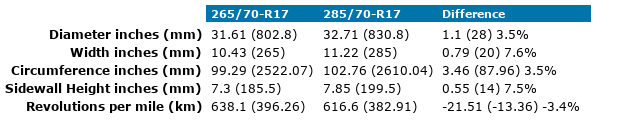
The odometer will be off by 3.4% per every mile (url=https://www.tacomaworld.com/tirecalc?tires=265-70r17-285-70r17]
265x70xR17-285x70xR17.png
[/url])

So how are you accounting for the odometer difference when you say 2-3MPG drop. I do agree with you having additional tire mass will greatly impact MPG. When I race on velodrome, I do use lightest 700C tires and wheels I have to improve acceleration.
 
I went from the Dunlaps, to Cooper Discover STT Pro load range E. went from 18 avg MPG to 14-15 MPG. I believe now the reason we see the street tires on the 4Runners was for gas mileage. I don't believe any of us bought the 4Runner for gas mileage anyway, wasnt the selling point for me. Love the Coopers though.

Load range E and the MT likely killed the mileage more than the fact they are 285's but I could be wrong.
 
The odometer will be off by 3.4% per every mile (url=https://www.tacomaworld.com/tirecalc?tires=265-70r17-285-70r17]
265x70xR17-285x70xR17.png
[/url])

So how are you accounting for the odometer difference when you say 2-3MPG drop. I do agree with you having additional tire mass will greatly impact MPG. When I race on velodrome, I do use lightest 700C tires and wheels I have to improve acceleration.


Another good point if people are using the evic to get their mpg numbers.
 
It's complicated, but generally the tire weight and rolling resistance are the main factors impacting mpg. It has very little to do with diameter, although there is obviously a relationship between weight and diameter. Additionally, diameter impacts effective gearing.

I can tell you this with certainty, There is no free lunch. You cannot have good off-road performance and great mpg. There is a balance.. but it is always give and take. P rated tires are not going to hold up to much abuse... Just have to pick your priorities. There is no magic tire that does it all well. ATs in LT form are the middle of the road. They are decent on and off. P rated is going to be more of a road tire while MTs are going to be more off-road performance oriented.

Those of us who push things a bit.. realized a long time ago to stop worrying about mpg. You can keep the mpg decent... but don't expect to be hitting difficult terrain and not struggling or ripping sidewalls without having some MPG downside.

Just pick where you want to be on the scale.. mpg and road performance are on one end and off road is on the other. You can be in the middle ,but can't have it all.

.
 
For constant speeds, yes. For stop and go, weight is the killer.

I agree. I do mostly highway driving but when I lived in the city, wide tires seemed to affect my trucks more than just heavy tires. Every vehicle is different as is everyone's driving habits so YMMV.
 
Let's compare two of the same tires to check my understanding; Cooper AT3s in LT275/70 and P285/70. The LT tire is 32.18" in diameter and 54 pounds while the P tire is 32.76" and 45 pounds. The smaller and also narrower tire is heavier. So if I'm understanding correctly, around town the 275s will get worse mileage than the 285s, but on the highway the 285s will be a tiny bit worse?
Because the 275s have more mass in the tread because they are 10-ply vs the P tire is 4-ply, and the 285s are wider (more rolling resistance)?

Also my p rated tires are holding up pretty well, and I wheel reasonably hard.

LTs: https://www.treaddepot.com/#!productDetail/tireStandardFitment/90000002734
Ps: https://www.treaddepot.com/#!productDetail/tireStandardFitment/90000002702
 
Last edited:
I can also get cooper atw in a p series 285 that is a low rolling resistance tire because of silica compounds.


I'm currently running Cooper Discoverer A/Tw in the stock size, Load E (so same size but heavier than stock).

I have no figures, but on the interstate (usually around 75 mph/121 kph) I've noticed I never get better than 18-18.5 mpg (7.65 to 7.9 km/L). On Montana roads, I've noticed anything over 70 mph (113 kph) and my fuel economy drops significantly. I remember reading an article that air resistance increases exponentially as speed increases (ie. it is not a straight line on a graph, rather air resistance increases even faster each time speed increases). All vehicles, in my opinion, have a "sweet spot" for the best combination of speed and fuel economy. With that in mind, the 4Runner is kind of a "brick". :)

No matter, for what my 4Runner does -- all things taken together -- I'm very happy. Sure, fuel economy isn't the best, but all of the other things significantly over-shadow that (at least for me).

And, I've been THOROUGHLY impressed with the Cooper Discoverer A/Tw tires! We just got more snow (not a lot), and the traction I get with them is outstanding. Especially when you consider it's still an all-year, all-terrain tire. I'm sure the A/T3 is good, but for Canada I would definitely recommend the A/Tw.

My tire result: OEM Dunlop Grand Trek - 39 lbs. / LT265/70-17 Cooper Discoverer A/Tw - 51 lbs.
 
Last edited:
Let's compare two of the same tires to check my understanding; Cooper AT3s in LT275/70 and P285/70. The LT tire is 32.18" in diameter and 54 pounds while the P tire is 32.76" and 45 pounds. The smaller and also narrower tire is heavier. So if I'm understanding correctly, around town the 275s will get worse mileage than the 285s, but on the highway the 285s will be a tiny bit worse?
Because the 275s have more mass in the tread because they are 10-ply vs the P tire is 4-ply, and the 285s are wider (more rolling resistance)?

Also my p rated tires are holding up pretty well.

LTs: https://www.treaddepot.com/#!productDetail/tireStandardFitment/90000002734
Ps:

https://www.treaddepot.com/#!productDetail/tireStandardFitment/90000002702

I agree that a p rated tire can handle woods roads, I don't hard core off road, but I do see rugged terrain with my job.

I have a set of 265/75/16 atw' waiting to go on my Tacoma once the frame replacement is complete, so I'll be able to judge them.

I also travel 50k a year for work, trying to find a balance between mpg and clearance/off road ability.

The less gas I put in my rig, the more money in my pocket. If it were just for pleasure, I'd go 285 for sure, but I think I'm leaning towards 265's even though 285's look so much better:eyebrows:
 

Members online

Forum statistics

Threads
278,307
Messages
3,554,053
Members
248,016
Latest member
Advally Service

Trending content

Back
Top