What did you do with your 4runner today?

It is a very close friend's garage but the majority of modifications and maintenance are done there so its convienant. He was actually the one driving when the cv and brace both broke. Torque and a few other things can break a ring and pinion. I actually noticed that a few people have toasted a ring and pinion on here. East coast gear solutions is definitely the people to go to and who everyone on here uses apparently. They had my new one at my door in two days. Theres a chevelle and a few 68 69 camaros along with a few corvettes in that shop that need to be finished.

What did you do to drive when the front CV blew? Unbolt the front drive shaft and lock the center?
 
What did you do to drive when the front CV blew? Unbolt the front drive shaft and lock the center?

Exactly, it was a complete shock and took a minute for me to accept that the rear dif had gone. It was a really good inclune with a lot of small loose rocks I was limping it out on. I don't think the transfer case these have like only one source to deliver the power to. It didn't know how much to distribute then gave me a good chunk of torque and boom went my differential.
 
1. made a deal on a set of fj coils for $100, they're off a 2012. Good deal?

2. noticed someone stole one of the covers(idk what they're called) from my stock roof rails.:frusty:
 
Last edited:
holy hell is that your garage? with a freakin lift?

Also WTF did you do to that diff? I've never seen ring gear carnage like that

see my build thread around the time i was installing my rear locker. I didn't have any teeth left on my ring gear.

Glad I didn't. Rear diff sounds pricey...

I ripped out my rear diff in 4wd with the center locked. All it takes is enough play in the pinion bearing and enough torque to deflect the factory pinion crush sleeve and you have yourself a busted differential. Not a bad idea to install a solid pinion spacer if your off-roading regularly.
 
I ripped out my rear diff in 4wd with the center locked. All it takes is enough play in the pinion bearing and enough torque to deflect the factory pinion crush sleeve and you have yourself a busted differential. Not a bad idea to install a solid pinion spacer if your off-roading regularly.

Can you explain what the entails/does? I see it mentioned with the guys who regear all the time
 
I feel like theres a word missing in this question lol what are you asking

Sorry, i meant like how difficult is the install (what it entails) and why a solid pinion spacer is better than stock (crush sleeve??)

once you do it do you have to set pinion depth and backlash and stuff? or can you install the spacer without having to do that
 
Sorry, i meant like how difficult is the install (what it entails) and why a solid pinion spacer is better than stock (crush sleeve??)

once you do it do you have to set pinion depth and backlash and stuff? or can you install the spacer without having to do that

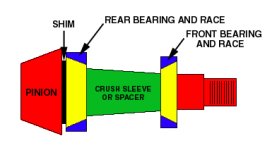
A crush sleeve is used in the assembly of a differential between the front bearing and the rear bearing in which the pinion gear rides on.
gear_layout.jpg

It's called a "crush" sleeve because it's designed to collapse slightly. Allowing you to set the bearing pre-loads for the front and rear pinion bearing without having to add or remove shims. You tighten the pinion nut until the bearing preload provides the proper required rotation torque the pinion gear should require to spin freely. Basically you tighten the pinion nut until the pinion gear won't turn unless your physically turning it with your hand.

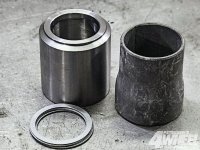
The difference between a crush sleeve and a solid pinion spacer is
crush-sleeve-and-solid-spacer.jpg
The solid spacer is well, solid it doesn't allow any give or flex the pre-load of the bearings are set with shims If just installing the spacer and not re-gearing you can measure the factory crush sleeve and start at that spacing, then back down on the shims from there.

The shim in the first image is the shim that places the pinion gear biting position in the center of the ring gear meshing position. (so you can see during assembly if re-gearing your going to go through a lot of, take apart, put together, check, take apart, put together, check, etc.) If using the factory gears and just installing a spacer you won't have to worry to much about the gear meshing position it should wind up where it was before it was disassembled.

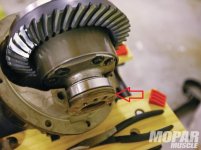
The back lash is set by bearing caps shown with a red arrow here:
mopp-1107-12-o+moser-engineering-plymouth-valiant-rearend+differential-backlash (800x600).jpg
These are located on both sides of the differential and adjust where the ring gear sits in relation to the pinion gear (setting backlash). These caps also adjust the bearing pre load of the carrier bearings, So once you get the backlash set you also have to tighten these rings to the proper torque (without changing the backlash) ensuring the bearings do not have any end play as well as are not tight enough to cause damage. (there is a rotational torque allowance here as well to tight the diff wont spin too loose it's going to wine like crazy and your talking 1000th's of inches)


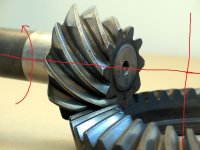
By installing a solid pinion spacer you can prevent the pinion gear from deflecting:
header.jpg
away from the ring gear. As you can see if the pinion gear moves away from the ring gear the less surface material the teeth have to mesh against thus causing the ring gear teeth to break away typically breaking through several teeth before lining up again.

hope this helps understand whats going on in there a little more. A crush sleeve works fine for daily driving and common torque loads. It doesn't do much good for the fluent off-roader though.

 

Attachments

  • gear_layout.jpg
    gear_layout.jpg
    46.4 KB · Views: 1,403
  • crush-sleeve-and-solid-spacer.jpg
    crush-sleeve-and-solid-spacer.jpg
    57.7 KB · Views: 986
  • mopp-1107-12-o+moser-engineering-plymouth-valiant-rearend+differential-backlash (800x600).jpg
    mopp-1107-12-o+moser-engineering-plymouth-valiant-rearend+differential-backlash (800x600).jpg
    51.4 KB · Views: 878
  • header.jpg
    header.jpg
    122.5 KB · Views: 1,259
It wasn't really too bad and getting it through them is absolutely the cheapest way to do it. It should be about $620 after they get my core and reimburse me for it. That's ready to go out the box slap it in and drive.

you didn't go with a locker? aw come on man..
 
A crush sleeve is used in the assembly of a differential between the front bearing and the rear bearing in which the pinion gear rides on.
View attachment 99729

It's called a "crush" sleeve because it's designed to collapse slightly. Allowing you to set the bearing pre-loads for the front and rear pinion bearing without having to add or remove shims. You tighten the pinion nut until the bearing preload provides the proper required rotation torque the pinion gear should require to spin freely. Basically you tighten the pinion nut until the pinion gear won't turn unless your physically turning it with your hand.

The difference between a crush sleeve and a solid pinion spacer is
View attachment 99732
The solid spacer is well, solid it doesn't allow any give or flex the pre-load of the bearings are set with shims If just installing the spacer and not re-gearing you can measure the factory crush sleeve and start at that spacing, then back down on the shims from there.

The shim in the first image is the shim that places the pinion gear biting position in the center of the ring gear meshing position. (so you can see during assembly if re-gearing your going to go through a lot of, take apart, put together, check, take apart, put together, check, etc.) If using the factory gears and just installing a spacer you won't have to worry to much about the gear meshing position it should wind up where it was before it was disassembled.

The back lash is set by bearing caps shown with a red arrow here:
View attachment 99733
These are located on both sides of the differential and adjust where the ring gear sits in relation to the pinion gear (setting backlash). These caps also adjust the bearing pre load of the carrier bearings, So once you get the backlash set you also have to tighten these rings to the proper torque (without changing the backlash) ensuring the bearings do not have any end play as well as are not tight enough to cause damage. (there is a rotational torque allowance here as well to tight the diff wont spin too loose it's going to wine like crazy and your talking 1000th's of inches)


By installing a solid pinion spacer you can prevent the pinion gear from deflecting:
View attachment 99734
away from the ring gear. As you can see if the pinion gear moves away from the ring gear the less surface material the teeth have to mesh against thus causing the ring gear teeth to break away typically breaking through several teeth before lining up again.

hope this helps understand whats going on in there a little more. A crush sleeve works fine for daily driving and common torque loads. It doesn't do much good for the fluent off-roader though.

Definitely helps. I thought that the shims set backlash, what are the bearing caps? Can't you just use a shim that would put the solid pinion spacer in the same spot as the factory crush sleeve?

and aka short answer is yes this is way over my head :crazy:
 
Definitely helps. I thought that the shims set backlash, what are the bearing caps? Can't you just use a shim that would put the solid pinion spacer in the same spot as the factory crush sleeve?

and aka short answer is yes this is way over my head :crazy:

The bearing caps set the back lash, the picture up there showing the carrier with the ring gear on it with a red arrow pointing to one side of the diff is showing a bearing cap if you look closely you can see it is threaded very finely to allow adjustment. On SOME carrier assemblies you only have a bearing cap on one side (the toyota diff has a cap on each side). On the differentials that only have one cap shims are used on one side of the carrier to set the back lash. With the bearing caps you can just unscrew one side and tighten the other to move the ring gear towards or away from the pinion gear.

You do use shims to make the solid pinion spacer the same or similar length to the crush sleave when it's installed. but these shims have no effect on the position of either gears. They simply determine how tight the front and rear pinion bearings ride.

With the factory crush sleeves you don't need shims in between the front and rear pinion bearings because the sleeve allows you to crush it tight enough to set the bearing pre load.

You're not alone with it being over your head many master technicians will never step foot inside of a diff even though they know how it works they don't want to deal with it. I've heard it referred to as "you have to speak differential to build one" Its just like anything though if you research it enough and practice it enough you'll become an expert at some point.
 
The bearing caps set the back lash, the picture up there showing the carrier with the ring gear on it with a red arrow pointing to one side of the diff is showing a bearing cap if you look closely you can see it is threaded very finely to allow adjustment. On SOME carrier assemblies you only have a bearing cap on one side (the toyota diff has a cap on each side). On the differentials that only have one cap shims are used on one side of the carrier to set the back lash. With the bearing caps you can just unscrew one side and tighten the other to move the ring gear towards or away from the pinion gear.

You do use shims to make the solid pinion spacer the same or similar length to the crush sleave when it's installed. but these shims have no effect on the position of either gears. They simply determine how tight the front and rear pinion bearings ride.

With the factory crush sleeves you don't need shims in between the front and rear pinion bearings because the sleeve allows you to crush it tight enough to set the bearing pre load.

You're not alone with it being over your head many master technicians will never step foot inside of a diff even though they know how it works they don't want to deal with it. I've heard it referred to as "you have to speak differential to build one" Its just like anything though if you research it enough and practice it enough you'll become an expert at some point.

Thanks for explaining that, i think I got it. But yeah, props to you. :crazy:
If I ever have to regear I'd probably try it myself but thats a long ways down the road. I'd love to do it just to say I did lol
 
Remember when I was going to get WK sliders but he wasn't making the xreas bracket? and then I ordered shockworks sliders and they wont be here till thanksgiving?

:whistle:

horrorcat-meme-generator-me-no-jealous-really-me-no-jealous-3bd77f.jpg

Haha. Yeh bud..I posted and was thinking it would be cool if there was a way you COULDN'T see it (reverse tag haha)

Also, aha...awesome differential breakdown! You're the man!
 

Members online

Forum statistics

Threads
278,316
Messages
3,554,113
Members
248,016
Latest member
Advally Service

Trending content

Back
Top