Wheel Shake when braking

I just went through the same thing. Wheel was shaking during stops. I replaced my front rotors and brakes with OEM and its good as new again. I had around 65k on my original rotors/pads. Not bad.
 
Once warped best to replace. If just lightly scored and no heat damage, turning works great. No experience as I do my own, but have always heard that improper torque on lugs causes warping.
 
I don't know if I entirely agree with that... I mean if the Rotors are brand new at 25mm, and you get them at 24.7mm and then turn them to 24.4mm I don't see that significantly affecting the heat distribution when the engineers have spec'd 23mm as minimum turn-to (which I would assume is derived from many factors, one of which is heat distribution/soaking effects.)

We use a ProCut on-car brake lathe at work and it does a great job on the rotors. I'm not saying don't get new rotors if you want with every brake job (hell, most of them are not that expensive and it saves time if you're doing it in the garage/backyard;) just that turning rotors isn't a bad thing if it's done right and you can easily do it.
agreed.
Sure. Turning them removes capacity though. Think about it: If the rotors could be thinner for all applications why wouldn't they just start at that thickness new?
because rotors wear down from braking. they will get thinner during the life of the pads, regardless if they are resurfaced or not.

the thickness of the rotor also coincides with the amount of fluid in the reservoir. it is completely safe to turn/use rotors down to the spec'd minimums, this is designed in, and is specific to each rotor and vehicle.

also, typically rotors don't warp. so them getting thinner isn't an issue in that regard.
 
i say rotors... if it was balancing, you would feel it while driving without applying brake pressure...
 
Huh?????? Post that on the 3rd gen forum. :-)

Duck and cover.

The term "warped rotor" is mainly a hold-over from long long ago. What "warps" rotors today is excessive heat that vitrifies the pad material and deposits it onto the rotor unevenly; this results in runout that reduces braking performance and causes pulsation.

The repair is still the same, replace the pads and turn the rotors.
 
The term "warped rotor" is mainly a hold-over from long long ago. What "warps" rotors today is excessive heat that vitrifies the pad material and deposits it onto the rotor unevenly; this results in runout that reduces braking performance and causes pulsation.

The repair is still the same, replace the pads and turn the rotors.

I did a runout test on my 2002 before I spent $600 on new top of the line DBA rotors and those babies were crooked as a politician. I wrote everything down as far as the variance but that went with the truck when I traded it in and can't recall the variance exactly. DS was worse tha PS for whatever reason. They were way out of spec according to alldatadiy specs.
 
Finally got my front OEM rotors on and all the wheel shake while braking is gone. Easy work to replace them, thanks for all the comments. JG
 
The term "warped rotor" is mainly a hold-over from long long ago. What "warps" rotors today is excessive heat that vitrifies the pad material and deposits it onto the rotor unevenly; this results in runout that reduces braking performance and causes pulsation.

The repair is still the same, replace the pads and turn the rotors.

Thanks, BWI, for as concise an explanation as I've ever read.

A favor though; please explain what is meant by "runout".
 
The term "warped rotor" is mainly a hold-over from long long ago. What "warps" rotors today is excessive heat that vitrifies the pad material and deposits it onto the rotor unevenly; this results in runout that reduces braking performance and causes pulsation.

The repair is still the same, replace the pads and turn the rotors.

Thanks, BWI, for as concise an explanation as I've ever read.

A favor though; please explain what is meant by "runout".
i don't mean to step on any toes,

I have resurfaced a LOT of rotors. when on the test drive, prior to performing any work, the pedal, and steering wheel can have a lot of bounce. many times when I go to turn the rotor, it is perfectly true, no deflection, or run out. once the blade hits the surface, it makes a complete cut all the way around.

taking a very light cut on these rotors is all that's needed to smooth things out. I think certain vehicles are more susceptible to this issue than others.

I have seen crooked rotors deliver smooth braking, and I have seen perfectly straight rotors deliver pulsations.

its less about the run out and more about where the friction material is spread across the rotor.
 
[MENTION=84120]nevada[/MENTION]

Please explain what "run out" means. I am not a brake mech, and the term baffles me.
 
@nevada

Please explain what "run out" means. I am not a brake mech, and the term baffles me.
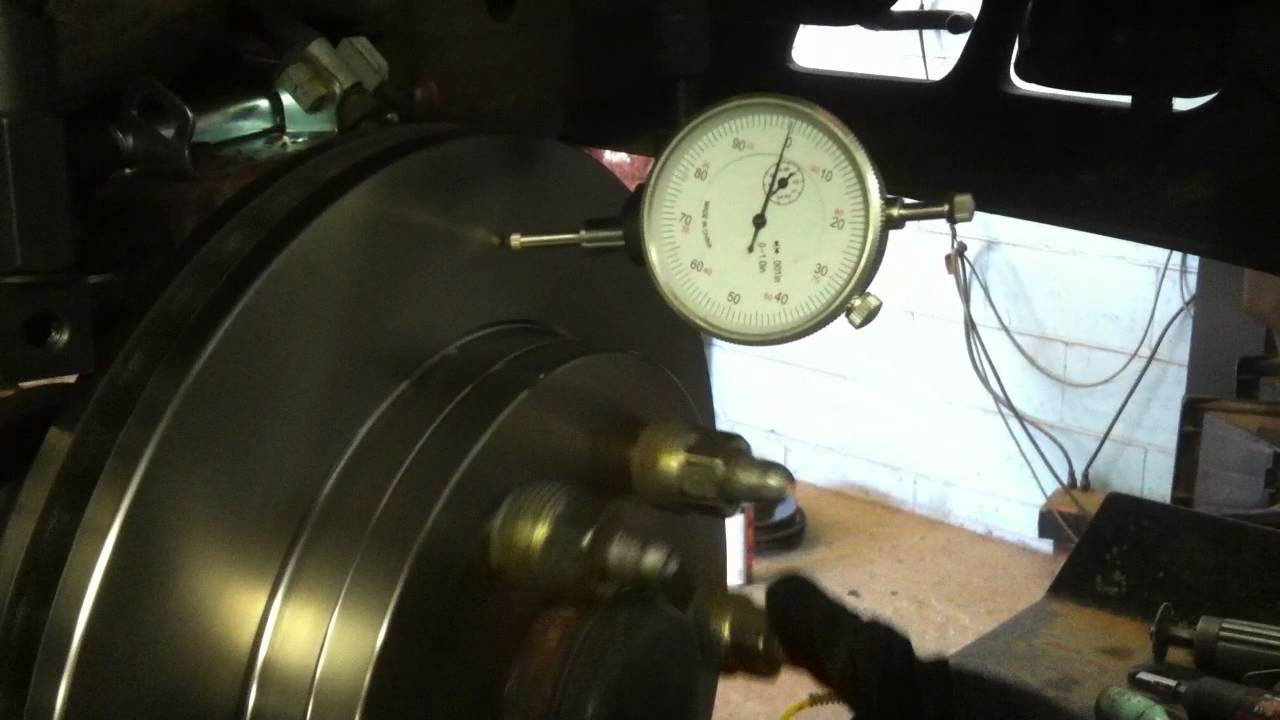
its just how much deflection there is. in extreme cases, you could call it wobble.

when using a solid point, and then when turning the rotor, its the measure of total deflection from that point. the total movement, both towards, and away.

maxresdefault.jpg


the dial indicator pictured being that solid point. as you turn the rotor, the needle will move. the run-out will be the total of that movement.
 
Perfect.... and with pictures no less. Thanks.

So, how is run out expressed? In mm + and - ?

What are some examples of average and extreme?

Perhaps you can tell I'm prepping for a discussion with my SM.
 
i don't mean to step on any toes,

I have resurfaced a LOT of rotors. when on the test drive, prior to performing any work, the pedal, and steering wheel can have a lot of bounce. many times when I go to turn the rotor, it is perfectly true, no deflection, or run out. once the blade hits the surface, it makes a complete cut all the way around.

taking a very light cut on these rotors is all that's needed to smooth things out. I think certain vehicles are more susceptible to this issue than others.

I have seen crooked rotors deliver smooth braking, and I have seen perfectly straight rotors deliver pulsations.

its less about the run out and more about where the friction material is spread across the rotor.

Just going by what I was taught, I've never really done a very scientific study on it. To be honest with you; we don't usually check runout at the dealership because in the end we just cut them or replace them if they're not in spec.
 
Perfect.... and with pictures no less. Thanks.

So, how is run out expressed? In mm + and - ?

What are some examples of average and extreme?

Perhaps you can tell I'm prepping for a discussion with my SM.
i cant really answer that. I do know there is a spec, but I think its different for every rotor.
also, I expect it can be expressed in both MM, and standard measurements. it all depends on the dial being used.

Just going by what I was taught, I've never really done a very scientific study on it. To be honest with you; we don't usually check runout at the dealership because in the end we just cut them or replace them if they're not in spec.
true, we don't check them either. the amount of time it takes, when the solution is the same regardless. it doesn't make sense to check them.
 
I have a 2002 limited 4x4 with 165k got it with 147k. My dad had the rotors replaced at the local Toyota dealership ~15K ago because of pulsation during braking. Then ~2.5k he had the rotors turned because the pulsation came back during braking. Both times the problem was temporarily fixed until it slowly crept back up until it was not pleasant or probably safe to drive... Well it's come back with a vengeance again. This time I am actually not going to let him waste his money. I have read about the issue, my question is thus. Should I do a covert Tundra brake conversion without telling anyone and just see if it's noticed, or if it fixes it. Or should I try to get another shop to turn the rotors on the hub. Honestly Idk what else to do, it's a seriously concerning thing when driving and coming to a complete un-anticipated stop.
 

Members online

No members online now.

Forum statistics

Threads
278,310
Messages
3,554,079
Members
248,016
Latest member
Advally Service

Trending content

Back
Top