Who Actually Follows 10,000 mile oil change schedule?

For the last 30 years I have been following the Change-Oil-When-It-Needs-It schedule. Meaning that if the oil is looking bad at 2000 miles since the last change, it gets changed. The old 3,000-mile oil change is a conservative approach to maintaining a vehicle that's not necessarily true for modern vehicles. I notice the oil needs changing quicker If I do a lot of towing etc. YMMV.

Big LOL on this one. You can't judge the condition of oil by its color. You either do the oil change by the prescribed interval, or do a professional oil analysis. I guess I'll taste my oil next time so I'll know if it's good enough for another 5k.

Lot have changed in 30 years!
 
Last edited:
I understand Toyota is coming out with an oil filter that is also good for 10K miles. That should remove a potential weak link.

I had a 93 4Runner that used 1 qt/800 miles from day 1. Last I heard it had 380K miles on it. Only engine repair was head gasket/head replacement due to bolts that stretched. Toyota paid for that at 80K miles.

I love these oil threads. Seldom anything new (including this post). Everyone postures as though they are running for office.

That said, remember "Oil is cheap".
 

There was a mod on Tacomaworld that sent in samples of oil at different amount of miles on his tacoma (same vvti motor) and showed consistently that the oil out preformed suggested intervals. Nice to see Edmunds.com putting in research for the masses


Here is also a good write up on Toyota oil filters vs the expensive alternatives. It will make you change your mind about spending the extra dough on from tough guards, mobil 1s, or even royal purples
Toyota Oil Filter (Made in Thailand) vs. the competition........ - Tacoma World Forums
 
Big LOL on this one. You can't judge the condition of oil by its color. You either do the oil change by the prescribed interval, or do a professional oil analysis. I guess I'll taste my oil next time so I'll know if it's good enough for another 5k.

Lot have changed in 30 years!

Taste the oil if you must. The state/condition of the oil dictates WHEN you should change it. Even Toyota (imagine that) recognizes this. They say:

What are the oil change intervals using synthetic oil?

If the vehicle operation meets the standard criteria for "Special Operating Conditions" such as: driving off-road, on dirt roads, towing a trailer, making repeated short trips under 32˚ F, or extensive idling; the engine oil must be replaced at 5,000 mile intervals, regardless of what type of oil is used.

So it would appear that different driving conditions warrant DIFFERENT change schedules. Even the Toyota University advises that the 5th Gen...
"The intervals may change based on driving habits and conditions." This can be found here: http://www.settraining.com/content/course-codes/12_07_HS_Toyota_Engines_and_Synthetic_Oil1.pdf

If you are NOT physically looking at your oil, then the 10K and 5K intervals are a good benchmark. But I'm sure we all check our engine oil at more regular intervals. During those regular visual inspections, you can see the condition of it. Are you going to tell me that if you looked at your oil and found it to be sludgy, you'd just put the cap back on and say "Toyota says that the 5th Gen T4R engine is good for a 10K oil change interval, I'll just wait?"

I don't think so, and that was precisely what I was advising in my post. Lets take a quick gander at what others "see" in oil:

HowStuffWorks "Checking Oil Clarity"

But as the oil gets older, the number of deposits in the oil continues to build and the filter is unable to extract all of the material. When this happens, the color of the oil changes and it indicates the oil should be changed. To check the clarity of the oil, let the car run for a few minutes and then shut it off. Find your oil dipstick, pull it out and check the level of oil and its color. If the oil is a dark-brown or black color, like Coca-Cola, then your oil needs to be changed. However, if it appears to be lighter, like the color of a cup of tea, then you still have some time before it needs to be changed.

How to Check Your Vehicle's Oil Level - For Dummies

Oil turns black pretty quickly, but that doesn’t affect the quality. Rub a little between your thumb and index finger, and if it leaves a dirty smudge, it probably needs to be changed.

How to Tell if Your Car Needs an Oil Change | eHow

Examine the oil on the dipstick and on the rag. There are three things you should check. First, look at the color of the oil. Fresh, clean oil is a light amber color and is transparent. Dirty oil is black or dark brown. If the oil looks dirty or is no longer transparent, it's time for an oil change. Second, look for any flecks of metal or debris in the oil. They might be barely visible, especially if the oil is dirty, but any debris in the oil indicates the need for an oil change and possibly some other engine problems.
Smell the oil for any burnt odor. Some mechanics will touch a finger to the dipstick and taste it for any sign of burning, but not everyone will want to taste their oil. Try smelling it instead. If you detect a burnt scent, it's time for an oil change.

oil change - How can you tell the oil needs to be changed? - Motor Vehicle Maintenance & Repair Stack Exchange

Grab the dip stick and run it through your fingers to get them oily. Spread the oil on your fingers and observe:

• Transparent, honey-like colour, no visible sediments, nice greasy feeling? You are good to go.
• Transparent, dark-brown to black, no sediments? Consider changing the oil soon.
• Murky, sediment-y, dark black? Change ASAP.

Engines running on flexifuel/ethanol (aka E85) can preserve the oil longer due to cleaner combustion, and it would normally have lighter colour than a comparable gasoline engine at the same mileage after the last oil change.

Checking Your Oil

If your oil is very black and dirty it could probably do with a change, although it can be quite normal for diesel engines to turn their oil black quite quickly. Healthy oil in a regularly serviced petrol engine is usually a light golden colour.

Dipstick Oil Analysis

Lesson No. 4 - Signs of an Aged Oil

• Oil is not like a fine wine that gets better over time. Instead, it ages at a rate that is influenced by driving conditions, fuel quality, engine age, motor oil quality and climate. If not changed in time, your oil will wither and fail to protect your engine.
• So, let’s take a close look at the oil on the dipstick. The oil should look smooth and glossy and somewhat transparent. If it has sludgy deposits or grainy particles of dirt, it’s time for an oil change. The same is true if the oil looks too thick, is too dark (opaque), and/or has a putrid rotten-cheese smell.
• If you still don’t know whether you need an oil change, consider doing a blotter spot test.

Oxidized and contaminated oil will lose interfacial tension. A simple test for interfacial tension is to place a drop of used oil from the dipstick on the surface of water. If the oil drop spreads out over the water’s surface (instead of beading up like a new oil) it may be time for an oil change.


You advised me that a lot has changed in the last 30 years with regard to oil and engines. I have an open mind, please tell me what has "changed" in the last 30 years?

 
Some mechanics will touch a finger to the dipstick and taste it for any sign of burning, but not everyone will want to taste their oil.

Only a total idiot would actually taste engine oil to see if it's time to change it.

What a load of complete shit.
 
Taste the oil if you must. The state/condition of the oil dictates WHEN you should change it. Even Toyota (imagine that) recognizes this. They say:

What are the oil change intervals using synthetic oil?

If the vehicle operation meets the standard criteria for "Special Operating Conditions" such as: driving off-road, on dirt roads, towing a trailer, making repeated short trips under 32˚ F, or extensive idling; the engine oil must be replaced at 5,000 mile intervals, regardless of what type of oil is used.

So it would appear that different driving conditions warrant DIFFERENT change schedules. Even the Toyota University advises that the 5th Gen...
"The intervals may change based on driving habits and conditions." This can be found here: http://www.settraining.com/content/course-codes/12_07_HS_Toyota_Engines_and_Synthetic_Oil1.pdf

If you are NOT physically looking at your oil, then the 10K and 5K intervals are a good benchmark. But I'm sure we all check our engine oil at more regular intervals. During those regular visual inspections, you can see the condition of it. Are you going to tell me that if you looked at your oil and found it to be sludgy, you'd just put the cap back on and say "Toyota says that the 5th Gen T4R engine is good for a 10K oil change interval, I'll just wait?"

I don't think so, and that was precisely what I was advising in my post. Lets take a quick gander at what others "see" in oil:

HowStuffWorks "Checking Oil Clarity"

But as the oil gets older, the number of deposits in the oil continues to build and the filter is unable to extract all of the material. When this happens, the color of the oil changes and it indicates the oil should be changed. To check the clarity of the oil, let the car run for a few minutes and then shut it off. Find your oil dipstick, pull it out and check the level of oil and its color. If the oil is a dark-brown or black color, like Coca-Cola, then your oil needs to be changed. However, if it appears to be lighter, like the color of a cup of tea, then you still have some time before it needs to be changed.

How to Check Your Vehicle's Oil Level - For Dummies

Oil turns black pretty quickly, but that doesn’t affect the quality. Rub a little between your thumb and index finger, and if it leaves a dirty smudge, it probably needs to be changed.

How to Tell if Your Car Needs an Oil Change | eHow

Examine the oil on the dipstick and on the rag. There are three things you should check. First, look at the color of the oil. Fresh, clean oil is a light amber color and is transparent. Dirty oil is black or dark brown. If the oil looks dirty or is no longer transparent, it's time for an oil change. Second, look for any flecks of metal or debris in the oil. They might be barely visible, especially if the oil is dirty, but any debris in the oil indicates the need for an oil change and possibly some other engine problems.
Smell the oil for any burnt odor. Some mechanics will touch a finger to the dipstick and taste it for any sign of burning, but not everyone will want to taste their oil. Try smelling it instead. If you detect a burnt scent, it's time for an oil change.

oil change - How can you tell the oil needs to be changed? - Motor Vehicle Maintenance & Repair Stack Exchange

Grab the dip stick and run it through your fingers to get them oily. Spread the oil on your fingers and observe:

• Transparent, honey-like colour, no visible sediments, nice greasy feeling? You are good to go.
• Transparent, dark-brown to black, no sediments? Consider changing the oil soon.
• Murky, sediment-y, dark black? Change ASAP.

Engines running on flexifuel/ethanol (aka E85) can preserve the oil longer due to cleaner combustion, and it would normally have lighter colour than a comparable gasoline engine at the same mileage after the last oil change.

Checking Your Oil

If your oil is very black and dirty it could probably do with a change, although it can be quite normal for diesel engines to turn their oil black quite quickly. Healthy oil in a regularly serviced petrol engine is usually a light golden colour.

Dipstick Oil Analysis

Lesson No. 4 - Signs of an Aged Oil

• Oil is not like a fine wine that gets better over time. Instead, it ages at a rate that is influenced by driving conditions, fuel quality, engine age, motor oil quality and climate. If not changed in time, your oil will wither and fail to protect your engine.
• So, let’s take a close look at the oil on the dipstick. The oil should look smooth and glossy and somewhat transparent. If it has sludgy deposits or grainy particles of dirt, it’s time for an oil change. The same is true if the oil looks too thick, is too dark (opaque), and/or has a putrid rotten-cheese smell.
• If you still don’t know whether you need an oil change, consider doing a blotter spot test.

Oxidized and contaminated oil will lose interfacial tension. A simple test for interfacial tension is to place a drop of used oil from the dipstick on the surface of water. If the oil drop spreads out over the water’s surface (instead of beading up like a new oil) it may be time for an oil change.


You advised me that a lot has changed in the last 30 years with regard to oil and engines. I have an open mind, please tell me what has "changed" in the last 30 years?
I would say that a lot has changed, 30 years ago I checked my oil with every gas fill up, in the last 15 years I can't remember the last time I pulled a dipstick. It seems like a waste of time, and my time isn't cheap.
 
Not me. My oil is getting changed every 5K with full synthetic. I don't trust the 10K deal and really don't care if my dealer makes more money on me. It is a 35K truck and I would rather be safe than sorry. The real reason is I think I know more than the Toyota engineers.:whistle:
 
I have changed my oil every 5k miles up until now. Have sent samples in to Blackstone a few times, all good, plenty of additive left.

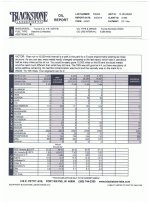
So I have decided to try one 10k interval and have it tested, I changed at 60k miles and now have 68k and going for 70k miles before changing oil. I will send a sample to Blackstone and see what the report says.

If all is good, this will prove to me that it can be done, if the report comes back marginal then I will continue my 5k intervals.

I chose this time of year (winter in CA) to do this test because there is less dust and the ambient temperatures are not so hot. The 60k miles oil change was in November the 70k should come up in early March.

I use the Toyota brand 0w20 synthetic oil and either Toyota or Purolator filters.

I plan to post the Blackstone 10k oil report when it arrives.

As promised I sent an oil sample to Blackstone after my first almost 10k mile oil change interval. I ended up having to do the oil change a little early due to my work schedule I would not have had another chance to do an oil change until after 10k miles and I did not want to go over.

Change was done at 68,936 miles on vehicle, 9,268 miles on the oil.
 

Attachments

  • Oil report 2-2014 001.jpg
    Oil report 2-2014 001.jpg
    140.3 KB · Views: 1,938
Looks like the motor is breaking in nicely. Your TBN is much higher than mine was at 8K (1.8 vs. 4.4) but most of my driving is short trips where the truck barely warms up with 1k mile road trips every month or so.
It looks like the miles are pretty easy on your truck. Didn't you say you had 70k on the OEM tires?
 
thanks vickpik58 for this oil analysis the past ones too. We can clearly see the engine break-in for the first 3 analysis', and we also clearly see that 10K miles is far into safe ranges!
 
Looks like the motor is breaking in nicely. Your TBN is much higher than mine was at 8K (1.8 vs. 4.4) but most of my driving is short trips where the truck barely warms up with 1k mile road trips every month or so.
It looks like the miles are pretty easy on your truck. Didn't you say you had 70k on the OEM tires?

Yes I still have the original Bridgestone tires on, but they are to the point that I would not want to get into the snow with them, but they have done fine in the recent rain. Not down to the wear bars yet.

I drive mostly highway miles with some in town and a fair amount of stop and go bay area traffic.

Very rare not to get the engine completely warmed up.

I am kind of surprised by the report, and thought it would be closer to the end of the oil's life.

I will probably still do 5k in the dusty hot summer months, but think I am going to extend to 10k the rest of the time.
 
Bringing mine in tomorrow :car: for it's 10k mile oil change/wheel rotation/adjustments...only thing is this oil change is really going to be at 11,600+, that's on a 2011 with 44k+ miles...running like a top!!!
 
3000 Mile

I've changed the oil in all my vehicles at 3000 miles/3 months.
Old habit I know and with synthetics, I could easily go 10k.
I always smell the oil and if it smell gassy, it gets changed.

I consider oil to be the lifeblood of an engine and not a waste of $$ if I want to do it more often.

My '07 Runner has 80K and runs very quiet and strong. It is the most reliable vehicle I have ever owned. Probably because the eng was built correctly.
I pick up my '14 Runner tomorrow. I hope it gives me the same great service.
 
Last edited:
My dealership puts the sticker in my window for service every 5,000 but told me verbally that I could do it every 10,000. Out of old habits though I am sticking with the 5k. Also, my other car is a 2004 Lexus RX330 that I bought brand new. I changed the oil every 5k its entire life and its at 88k now it runs the same as the day I got it. Seriously, that car has been the most stone-cold reliable vehicle I have every been around. I hope my T4R is just like it.
MB
 

Members online

Forum statistics

Threads
278,315
Messages
3,554,125
Members
248,016
Latest member
Advally Service

Trending content

Back
Top