Why Seafoam is BAD!!

Never used it, mostly likely never will..............

Before there was seafoam (craze), there were engines lasting to 200-300K miles. This with regular maintenance. IF your motor is running perfectly smooth, then its fine and doesn't need it. If you have injector issues, then this stuff could work, but then you have to think about HOW it got like that. Bad gas? Bad maintenance? Try using quality fuel (I'm talking about top tier gas vs. grocery store fuel), change your oil frequently (synthetic could help) as well as your filters. There shouldn't be a need for products like SF.

For the record, I wouldn't use if my engine was running fine.
 
Ill agree with cookie- a well maintained engine doesn't need any additives other than maybe a injector cleaner once in a while.

Sounds like that guy was not maintaining his engine if his oil was "very dirty"
And the "experts" at Jiffy lube probably added too much and he probably drove it too long. You mentioned a week-
Ive heard more horror stories of Jiffy lube and other quick change "shops" that put the wrong filter on and destroy engines that way.
Im still not saying you cant destroy and engine with Seafoam- it is a solvent but it is 100% petroleum based so it does have lubricating properties...

Seafoam was trademarked in 1942- so its been on the market for more than 70 years... If it were destroying engines on a regular basis I think there would be more than a few stories of a "friend of a friend of a friends car that blew up"
Just my .02
 
Ive used it in my crankcase and theres a reason your not supposed to use it for more than 300 miles once you put it in your oil. Ive used it when my oil change was coming up and used it for about 100 miles just to clean it out. Just personal experience
 
Seafoam works (as an expensive weed killer)
It's not going in my crankcase. Well it could, if it did not also get into my main/rod/cam/and crank bearings.
 
Personal Experience, Not A Friend of a Friend of a Friend Story

For you doubters of the damage Seafoam can do to an engine, below is my edited (for spelling), first person Seafoam experience (i.e.: NOT a “friend of a friend of a friends car that blew up" story).

As I mention earlier (on page 1) in this thread, if you want to read both of my comments in their original form (with spelling errors) in the original thread from this website, go to:

http://www.toyota-4runner.org/3rd-gen-t4rs/158989-new-engine-knock-after-seafoam.html

and:
http://www.toyota-4runner.org/3rd-gen-t4rs/158989-new-engine-knock-after-seafoam-2.html

I have lived the Seafoam nightmare personally and as far as I’m concerned, it will never enter another vehicle I own. Period.

Everyone is entitled to their own opinion and by no means am I trying to tell anyone to stop using the product, but be warned: If you use it and your suffer a catastrophic engine failure, please do not tell me that you were not warned.

All I am trying to do is keep others from experiencing the pain my engine (and wallet) suffered.

First Post:

Purchased a used '98 4Runner several years ago. It had 135k on it. Three hundred miles after I bought, (no joke....300 miles), it developed a whine in the engine that would come up about 20 seconds after start up and would continue until shut down. I thought it was a power steering pump or bad belt but I wanted another opinion so I took it to a mechanic I knew and trusted.

He changed the oil and said it looked like it hadn't been changed in quite some time. He even went to the trouble to show me the old filter and oil that came out of it. His exact words were "I have solved lots a problems by changing the oil." Well sure enough the whine disappeared.

He recommended I do several oil changes over the next few miles/months which I did. No problems at all from the engine and whine was gone and stayed gone. Even drove it from TN to TX and back. Best to my memory I got something like 18-20+ miles MPG on the trip.

Followed my mechanic's advice and changed oil 3 times over the next 5k miles. Again, no problems.

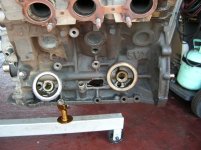
Then at 140,040 I got wise and Seafoamed the engine. Did exactly what the can said do, 1 oz. per quart of engine oil (think I got that right). Drove it for 78 miles to 140,118 and then changed oil. Used 5W-30 just as the manual said and Toyota oil filter. Then at 140,171.....63 measly miles later.......it threw a rod (see picture of engine below).

I think Seafoam is a good product and I don't know if it caused my problem or not, but looking back I wish I had followed my friends advice and just changed the oil more frequently. His advice worked for 5,000 miles. 63 miles after Seafoam I was walking.

The money I spend on a remanufactured engine would have paid for a whole bunch of oil changes. Several mechanic have told me the best way to clean an engine out is to just simply keep the oil changed.

I'm not an expert, but I agree with THatfield with what happened to me in my case.

On a similar note, a friend of mine had a Ford 3/4 ton with a V8. It knocked too for what seemed like years. He wanted to fix it, but his mechanic told him not to but to drive it until it died.

It finally did one day. Threw a rod. He was towing a horse trailer that day. Needless to say he was very mad when it happened.

Knocks in engines just aren't good.
[Picture of engine with hole in block is inserted here]

Second post:

My first inclination was to not post another comment on this thread because I don’t want to get into an endless debate on Seafoam. But after a period of long thought, I realized these threads live long after many of us are gone and future Toyota 4Runner (car) owners need a well-rounded view of the use of the product and that involves hearing both sides of the debate. Their car engines depends on it. When I used it on my ill-fated adventure, I had read many, many threads from other websites.

In response to Nelsonmd’s comment regarding a high mileage vehicle that “….you suddenly load with seafoam. I bet if you added it gingerly just before oil changes for a while, giving it time to work slowly and wash everything into the filter, they you’d be fine.” I did add it gingerly, per Seafoam’s directions, and I had problems.

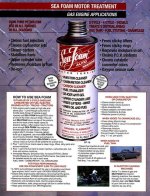
I have attached a flyer I obtained from the Seafoam website just prior to my use of it in my 4Runner. Please note I was correct in my previous (long winded) post when it directs to use 1 ½ oz. per quart of oil.

And nowhere did I see a limit on the flyer on how long it should stay in your oil. But it does recommend the product be used every 2,000 to 5,000 miles. I apologize that the flyer is hard to read but that is exactly how I downloaded it from their website in the fall of 2008.

Here is another website which also lists the directions for Seafoam’s use.

The Truth About Seafoam - Car Forums and Automotive Chat

My recommendation is if you want to try something that will help your vehicle run better, don’t ingest Seafoam through a vacuum hose but rather disassembly and clean your Throttle Body (TB) and Mass Air Flow (MAF) Sensor.

One very good post with excellent directions for this cleaning procedure is here:

Toyota 4Runner Highlander Throttle Body cleaning and O Gasket Mod

Another good post from this website with the cleaning and O-gasket change is here:

TRD Throttle Body "O" Gasket

In case either of the two above websites disappear sometime in the future or the links fail to work, Google “Throttle Body Cleaning and 'O' Gasket Mod” or “Modification” and they, or similar links, should come up.

I also recommend disassembling your Idle Air Control (IAC) valve from the TB and cleaning that too. After following the above procedure, cleaning and reassembling those three things (TB, MAF, and IAC) did more good for my 4Runner than any can of Seafoam ever did. Period. It starts better, idles better (lower RPM and smoother), and responds much quicker.

And I agree with many others—including my trusted mechanic—who recommend using a good quality oil and oil filter and changing them frequently to avoid any serious engine problems. As I said in my previous post on this thread, I followed this advice and my 4Runner’s original engine ran for 5,000 miles after I purchased it. I used Seafoam in the oil once and it didn’t last 63 miles.

In my humbler opinion it’s not a coincidence my engine failed after I used Seafoam. It’s a fact. And yes, I think the product caused the failure.

But I also agree with: to each his own regarding products and which to use and not use. But I also felt a sense of responsibility to all the future Toyota owners who will read this thread and need to hear another story about its use.

Placing Seafoam in an engine’s oil is playing Russian roulette in my opinion. Sometimes the hammer falls on an empty cylinder and sometimes it doesn’t. In my case the hammer fell on a loaded cylinder on the very first time and my engine (and wallet) paid the price.

Once was enough for me. Never again.

[Insert Seafoam Flyer/Specification Sheet Here]
 

Attachments

  • DSCN1937.jpg
    DSCN1937.jpg
    134.8 KB · Views: 23,942
  • Seafoam Directions.jpg
    Seafoam Directions.jpg
    95.7 KB · Views: 23,298
Purchased a used '98 4Runner several years ago. It had 135k on it. Three hundred miles after I bought, (no joke....300 miles), it developed a whine in the engine that would come up about 20 seconds after start up and would continue until shut down. I thought it was a power steering pump or bad belt but I wanted another opinion so I took it to a mechanic I knew and trusted.

He changed the oil and said it looked like it hadn't been changed in quite some time. He even went to the trouble to show me the old filter and oil that came out of it. His exact words were "I have solved lots a problems by changing the oil." Well sure enough the whine disappeared.


You had engine bearing issues to start not to mention issues with the "oil not being changed in a long time". Keeping fresh oil in there was your band aid. Seafoam did not make your rod fly out of your block. Not to mention that your engine blew with no seafoam in it. It blew after you changed it out.


Both engines you talked about had knocks or whines BEFORE Seafoam. Seafoam was never intended to fix either of those problems. Those engines were on there way to the scrap heap either way.
 
Last edited:
Fact and Humor

One of the very first emotions that ran through my mind after the premature death of my 4Runner’s original engine was to broadcast a warning of the possible destructive effects of Seafoam. But as I managed the aftermath and fallout of the situation, it slowly dawned on me most people really didn’t care what I had to say. There were so many glowing and positive reviews of the product, my meager comments would be a simple counter breeze in a vast hurricane. I kept that view for several years until I read Scotty_h’s thread “New Engine Knock After Seafoam?” on this website.

Trying to improve your vehicle and then having the sinking feeling you made things worse was an emotion I could relate to so I posted my story in support of him. And some of the comments were exactly such that was the better judgment that kept me silent and from posting for so many years. If I wished to be sadden and depressed, I needn’t read anyone’s comments about how I did it wrong and it wasn’t the product, all I had to do was look at my empty wallet.

Which brings the story to this thread.

While I cannot testify as to the motive or reasons for why it was created, I was thankful that someone was trying to honestly provide an avenue that negative (and costly) outcomes of the product were given as much chance to be heard as those that were in stark—and overwhelming—contrast. I have also taken so much from this community in knowledge I felt it was time I give back something for the greater good of those known as Toyota 4Runner owners.

Originally I just posted links to my comments, but later realized that some probably don’t click on the links and go to the sources cited, thus I copied and pasted my original comments. And then it started..…again.

I come to this website and others like it to learn. And it is agreed that far too many views and positions voiced are based upon urban myths and legends, old wives tales, pipe dreams or a friend of a friend of a friend story as has been previously suggested. Often, there is no hard evidence or first person experience, just talk. Having had first person experience in the subject at hand, I entitled my previous comment based upon a mixture of fact and humor. From the tone and color it is apparent it was not received either way.

Where the view originated that it was the goal to fix something inside the engine with the use of Seafoam cannot be explained. The goal was not to fix anything. The goal was to flush and clean the 4Runner’s engine with the idea to prolong and extend its useful life when it appeared it had been denied basic preventive maintenance. From what is gathered reading other’s comments on their use of the product, it is submitted that is their goal also. From the literature the company provides its customers and users,
(Using Sea Foam Motor Treatment in crankcase oil - Sea Foam Sales Company) it implies directly that is the very reason for the product’s existence.

Other submissions infer the product was used incorrectly. Some go so far to search out and imply unverifiable facts in their response which—it appears—maybe an effort to explain why a mechanical—or other unforeseen but not wanting—issue occurred. Regardless the case, great lengths, it seems, are used to justify its continued use and acceptance.

Commissioner Gordon (Gary Oldman) was so eloquent: “You’re a detective now, son. You’re not allowed to believe in coincidence anymore.” For 5,000 miles my 4Runner’s engine survived by following my trusted mechanic’s (and others who echo the same) advice: Use—and frequently change—a good quality oil and oil filter.

None of those types of aforementioned implications or submissions apply in this case. Seafoam in the engine oil one time (strictly adhering to their recommendations) and the engine failed immediately thereafter. You’re right Mr. Commissioner: It’s not a coincidence.

The meager benefits gained (acceleration, response, idle, cleaner engine, quieter lifters, etc.) aren’t worth the larger risks (total engine failure) involved. More practical and far less risky methods and practices are available and proven, many championed and used by seasoned (old) mechanics like mine. From the results of that first (and only) time use, Seafoam was forever removed from my tool chest.

I will make one last attempt: If anyone reading this is seriously contemplating the use of the product and wish to obtain a respectful, honest, intelligent, and low pressure view, then please PM me. As with these threads, I plan on being around long after this posting and would be more than happy to share my experience (although negative) about it. If someone had done that for me, it would have saved me a lot of misery, money, and time.

Good day.

 
Do you have any pictures of the bearings, inner surfaces of the engine, pick-up tube, and other components such as the cylinderhead and so on? Typically what I see happen is that people try to fix a severely sludged up engine with a product like Seafoam or say BG's EPR and essentially clean the engine too well too fast. I wouldn't say it is the fault of the product itself as BG's EPR says specifically not to use it in severely sludged engines (I'm not sure if Seafoam has updated their packaging.)


If I recall the 5VZ-FE was prone to sludging if not well maintained (though no where near as bad as Toyota's historic 3.0L & 3.3L engines. The problem is these products work very well, I usually use Seafoam to decarbon piston tops or clean up GDI intake ports. Unless you're planning on doing one or more oil changes, filter changes, and possibly dropping the oil pan back to back; you really shouldn't be trying to run something like Seafoam in the crankcase. I ran Seafoam once in the crankcase of my 2UZ-FE after I got it, mostly to make sure I cleaned up the inside a bit before putting in good synthetic oil; it didn't hurt anything really, but I'm not sure how well it helped to be honest. I ran it about 50~100mi before my oil change and haven't had any issues since. But I have seen some horror stories in terms of sludge; most of them are due to poor maintenance practices. I normally don't recommend people use Seafoam as anything more than a fuel treatment, because it does really well in that respect and it's also because sludge is a tricky thing to deal with. I'm not saying don't use it, just be cautious and consider maybe doing more than one oil change and/or check the oil pan/pick-up. Sludge doesn't always show up as thick goo, sometimes its semi-crumbly charcoal like substance that can make this nasty paste.

That being said, at the dealership we're using a similar BG EPR product that is run in the engine for 10~15minutes before draining the oil and changing it. So far we haven't had any issues with it destroying an engine and we've been running it in hundreds of cars regularly for almost a year now.

A while back we had a parts truck Tundra with the 5VZ-FE that had HORRIBLE sludge in it (the filter stud backs off on those engines sometimes when they get high mileage and leaks at the oil filter. The engine had been run with about 1~1.5qts of oil for a month and I'm surprised it didn't seize at all. I told our parts manager that we could try to de-sludge it via EPR, but chances are the engine would probably be toast; she okay'd the use of EPR (against the warning not to use it in a severely sludged engine, per my suggestion as a Hail Mary.) Ran two cans of the stuff for about 30min, drained the oil twice (that stuff looked blacker and as nasty as diesel oil.) Filled it up and was shocked that the oil not only was practically still new after a 10mile test drive up a extremely steep hill behind our dealership (including engine braking as I wanted to load up the engine in case it was on the edge of failing,) but that oil pressure was fine, engine didn't hiccup, and that the vehicle was pretty damn clean under there. Fast forward almost a year and it's still running strong. So to reiterate I used twice the recommended amount, in a severely sludged engine, for twice the recommended length of time, and it did not blow up (the BG EPR is supposed to actually be stronger than Seafoam as it is designed specifically for crankcase cleaning.) Was it a lucky fluke? Most likely, I was expecting the engine to be unsalvagable (with 300k+ and that much sludge, I figured it'd throw a rod or just need to be rebuilt); but it ran okay.

I'm not saying you're wrong, I actually agree that if your engine is severely sludged, simply using Seafoam in the crankcase and then doing a plain oil change may not be a wise decision. I'm just providing a counter point to your experience based on an empirical test I did (to be honest I was itching to really push that EPR stuff to the max for a while because I wasn't sure it really did anything) and the results I got. Sludge is a very tricky condition to deal with in extremely high mileage or neglected engines. I'd think of it as an avalanche waiting to happen. If it's the snow on your roof, not a big deal to let it roll and clean it up (mildly sludged/dirty engines,) it's when it's big enough to swallow the whole house that you may not want to poke it.

From this thread:

http://www.toyota-4runner.org/4th-gen-t4rs/182178-seafoam-crankcase-bad-good.html#post2053861
 
As a mechanic I want to chime in here.

1: Any "additive" (yes, even the BG stuff that everyone is hooked on like Meth at the moment) - WILL NOT save an engine. Snake oils, miracle cures, "Guaranteed to pass", "rebuild in a can" products are all just pure utter garbage. They *might* bandaid your problem. Or they may create a new one.


2: Thinning down oil, is a bad thing. No matter what you are thinning down with, if your engine isn't designed for that viscosity, you're gonna have a bad result.


The thing is, "Preventative Maintenance" is exactly that. Preventing wear and tear, and part failures. Nothing will replace it, nothing.

Most of us people buying used hardware, really just gotta cross our fingers and hope the previous owner(s) wasn't a dope or an ass.
 
Never understood why people are so obsessed with additives for every fluid in their car, all I'll ever put in my 4Runner is gas and fresh oil every 3K.
 
Never understood why people are so obsessed with additives for every fluid in their car, all I'll ever put in my 4Runner is gas and fresh oil every 3K.

Anyone can do routine maintenance.

It gives people a certain sense of smugness to tell everyone that they do more than what is required by pouring snake oils into their engines.

The people who make this crap laugh all the way to the bank.
 
I think SeaFoam is a great product and use it frequently with work. If the engine has sludge in it already the death clock has already begun. Does SF speed up that process? I don't think it is possible to know in 100% certainty.

If you want to clean the internals slowly I would just start using a good synthetic oil as it will do a great job of cleaning slowly.
 
Seafoam 5VZ-FE

Been reading this thread and others, thanks for your expertise.

Put a deposit on my dream, a 2002 T4R LTD, 148K, 1-owner, maintenance records are excellent, and flying out to pick her up this week. Was considering using Seafoam in the fuel on the way back, split over several tanks (700mi drive) to clean the injectors. Have used Seafoam in the past regularly, only in the fuel, on Honda/Nissan/Isuzu V6s, no problem. Now I'm not so sure, ha. Maybe I'll just reset the EFI relay and go from there. Thoughts/feedback welcome. Thanks.
 
Ive had an 85 Camaro, 94 f150, 04 Expedition, and now an 84 4Runner and ive used Seafoam in every one of them HOWEVER, i would NEVER put it in my crankcase. Ive always just poured half a can into my brake booster vacuum line once every 6 months or so depending on how many miles the vehicle ran during that time. on fuel injected vehicles i havent ever noticed a difference however on carbed vehicles i could tell that it ran a bit smoother that before; about as much of a difference between needing a plug and wire tuneup and then after doing said tuneup. Theres a video on youtube where a guy uses his own personal vehicle, no sponsor or baised facts or anything, and uses one of those micro snake cameras and did a before and after video when he inserted the camera into the spark plug housings so that you could see the pistons. there wasnt a big difference however the after definitely had a visual difference in how clean the pistons heads were
 
Don't mind me just another stranger here to add his $.02.

Personally I've never had a bad experience with seafoam. I've used it many times and it has seemed to help in any case I've used it. here's a video to support my statement: https://www.youtube.com/watch?v=agAWXnT4-EQ

I look at Seafoam the same way I look at changing ATF or switching over to a synthetic oil, It won't cause a problem if used correctly but it can make a existing problem more apparent.

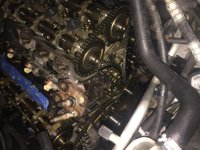
My main point is that you shouldn't have any issues using seafoam if you maintain your engine. As for the OP saying that the pick-up was clogged with deposits due to the seafoam causing low oil pressure isn't likely accurate. If it is then the engine sure as hell wasn't maintained. It wouldn't have had chunks big enough to clog the pick up tube if it was. The engine in the photo below has 181k HARD miles with synthetic oil changes done every 6k-7k.

My advice is an ounce of prevention is a pound of cure. Change your oil regularly and you never will need to use seafoam in your oil. If you do have a bit of gunk you should be fine using it, personally I prefer adding some ATF into the oil when it needs to be topped off (no more than a quart in between oil changes). Good day!
 

Attachments

  • IMG_1070.jpg
    IMG_1070.jpg
    133.4 KB · Views: 2,115
Like Skully I have used seafom on several vehicles. I have never used it in my crankcase though. I don't have any issue putting it in the PCV or in the fuel tank. I have only used cleaners in oil on very old used vehicles that really needed some deep cleaning. Those lasted years.
I am fortunate to be able to buy new vehicles but I tend to hold them over a decade. The previous vehicle to my runner was 16 years old. Still ran well, saw seafoam. I was just getting tired of the small problems driving me nuts so I moved on. My other vehicles right now are another 16 year old as well as a 13 year old.
 

Members online

Forum statistics

Threads
278,312
Messages
3,554,089
Members
248,016
Latest member
Advally Service

Trending content

Back
Top