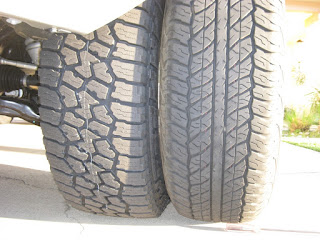
Wildpeak AT3W 117T vs Stock Dunlop

Mutant138

Banned
Looking at upsizing to the Falken Wildpeak AT3W All Terrain Radial Tire - 285/70R17 117T. Falkens website says it's a 4 ply tire. Isn't the stock dunlop a 4 ply tire?

Are they really the same thing in terms of sidewall? Just saying if I can save some money or if I really should cough up for a true 10 Ply.
 
Last edited:
Register to hide this ad
Looking at upsizing to the Falken Wildpeak AT3W All Terrain Radial Tire - 285/70R17 117T. Falkens website says it's a 4 ply tire. Isn't the stock dunlop a 4 ply tire?

Are they really the same thing in terms of sidewall? Just saying if I can save some money or if I really should cough up for a true 10 Ply.

The sidewall lugs will offer more protection than the stock dunlops. Addtionally, the traction will be MUCH better! Whether to jump up to the LT (10ply), depends if you are going to do alot of rock crawling. Lots of folks have had great success with the P Wildpeaks (M4STR?)
 
The sidewall lugs will offer more protection than the stock dunlops. Addtionally, the traction will be MUCH better! Whether to jump up to the LT (10ply), depends if you are going to do alot of rock crawling. Lots of folks have had great success with the P Wildpeaks (M4STR?)

Unless you want extreme off-roading then the at3 is all you need love them
Mike

Not necessarily doing a lot of rock crawling but I live in jagged sun baked rock country.

I had a stick puncture my sidewall one one of my stocks requiring a replacement. Then I had the smallest screw ever cause a leak. Really under impressed by toyotas choice of tire. Granted the falkens have far more tread depth and sidewall tread that would have potentially saved me in those instances. IDK I'm not sold yet on P rated tires.
 
I live in nyc. Potholes are by far more severe in the damage that they have done then any east coast trail I have seen maybe you should do more research on puncture resistant tires
Mike
 
The sidewall lugs will offer more protection than the stock dunlops. Addtionally, the traction will be MUCH better! Whether to jump up to the LT (10ply), depends if you are going to do alot of rock crawling. Lots of folks have had great success with the P Wildpeaks (M4STR?)

Not necessarily doing a lot of rock crawling but I live in jagged sun baked rock country.

I had a stick puncture my sidewall one one of my stocks requiring a replacement. Then I had the smallest screw ever cause a leak. Really under impressed by toyotas choice of tire. Granted the falkens have far more tread depth and sidewall tread that would have potentially saved me in those instances. IDK I'm not sold yet on P rated tires.

I live in nyc. Potholes are by far more severe in the damage that they have done then any east coast trail I have seen maybe you should do more research on puncture resistant tires
Mike

I have 26,500 miles on my P265 Wildpeaks, including 2,512 dirt miles in AZ, UT, and MT. Terrain covers everything up to and including standard difficult trails.

ALL but a couple dozen miles were at 30-33 psi. This is important, see below.

I have complete confidence in the tire in Montana, Utah, Sedona, and Northern AZ.

My verdict for the Sonoran Desert is TBD. I have about 400 miles on trails and 100 on dirt roads there. All of these are north or west of PHX. I have had no issues on any of the slow trails like Backaway to CK or Crapshoot.

BUT, I did have a puncture near KOFA moving at some speed over embedded rock. I was at 33 psi. Maybe 28 would have helped but this is splitting heir. This is a weakness of the P metric construction of the tire (no similar issues on embedded rock near Flagstaff or elsewhere outside that desert though).

Next time we went into similar terrain, I aired down, kept the speed up and burst a sidewall. This I take on myself. I have kept pressures above 28 since and have had no issues since then.

In terms of life expectancy with my use, the two tires from the original set still on the axles are 6.5/32nds at 26,500 miles. BUT WATCH THIS: the tires lost 1/32 over a 5,300 mile trip to MT and back including about 500 off pavement miles there. HOWEVER, since coming back I seem to have lost another 0.5 in just 1000 miles, of which about 110 off pavement including 11 at Cinder Hills (which is probably super unhealthy for the tires). So AZ terrain just eats tires as I have long suspected. My LTD KO2s on my Outback lost tread at an alarming rate as well as have all other tires I have used off pavement in AZ. Still, I would expect a useful life expectancy of 35,000 miles out of KO2s vs 27,000 or so out of P WIldpeaks. But I like the Wildpeaks off road better (puncture resistance aside) and they are far superior on road. Add the price differential and the KO2 don't cost any less. Better in the south but that's it.

In sum, here are the pros:

--excellent on road, very comfy, no noise in my size
--outstanding traction on rock and great in dirt
--strong enough for all terrains when new or newish and for most even at 7/32.
--NO airing down! So much better to just get on trail and off trail.
--strong enough for crawling anywhere, though not sure if true when all tires are low tread
--P metric tires give you an extra 0.5" clearance over LT tires since you do not have to air down.

Here are the cons:
--Starts at 13 and not 14/32.
--First 2/32nds go in under 4000 miles so you spend only 10000 miles above 10/32nds.
--Puncture resistance in the harshest desert terrains at speed.

Generally, it would seem that a harder compound that has less traction but lasts a bit longer would be nice to have. But a harder compound will chunk more in the desert (mine started to chunk only when approaching 7/32 or 22-23,000 miles), provide less traction in rain and snow, and will also have longer stopping distances.

Add a price of 142/tire in 265 and the Wildpeak has no serious competition for people like me who do plenty of both road and off pavement driving.

However, in 285, at 190/tire, I am not so sure, especially for people who stay mostly in and around Arizona. Maybe consider the new Destination XT which is LTE but a very light LTE. Also maybe worth waiting for the release of the new Maxxis Razr AT later this year. Or you can go LTC 255 75 17 Destination XT at 40lb per tire.

EDIT: as for the Wildpeaks vs the stock tires, there is no comparison at all. The Wildpeak have MT sized shoulder protectors and an outstanding tread pattern. Oh, they also have better standardized speed rating, load rating, and traction rating, in addition to their dominance in the dirt.

EDIT 2: I am not sure what "true 10 ply" stands for but the only ATs with a 3-ply sidewall are LTD/E KO2s, Cooper STT Maxx, the ATZ P3, and the new Geolander ATX. Maybe the new Maxxis Razr will be as well. Nowadays there are MTs with 2 ply sidewall such as 255 75 Yokohama MT003 or the Dick Cepek Extreme Country in 265 70.

SL = old 4 ply classification but that does not mean much. Tires like the Duratrac and the Cooper AT3 have well-established reputations for punctures, irrespective of load rating. The only obvious shortcoming of the SL is the 5 ply tread vs 6 on XL or LT metric sizes. Our Subaru rides on XL tires that have 6 plies in the thread (only street set that has never had a puncture).

This became way longer than intended, but in conclusion I would say that the Wildpeak is in my opinion the best bet in SL/P but maybe Open Country AT II will last longer. Ridge Grappler in P may be another viable P option.

 
Last edited:
Walmart and Amazon have both had the P285s at $170/ea recently.

I had Discount price match Walmart last week during their 10% off sale.
 
I live in nyc. Potholes are by far more severe in the damage that they have done then any east coast trail I have seen maybe you should do more research on puncture resistant tires
Mike

I'm from NYC myself I know all about the potholes. I think Mast4r has provided me with all the information I need. Thanks.

I have 26,500 miles on my P265 Wildpeaks, including 2,512 dirt miles in AZ, UT, and MT. Terrain covers everything up to and including standard difficult trails.

ALL but a couple dozen miles were at 30-33 psi. This is important, see below.

I have complete confidence in the tire in Montana, Utah, Sedona, and Northern AZ.

My verdict for the Sonoran Desert is TBD. I have about 400 miles on trails and 100 on dirt roads there. All of these are north or west of PHX. I have had no issues on any of the slow trails like Backaway to CK or Crapshoot.

BUT, I did have a puncture near KOFA moving at some speed over embedded rock. I was at 33 psi. Maybe 28 would have helped but this is splitting heir. This is a weakness of the P metric construction of the tire (no similar issues on embedded rock near Flagstaff or elsewhere outside that desert though).

Next time we went into similar terrain, I aired down, kept the speed up and burst a sidewall. This I take on myself. I have kept pressures above 28 since and have had no issues since then.

In terms of life expectancy with my use, the two tires from the original set still on the axles are 6.5/32nds at 26,500 miles. BUT WATCH THIS: the tires lost 1/32 over a 5,300 mile trip to MT and back including about 500 off pavement miles there. HOWEVER, since coming back I seem to have lost another 0.5 in just 1000 miles, of which about 110 off pavement including 11 at Cinder Hills (which is probably super unhealthy for the tires). So AZ terrain just eats tires as I have long suspected. My LTD KO2s on my Outback lost tread at an alarming rate as well as have all other tires I have used off pavement in AZ. Still, I would expect a useful life expectancy of 35,000 miles out of KO2s vs 27,000 or so out of P WIldpeaks. But I like the Wildpeaks off road better (puncture resistance aside) and they are far superior on road. Add the price differential and the KO2 don't cost any less. Better in the south but that's it.

In sum, here are the pros:

--excellent on road, very comfy, no noise in my size
--outstanding traction on rock and great in dirt
--strong enough for all terrains when new or newish and for most even at 7/32.
--NO airing down! So much better to just get on trail and off trail.
--strong enough for crawling anywhere, though not sure if true when all tires are low tread
--P metric tires give you an extra 0.5" clearance over LT tires since you do not have to air down.

Here are the cons:
--Starts at 13 and not 14/32.
--First 2/32nds go in under 4000 miles so you spend only 10000 miles above 10/32nds.
--Puncture resistance in the harshest desert terrains at speed.

Generally, it would seem that a harder compound that has less traction but lasts a bit longer would be nice to have. But a harder compound will chunk more in the desert (mine started to chunk only when approaching 7/32 or 22-23,000 miles), provide less traction in rain and snow, and will also have longer stopping distances.

Add a price of 142/tire in 265 and the Wildpeak has no serious competition for people like me who do plenty of both road and off pavement driving.

However, in 285, at 190/tire, I am not so sure, especially for people who stay mostly in and around Arizona. Maybe consider the new Destination XT which is LTE but a very light LTE. Also maybe worth waiting for the release of the new Maxxis Razr AT later this year. Or you can go LTC 255 75 17 Destination XT at 40lb per tire.

EDIT: as for the Wildpeaks vs the stock tires, there is no comparison at all. The Wildpeak have MT sized shoulder protectors and an outstanding tread pattern. Oh, they also have better standardized speed rating, load rating, and traction rating, in addition to their dominance in the dirt.

EDIT 2: I am not sure what "true 10 ply" stands for but the only ATs with a 3-ply sidewall are LTD/E KO2s, Cooper STT Maxx, the ATZ P3, and the new Geolander ATX. Maybe the new Maxxis Razr will be as well. Nowadays there are MTs with 2 ply sidewall such as 255 75 Yokohama MT003 or the Dick Cepek Extreme Country in 265 70.

SL = old 4 ply classification but that does not mean much. Tires like the Duratrac and the Cooper AT3 have well-established reputations for punctures, irrespective of load rating. The only obvious shortcoming of the SL is the 5 ply tread vs 6 on XL or LT metric sizes. Our Subaru rides on XL tires that have 6 plies in the thread (only street set that has never had a puncture).

This became way longer than intended, but in conclusion I would say that the Wildpeak is in my opinion the best bet in SL/P but maybe Open Country AT II will last longer. Ridge Grappler in P may be another viable P option.


Wow that was actually the exact data that I needed. Handy having other people in the area testing out everything for me haha.

I need to air down with my back and my frequent trips through very soft sand. I also spend more time doing desert stuff then I do up north. I'm also pretty aggressive with my right foot sometimes. That means punishing my tires pretty consistently on jagged sun baked half buried rock. Seems pretty definitive I should go 10 Ply.

Only question now is M/T or A/T... guess the k02 is a happy medium. Wildpeak M/T's look amazing tho haha (because looking cool is the most important thing after all).

Sounds like wildpeaks P fit your need perfectly. You could prob add that lower weight and ease of balance are also pros. Thanks for your insight that was super helpful.

Walmart and Amazon have both had the P285s at $170/ea recently.

I had Discount price match Walmart last week during their 10% off sale.

I love that discount does that. There is one right down the street from me too.
 
I imagine the stock Dunlops might do okay on graded, gently sloped fire roads. For offroading the stock tire won't compare well to an all-terrain in the same size.

IMG_5828-1.jpg
 
I imagine the stock Dunlops might do okay on graded, gently sloped fire roads. For offroading the stock tire won't compare well to an all-terrain in the same size.

IMG_5828-1.jpg

Stock tires do better then people give them credit for but of course there is not comparison to the wildpeaks.

I was inquiring more about if the sidewalls are comparable in strength. From what MAST4R is telling me they pretty much are apart from treading. 10 PLY for me.
 
Last edited:
Stock tires do better then people give them credit for but of course there is not comparison to the wildpeaks.

I was inquiring more about if the sidewalls are comparable in strength. From what MAST4R is telling me they pretty much are apart from treading. 10 PLY for me.

I hate to use the term "ply" as it more of a marketing term based on early tire construction with layers of cotton plies. Apparently as Nylon was introduced they could get the same strength with less plies and that complicated the rating system. Since the air inside the tire does the work of weight bearing and plies were irrelevant they gravitated to ratings based on tire load capability..

To me the load ranges are similar 113/2535 lbs vs 115/2679 lbs so actual construction is key with the AT3's greater tread depth and the extra blocks of rubber to help protect the sidewalls. The weight of the two tires is an interesting bit too: 39lbs vs 46.5lbs so I'd believe the AT3W is putting rubber into the tread and where it will offer better protection against rocks and other sharp stuff hitting the sidewall.

If you go with load range E (10 Ply) that will be a stiff ride in my book so be sure to report back on what you think
 
Stock tires do better then people give them credit for but of course there is not comparison to the wildpeaks.

I was inquiring more about if the sidewalls are comparable in strength. From what MAST4R is telling me they pretty much are apart from treading. 10 PLY for me.

I hate to use the term "ply" as it more of a marketing term based on early tire construction with layers of cotton plies. Apparently as Nylon was introduced they could get the same strength with less plies and that complicated the rating system. Since the air inside the tire does the work of weight bearing and plies were irrelevant they gravitated to ratings based on tire load capability..

To me the load ranges are similar 113/2535 lbs vs 115/2679 lbs so actual construction is key with the AT3's greater tread depth and the extra blocks of rubber to help protect the sidewalls. The weight of the two tires is an interesting bit too: 39lbs vs 46.5lbs so I'd believe the AT3W is putting rubber into the tread and where it will offer better protection against rocks and other sharp stuff hitting the sidewall.

If you go with load range E (10 Ply) that will be a stiff ride in my book so be sure to report back on what you think

I would say that tread puncture resistance and sidewall puncture resistance are different beasts.

Sidewall: as the two of you well know, while the internet goes berserk with people imagining themselves driving Die Hard, Axle Alley, or Highway to Hell on pristine Toyotas, the reality is that vehicles with actual street capabilities don't need monster sidewalls. P metric AT are enough (they are normally reinforced anyway). There are many of us who have crawled with no issues on standard difficult trails, not the crazy stuff. But playing carefully with tires pressure is key. P metrics cannot be just aired down to 20 as SoP in rock.

The only way I have found to distinguish between P metrics as well as between P and 2-ply sidewall LTC is shoulder protectors.

Tread: While comparatively few people talk about punctures in relation to the tread, this is exactly where P metrics have a clear disadvantage in the desert for two reasons: 1/ they have 5 actual plies in the tread vs 6 on LTs. 2/ the have much shallower starting tread so for the first X % of the life of a tire the LT gets a lot more protection. Under 11-12/32 the 5 vs 6 ply count is the only difference. That said, the only areas where this really matters are some of the deserts in the SW: but not all.

If I were to choose a do-it-all tire for a vehicle driven almost entirely in AZ and nearby I would probably go like this:

255 75 17: Destination MT 2 for brand new design and 3 ply sidewall plus LTC and low weight.

265 70 17: Cooper STT Pro for great traction and strength reputation and relatively low weight. Less aggressive options: LTE Destination XT, LTE Toyo AT II, LTC KO2 all of which have good weight.

285 70 17: haven't studied these carefully but with weights being ridiculous across the board, I would probably settle for something like LTC KO2.

If I were choosing tires for a second set, the STT Maxx and the ATZ P3 would be on top of my list. But their weights are ridiculous for a DD, for my taste.
 
Last edited:
Tread: While comparatively few people talk about punctures in relation to the tread, this is exactly where P metrics have a clear disadvantage in the desert for two reasons: 1/ they have 5 actual plies in the tread vs 6 on LTs. 2/ the have much shallower starting tread so for the first X % of the life of a tire the LT gets a lot more protection. Under 11-12/32 the 5 vs 6 ply count is the only difference. That said, the only areas where this really matters are some of the deserts in the SW: but not all.

I prob should have lead with "puncture" resistance because honestly that's what I'm on about. I'm just looking to avoid plugging tires because I run over a thumb tack or tearing a sidewall and having to replace whole sets or pairs.

I like your point and i think it's quite valid and address my concerns. However just for conversations sake I don't think this applies just to the SW desert. For example, I lost a tire in the desert because a small random ass stick went through my sidewall. That stick went through pure sidewall with no treads so in reality the only thing that could have saved me would be having a higher "rated" tire (since ply ratings are as inconsistent as I suspected). I would argue that unless you're pre running in the dunes, tire rating should be base on how much you offroad, and how hard. You never know what could happen and these tires are expensive enough without having to replace prematurely due to damage. IDK much about off road tire warranties due to trail damage but if they replace the P rated would make complete sense as long as you don't make remote trips. But, I'm a rookie beeoch compared to the rest of the 4x4 collective so what do i know :shrug:
 
I prob should have lead with "puncture" resistance because honestly that's what I'm on about. I'm just looking to avoid plugging tires because I run over a thumb tack or tearing a sidewall and having to replace whole sets or pairs.

I like your point and i think it's quite valid and address my concerns. However just for conversations sake I don't think this applies just to the SW desert. For example, I lost a tire in the desert because a small random ass stick went through my sidewall. That stick went through pure sidewall with no treads so in reality the only thing that could have saved me would be having a higher "rated" tire (since ply ratings are as inconsistent as I suspected). I would argue that unless you're pre running in the dunes, tire rating should be base on how much you offroad, and how hard. You never know what could happen and these tires are expensive enough without having to replace prematurely due to damage. IDK much about off road tire warranties due to trail damage but if they replace the P rated would make complete sense as long as you don't make remote trips. But, I'm a rookie beeoch compared to the rest of the 4x4 collective so what do i know :shrug:

I think we need to distinguish here. First, even an MT can be punctured by a stick, when luck completely runs out :)

But in general, if you are talking street tires, then I agree that the concern applies everywhere.

If you are talking the better P-metric AT tires, then, no, the concern is imo very specific to desert environments with sharp rocks.

I have rolled over countless sticks, dozens of branches, and a few logs in Western Montana on the Wildpeaks with not a hint of an issue. Sure the sidewalls are covered in marks (that go away when cleaned) and minor cuts but nothing to worry about. They rub against rocks on every rockier trail. In addition to the Wildpeaks, I have about 3,000 prior miles on P metric ATs in AZ, UT, and SW CO. It is not like P metric ATs fail all the time. Maybe they would on very heavy 4R builds and big trucks.

Incidentally, I emailed Toyo last night and they responded today (!). I had some questions and I told them what and how much I drive. They recommended I look into their commercial grade Open Country CT :rofl:

More importantly, they said AT III is around the corner but don't have a release date yet. I am interested because the AT II is known to be among the most long-lasting AT tires. If the AT III keeps that while otherwise modernizing the still good AT II it could be a winner. They also said it is normal for tires to wear faster at first (my biggest gripe with the Wildpeaks).

The problem is that we have the harshest road conditions (heat) and the harshest offroad ones. So on/offroad tires here really don't last. I don't want to know how long MTs that are actually used on trail last here.

EDIT: a good related post by Jetboy:
https://www.toyota-4runner.org/2648199-post32.html

I counted tread plies. So an LTC can have 5 or 6 tread plies so not really different from P (SL is 5 and Xl is 6). My D rated KO2s had 6 tread plies. But the E rated Toyo AT II has 8 plies.

Btw, maybe consider the Toyo AT II. It is a much lighter than most E loads and AT II has been shown by independent sources to outlast the majority of AT tires. There is an AT III coming out, per Toyo, but no release date.

When I got the Wildpeaks I was 100% against E load and completely overlooked that the AT II is only 47 lb in my size which changes the conversation. I also faulted them for noise after 20k but after reading more the problem may have been with me (poor rotation habits back then).
 
Last edited:
Forgot to mention one more thing: the Wildpeaks in P and E alike have high-turn up plies, which is supposed to mean that a section of the sidewall has 4 plies and the rest 2 plies, from what I understand. Both have a 5-ply tread.
 
My anecdotal experience, but I've got about 5,000 miles on harsh desert rocks with my 265P rated AT3W's, and I've had zero issues, although I air down to 20psi (no issues with the tires handling it) it just wraps around anything. I'd imagine tire pressure has a big part to play in that.

h7Jrb8c.jpg


Not to mention I got DiscountTire to price match amazon at $123 a tire. Really can't beat the bang for buck, and they seem to do great compared to the K02's in rain.
 
Question

Hey guys. Been looking to upgrade my tires On my 2018 4runner SR5 to the Toyo open country AT 3 and noticed prices difference with all the numbers and letters on the side wall. I am looking at getting 285/70/17 and on one site they are selling them for 180 per tire and another 230 per tire. The 180 dollar is 117T. What does that even mean? Why so much cheaper than others. I am not an off road guy just love the looks of the aggressive tire. Any help?
 
Hey guys. Been looking to upgrade my tires On my 2018 4runner SR5 to the Toyo open country AT 3 and noticed prices difference with all the numbers and letters on the side wall. I am looking at getting 285/70/17 and on one site they are selling them for 180 per tire and another 230 per tire. The 180 dollar is 117T. What does that even mean? Why so much cheaper than others. I am not an off road guy just love the looks of the aggressive tire. Any help?


The number is the load index, it’s a standard p metric not LT, the T is the speed rating. It’s likely the $230 tire is an LT


Sent from my iPhone using Tapatalk
 

Members online

Forum statistics

Threads
278,316
Messages
3,554,120
Members
248,016
Latest member
Advally Service

Trending content

Back
Top