Extreme Cold and Tire Pressure Monitor

chunderboy

New member
Is it normal for the tire pressure censor to illuminate on the dash during times of extreme cold? The reason that i ask is b/c mine just went on as i got to work and all the tires are the same pressure. Is there anything that i should look at or anything like that
 
Register to hide this ad
Go to "2004 Tire Pressure Monitoring System" post.

What you are experiencing is normal.
 
Last edited:
Found it. Much thanks. Hopefully it will just go out Let me ask you this. Should the tires on my 04 sport model be inflated to 35 psi all the time. and what about the spare. Just wondering.
 
chunderboy said:
Found it. Much thanks. Hopefully it will just go out Let me ask you this. Should the tires on my 04 sport model be inflated to 35 psi all the time. and what about the spare. Just wondering.

Okay here ya go from a previous posting (probably more than you wanted).


quote:
--------------------------------------------------------------------------------
Originally posted by barkley89
As expected, it got cold again. Surprise, light came back on. Went ahead and put 35-lbs all the way around and light went out. Starting to think maybe, just maybe...I had low tire pressure?! Before putting air all around, all five tires had 31-lbs. As tire pressure on door plate spec's suggest 32-lbs, I have hard time beleiving 1-lb would make a difference...but...

Other than a slightly harder ride, what would running higher pressure have for downsides?
--------------------------------------------------------------------------------


Could just be the spare throwing you off. You may want to try over-inflating it just a bit more, and let some of that air out if/when you need to use it. Although I have not mentioned it before, external atmospheric pressure can also affect internal tire pressure (rise and fall of barametric pressure), however is probably negligable compared to temperature changes.

I am not suggesting that anyone ride on over-inflated tires. Simply "over-inflate" them in a warm garage to compensate for much colder temperatures outside which will cause a drop in internal tire pressure. Perhaps the "best" thing to do would be to fill tires when they are sitting outside in the cold to recommended psi. But realize when you bring the car into warmer temperatures (say a heated garage), internal tire pressure will increase.

Once again from my previous thread:

It comes down to simple physics and the "ideal" gas law PV=nRT, or rearranged P=nRT/V. Where P is pressure, n=amount of air, R is a constant, T is temperature, V is tire volume.

Basically, the light goes on and off as pressure changes, and pressure increases as tire temperature increases. And pressure decreases as tire temperature decreases. The temperature change could be due to weather or friction from driving, or both.

The sensors only come on when tire pressure becomes too low (around 23 psi in my 4runner). Now, I live in Alaska, and my car can experience 100 degree temperature changes in a single day (from heated garage to artic cold).

My winter-time solution is this: In a 50 degree F garage, over-inflate tires by 5 psi-- light should be in good shape and stay off unless your tires get really cold (say -20 F or colder). Sometimes the light might come on when you first get in to drive, but after driving will usually go off due to tires being heated by friction. JUST REMEMBER TO LET SOME AIR OUT IN THE SPRING TIME, or your tires will be way-overinflated.

For summer conditions and 60-70 degree F garage temp, put tire at recommended psi.

I know the light can be a real nuisance for picky people like me, but it is there for a reason. If the pressure light comes on while you are driving, you probably are losing air--Unless you've gone from heated garage to much colder conditions.

When I get in my 4runner and it is outside and -35 deg F, I know my tire pressure light will be lit--so I walk around the vehicle and look at the tires before I get in and drive anywhere.

Good luck all

 
Ok, consider this a silly question. But here goes

Just checked the tire pressure. As of now about 3 hours since last driven, and the drive was 25 miles to work. The tire pressure is at 27 PSI all around the car. Should i inflate to 35 PSI as soon as i leave work, or should i inflate to a diff. PSI

Thanks for the help
 
chunderboy said:
Ok, consider this a silly question. But here goes

Just checked the tire pressure. As of now about 3 hours since last driven, and the drive was 25 miles to work. The tire pressure is at 27 PSI all around the car. Should i inflate to 35 PSI as soon as i leave work, or should i inflate to a diff. PSI

Thanks for the help

If its pretty darn cold outside I would just go with 32 psi, maybe an extra 1 for good measure. Somewhere, someone posted that the warning light comes on at 29 psi, or less. So my assertion of 23psi (or less)=light is probably not high enough.

Not a silly question at all. We are all figuring this stuff out as we go...

:confused: :arrow: :help: :jump: :driving:
 
Sounds good. So on a day like this, how long does it really take for the tires to

A. get up to temp
B. get up to the max PSI from what PSI is actually in the tire. a.k.a when does the tire get the biggest with the air that is actually in it.

Just curious
 
chunderboy said:
Sounds good. So on a day like this, how long does it really take for the tires to

A. get up to temp
B. get up to the max PSI from what PSI is actually in the tire. a.k.a when does the tire get the biggest with the air that is actually in it.

Just curious

Good questions, but difficult to answer, as there are many variables, and the changes we see with psi are mostly temperature dependent.

Ideally the "amount" of air in the tire doesn't change unless you change it or you have a leaking tire. The "amount" of air is not volume, or psi, but rather the number of air molecules. The space (volume) these molecules occupy is restricted by the tire volume. The psi varies with temperature, and to a much lesser degree external pressure (barametric pressure).

Now, I know you just want the "skinny" and just give you a straightforward answer. But I really can't.

I can make a guess, but first you have define for me your: "On a day like this." What is the day like (and don't tell me that it's the SOS, or "I'm in a pretty good mood today"):D
 
carina71

You read my mind, i was totally going to give a wise ass answer

But, it is about 15-20 degrees outside with a wind chill of about 10-15 mph. Bringing the wind chill temp to about 5-0. The car is parked in an outside garage. Protected by the elements, but on insulates the temp by about 5 degrees.

And as i said before, the drive is approx. 25 miles door to door.

Now, where i will be filling the tires up, will be about a 2 mile drive or so. Will that, or should i say, how much will that effect the PSI, that i read now, to when i actually get to the station to fill it up

And i don't mind long answers, in my job, there are no such thing. SO bring it on carina71
 
chunderboy said:
carina71

You read my mind, i was totally going to give a wise ass answer

But, it is about 15-20 degrees outside with a wind chill of about 10-15 mph. Bringing the wind chill temp to about 5-0. The car is parked in an outside garage. Protected by the elements, but on insulates the temp by about 5 degrees.

And as i said before, the drive is approx. 25 miles door to door.

Now, where i will be filling the tires up, will be about a 2 mile drive or so. Will that, or should i say, how much will that effect the PSI, that i read now, to when i actually get to the station to fill it up

And i don't mind long answers, in my job, there are no such thing. SO bring it on carina71

15-20? Farenheight, Celsius, Kelvin???
 
"Overinflating" a little seems to be no problem

Seems to me that the tires lose air steadily, even if there is no problem with what we'd normally call leaks. I think I've heard a figure like 1 PSI/month or so.

I'm in moderate temperatures most of the time, and I've been inflating to 35-36 PSI when I check the tires. That's above the specified figure, but well below the max on the tire sidewall. I can't complain at all about a rough ride, so that works for me.
 
I'm just used to inflating tires to like 32. But these are bigger, and (so says all the boys/girls on here ) that you can inflate to 35 and be fine, and not have to worry about over inflating.
 
I had your situation.

On my limited 2005 4Runner that we had just purchased. First day it gets to 10F, the TPS monitor light comes on and the wife tells me about it. Having read all the informative posts, I go out and start checking the pressure.

I have 28 PSI in all the tires and the light is on... I decide to put 32 psi in all the tires when the temp is about 18F. I do all five (yes, four and the spare), and the next morning in similar situation the light is off. I'm estimating that this is about 35 psia at 50F.

Since then the temp has been colder and we have had no more occurances of the light. My advice is to raise the pressure comparable to what I did... and see what happens.
 
chunderboy said:
Farenheight, sorry

I'm just glad you didn't say Kelvin.

Okay, let me catch my breath here...

15-20F really is not that cold, but the fact that there is wind won't make that much dfference because the car is moving anyway creating apparent wind on the wheels.

As an asside: Wind only creates "chill" on things that give off heat, or are warmer than the ambient air temperature (without wind chill). Wind chill is the effect of heat being "taken away" due to air movement. Wind chill will bring things down to the ambient air temperature quicker, but no colder.

Now, I still no not know your speed, which will affect the amount of friction experienced by the tires, and thus their temperature increase, and thus the resultant psi increase. But for our purposes that doesn't matter as it is all academic and we can work with practicality.

Just do this:

Measure the psi just before you leave work. Let's say it stays at 27 psi. Measure it again when you get to the gas station (don't wait for the tires to cool). Lets say they are at 29psi when you get to the gas station. thats a 2psi difference.

Now, if the recommended pressure when the tires are cool is 32psi then simply add the change in psi from work to gas station (2 psi). So, you would fill your tires to 34psi. Except for your spare which was not warmed by friction, so you just go with 32psi for the spare.

This way you don't have to worry about whether the tires were as warm as they were going to get from friction.

That should have you good to go.

Good luck.
 
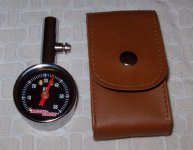
Tire gauge

chunderboy said:
Good advice, and def a good guage to use

Here's a pic of my favorite tire gauge. About $6 at Sears--hard to find. I have a digital one and one of the pen-like ones, but this is my favorite and very accurate.
 

Attachments

  • tiregauge2.jpg
    tiregauge2.jpg
    92.4 KB · Views: 226
I have the pen one, and am def not satisfied with its ability to read. That one i am going to get. Sears has it. Is the company name accuguage. or is it something diff
 
chunderboy said:
I have the pen one, and am def not satisfied with its ability to read. That one i am going to get. Sears has it. Is the company name accuguage. or is it something diff

Yes, Accu-Gauge. They are hard to find anymore since the digital ones are taking over, and I think are fancy crapy. This one doesn't need batteries, and has never failed me to stay accurate (until I ran over my old one). It was about ten years old before I demolished it. So 4 months ago I went everywhere trying to find ianother one. Finally I found two at Sears and I bought them both.
 
BASTARD. you probably grabbed the last two on earth. I am call ing all the sears in this area to find them

Wish me luck.

Oh, if there are none of those left, any other ones off the top of your head that are quality
 

Members online

Forum statistics

Threads
278,316
Messages
3,554,121
Members
248,016
Latest member
Advally Service

Trending content

Back
Top