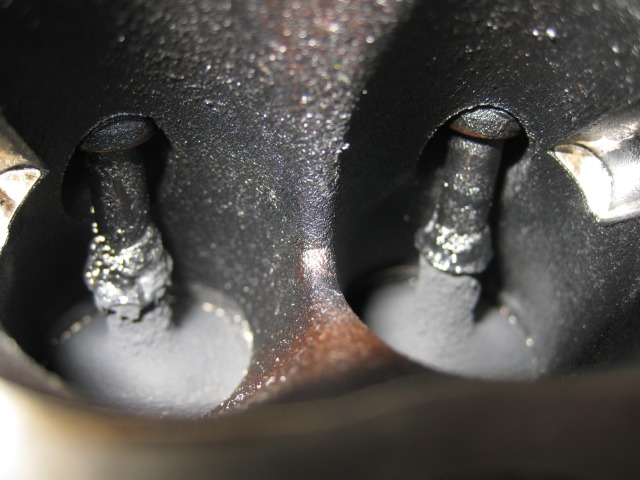
119,000 Mile Seafoam treatment on my 03 SE 4.7

4 environmentalist killed themselves after watching that.
:hatsoff:

When I got my 4Runner I sent a screen shot of my potential vanity plate from the DMV to the missus, telling her it was on its way.

If anyone in VA is interested; IH8OZONE is still available...
 
Am I alone in not understanding this obsession with sea foam? I think it is cool to fog your neighbors with white smoke, but beyond the 30 seconds of smoke, why? I realize that everyone does it, but there is nothing that shows that it does anything beside drain a few dollars from your pocket and kill a few mosquitos. I have cleaned a lot of surfaces in my time and never seen anything cleaned with a short blast of a solvent. Is it wrong to see sea foam as just hype?
 
Am I alone in not understanding this obsession with sea foam? I think it is cool to fog your neighbors with white smoke, but beyond the 30 seconds of smoke, why? I realize that everyone does it, but there is nothing that shows that it does anything beside drain a few dollars from your pocket and kill a few mosquitos. I have cleaned a lot of surfaces in my time and never seen anything cleaned with a short blast of a solvent. Is it wrong to see sea foam as just hype?

The smoke is just the carbon and gunk being burned from your engine. There are people out there that do it just for fun, but it actually serves a purpose for people who want to clean their engines.
 
Didn't want to start a fresh thread to share this but I just did mine over the weekend:

Seafoaming the 4Runner - YouTube

Might be all in my head, but so far I've noticed a smoother idle, revving, and shifting.

So far the jury's still out on any fuel economy gains.

Sorry for the iPhone video
 
I don't think it is in your head. They do idle and run more smooth after the treatment. I know i am getting better gas mileage, by about .8 to 1 mile per gallon. It might have been better, but at the same time i did the treatment i added the DS spacer lift and went up a size on my tires. Thanks for posting the video.
 
I don't think it is in your head. They do idle and run more smooth after the treatment. I know i am getting better gas mileage, by about .8 to 1 mile per gallon. It might have been better, but at the same time i did the treatment i added the DS spacer lift and went up a size on my tires. Thanks for posting the video.

I'm with ya man. I'm just trying to gain a little back of what I lost from the lift, wheels and tires myself. Haven't done a lot of driving since the treatment and the bit that I've done has been all city, so it's really hard for me to tell right now.

I'd like to get in and clean out the throttle body/MAF next to see if I can get any gains from that.
 
Am I alone in not understanding this obsession with sea foam?

You're NOT alone. Years ago with carburated vehicles - carbon buildup was common. But today with fuel injection and vehicles being much more efficient there is almost 0 carbon buildup. I guess it may clean out the injectors a little..but that's about it. I wouldn't use it for the sake of using it. If you are experiencing a problem (poor acceleration, bad idle...etc) then by all means you should give it a try. I'm not experiencing any of those problems and I have over 200k miles on my 05 4runner.
 
You're NOT alone. Years ago with carburated vehicles - carbon buildup was common. But today with fuel injection and vehicles being much more efficient there is almost 0 carbon buildup. I guess it may clean out the injectors a little..but that's about it. I wouldn't use it for the sake of using it. If you are experiencing a problem (poor acceleration, bad idle...etc) then by all means you should give it a try. I'm not experiencing any of those problems and I have over 200k miles on my 05 4runner.

I would respectfully dissagree, carbon build-up is inherent in all gasoline & Diesel engines. There is no engine on the market that has a 100% burn efficiency and as a result carbon forms.

It forms in varying degrees for varying engines in varying conditions, and it was more prevelant in carbuerated engines of old. Carbon build-up still results in modern day engines, hell, the new direct injection engines are huge carbon builders because of the lack of a fuel injector spraying fuel on the back of the intake valves and their insane amount of cam timing manipulation. They build up so much carbon they block off the intake ports sometimes!

3729989363_071fc8c6e6_o.jpg

caked-intake-valves.jpg

5038125759_abea16d700.jpg


Many of these are modern engines with less than 40k on the odometer with perfect oil change intervals. Its just a consequence of the type of injection system they use, it doesn't make the engines bad engines. Just soething to be aware of when servicing.

That being said, I was blown away when my good friend of mine informed me about how dirty these GDIs run. He sees them regularly and here' a lil nudge to Seafoam; one of the ways they repair this problem is by removing the intake manifold, soaking the closed intake ports with seafoam for a few hours or overnight and then going in there with soft bristle brushes.

On your more average style of fuel injection vehicles, many use EGR systems that introduce carbon into the intake system and back through the engine. While idealy these systems should only introduce soot that should be burned off easily enough, an engine is not a perfect heat transference method and as such a lot of unburned fuel and partially burned fuel is floating in an engine at any one point in time. Intakes get sooted up, that soot layers up and you get carbon build-up.

 
Last edited:
I've NEVER had carbon buildup on any vehicle that had fuel injection. Especially to the degree of those pics - EVEN AFTER 300K MILES. It may also be that something is wrong.
 
Nice way to prematurely kill your cats.

We have port injection sea foam does little on these engines and is not needed.
 
Nice way to prematurely kill your cats.

We have port injection sea foam does little on these engines and is not needed.

Care to elaborate for those of us not well-versed in the different methods of fuel injection and the carbon build-up associated with each?
 
the proof is in the results. I don't care what your textbooks say, when so many people are experiencing smoother idling and reving, something is happening when they do seafoam treatment. besides, and correct me if I'm wrong, the seafoam isn't what is creating the white smoke, it's all the carbon getting burnt off
 
the seafoam isn't what is creating the white smoke, it's all the carbon getting burnt off

I guarantee you that if you did the Sea-Foam treatment to a NEW engine you'd still get LOTS of White Smoke.
 
It's whatever... I'm not here to debate the benifits (or lack of) of Seafoam. Call it snake oil if you like.

If it could possibly extend the longevity of my babies engine, then for the cost of eight bucks, it's totally worth it in my opinion.

Don't like it? Don't use it... simple.
 
it is good stuff and it works well for me. I am not going to get in a online debate, especially with people who just love to debate....from behind their keyboards......:hatsoff:
 
I can definitely attest to the fact the carbon build up happens in modern engines just as badly. Especially, as was mentioned, in direct injection setups.

When I pulled my intake manifold off my IS350 ( which uses both direct and regular injection) I was astonished at the amount of carbon build up on the valves. The IS250 is even worse because it uses direct injection solely.

I used seafoam as a soak and a soft bristle brush to manually polish and clean all of the carbon and soot. I also took the chance to grind and polish up the manfold runners where I could, even aluminum casting leaves horrible rough patches.

turbulence in your air delivery saps more power and efficiency then you think.

Just as an example, most of the gains from any intake comes solely from a smoother intake path and the ability to draw air from outside the engine bay. When you remove the helmholtz resonators and flexible tubing for filter changes, THAT's where you get your power. Most engines are already designed with an air intake capability and heat shielding that far exceeds what is necessary. It's just a simple smoothing that allows the air to flow with less interruption that ensures optimal fuel burn.
 
Last edited:
is there a reason people stopped using Marvels Mystery Oil?
I used to watch my Dad use it on our old carb. cars the smoke was gray white if i remember correctly.
is seafoam a better choice?
 
well....marvel mystery oil is a petroleum based cleaning agent and many people swear by it.

I have used it in the crankcase when I first got both of my vehicles to give a good scrub to the internals but I always drain it after 1-2k miles. The reason being that, because it is a cleaning agent, it will continue to clean and clean until the lubrication qualities are also cleaned away. There's no real way to know when it's cleaned all it can and when it starts to damage the engine.

using it in the fuel as an additive injectior/carbon cleaner also seems to work, although there havent been any studies, I dont think, on the long term effects on rubber gaskets and such. E85 gasoline probably has worse effects on gaskets.

Those things being said, I dont believe that marvel mystery oil is meant for use on the induction system. Only in crankcase and fuel.

If you really wanna be clean, substitute a quart of oil for marvel, change after 1-2k miles. use the appropriate amount of marvel in your gas (or lucas) for your injectors and then use seafoam for the induction side which should dissolve and loosen depostis that dont get sprayed by your fuel system.

You shouldnt need to do this but every 30k miles or so if you're anal about having a "clean" engine. using a fuel treatment is probably recommended on a semi-regular basis even if you use name brand fuel. I used only mobil and texaco 93 octane (premium) gas and I still had buildup.


Moral of the story, is that they both appear to work as intended when used in moderation, as is most of life.
 
Last edited:

Members online

No members online now.

Forum statistics

Threads
278,315
Messages
3,554,125
Members
248,016
Latest member
Advally Service

Trending content

Back
Top