14.1

rubbertoe

New member
Hey 4th Gen'rs is this a normal freeway average for a 4th Gen after 3 inch lift with 31"Good year wrangler kevlar S/A (FYI goodyear,silent their not! ) A buddy of mine lost his keys (special lazar cut, mountain unobtanium ) while snowboarding in mammoth .so i ended up running some keys for him .3 hr drive each way from San Diego to hwy 395 just under 300 hundred miles round trip .I averaged 14.1 mpg @ 75 mph is this any good ?
 
Last edited:
Register to hide this ad
no, that is not very good.

was it hilly? i have 265/70/17s and i can get 21 easily on the highway, at about 68 mph. either it was really hilly or you might be a little lead footed
 
Hey 4th Gen'rs is this a normal freeway average for a 4th Gen after 3 inch lift with 31"Good year wrangler kevlar S/A (FYI goodyear,silent their not! ) A buddy of mine lost his keys (special lazar cut, mountain unobtanium ) while snowboarding in mammoth .so i ended up running some keys for him .3 hr drive each way from San Diego to hwy 395 just under 300 hundred miles round trip .I averaged 14.1 mpg @ 75 mph is this any good ?

Considering that you were going from sea level up over several mountain passes, on a lifted truck and 75 mph I would say yes, your MPG is probably correct. Is your 4runner a V6 or a V8? If it's a V6 I'd say your MPG is a tad low but if it's a V8 that's probably as good as you can get.

Here's a hint: MPG plummets after 60mph (that's why we had a national speed limit of 55mph for many years.) This is particularly true on a boxy vehicle like the 4runner. Also if you are going 75 you are probably doing a lot of passing and accelerating - this will also kill your MPG.

If you want better MPG, slow down. I get ~ 15 - 18 MPG on a regular basis while pulling a 1,000lb teardrop trailer. You know how I get that MPG? When I'm on the freeway I set the CC at 65 and leave it there. ;):
 
Considering that you were going from sea level up over several mountain passes, on a lifted truck and 75 mph I would say yes, your MPG is probably correct. Is your 4runner a V6 or a V8? If it's a V6 I'd say your MPG is a tad low but if it's a V8 that's probably as good as you can get.

Here's a hint: MPG plummets after 60mph (that's why we had a national speed limit of 55mph for many years.) This is particularly true on a boxy vehicle like the 4runner. Also if you are going 75 you are probably doing a lot of passing and accelerating - this will also kill your MPG.

If you want better MPG, slow down. I get ~ 15 - 18 MPG on a regular basis while pulling a 1,000lb teardrop trailer. You know how I get that MPG? When I'm on the freeway I set the CC at 65 and leave it there. ;):

Thanks for your input guy's .yes i might have been pushing speed a bit as cc was set at 70-75 and hasn't been calibrated since the lift so speeds could have been faster than what was reading .There also was fairly heavy winds last night The only reason i maintained such speeds was going thru L.A was i was the slow one in traffic.believe me the place is a bit nutty to be honest.But recently on a trip from San Diego to Lake Havasu,Az towing a small car @1600 lb my milage was around 13 + mpg . i was just under the impression that 16 mpg was a target mpg and i understand that lifting the truck will affect those numbers but to what extent is what i was curious about
 
Sounds about right for a lifted truck, with larger tires, aerodynamics of a wooden coffin driving up to the mountains.
 
Thanks for your input guy's .yes i might have been pushing speed a bit as cc was set at 70-75 and hasn't been calibrated since the lift so speeds could have been faster than what was reading .There also was fairly heavy winds last night The only reason i maintained such speeds was going thru L.A was i was the slow one in traffic.believe me the place is a bit nutty to be honest.But recently on a trip from San Diego to Lake Havasu,Az towing a small car @1600 lb my milage was around 13 + mpg . i was just under the impression that 16 mpg was a target mpg and i understand that lifting the truck will affect those numbers but to what extent is what i was curious about

Also did you calibrate for the bigger tires? If not that's another factor. IOW your MPG may not have been 14.1, it might have been 15 or better. But it looks like 14.1 because your bigger tires mean fewer revolutions per mile, which means your odometer is under-reporting the number of miles driven. When I was running 32's on my T4R (BFG MTs in 255/75/17) I would take the miles driven and multiply by 1.055 (5.5%) to get my true miles driven. Then divide THAT number by the number of gallons to fill and you have the true MPG.
 
Considering that you were going from sea level up over several mountain passes, on a lifted truck and 75 mph I would say yes, your MPG is probably correct. Is your 4runner a V6 or a V8? If it's a V6 I'd say your MPG is a tad low but if it's a V8 that's probably as good as you can get.

Here's a hint: MPG plummets after 60mph (that's why we had a national speed limit of 55mph for many years.) This is particularly true on a boxy vehicle like the 4runner. Also if you are going 75 you are probably doing a lot of passing and accelerating - this will also kill your MPG.

If you want better MPG, slow down. I get ~ 15 - 18 MPG on a regular basis while pulling a 1,000lb teardrop trailer. You know how I get that MPG? When I'm on the freeway I set the CC at 65 and leave it there. ;):

Also did you calibrate for the bigger tires? If not that's another factor. IOW your MPG may not have been 14.1, it might have been 15 or better. But it looks like 14.1 because your bigger tires mean fewer revolutions per mile, which means your odometer is under-reporting the number of miles driven. When I was running 32's on my T4R (BFG MTs in 255/75/17) I would take the miles driven and multiply by 1.055 (5.5%) to get my true miles driven. Then divide THAT number by the number of gallons to fill and you have the true MPG.
Now that makes sense .
 
Calibrating for bigger tires...

I guess there are devices, gadgets, geegaws, etc, that you can attach to your vehicle to adjust the odometer and speedo when you put on bigger tires? Never used one so I don't know how well they work or how easy they are to use.

However, if you want to do it the cheap way (which is my way), this is how you do it:

1. Get a decent GPS that you think is accurate. Remember that nothing is 100% accurate, but find something that is 'good enough' for you. I use on old Magellan Meridian usually although I have a newer Garmin that sits in the 4runner all the time that works just as well. You can also probably use your phone if you download a GPS app.

2. Find the "trip odometer" function on the GPS (all of them should have one.) Set the trip odo on the GPS device to 0 and then set one of the trip meters on the 4runner to 0.

3. Drive. The longer the better. Make sure you have a good GPS signal the whole time, as losing a GPS signal will mess up your results.

4. After a drive (I would recommend at least 100 miles), look at the two trip meters. Most likely, the GPS will show more miles than the 4runner's trip meter (if you are running bigger tires than stock it almost certainly will.)

5. Now, divide the GPS miles by the 4runner trip meter miles. For example (I'll make the math simple but it works even if the numbers aren't "even"), let's say the 4runner is showing exactly 100.0 miles and the GPS trip meter is showing 105.5. 105.5/100 = 1.055. Write this number down (if you keep track of your MPG in a little book, like I do, you can write this in the book.) This is your mileage adjustment factor.

For example, you drive 335.5 miles as shown on the trip meter and you take exactly 22.1 gallons of gas.

Without using the adjustment factor, you'd divide 335.5 / 22.1 = 15.18 MPG - pretty bad, hugh? But if you multiply 335.5 x 1.055 (your adjustment factor) you get 353.9 which is the actual number of miles you drove.

Divide that number by the number of gallons used to fill the tank and you have your TRUE MPG which in this case would be 16.01.

If you have a device like a Scangauge or an Ultragauge, you can also calibrate that by using the GPS as a baseline. It's actually easier (and safer) to calibrate the Ultra Gauge, the SGII is a little more difficult as you are calibrating while driving (because on the SGII the calibration is based on speed while on the UG the calibration is based on distance.)

Once you get the UG or SGII calibrated, you can set them to show DTE (Distance to Empty) which will give you a much more accurate indication of how many miles you have left than the "range" gauge on the 4runner's HVAC panel (although personally I think the "Range" reading is intentionally "pessimistic" to keep you from running out of gas. IOW, it will show that you have 10 miles left when in reality you have 40 or 50 because they want you to go and get gas NOW rather than later.)
 
Hey 4th Gen'rs is this a normal freeway average for a 4th Gen after 3 inch lift with 31"Good year wrangler kevlar S/A (FYI goodyear,silent their not! ) A buddy of mine lost his keys (special lazar cut, mountain unobtanium ) while snowboarding in mammoth .so i ended up running some keys for him .3 hr drive each way from San Diego to hwy 395 just under 300 hundred miles round trip .I averaged 14.1 mpg @ 75 mph is this any good ?

IMHO, I would say 14.1 is low…

Just FYI (to compare) in the last 2 month I have made numerous hunting trips (80 miles one way), 70 % of that rip speed limit is 75 MPH so I am going about 83-85, it is hilly and normally going against (10-20 mph) the wind at least one direction; my average for the round trip (that includes small portion of off-roading as well as numerous stop and go and ideling) is hovering about 17.7 to 18.1 mpg (calculated); my truck has V8, it is lifted and does have oversized (32”) AT tires (265/70-R17);

Also, you have mentioned that you have 31” tires and it seems that most of replies assumed that you have oversized tires… without knowing the exact size of your tires I would not agree with that assumption as standard tires size for 4th gen is 30.6 “ (265/65-R17 ) and in most cases that size rounds to 31”;
 
IMHO, I would say 14.1 is low…

Just FYI (to compare) in the last 2 month I have made numerous hunting trips (80 miles one way), 70 % of that rip speed limit is 75 MPH so I am going about 83-85, it is hilly and normally going against (10-20 mph) the wind at least one direction; my average for the round trip (that includes small portion of off-roading as well as numerous stop and go and ideling) is hovering about 17.7 to 18.1 mpg (calculated); my truck has V8, it is lifted and does have oversized (32”) AT tires (265/70-R17);

Also, you have mentioned that you have 31” tires and it seems that most of replies assumed that you have oversized tires… without knowing the exact size of your tires I would not agree with that assumption as standard tires size for 4th gen is 30.6 “ (265/65-R17 ) and in most cases that size rounds to 31”;
Progress4m well i think my mpg maybe on the low side but this is why i ask . i also wasn't super clear about the mountainous grades that were involved for most of the trip .imo the mountains i had to drive thru ( the san gabriel mountains) are probably not comparable to the hills of texas for an apple to apple comparison .but what is interesting is that you experience the high mpg #'s that you do also being honest about your driving style .it gives me something i would l like to strive for i would like some 17-18 mpg numbers !
 
Progress4m well i think my mpg maybe on the low side but this is why i ask . i also wasn't super clear about the mountainous grades that were involved for most of the trip .imo the mountains i had to drive thru ( the san gabriel mountains) are probably not comparable to the hills of texas for an apple to apple comparison ...

Totally agree with that! Hills I am referring to is about 1000 feet change in elevation (going from 550 to 1500 feet above the seal level) … so it is definitely not mountains; LOL :)

In addition, and I just wanted to share my 20 years cross country travels experience (7 years with my current 4Runner): obviously any hilly terrain, low (cold) temperature and head wind will negatively impact mpg…. But anything above 3500-4000 feet will actually increase my MPG numbers; for example in Colorado Springs (Colorado) area (around 6000 above the sea level) my truck will give me 20-21 MPG on every visit there (more than dozen times) and that is traveling at 75-80 MPh on I-25;

Again just wanted to share what I know;

:cheers:
 
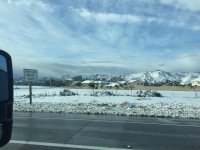
Here are pictures from today the aftermath of the storm weather we were driving in the other night .I guess i didn't know what i was dealing with storm wise, as i never rolled my window down the whole time we were driving ,untill i got there (T4R was a nice comfy ride i might add)and then we got out for the handoff in Hysperia ,Ca holy mackerel it was windy and cold ! Here are some pics of Rancho California Rd.Temecula ,Ca my buddy who lost the keys took on his way home,for reference this is an area that doesn't ever get snow ,ever! this was a rare occasion that a cold front would move this far south,@1500 ft elevation,this is a high desert local .I ill have to take some mpg numbers when im not in severe weather to compare this trip to,but as i try to drive this truck as little as possible and save it primarily for family outings or road trips. on the short range or round the town outings i don't pay a whole lot of attention to mileage .shoot for all i know what may attribute to my numbers is the horrible fuel mix we get here in CA ?
 

Attachments

  • IMG_3144.jpg
    IMG_3144.jpg
    132.7 KB · Views: 195
  • IMG_3142.jpg
    IMG_3142.jpg
    129.5 KB · Views: 193
Last edited:
Totally agree with that! Hills I am referring to is about 1000 feet change in elevation (going from 550 to 1500 feet above the seal level) … so it is definitely not mountains; LOL :)

In addition, and I just wanted to share my 20 years cross country travels experience (7 years with my current 4Runner): obviously any hilly terrain, low (cold) temperature and head wind will negatively impact mpg…. But anything above 3500-4000 feet will actually increase my MPG numbers; for example in Colorado Springs (Colorado) area (around 6000 above the sea level) my truck will give me 20-21 MPG on every visit there (more than dozen times) and that is traveling at 75-80 MPh on I-25;

Again just wanted to share what I know;

:cheers:

The reason why you get better gas mileage at high elevation is that the aero drag goes down with the change in air pressure/density, which is pretty large at 6000+ ft elevation.

Also, your engine power goes down by roughly the same change in air pressure/density, so you operate at higher throttle openings, which reduces pumping losses and increases efficiency. So it's like down-sizing the displacement of your engine.
 
The reason why you get better gas mileage at high elevation is that the aero drag goes down with the change in air pressure/density, which is pretty large at 6000+ ft elevation.

Also, your engine power goes down by roughly the same change in air pressure/density, so you operate at higher throttle openings, which reduces pumping losses and increases efficiency. So it's like down-sizing the displacement of your engine.

Agreed; that is one of reasons and one of my arguments to my wife why we need to move to Colorado… LOL ...
 

Members online

Forum statistics

Threads
278,307
Messages
3,554,049
Members
248,016
Latest member
Advally Service

Trending content

Back
Top